
Maxime Lalanne
Illustration — Bust of Lalanne in the Jardin botanique de Bordeaux François Antoine Maxime Lalanne (November 27, 1827 – July 29, 1886) was a French artist known for his etchings and charcoal drawings (fusain).
Also recorded as Maxime François Antoine Lalanne · Maxime-François-Antoine Lalanne · Maxime Francois Antoine Lalanne
Maxime Lalanne

Sylvain Machefert / Symac · CC BY-SA 3.0
- Born
- 1827 · Bordeaux.
- Died
- 1886 · Nogent-sur-Marne.
- Nationality
- France
- Occupation
- copper engraver · etcher · painter
- Teachers
- Jean Gigoux
- Honours
- Knight of the Legion of Honour
- Languages
- French
VALÉORINE Encyclopedia
VALÉORINE documentary reading
Documentary summary
Illustration — Bust of Lalanne in the Jardin botanique de Bordeaux François Antoine Maxime Lalanne (November 27, 1827 – July 29, 1886) was a French artist known for his etchings and charcoal drawings (fusain).
Admitted source layer · organised and presented by VALÉORINE
Reference Check
Propose documentary evidence for Maxime Lalanne. A contribution is never written directly as fact: identity, source, rights and evidence gates still decide.
Sign in to contribute
World of VALÉORINE
Documentary connections
Only confirmed graph relationships appear here. Images are shown only when their identity and reuse rights both pass the documentary gate.
Documentary evidence
Documentary basis
Authority files
bnf · getty · gnd · loc · wikidata · Q2059329 · wikipedia · Maxime Lalanne
In this article
Early life
Early life
Training under Jean Gigoux is recorded. Soya-Jensen and Pierre Louis Léger Vauthier are recorded as having studied under Maxime Lalanne. The recorded working language is French. Places of work recorded in the authority are Paris, Netherlands and Haarlem. Work by Maxime Lalanne is recorded in the collections of National Gallery of Victoria, Art Institute of Chicago, The Nelson-Atkins Museum of Art, National Gallery of Canada and Philadelphia Museum of Art. Distinctions recorded are Knight of the Legion of Honour.
Maxime Lalanne was born in Bordeaux on November 27, 1827, to Anne (previously Anne Cecile Gellibert) and Antoine Lalanne. His father was a civil servant who rose to the position of clerk of the first chamber of the Court of Appeals. Maxime Lalanne first pursued classical and traditional studies at the l'institution Oré, where he learned drawing from Saulnier. He received his Bachelor of Letters degree in 1848. Although his artistic talent was noted by his comrades and teachers, Lalanne pursued a career in law rather than in art.
Entry into artistic career
Entry into artistic career
Lalanne drew in his spare time, perhaps under Fozembas, while clerking as a notary. In 1850, he exhibited six drawings (pencils and pastels) at the eighth Exposition of the Philomathique Society in the Palais de Justice. The prodigious Léo Drouyn noticed his work and urged him to persevere. Reporting on these works, the newspaper La Tribune described him as "richly gifted" and his drawing as "first rate". Lalanne was awarded a bronze medal for his work. Shortly thereafter, Lalanne vacationed in Cénon and returned to Bordeaux with dozens of charcoal drawings of the countryside which, Marionneau reported, were remarkable. His friends encouraged him to abandon his law studies and to pursue his art exclusively.
Move to Paris
Move to Paris
In 1852, Lalanne followed their advice and left Bordeaux for Paris and the studio of Jean François Gigoux (with whom Lalanne remained close throughout his life). Lalanne's ties to Bordeaux remained strong: he exhibited 640 works there in a retrospective in 1874 and donated proofs of all his etchings to the city in 1875 and 1882. But regardless of those ties, Lalanne became and remained a Paris artist who lived, worked and taught chiefly in Paris until retiring to Nogent-sur-Marne in 1885. Lalanne made his appearance at the Salon in Paris in 1852 with two charcoal drawings, which he continued to submit throughout his career. Charcoal had only been recently recognized by the Salon as an independent category, and was very popular for both its novelty and expressiveness. Lalanne's reputation in the medium is evidenced by his well-received treatise on the subject, Le Fusain. The importance of drawing to Lalanne is without doubt — at his death the number of Lalanne's drawings in public and private hands exceeded 1200.
Illness and death
Illness and death
That illness was Lalanne's 10-year struggle with osteomalacia, a crippling bone disease that causes bone softness and disintegration. Lalanne continued working until he died, with charcoal in his hand, on 29 July 1886, shortly after completing a drawing for his cousin, the author Leopold Lalanne. He was buried in Nogent-sur-Marne on August 1. His remains were moved on September 25, 1889, to the vault reserved for artists in Bordeaux. A monument by Pierre Granet was erected in the public garden in Bordeaux on June 26, 1897. Only the pedestal and bust remain (its bronze having been pillaged by the Nazis).
Work
Work
The recognition of Lalanne's artistic vision has sometimes been crowded out by his self-evident technical skill. His Traité de la gravure à l’eau-forte instructed generations from its first printing in 1866 through at least 12 editions to 2010. John Taylor Arms, an etcher of peculiar technical attentiveness and intricacy, took his instruction and inspiration from Lalanne. James McBey and Ernest S. Lumsden also taught themselves to etch from Lalanne's treatise. Lalanne taught and demonstrated almost every conceivable technique applicable to the etching plate, but in his own work he remained an almost steadfast adherent to pure line. It is as if anything but pure line was clutter to Lalanne and his worlds. Except for demonstrations, there are no extant examples of pure drypoint in Lalanne's oeuvre. Lalanne saw drypoint as a tool to correct "mistakes" as explained in his treatise (though he himself sometimes deviated). Although he clearly knew the atmospheric value of aquatint, only one confirmed example of his use of the medium exists – and only on one quadrant of a plate. Similarly, only one soft ground etching comes down from Lalanne (apart from demonstrations). Lalanne knew how to command line alone to say precisely what he wanted to say. He accomplished that result through multi-stage biting: a continuing process that created, through line variance, every atmospheric element he desired. The rest was left to (occasional) burnishing, drypoint corrections/additions, and surface tone – a critical element to Lalanne. Subjecting plates to numerous progressive bitings, Lalanne achieved a warmth, depth and dimensionality never before seen in etching, and rarely seen since, as a review of some of his work demonstrates. Through multi-stage biting, À Bordeaux drives the viewer from the dark and rich boat and boathouse in the foreground through the harbor to the distant town in a near infinite visual horizon. Through seven identifiable levels of biting, Rade de Bordeaux (Bordeaux, Effet de Neige) creates a blanket of vista that wraps the viewer in a surrounded sense of stillness and snow. In Une Rue de Rouen, the dominance of the cathedral in the background is established not through bold line but through scant biting. In Bords de la Tamise, Lalanne does the near impossible: he creates fog through multi-stage biting alone. Lalanne produced over 200 etchings, but even if had completed only these four, his place in history as a technical genius would have been secured. Using realistic elements as a vehicle, Lalanne's etchings organize the visual field into a new order of unrelenting harmony, consistent with the subject, that fosters access to the image whose sense of place inspired the work. This would have been branded as a dance too close to the heretical edges of impressionism had it been perceived at the time, but it was not. Critics stumbled close to this reckoning, but never quite reached it. Lalanne did not use etching to make social, political or even artistic statements, but rather let the world speak for itself. People play only a small role in Lalanne's world. Even in Lalanne's volume on Victor Hugo, the author Hugo is no more important than the plants in the garden, and seems crowded and overtaken by them. Lalanne had his share of failures. Le Rocher de Sisteron, Vittel and Vue des Ruines du Château de Fère, for example, come across as two dimensional amateur exercises with little to commend them. The Crisenoy suite is technically astute but completely vacant, and the same can be said for the six plates that may have been destined for a book on architecture. Those failures are nevertheless instructive. Against complaints that Lalanne was generally without depth and warmth, these works make it easy to tell when he was, and when he was not. Moreover, they permit us to isolate an additional element of continuity that stretches across all works. At a time when the etching plate was increasing in size, wall display was becoming more pervasive, and the intimacy of etching was at risk, even in his failures Lalanne attempts to draw the viewer closer to establish the connection that is historically fundamental to etching. This continuous predisposition is all the more evident in Lalanne's largely unpublished oeuvre of smaller works and miniatures. It is simply impossible to experience most of these works except in close quarters. One of these etchings, Jardin avec statue au bord d’une piêce d’eau, is among the best in Lalanne's entire oeuvre.
Identity and origins
Identity and origins
The authorities additionally record the headings Maxime François Antoine Lalanne, Maxime-François-Antoine Lalanne and Maxime Francois Antoine Lalanne. His recorded language was French.
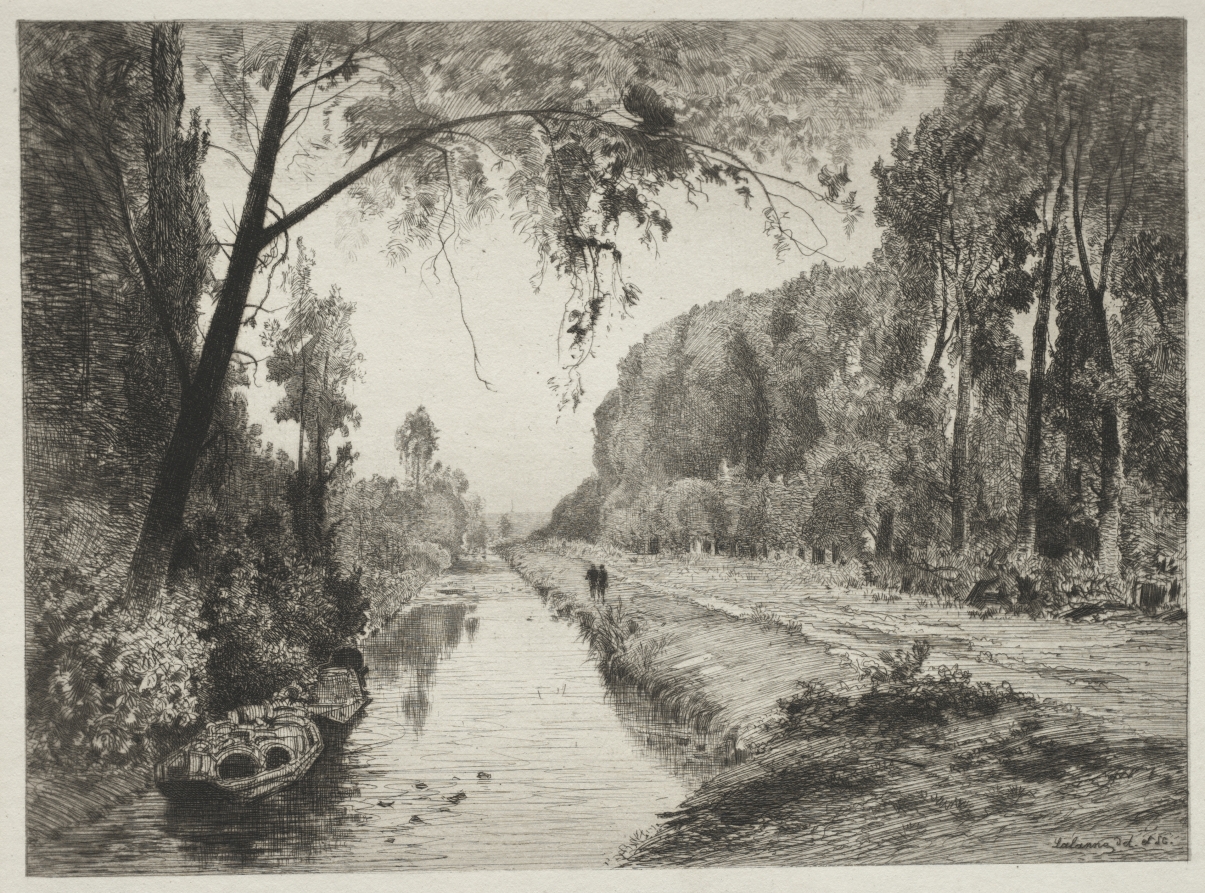
Canal at Pont Sainte-Maxence, c. 1878, by Maxime Lalanne
Maxime Lalanne · The Cleveland Museum of Art · Bequest of John L. Severance
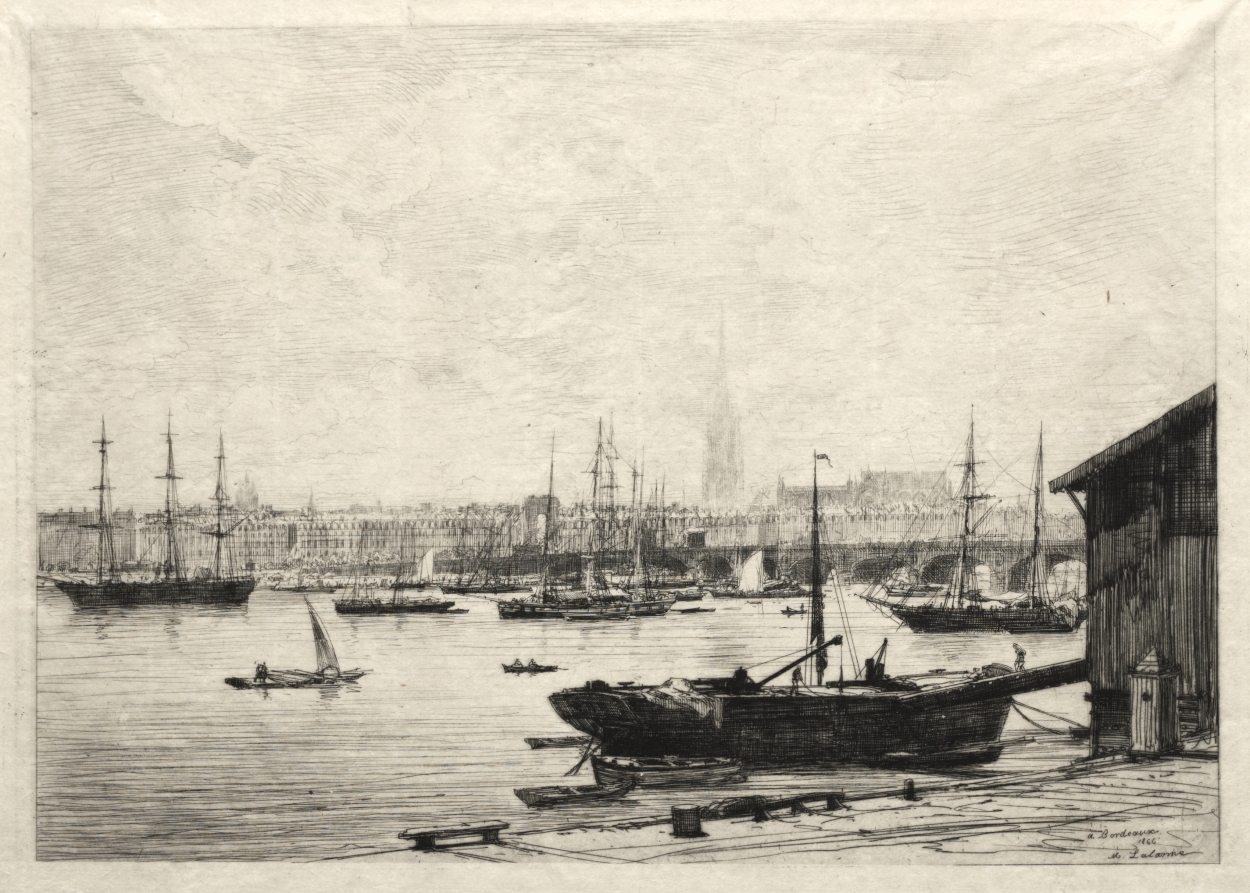
Bordeaux, 1866, by Maxime Lalanne
Maxime Lalanne · The Cleveland Museum of Art · Gift of Ralph King, the Frederick Keppel Memorial
Life and career
Dated record
Life and career
The full dated record · 2 entries
1827
Maxime Lalanne born at Bordeaux.
1886
Maxime Lalanne died at Nogent-sur-Marne.
Places
Named by the record
Places
Only places the record itself states, plotted where the house gazetteer settles their coordinates. Nothing is inferred from a name or a nationality.
Bordeaux.
Birth place
Nogent-sur-Marne.
Death place
Prints
• Illustration — Castle overlooking a River Lalanne's print debut was in 1853—in lithography rather than etching. Lalanne began etching for Alfred Cadart in 1862 as one of the founding members of Cadart's 160-member Société des Aquafortistes (formed in September 1862), and his work was among the first published and distributed by the Société – Rue des Marmousets (published in November 1862 as plate 15). Lalanne made his etching debut at the Salon in 1863, submitting three street scenes (all of which would appear in Cadart publications). Lalanne's etchings struck a chord. He received awards from the Salon for etching in 1866, 1873 (3ème classe), 1874 (3éme classe) and was decorated as Chevalier de la Légion d’Honneur in 1875. He was also knighted as Chevalier of the Order of Christ by King Fernando of Portugal (who, perhaps not surprisingly, was one of the 160 members of Cadart's Société des Aquafortistes). Lalanne arrived on the scene at an opportune moment, for both himself and for the Cadart publishing house. During the 20-year period in which they worked together (from 1862 to 1881), Lalanne produced over 145 etchings, and the Cadart house issued over 80 of them (often more than once) in numerous Cadart publications. While the impressionists were rebelling against artistic convention and the Salon, Lalanne remained ever faithful to it, and the Salon accepted and exhibited over 120 etchings by Lalanne from 1863 to 1886. It was because of this loyalty (and the resulting friendships) that Lalanne continued to be a member of the jury of the Salon, for painting, even (according to Marionneau) after illness prevented his full participation.
Primary material
Documents and archives
institutional register
- Bibliothèque nationale de France authority file 14959084b
General reference · Bibliothèque nationale de France
- FAST authority file 92241
General reference · FAST
- GND (German National Library) authority file 117573922
General reference · GND (German National Library)
- IdRef (French universities) authority file 111610540
General reference · IdRef (French universities)
- ISNI authority file 0000000109632264
General reference · ISNI
- Library of Congress authority file n82066189
General reference · Library of Congress
reference work
- “Maxime Lalanne”, English Wikipedia, consulted as further reading
Reputable secondary · Wikipedia
References
Citations
References
Each reference names the institution holding it, so a reader may go to the document itself.
reference work
Secondary witnessinstitutional register
Bibliothèque nationale de France authority file 14959084bBibliothèque nationale de France
Secondary witnessinstitutional register
Secondary witnessinstitutional register
GND (German National Library) authority file 117573922GND (German National Library)
Secondary witnessinstitutional register
IdRef (French universities) authority file 111610540IdRef (French universities)
Secondary witnessinstitutional register
Secondary witnessinstitutional register
Library of Congress authority file n82066189Library of Congress
Secondary witnessinstitutional register
RKDartists authority file 47489RKDartists
Secondary witness
Every cited source · 11
- 01
“Maxime Lalanne”, English Wikipedia, consulted as further reading
reference work · Reputable secondary · Wikipedia
Consult the source - 02
Bibliothèque nationale de France authority file 14959084b
institutional register · General reference · Bibliothèque nationale de France
Consult the source - 03
- 04
GND (German National Library) authority file 117573922
institutional register · General reference · GND (German National Library)
Consult the source - 05
IdRef (French universities) authority file 111610540
institutional register · General reference · IdRef (French universities)
Consult the source - 06
ISNI authority file 0000000109632264
institutional register · General reference · ISNI
Consult the source - 07
Library of Congress authority file n82066189
institutional register · General reference · Library of Congress
Consult the source - 08
RKDartists authority file 47489
institutional register · General reference · RKDartists
Consult the source - 09
Union List of Artist Names authority file 500022662
institutional register · General reference · Union List of Artist Names
Consult the source - 10
- 11
Wikidata, structured authority record Q2059329: Maxime Lalanne
institutional register · General reference · Wikimedia Foundation
Consult the source
Further particulars
Held on the record
Further particulars
Open the remaining particulars
Formation and teaching. He trained under Jean Gigoux. Each of those relationships is stated by the authority record rather than inferred from style. He belonged to Académie des sciences, belles-lettres et arts de Rouen and Société des aquafortistes. He worked at Paris, Netherlands, Haarlem and Utrecht. Lalanne received Knight of the Legion of Honour.
Career and activity
Recognition and collections
Work by Maxime Lalanne is
National Gallery of Victoria, Art Institute of Chicago, The Nelson-Atkins Museum of Art and National Gallery of Canada
The Encyclopedia exists whether or not anything is for sale. Corrections are recorded rather than overwritten, and every version of this record is kept. Published 16 August 2026.
Elsewhere in Paintings
18,859 published records in this field, each with its sources named.
- Maxa NordauArtist
- Maxfield ParrishArtist
- Maxim GauciArtist
- Maxim VorobievArtist
- Maximilian LenzArtist
- Maximilian MessmacherArtist
- Maximilian ReinitzArtist
- Maximilien Lambert GelissenArtist
Best supported in this field
For owners
Own a work by Maxime Lalanne?
A specialist will read what you send and tell you what the house can establish, what it cannot, and whether the object is suited to sale. There is no charge and no obligation. The object stays with you throughout; nothing is shipped to us unless it is arranged in writing beforehand.