
Ni Zan
Ni • Illustration — Portrait of Ni Zan • Illustration — Six Gentlemen (1345), collection of the Shanghai Museum
Also recorded as Hsiao-hsien · Xiaoxian · Tsan · Zan Ni
Ni Zan

Gleb Simonov · CC BY-SA 4.0
- Born
- 1301. · Wuxi.
- Died
- 1374. · Wuxi.
- Nationality
- Yuan dynasty.
- Occupation
- painter, poet, calligrapher, collector and monk.
- Fields
- shan shui, regular script and semi-cursive script.
- Movements
- Southern School.
VALÉORINE Encyclopedia
VALÉORINE documentary reading
Documentary summary
Ni • Illustration — Portrait of Ni Zan • Illustration — Six Gentlemen (1345), collection of the Shanghai Museum
Admitted source layer · organised and presented by VALÉORINE
Note VALÉORINE
Ni Zan (1301–1374) was a calligrapher, collector and monk, among other activities and a national of Yuan dynasty. The calligrapher was born and died in Wuxi.
Ni Zan worked in Lake Tai. The calligrapher was active in regular script, semi-cursive script and shan shui. Ni Zan was associated with Southern School.
Genres include Four Masters of the Yuan Dynasty. Works by the calligrapher are held at Art Institute of Chicago, Cleveland Museum of Art and Metropolitan Museum of Art, among others.
Composed from admitted, traceable facts · 27 September 2026
VALÉORINE
Reference Check
Propose documentary evidence for Ni Zan. A contribution is never written directly as fact: identity, source, rights and evidence gates still decide.
Sign in to contribute
Documentary evidence
Evidence Panel
not yet certified
- Identity
- resolved
- Independent source families
- 0
- Admitted assertions
- 0
- Open conflicts
- 0
In this article
Biography
Biography
The field of work recorded is shan shui, regular script and semi-cursive script. Subjects and genres recorded for the work are Four Masters of the Yuan Dynasty. Dong Yuan, Jing Hao and Guan Tong are recorded as an influence. Places of work recorded in the authority are Lake Tai. Work by Ni Zan is recorded in the collections of Art Institute of Chicago, Metropolitan Museum of Art, Shanghai Museum, Princeton Art Museum and Cleveland Museum of Art.
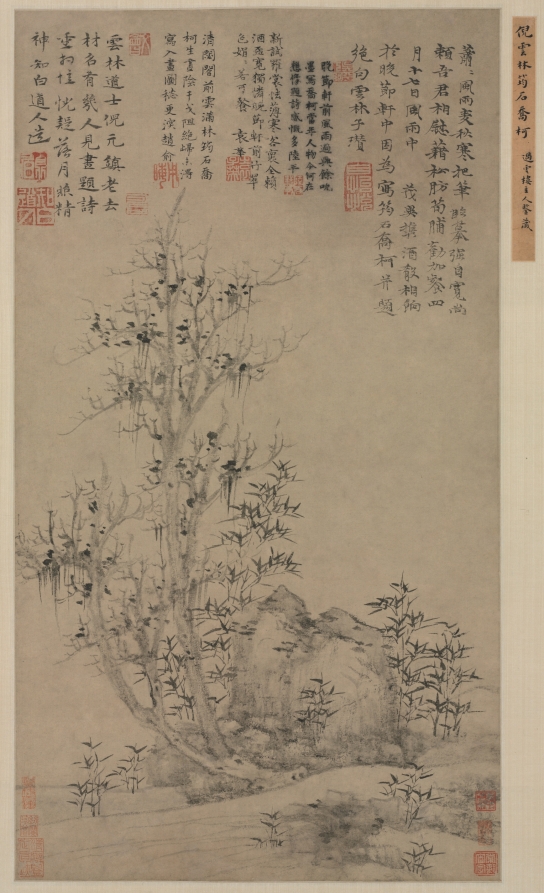
Bamboo, Rock, and Tall Tree, c. 1300s, by Ni Zan
Ni Zan · The Cleveland Museum of Art · Leonard C. Hanna Jr. Fund
Key facts
Key facts
• Tl — Gê Tsān Ni Zan (1301–1374) was a Chinese painter during the Yuan and early Ming periods. Along with Huang Gongwang, Wu Zhen, and Wang Meng, he is considered to be one of the Four Masters of the Yuan dynasty.
Life
Life
• Illustration — Tomb of Ni Zan Ni Zan was born into a wealthy family in Wuxi. His courtesy name was Yuan Zhen (元鎮), and his art names were Yun Lin Zi (雲林子), Huan Xia Sheng (幻霞生), and Jing Man Min (荊蠻民). He was born after the death of the Kublai Khan, the Mongol ruler who defeated the Song and established dominance over all the areas that had traditionally been considered China. The Yuan rulers did not trust many of the Confucian scholars and instead preferred to appoint Mongolians and Muslims to administrative positions. Ni Zan was born into an elite family who could afford the cost of a rigorous Confucian education for him in spite of the unavailability of high-paying governmental jobs that traditionally were the reward for such an education. He was one of a number of wealthy scholars and poets who were part of a movement that radically altered traditional conceptions of Chinese painting. Their paintings depicted representations of natural settings that were highly localized, portraying personally valued vistas that reflected their individual feelings. During the 1340s a number of droughts and floods caused a famine throughout Ni Zan's region, which subsequently led to peasant revolts. These revolts peaked in 1350 due to the government's use of forced labor to repair the dikes on the Yellow River. Throughout the 1340s, the Yuan rulers also imposed heavy taxes on the rich landowners of the region in order to cover the cost of the ongoing natural disasters. There are many divergent opinions concerning Ni Zan's reaction to these taxes, and his ensuing actions are unclear. However, it has been established that he distributed all of his possessions to his friends and moved into a houseboat. He left on the eve of the millenarianist Red Turban Revolt and travelled throughout the relatively peaceful southeast while various revolutionary parties tore through his region of origin. It was at this time that Ni Zan developed his distinctive style. Ni Zan's landscapes after 1345 all take very much the same form: ink-monochrome paintings of widely separated riverbanks rendered in sketch brushwork and foreground trees silhouetted against the expanse of water. His sparse landscapes never represent people and defy many traditional concepts of Chinese painting. Many of his works hardly represent the natural settings they were intended to depict. Indeed, Ni Zan consciously used his art as a medium of self-expression. In 1364, he said "I use bamboo painting to write out the exhilaration in my breast, that is all. Why should I worry whether it shows likeness or not?" Ni Zan travelled around southern China during the collapse of the Yuan Dynasty and spent his time painting. During his lifetime, his work was highly valued and in itself was enough to pay for the hospitality provided by his friends as he travelled. He returned to his hometown in 1371 after the establishment of the Ming Dynasty. In 1372, he painted his Rongxi Studio, which epitomizes his style.
Life and career
Dated record
Life and career
The full dated record · 2 entries
1301
Ni Zan born at Wuxi.
1374
Ni Zan died at Wuxi.
Paintings
• Illustration — Ni Zan, Water and Bamboo Dwelling, collection of the National Museum of China • Illustration — Ni Zan, Trees in a River Valley in Yü shan, private collection, New York City • Illustration — The Distant Cold Flow Pine, collection of the Palace Museum, Beijing. • Illustration — Bamboo, and Elegant Stone, collection of the Palace Museum, Beijing • Illustration — Twin Trees by the South Bank (Annan shuangshu), 1353, collection of the Princeton University Art Museum
Notes from the source article
Cited by Wikipedia
Notes from the source article
These works are cited by the source article, in its own numbering. They are recorded as its citations, not as sources VALÉORINE has verified.
- 1.Cihai: Page 253.
References
Citations
References
Each reference names the institution holding it, so a reader may go to the document itself.
scholarly publication
Verified
The Encyclopedia exists whether or not anything is for sale. Corrections are recorded rather than overwritten, and every version of this record is kept. Published 14 August 2026.
Elsewhere in Paintings
18,705 published records in this field, each with its sources named.
- Ni Chiang-huaiArtist
- Ni DuanArtist
- Ni TianArtist
- Ni YuanluArtist
- Nicaise de KeyserArtist
- Nicasio Pajarito GonzalezArtist
- Nicasius BernaertsArtist
- Niccolò Antonio ColantonioArtist
Best supported in this field
For owners
Own a work by Ni Zan?
A specialist will read what you send and tell you what the house can establish, what it cannot, and whether the object is suited to sale. There is no charge and no obligation. The object stays with you throughout; nothing is shipped to us unless it is arranged in writing beforehand.