
New Valencian School
The New Valencian School (Nueva Escuela Valenciana in Spanish, Nova Escola Valenciana in Valencian) was a trend within Spanish comics that originated in Valencia during the transition to democracy initially through fanzines and peaked editorially during the early 1980s. It comprised several Valencian artists, such as Mique Beltrán, Miguel Calatayud, Manel Gimeno, Sento Llobell, Javier Mariscal, Micharmut and Daniel Torres, and it's credited for pioneering the creation and recognition of adult, cinematographically inspired comics.
New Valencian School
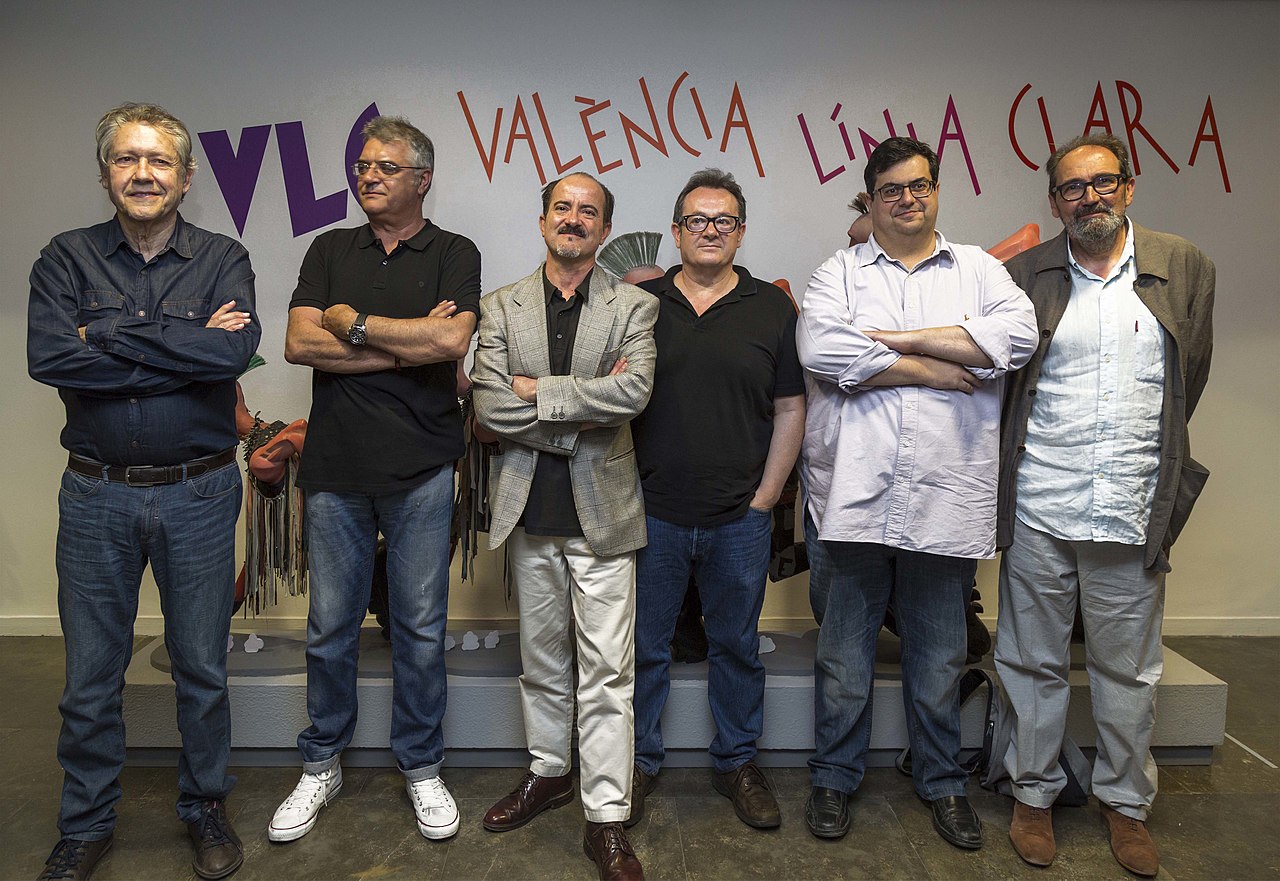
Juan García · Institut Valencià d'Art Modern · CC BY-SA 4.0
- Region
- Spain
VALÉORINE Encyclopedia
VALÉORINE documentary reading
Documentary summary
The New Valencian School (Nueva Escuela Valenciana in Spanish, Nova Escola Valenciana in Valencian) was a trend within Spanish comics that originated in Valencia during the transition to democracy initially through fanzines and peaked editorially during the early 1980s. It comprised several Valencian artists, such as Mique Beltrán, Miguel Calatayud, Manel Gimeno, Sento Llobell, Javier Mariscal, Micharmut and Daniel Torres, and it's credited for pioneering the creation and recognition of adult, cinematographically inspired comics.
Admitted source layer · organised and presented by VALÉORINE
Reference Check
Propose documentary evidence for New Valencian School. A contribution is never written directly as fact: identity, source, rights and evidence gates still decide.
Sign in to contribute
World of VALÉORINE
Documentary connections
Only confirmed graph relationships appear here. Images are shown only when their identity and reuse rights both pass the documentary gate.
Documentary evidence
Documentary basis
Authority files
wikidata · Q974521 · wikipedia · New Valencian School
In this article
Concept
Concept
The New Valencian School was named as such in reference to the classical "Valencian school" that was part of the mainstream of Spanish comics through the Francoist era ranging from naïf fantasy series like Pumby to historical adventure such as in El Guerrero del Antifaz. This label wasn't assigned by the artists themselves, and Sento Llobell attributes its coining to "someone from Norma Editorial, I suppose". Several of them have expressed their scepticism, with Mique Beltrán noting that if a School implies a manifesto-driven movement it wasn't such a thing. Some essays on these artists have criticized this label as an erroneous marketing-motivated definition on what was a generation rather a school that suggests a rupture with the 1950-60s adventure and humor Valencian comics when it was actually an evolution of these, while admitting that it made a mark in the local comic fandom leading to its continued use decades later.
Characteristics
Characteristics
• Illustration — Sento Llobell in Librería Futurama (2013) • Illustration — Daniel Torres in the 2019 Barcelona ICF While sharing similar underground origins, the Valencian trend differed from other Spanish currents such as the Barcelonese comix scene as it focused on renewing from a postmodern outlook genres such as science fiction, crime fiction and adventure rather than on social commentary and ideological transgression. Miguel Calatayud set its bases in 1970 with Peter Petrake, a surreal crime fiction in psychedelic pop art aesthetics. The pop-art satirical paintings of Valencian artistic collective Equipo Crónica, which had been active since the mid-1960s, were also a major influence. Most of the New Valencian School's artists were influenced by ligne claire, which they translated in different ways by fusing it with a variety of trends. Beltrán combined it with Bruguerian humor and a stylization of vintage American comics in Cleopatra, while Calatayud blended it with psychedelia and cubist techniques in La diosa sumergida (The Submerged Goddess) and La pista atlántica (The Atlantic Trail).
History
History
The core of the group was first gathered in 1977 when Calatayud, Micharmut, Sento and Torres joined Gimeno's fanzine El gat pelat (The Shaved Cat), which still focused on social commentary. Together they created the fanzine label Els tebeus del cingle (The Cliff's Comics), which published five monographic albums. The group was subsequently joined by Beltrán in El gat pelats fourth issue. While New Valencian School members were initially published in newly founded alternative magazines El Víbora and Bésame Mucho, the creation in 1981 of Norma's ligne claire-oriented magazine Cairo created an ideal environment for their artistic purposes. Beltrán and Torres' most emblematic creations, Cleopatra and Rocco Vargas, were first serialized in it. The opening that same year of Librería Futurama, the first specialized comics store in both Valencia and Spain, also favored the trend's popularization. The School attracted some international attention and in 1984 it was the subject of an exhibition at the Angoulême Festival. But the end of Cairo that same year led to its decline. Some of its members later worked in children's comics, with Beltrán and Torres creating Marco Antonio and Tom respectively for El Pequeño País, before returning to adult comics in a more realistic vein following the rise of the graphic novel scene in Spain. These include Sento's Civil War trilogy Dr. Uriel and Torres' La casa (The House). In 2016 it was the subject of IVAM's exhibition Valencia Línea Clara.
Places
Named by the record
Places
Only places the record itself states, plotted where the house gazetteer settles their coordinates. Nothing is inferred from a name or a nationality.
- Spain
Named but not plotted · 1
New Valencian School is associated with Spain.
Country
Primary material
Documents and archives
reference work
- “New Valencian School”, English Wikipedia, consulted as further reading
Reputable secondary · Wikipedia
authority record
- Wikidata, structured authority record Q974521: New Valencian School
General reference · Wikidata
Notes from the source article
Cited by Wikipedia
Notes from the source article
These works are cited by the source article, in its own numbering. They are recorded as its citations, not as sources VALÉORINE has verified.
- 1.Cavanilles, Javier. "The New Valencian School: based on real events?". Valencia Plaza, 2 April 2016
- 2.Pons, Álvaro. "The New Valencian School. An example of formal renovation from the cartoon's tradition". Valencia Polytechnic University
- 3.Puchades, Juan. "Comics: Marco Antonio. Complete work, by Mique Beltrán". Efe Eme, 6 February 2013
- 4.Moreira, M. Futurama, 26 años en el noveno arte. ABC. 28 May 2007.
- 5.Abella, Anna. "If walls talked". El Periódico de Catalunya, 29 November 2015
- 6.Hermoso, Borja. "Comics as museum pieces". El País, 9 June 2016
References
Citations
References
Each reference names the institution holding it, so a reader may go to the document itself.
reference work
Secondary witnessauthority record
General reference
The Encyclopedia exists whether or not anything is for sale. Corrections are recorded rather than overwritten, and every version of this record is kept. Published 16 August 2026.
Elsewhere in Terminology
620 published records in this field, each with its sources named.
- New RomanticMovement
- New schoolMovement
- New SculptureMovement
- New SimplicityMovement
- New VisionMovement
- New WaveMovement
- new wave of American heavy metalMovement
- new wave of British heavy metalMovement
Best supported in this field
For owners
Own an object connected with New Valencian School?
A specialist will read what you send and tell you what the house can establish, what it cannot, and whether the object is suited to sale. There is no charge and no obligation. The object stays with you throughout; nothing is shipped to us unless it is arranged in writing beforehand.