
Hudson River school
Illustration — Thomas Cole (1801–1848), The Oxbow (The Connecticut River near Northampton) (1836), Metropolitan Museum of Art The Hudson River School was a mid-19th-century American art movement made by a group of landscape painters whose aesthetic vision was influenced by Romanticism. Early on, the paintings typically depicted the Hudson River Valley and the surrounding area, including the Catskill, Adirondack, and White Mountains. Works by second-generation artists expanded to include other locales in New England, the Maritimes, the Western United States, and South America.
Also recorded as hudson River School of Landscape Painting
Hudson River school

Thomas Cole · Metropolitan Museum of Art · Public domain
- Field
- Romanticism
- Region
- United States
VALÉORINE Encyclopedia
VALÉORINE documentary reading
Documentary summary
Illustration — Thomas Cole (1801–1848), The Oxbow (The Connecticut River near Northampton) (1836), Metropolitan Museum of Art The Hudson River School was a mid-19th-century American art movement made by a group of landscape painters whose aesthetic vision was influenced by Romanticism. Early on, the paintings typically depicted the Hudson River Valley and the surrounding area, including the Catskill, Adirondack, and White Mountains. Works by second-generation artists expanded to include other locales in New England, the Maritimes, the Western United States, and South America.
Admitted source layer · organised and presented by VALÉORINE
Reference Check
Propose documentary evidence for Hudson River school. A contribution is never written directly as fact: identity, source, rights and evidence gates still decide.
Sign in to contribute
World of VALÉORINE
Documentary connections
Only confirmed graph relationships appear here. Images are shown only when their identity and reuse rights both pass the documentary gate.

Associated With · incoming
Asher Brown Durand
Engraver
Smithsonian Institution on Flickr

Associated With · incoming
Eliza Pratt Greatorex
Artist
Own work

Associated With · incoming
John William Casilear
Photographer
New York Historical Society

Associated With · incoming
Julie Hart Beers
Artist
[1]
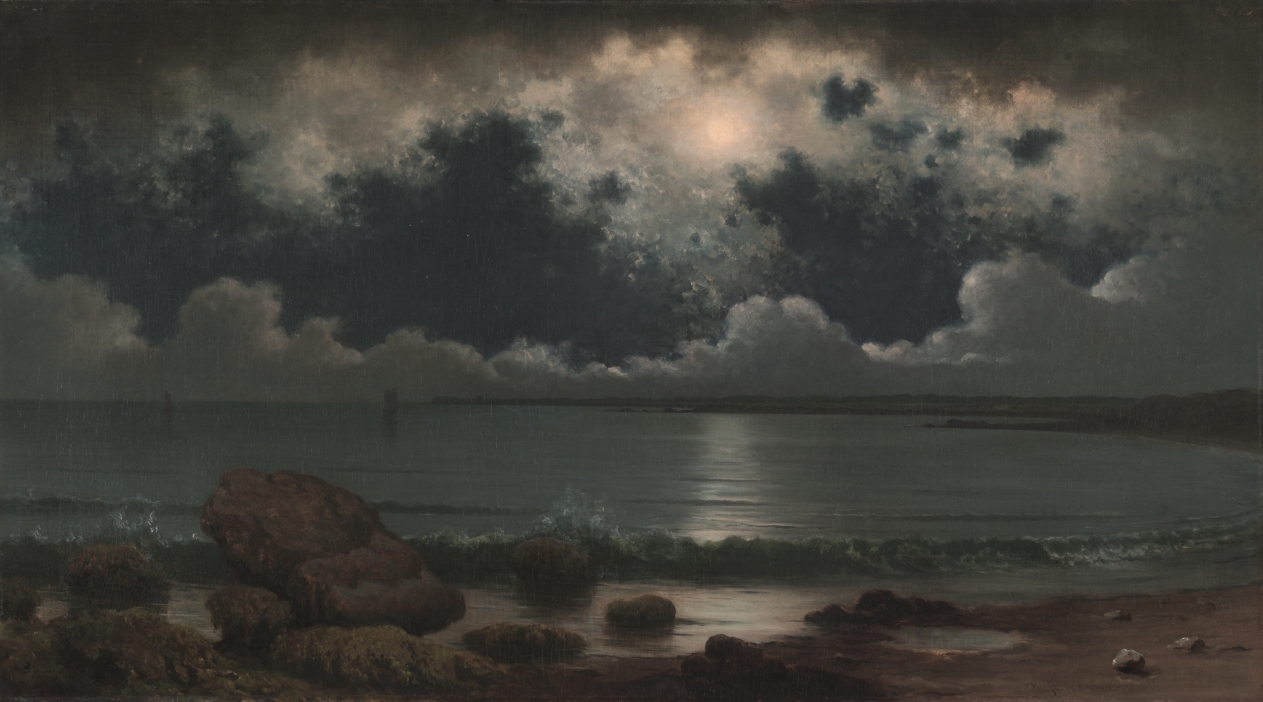
Associated With · incoming
Martin Johnson Heade
Artist
Mr. and Mrs. William H. Marlatt Fund and Gift of Delbert Gutridge in memory of Orrel A. Parker by exchange

Associated With · incoming
Robert Seldon Duncanson
Photographer
Smithsonian American Art Museum https://americanart.si.edu/artist/robert-s-duncanson-1353
Broader Term · outgoing
Romanticism
Term
Located In · outgoing
United States
Place

Associated With · incoming
William Sidney Mount
Artist
http://photography.si.edu/SearchImage.aspx?t=5 id=3843 q=aaa_charscrs_4411 or https://www.flickr.com/photos/smithsonian/2548171512/
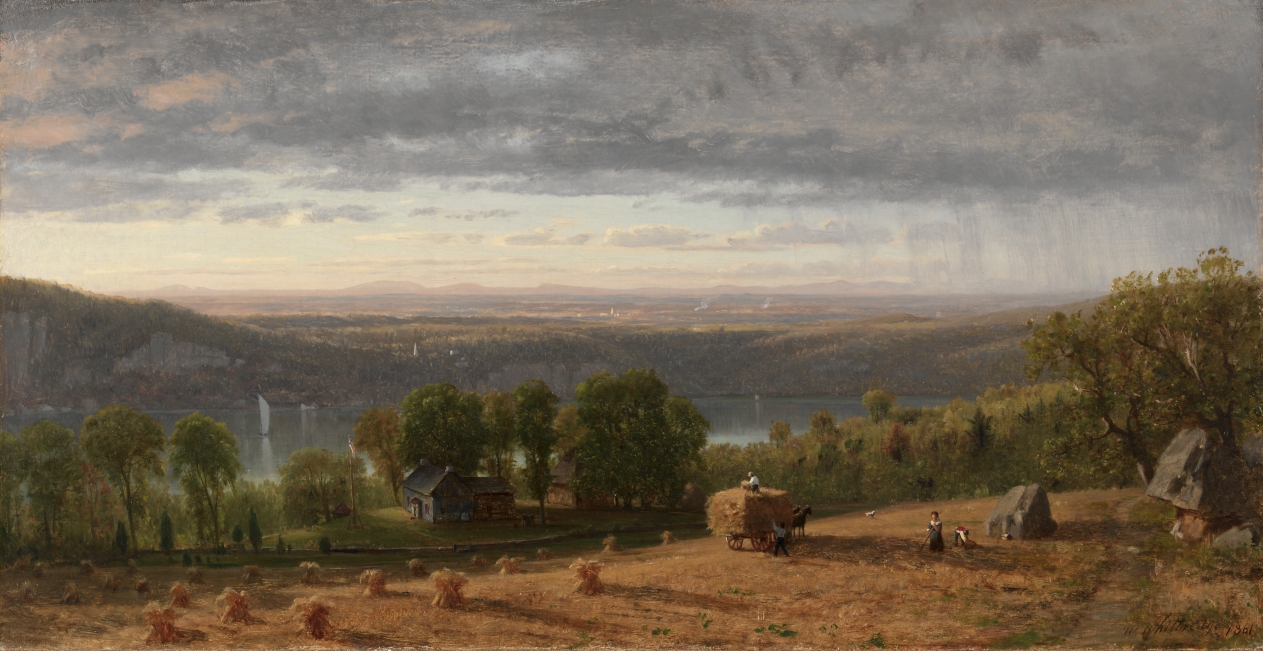
Associated With · incoming
Worthington Whittredge
Photographer
Mr. and Mrs. William H. Marlatt Fund
Documentary evidence
Documentary basis
Authority files
getty · 500399799 · gnd · 1087603560 · wikidata · Q943853 · wikipedia · Hudson River School
In this article
Overview
Overview
The school of landscape painters flourished between 1825 and 1870, which was often called the "native", "American", or "New York" school. New York City was the center of it, many members had studios in the Tenth Street Studio Building in Greenwich Village. The term Hudson River School is thought to have been coined by the New York Tribune art critic Clarence Cook or by landscape painter Homer Dodge Martin. The name appeared in print in 1879, it was initially used during the 1870s disparagingly, as the style had gone out of favor after the plein-air Barbizon School had come into vogue among American patrons and collectors. Hudson River School paintings reflect three themes of America in the 19th century: discovery, exploration, and settlement. They also depict the American landscape as a pastoral setting, where human beings and nature coexist peacefully. Hudson River School landscapes are characterized by their realistic, detailed, and sometimes idealized portrayal of nature, often juxtaposing peaceful agriculture and the remaining wilderness which was fast disappearing from the Hudson Valley just as it was coming to be appreciated for its qualities of ruggedness and sublimity. In general, Hudson River School artists believed that nature in the form of the American landscape was a reflection of God, though they varied in the depth of their religious conviction. They were inspired by European masters such as Claude Lorrain, John Constable, and J. M. W. Turner. Several painters were members of the Düsseldorf School of Painting, and they were educated by German Paul Weber.
Founder
Founder
• Illustration — Thomas Cole, A View of the Two Lakes and Mountain House, Catskill Mountains, Morning, 1844, Brooklyn Museum of Art Thomas Cole is generally acknowledged as the founder of the School. He took a steamboat up the Hudson in the autumn of 1825, stopping first at West Point then at Catskill landing. He hiked west, high into the eastern Catskill Mountains of New York to paint the first landscapes of the area. The first review of his work appeared in the New York Evening Post on November 22, 1825. Cole was from England and the brilliant autumn colors in the American landscape inspired him. His close friend Asher Brown Durand became a prominent figure in the school. A prominent element of the Hudson River School was its themes of nationalism, nature, and property. Adherents of the movement also tended to be suspicious of the economic and technological development of the age.
Second generation
Second generation
• Illustration — Frederic Edwin Church, Niagara Falls, 1857, Corcoran Gallery of Art, Washington, D.C. • Illustration — Albert Bierstadt, Among the Sierra Nevada, California, 1868, Smithsonian American Art Museum, Washington, D.C. • Illustration — John Frederick Kensett, Mount Washington, 1869, Davis Museum at Wellesley College • Illustration — Asher Brown Durand, The Catskills, 1859, Walters Art Museum The second generation of Hudson River School artists emerged after Cole's premature death in 1848; its members included Cole's prize pupil Frederic Edwin Church, John Frederick Kensett, and Sanford Robinson Gifford. Works by artists of this second generation are often described as examples of Luminism. Kensett, Gifford, and Church were also among the founders of the Metropolitan Museum of Art in New York City. Most of the finest works of the second generation were painted between 1855 and 1875. Artists such as Frederic Edwin Church and Albert Bierstadt were celebrities then. They were both influenced by the Düsseldorf school of painting, and Bierstadt had studied in that city for several years. Thousands of people would pay 25 cents per person to view paintings such as Niagara and The Icebergs. The epic size of these landscapes was unexampled in earlier American painting and reminded Americans of the vast, untamed, and magnificent wilderness areas in their country. This was the period of settlement in the American West, preservation of national parks, and establishment of green city parks.
Female artists
Female artists
Several women were associated with the Hudson River School. Susie M. Barstow was an avid mountain climber who painted the mountain scenery of the Catskills and the White Mountains. Eliza Pratt Greatorex was an Irish-born painter who was the second woman elected to the National Academy of Design. Julie Hart Beers led sketching expeditions in the Hudson Valley region before moving to a New York City art studio with her daughters. Harriet Cany Peale studied with Rembrandt Peale and Mary Blood Mellen was a student and collaborator with Fitz Henry Lane.
Notable artists
Notable artists
• Albert Bierstadt (1830–1902) • William Mason Brown (1828–1898) • John William Casilear (1811–1893) • Frederic Edwin Church (1826–1900) • Thomas Cole (1801–1848) • Samuel Colman (1832–1920) • Jasper Francis Cropsey (1823–1900) • Thomas Doughty (1793–1856) • Robert Duncanson (1821–1872) • Asher Brown Durand (1796–1886) • Sanford Robinson Gifford (1823–1880) • James McDougal Hart (1828–1901) • William Hart (1823–1894) • William Stanley Haseltine (1835–1900) • Martin Johnson Heade (1819–1904) • Hermann Ottomar Herzog (1832–1932) • Thomas Hill (1829–1908) • David Johnson (1827–1908) • John Frederick Kensett (1816–1872) • Jervis McEntee (1828–1891) • Thomas Moran (1837–1926) • Robert Walter Weir (1803–1889) • Worthington Whittredge (1820–1910) • Francis Augustus Silva (1835–1886)
Definition
Definition
The following is established of the heading itself. It is also recorded that hudson River school is classified as a Romanticism. The register further records that hudson River school is associated with United States.
Places
Named by the record
Places
Only places the record itself states, plotted where the house gazetteer settles their coordinates. Nothing is inferred from a name or a nationality.
- United States
Figures, places and works
Knowledge graph
Figures, places and works
Those recorded within this movement, and the places and works associated with it.
Associated with
4- Asher Brown DurandEngraver
Established from a fact already recorded on a verified source.
- Robert Seldon DuncansonPhotographer
Established from a fact already recorded on a verified source.
- William Sidney MountArtist
Established from a fact already recorded on a verified source.
- Worthington WhittredgePhotographer
Established from a fact already recorded on a verified source.
Legacy
Hudson River School art has had minor periods of a resurgence in popularity. The school gained interest after World War I, likely due to nationalist attitudes. Interest declined until the 1960s, and the regrowth of the Hudson Valley has spurred further interest in the movement. Historic house museums and other sites dedicated to the Hudson River School include Olana State Historic Site in Hudson, New York, the Thomas Cole National Historic Site in the town of Catskill, the Newington-Cropsey Foundation's historic house museum, art gallery, and research library in Hastings-on-Hudson, New York, and the John D. Barrow Art Gallery in the village of Skaneateles, New York.
Public collections
Public collections
One of the largest collections of paintings by artists of the Hudson River School is at the Wadsworth Atheneum in Hartford, Connecticut. Some of the most notable works in the Atheneum's collection are 13 landscapes by Thomas Cole and 11 by Hartford native Frederic Edwin Church. They were personal friends of the museum's founder, Daniel Wadsworth.
Other collections
Other collections
• Albany Institute of History & Art in Albany, New York • Arnot Art Museum in Elmira, New York • Berkshire Museum in Pittsfield, Massachusetts • Brooklyn Museum in Brooklyn, New York • Corcoran Gallery of Art in Washington, DC • Crystal Bridges Museum in Bentonville, Arkansas • Cummer Museum of Art & Gardens in Jacksonville, Florida • Detroit Institute of Arts in Detroit, Michigan • Fenimore Art Museum in Cooperstown, New York • Frances Lehman Loeb Art Center in Poughkeepsie, New York • Fruitlands Museum in Harvard, Massachusetts • Gilcrease Museum in Tulsa, Oklahoma • Haggin Museum in Stockton, California • Hudson River Museum in Yonkers, New York • Hunter Museum of American Art in Chattanooga, Tennessee • Louvre Museum in Paris, France • Lyman Allyn Art Museum in New London, Connecticut • Mabee-Gerrer Museum of Art in Shawnee, Oklahoma • Marsh-Billings-Rockefeller National Historical Park in Woodstock, Vermont • Metropolitan Museum of Art in Manhattan, New York • Munson-Williams-Proctor Arts Institute in Utica, New York • Museum of Fine Arts in Boston, Massachusetts • Museum of White Mountain Art in Jackson, New Hampshire • National Gallery of Art in Washington, DC • Newark Museum in Newark, New Jersey • Newington-Cropsey Foundation in Hastings-on-Hudson, New York • New-York Historical Society in Manhattan, New York • Olana State Historic Site in Hudson, New York • Rockwell Museum in Corning, New York • St. Johnsbury Athenaeum in St. Johnsbury, Vermont • Thyssen-Bornemisza Museum in Madrid, Spain • The Heckscher Museum of Art in Huntington, New York • Virginia Museum of Fine Arts in Richmond, Virginia • Worcester Art Museum in Worcester, Massachusetts • Wadsworth Atheneum in Hartford, Connecticut The Newington-Cropsey Foundation, in their Gallery of Art Building, maintains a research library of Hudson River School art and painters, open to the public by reservation.
Documents and archives
Primary material
Documents and archives
authority file
- Gemeinsame Normdatei 1087603560, Hudson River School.
General reference · Deutsche Nationalbibliothek
- Getty Union List of Artist Names 500399799, Hudson River School.
General reference · The Getty Research Institute
reference work
- “Hudson River School”, English Wikipedia, consulted as further reading
Reputable secondary · Wikipedia
authority record
- Wikidata, structured authority record Q943853: Hudson River school
General reference · Wikidata
Notes from the source article
Cited by Wikipedia
Notes from the source article
These works are cited by the source article, in its own numbering. They are recorded as its citations, not as sources VALÉORINE has verified.
- 1.Kennet T. Jackson. The Encyclopedia of New York City. Yale University. 172. 1995. 0-300-05536-6.
- 2.Howat, John K. American Paradise: The World of the Hudson River School. Metropolitan Museum of Art, Harry N. Abrams, Inc. 3, 4. 1987.
- 3.Kornhauser, Elizabeth Mankin. Hudson River School: Masterworks from the Wadsworth Atheneum Museum of Art. Wadsworth Atheneum Museum of Art. vii. 2003.
- 4.Hudson River Museum. The Panoramic River: the Hudson and the Thames. 188. 2013. 978-0-943651-43-9.
- 5.Virginia Tech History Department. The Hudson River School: Nationalism, Romanticism, and the Celebration of the American Landscape.
- 6.John K. Howat: American Paradise: The World of the Hudson River School, S. 311
- 7.O'Toole, Judith H. Different Views in Hudson River School Painting. Columbia University Press. 11. 2005. 9780231138208.
- 8.Boyle, Alexander. Thomas Cole (1801–1848) The Dawn of the Hudson River School. Hamilton Auction Galleries.
- 9.Smithsonian Museum. Asher B. Durand. Smithsonian American Art Museum: Renwick Gallery.
- 10.Angela Miller, The Empire of the Eye (1996); Alfred L. Brophy, Property and Progress: Antebellum Landscape Art and Property, McGeorge Law Review 40 (2009): 601-59.
- 11.Avery, Kevin J. Metropolitan Museum of Art: Frederick Edwin Church. Metropolitan Museum of Art.
- 12.Corcoran Museum of Art. Corcoran Highlights: Niagara.
- 13.Potter, Russell A. Review of 'The Voyage of the Icebergs: Frederic Edwin Church's Arctic Masterpiece'. Rhode Island College.
- 14.Dobrzynski, Judith H. The Grand Women Artists of the Hudson River School. Smithsonian.
- 15.Traditional Fine Arts Organization, Inc. Remember the Ladies: Women Artists of the Hudson River School. Resource Library.
- 16.Zimmer, William. Hudson River School Just Keeps on Rolling. The New York Times. October 17, 1999.
- 17.White, Mark Andrew. Progress on the Land: Industry and the American Landscape Tradition. Melton Art Reference Library. 6–13. 2002. 0-9640163-1-1.
- 18.Hershenson, Roberta. Work Is in Dispute, but Cropsey's Home Is Open. The New York Times. November 7, 1999.
- 19.Encyclopedia Britannica
- 20.Allaback, Sarah. 19th Century Painters: Hudson River School. 2006. Hudson River Valley National Heritage Area.
- 21.Rickey, Frederick. Robert W. Weir (1803–1889). United States Military Academy.
Bibliography printed in the source article · 5
- Avery. Hudson River School Visions: The Landscapes of Sanford R. Gifford. The Metropolitan Museum of Art. 2003. 978-0-300-10184-3.
- Ferber, Linda S. (2009). The Hudson River School: Nature and the American Vision. New York Historical Society.
- The Metropolitan Museum of Art. American Paradise: The World of the Hudson River School. 1987. 978-0-87099-496-8.
- Sullivan, Mark W. (1991). The Hudson River School: An Annotated Bibliography . Metuchen, NJ: Scarecrow Press.
- Wilmerding, John (1980). American Light: The Luminist Movement, 1850–1875: Paintings, Drawings, Photographs. Washington, D.C.: National Gallery of Art. . .
References
Citations
References
Each reference names the institution holding it, so a reader may go to the document itself.
reference work
Secondary witnessauthority file
Gemeinsame Normdatei 1087603560, Hudson River School.Deutsche Nationalbibliothek
Secondary witnessauthority file
Getty Union List of Artist Names 500399799, Hudson River School.The Getty Research Institute
Secondary witnessauthority record
General reference
The Encyclopedia exists whether or not anything is for sale. Corrections are recorded rather than overwritten, and every version of this record is kept. Published 16 August 2026.
Elsewhere in Terminology
620 published records in this field, each with its sources named.
- HistoricismMovement
- holy minimalismMovement
- Hong Kong New WaveMovement
- Hoosier GroupMovement
- humourMovement
- Hurufiyya movementMovement
- idealismMovement
- Igbo artMovement
Best supported in this field
For owners
Own an object connected with Hudson River school?
A specialist will read what you send and tell you what the house can establish, what it cannot, and whether the object is suited to sale. There is no charge and no obligation. The object stays with you throughout; nothing is shipped to us unless it is arranged in writing beforehand.