
Nandalal Bose
Nandalal Bose (3 December 1882 – 16 April 1966) was one of the pioneers of modern Indian art and a key figure of Contextual Modernism. A pupil of Abanindranath Tagore, Bose was known for his "Indian style" of painting. He became the principal of Kala Bhavan, Santiniketan in 1921.
Also recorded as Nandalalā Basu · Nanda Lal Bose
Nandalal Bose

Abrsinha · CC BY-SA 4.0
- Name
- Nandalal Bose
- Born
- 3 December 1882
- Birthplace
- Haveli Kharagpur, Bengal Presidency, British India (now in Bihar, India)[1]
- Died
- 16 April 1966
- Place of death
- Santiniketan, West Bengal, India
- Field
- Painting
- Movement
- Contextual Modernism
- Awards
- Principal of Kala Bhavana, Santiniketan (1921), Padma Vibhushan (1954), Fellow of the Lalit Kala Academy (1954), Deshikottama (1952), Honorary D.Litt, Silver Jubilee Medal, The Tagore Birth Centenary Medal, Honorary Doctor of the University of Calcutta
- Education
- University of Calcutta, Government College of Art and Craft
- Spouse
- Sudhira Devi (1903)
- Nationality
- India, British Raj and Dominion of India.
- Occupation
- painter, printmaker and writer.
VALÉORINE Encyclopedia
VALÉORINE documentary reading
Documentary summary
Nandalal Bose (3 December 1882 – 16 April 1966) was one of the pioneers of modern Indian art and a key figure of Contextual Modernism. A pupil of Abanindranath Tagore, Bose was known for his "Indian style" of painting. He became the principal of Kala Bhavan, Santiniketan in 1921.
Admitted source layer · organised and presented by VALÉORINE
Reference Check
Propose documentary evidence for Nandalal Bose. A contribution is never written directly as fact: identity, source, rights and evidence gates still decide.
Sign in to contribute
World of VALÉORINE
Documentary connections
Only confirmed graph relationships appear here. Images are shown only when their identity and reuse rights both pass the documentary gate.
Documentary evidence
Documentary basis
Authority files
gnd · 16117909-5 · wikidata · Q3348980 · wikipedia · Nandalal Bose
In this article
Biography
Biography
He was influenced by the Tagore family and the murals of Ajanta; his classic works include paintings of scenes from Indian mythologies, women, and village life. Today, many critics consider his paintings among India's most important modern paintings.[2][3] In 1976, the Archaeological Survey of India, Department of Culture, Govt. Of India declared his works among the "nine artists" whose work, "not being antiquities", were to be henceforth considered "to be art treasures, having regard to their artistic and aesthetic value".[5] He was given the work of illustrating the Constitution of India.[13]
Nandalal Bose studied at University of Calcutta and Government College of Art & Craft. Krishna Reddy is recorded as having studied under Nandalal Bose. The recorded working language is Bangla. Work by Nandalal Bose is recorded in the collections of Art Institute of Chicago, Ashmolean Museum, Victoria Memorial, National Gallery of Modern Art, Bengaluru and Cleveland Museum of Art. Distinctions recorded are Padma Vibhushan, Deshikottam and honorary doctor of the University of Calcutta.
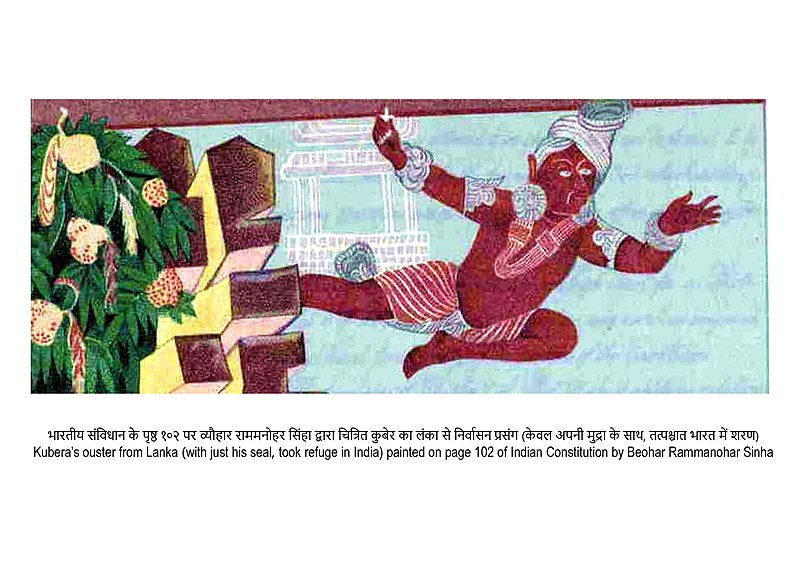
Yaksha king Kubera’s ouster from his golden kingdom of Lanka (with just his seal, devoid of even his Pushpak-aircraft, Kubera later took refuge in Gandhmandana/Alkapuri in India), painted on page 102 of Indian Constitution by Santiniketan artist Rammanohar (Jabalpur-born Beohar Rammanohar Sinha). Rammanohar was mentored by the revivalist modernist Indian maestro Nandalal Bose. Rammanohar was his f
Abrsinha

Celebration of cultural prosperity in Emperor Chandragupta Vikramaditya’s court, painted on page 104 of the original calligraphic Indian Constitution by Santiniketan artist Rammanohar (Jabalpur-born Beohar Rammanohar Sinha). Rammanohar was mentored by the revivalist modernist Indian maestro Nandalal Bose. Rammanohar was his favorite disciple who also played an important role in India’s cultural di
Abrsinha
Key facts
Key facts
• Honorific Prefix — Padma Vibhushan • Name — Nandalal Bose • Born — 3 December 1882 • Birthplace — Haveli Kharagpur, Bengal Presidency, British India (now in Bihar, India)[1] • Died — 16 April 1966 • Place of death — Santiniketan, West Bengal, India • Field — Painting • Movement — Contextual Modernism • Awards — Principal of Kala Bhavana, Santiniketan (1921), Padma Vibhushan (1954), Fellow of the Lalit Kala Academy (1954), Deshikottama (1952), Honorary D.Litt, Silver Jubilee Medal, The Tagore Birth Centenary Medal, Honorary Doctor of the University of Calcutta • Education — University of Calcutta, Government College of Art and Craft • Spouse — Sudhira Devi (1903) • Children — Gouri Bhanja (daughter) Jamuna Sen (daughter) • Relatives — Surendranath Kar (cousin) • Father — Purnachandra Bose • Mother — Kshetramonidevi
Early life
Early life
Nandalal Bose was born on 3 December 1882 in a middle-class Bengali family at Haveli Kharagpur, in Munger district of Bihar state. The family originally hailed from Jejur, Hooghly District of West Bengal.[6] His father, Purna Chandra Bose, was at that time working in the Darbhanga Estate.[7] His mother Khetramoni Devi was a housewife with a skill in improvising toys and dolls for young Nandalal. From his early days Nandalal began taking an interest in modelling images and later, decorating Puja pandals. In 1898, at the age of fifteen, Nandalal moved to Calcutta for his high school studies in the Central Collegiate School. After clearing his examinations in 1902, he continued his college studies at the same institution. In June 1903 he married Sudhiradevi, the daughter of a family friend. Nanadalal wanted to study art, but he was not given permission by his family. Unable to qualify for promotion in his classes, Nandalal moved to other colleges, joining the Presidency College in 1905 to study commerce. After repeated failures, he persuaded his family to let him study art at Calcutta's School of Art.[8]
Career
Career
• Illustration — Yama and Savitri, from a painting by Nandalal Bose, 1913 • Illustration — Kirat-Arjuna, 1914 As a young artist, Nandalal Bose was deeply influenced by the murals of the Ajanta Caves. He had become part of an international circle of artists and writers seeking to revive classical Indian culture; a circle that already included Okakura Kakuzō, William Rothenstein, Yokoyama Taikan, Christiana Herringham, Laurence Binyon, Abanindranath Tagore, and the seminal London Modernist sculptors Eric Gill and Jacob Epstein.[9] To mark the 1930 occasion of Mahatma Gandhi's arrest for protesting the British tax on salt, Bose created a black on white linocut print of Gandhi walking with a staff. It became the iconic image for the non-violence movement. • Illustration — Untitled by Nandalal Bose, 1954, Collage and ink on paper, DAG Museums His genius and original style were recognised by artists and art critics like Gaganendranath Tagore, Ananda Coomaraswamy and O. C. Ganguli. These lovers of art felt that objective criticism was necessary for the development of painting and founded the Indian Society of Oriental Art. He became principal of the Kala Bhavana (College of Arts) at Tagore's International University Santiniketan in 1921.[11] He was also asked by Jawaharlal Nehru to sketch the emblems for the Government of India's awards, including the Bharat Ratna and the Padma Shri.[12] Along with his disciple Rammanohar, Nandalal Bose took up the task of beautifying/decorating the original manuscript of the Constitution of India. He died on 16 April 1966 in Santiniketan[14][15] of natural causes. Today, the National Gallery of Modern Art in Delhi holds 7000 of his works in its collection, including a 1930 black and white linocut of the Dandi March depicting Mahatma Gandhi, and a set of seven posters he later made at the request of Mahatma Gandhi for the 1938 Haripura Session of the Indian National Congress.[17]
Selected artworks
Selected artworks
A major collection of Bose's artworks is preserved and displayed at the National Gallery of Modern Art (NGMA) in New Delhi. His notable works span mythological themes, the Indian independence movement, and rural life:[18] • Mythological & Historical Themes: Sati (1907), Siva Drinking World Poison, and Parthasarthi. • National Movement: The iconic 1930 linocut print of Mahatma Gandhi's Dandi March and the 1938 Haripura Congress Posters. • Rural Life & Artisans: Tiller of the Soil, Pith Worker, and Pounding of Rice. • Landscapes: Darjeeling and Fog.
His place in Indian art
His place in Indian art
In his introduction for the Christie's catalogue, R. Siva Kumar wrote[19]-
Life and career
Dated record
Life and career
The full dated record · 2 entries
1882
Nandalal Bose born at Tarapur.
1966
Nandalal Bose died at Santiniketan.
Places
Named by the record
Places
Only places the record itself states, plotted where the house gazetteer settles their coordinates. Nothing is inferred from a name or a nationality.
Tarapur.
Birth place
Santiniketan.
Death place
Publications
• Illustration — Illustration of the poem Rikto (রিক্ত; Empty) in Rabindranath Tagore's Chharar Chhabi (ছড়ার ছবি). • Drishti o srishti [Vision and the Creation] by Nandalal Bose, published by Visva-Bharati Granthana Vibhaga [Edition Language - Bengali] • Shilpa Charcha [শিল্প চর্চা] by Nandalal Bose, published April 1956 by Visva Bharati [Edition Language - Bengali] • Pictures from the life of buddha by Nandalal Bose • Rupavali by Nandalal Bose
Students
Some of his notable students were E.KUMARIL SWAMY Benode Behari Mukherjee, Ramkinkar Baij, Beohar Rammanohar Sinha, K. G. Subramanyan, A. Ramachandran, Pratima Thakur, Jahar Dasgupta, Satyajit Ray, Dinkar Kaushik, Amritlal Vegad, A.D.Jayathilake (1756), and Kiron Sinha[20]
Recognition and collections
Where the work is held
Recognition and collections
Nandalal Bose received Padma Vibhushan, Deshikottam and honorary doctor of the University of Calcutta.
Documents and archives
Primary material
Documents and archives
reference work
- “Nandalal Bose”, English Wikipedia, consulted as further reading
Reputable secondary · Wikipedia
- Wikidata, structured authority record Q3348980: Nandalal Bose
Reputable secondary · Wikimedia Foundation
scholarly publication
- 6. Landscapes Of Nandalal Bose (1882–1966): Japanism, Nationalism And Populism In Modern India, Okakura Tenshin and Pan-Asianism, 2009
Scholarly · Crossref registry · 2009
authority file
- Gemeinsame Normdatei 16117909-5, Nandalal Bose (1882-1966) Centenary Exhibition (1982 : Delhi).
General reference · Deutsche Nationalbibliothek
Honours and awards
Nandalal Bose, who left a major imprint on Indian art, was the first recipient of a scholarship offered by the Indian Society of Oriental Art, founded in 1907. In 1954, he became the first artist to be elected Fellow of the Lalit Kala Akademi, India's National Academy of Art. In 1954, Nandalal Bose was awarded the Padma Vibhushan. In 1957, the University of Calcutta conferred honorary D.Litt. on him.[21] Vishvabharati University honoured him by conferring on him the title of 'Deshikottama'. The Academy of Fine Arts in Calcutta honoured Nandalal with the Silver Jubilee Medal. The Tagore Birth Centenary Medal was awarded to Nandalal Bose in 1965 by the Asiatic Society of Bengal. Acharya Nandalal, an Indian documentary film on the artist was made by Harisadhan Dasgupta in 1984.[22]
Notes from the source article
Cited by Wikipedia
Notes from the source article
These works are cited by the source article, in its own numbering. They are recorded as its citations, not as sources VALÉORINE has verified.
- 1.C. H. Prahlada Rao. Nanadlal Bose. Rashtrotthana Sahitya. January 2014.
- 2.Rediff.com News. San Diego museum showcases Nandalal Bose. 25 June 2008.
- 3.Robert L. Pincus. The Art of Nandalal Bose' is first U.S. showcase for an Indian icon. Paramus Post. 15 March 2008.
- 4.SAGE Publications. Culture and the Making of Identity in Contemporary India. 49–. 13 July 2005. 978-0-7619-3381-6.
- 5.The Government Museum and Art Gallery Chandigarh, India.
- 6.Samsad Bangali Charitabhidhan by Anjali Bose, 1976, p. 236
- 7.Litent. Nandalal Bose. 3–. 1 January 2014.
- 8.Dinkar k Kowshik. Nandalal Bose, the doyen of Indian art. National Book Trust, India. 1985.
- 9.Rupert Richard Arrowsmith, "The Transcultural Roots of Modernism: Imagist Poetry, Japanese Visual Culture, and the Western Museum System", Modernism/modernity Volume 18, Number 1, January 2011, 27–42. .
- 10.Video of a Lecture mentioning Bose in the context of Indian influences n global modernism, London University School of Advanced Study, March 2012.
- 11.Mandal, Panchanan. Bharatshilpi Nandalal. Rarh Gobeshona Parshad. 1. 1968.
- 12.Nandalal Bose paintings on display in U.S. The Hindu. 15 March 2008.
- 13.World Digital Library. The Constitution of India. 7 May 2009.
- 14.Kumar, R. Siva. Bose, Nandalal. Grove Art Online. 2003. 978-1-884446-05-4.
- 15.National Gallery of Modern Art, New Delhi. ngmaindia.gov.in.
- 16.Chatterjee, Prerna. Celebrating Nandalal Bose, artist who rejected everything British & designed India's constitution. ThePrint. 2018-12-03.
- 17.The Economic Times. Bengal School of Art exhibition to open in US. 24 June 2008.
- 18.National Gallery of Modern Art, New Delhi. Virtual Tour of Nandalal Bose.
- 19.Nandalal Bose (1882-1966).
- 20.Ghosh, Sabyasachi. The Agony and the Ecstasy. The Telegraph. 18–19. 7 June 1987.
- 21.University of Calcutta. Annual Convocation.
- 22.Rajadhyaksha, Ashish. Encyclopaedia of Indian cinema. British Film Institute. 1999. 9780851706696.
Bibliography printed in the source article · 5
- Nandalal Bose and Indian painting, by Ramyansu Sekhar Das. Tower Publishers, 1958.
- Bharat Shilpi Nandalal, Volumes 1-4, (in Bengali) by Panchanan Mandal, Rarh Gobeshona Parshad, Santiniketan, 1968
- Nandalal Bose: a collection of essays : centenary volume. Lalit Kala Akademi, 1983.
- Nandalal Bose, the doyen of Indian art. (National biography), by Dinkar Kowshik. National Book Trust, India, 1985.
- Rhythms of India: The Art of Nandalal Bose, exhibition catalogue. Sonya Rhie Quintanilla. San Diego Museum of Art. 2008.
References
Citations
References
Each reference names the institution holding it, so a reader may go to the document itself.
scholarly publication
6. Landscapes Of Nandalal Bose (1882–1966): Japanism, Nationalism And Populism In Modern India, Okakura Tenshin and Pan-Asianism, 2009Crossref registry
Institutional witnessreference work
Secondary witnessauthority file
Gemeinsame Normdatei 16117909-5, Nandalal Bose (1882-1966) Centenary Exhibition (1982 : Delhi).Deutsche Nationalbibliothek
Secondary witnessreference work
Wikidata, structured authority record Q3348980: Nandalal BoseWikimedia Foundation
Secondary witness
Further particulars
Held on the record
Further particulars
Open the remaining particulars
Nandalal Bose studied at University of Calcutta and Government College of Art & Craft. Each of those relationships is stated by the authority record rather than inferred from style.
The authorities additionally record the headings Nandalalā Basu and Nanda Lal Bose. His recorded language was Bangla. 3 children are recorded: Biswarup Bose, Gauri Bhanja and Jamuna Sen. Recorded as having received Padma Vibhushan, Deshikottam and honorary doctor of the University of Calcutta.
Identity and origins
The Encyclopedia exists whether or not anything is for sale. Corrections are recorded rather than overwritten, and every version of this record is kept. Published 14 August 2026.
Elsewhere in Paintings
18,792 published records in this field, each with its sources named.
- Nancy HaynesArtist
- Nancy J. AdlerArtist
- Nancy MérienneArtist
- Nancy van OverveldtArtist
- Nandini GoudArtist
- Nándor KatonaArtist
- Nanette CarterArtist
- NanhaArtist
Best supported in this field
For owners
Own a work by Nandalal Bose?
A specialist will read what you send and tell you what the house can establish, what it cannot, and whether the object is suited to sale. There is no charge and no obligation. The object stays with you throughout; nothing is shipped to us unless it is arranged in writing beforehand.