
Muhammad Iqbal
Sir Muhammad Iqbal (9 November 187721 April 1938) was an Islamic philosopher and poet. His poetry in Urdu is considered among the greatest of the 20th century, and his vision of a cultural and political ideal for the Muslims of British India is widely regarded as having animated the impulse behind the Pakistan Movement. The honorific commonly refers to him as Allamah (learned) and is widely considered one of the most important and influential Muslim thinkers and Islamic religious philosophers of the 20th century.
Also recorded as Sir Muhammad Iqbal · Allama Iqbal · Muhammed İkbal · Sir Allama Muhammad Iqbal
Muhammad Iqbal

Amrita Sher-Gil · Reproduced in Tony Halliday, ed. (1992) Insight Guides: Pakistan. Published by Apa Publications (HK) Ltd. · Public domain
- Name
- Muhammad Iqbal
- Born
- 9 November 1877
- Birthplace
- Sialkot, Punjab, British India (present-day Punjab, Pakistan)
- Died
- 21 April 1938
- Place of death
- Lahore, Punjab, British India (present-day Punjab, Pakistan)
- Occupation
- * Philosopher
- Nationality
- British Raj.
- Fields
- poetry, philosophy and politics.
- Education
- Murray College, University of Cambridge, Trinity College and Ludwig-Maximilians-Universität München.
- Known for
- Ilm Al-Iqtisad, The Development of Metaphysics in Persia, The Reconstruction of Religious Thought in Islam, The Secrets of the Self, The Mysteries of Selflessness, Message from the East, The Call of the Marching Bell and Persian Psalms.
- Honours
- Sir and Knight Bachelor.
- Languages
- Urdu, Persian and German.
VALÉORINE Encyclopedia
VALÉORINE documentary reading
Documentary summary
Sir Muhammad Iqbal (9 November 187721 April 1938) was an Islamic philosopher and poet. His poetry in Urdu is considered among the greatest of the 20th century, and his vision of a cultural and political ideal for the Muslims of British India is widely regarded as having animated the impulse behind the Pakistan Movement. The honorific commonly refers to him as Allamah (learned) and is widely considered one of the most important and influential Muslim thinkers and Islamic religious philosophers of the 20th century.
Admitted source layer · organised and presented by VALÉORINE
Note VALÉORINE
Muhammad Iqbal (1877–1938) was a children's writer, jurist and lawyer, among other activities, a national of the British Raj. The children's writer was born in Sialkot and died in Lahore.
Muhammad Iqbal was educated at Government College University, Heidelberg University and Ludwig-Maximilians-Universität München, among others. The children's writer lived in Lahore and Sialkot. Activity centred on philosophy, poetry and politics.
Among the works are Gabriel's Wing, Gift from Hijaz, Ilm Al-Iqtisad and Javid Nama, among others. Languages used include Arabic, English and German. Honours include Knight Bachelor and Sir.
Composed from admitted, traceable facts · 27 September 2026
VALÉORINE
Reference Check
Propose documentary evidence for Muhammad Iqbal. A contribution is never written directly as fact: identity, source, rights and evidence gates still decide.
Sign in to contribute
Documentary evidence
Evidence Panel
not yet certified
- Identity
- resolved
- Independent source families
- 0
- Admitted assertions
- 0
- Open conflicts
- 0
Authority files
gnd · 1399417312 · wikidata · Q484141 · wikipedia · Muhammad Iqbal
In this article
Biography
Biography
Iqbal was born and raised in Sialkot, Punjab, British India and studied at Scotch Mission College in Sialkot and Government College University in Lahore. He taught Arabic at the Oriental College, Lahore, from 1899 until 1903, during which time he wrote prolifically. Notable among his Urdu poems from this period are "Parinde Ki Faryad" ("A Bird's Prayer"), an early contemplation on animal rights, and "Tarana-e-Hindi" ("Anthem of the Indians"), a patriotic poem—both composed for children. In 1905, he departed from India to pursue further education in Europe, first in England and later in Germany. In England, he earned a second BA at Trinity College, Cambridge, and subsequently qualified as a barrister at Lincoln's Inn. In Germany, he obtained a PhD in philosophy at the Ludwig-Maximilians-Universität München (LMU), with his thesis focusing on "The Development of Metaphysics in Persia" in 1908. Upon his return to Lahore in 1908, Iqbal established a law practice but primarily focused on producing scholarly works on politics, economics, history, philosophy, and religion. He is most renowned for his poetic compositions, including "Asrar-e-Khudi", "Rumuz-e-Bekhudi", and "Bang-e-Dara". His literary works in the Persian language garnered him recognition in Iran. An ardent proponent of the political and spiritual revival of the Muslim world, particularly of the Muslims in the Indian subcontinent, the series of lectures Iqbal delivered to this effect were published as The Reconstruction of Religious Thought in Islam in 1930. He was elected to the Punjab Legislative Council in 1927 and held several positions in the All-India Muslim League. In his Allahabad Address, delivered at the League's annual assembly in 1930, he formulated a political framework for the Muslim-majority regions spanning northwestern India, spurring the League's pursuit of the two-nation theory. In August 1947, nine years after Iqbal's death, the partition of India gave way to the establishment of Pakistan, a newly independent Islamic state in which Iqbal was honoured as the national poet. He is also known in Pakistani society as Hakim ul-Ummat (The Wise Man of the Ummah) and as Mufakkir-e-Pakistan (The Thinker of Pakistan). The anniversary of his birth (Youm-e Weladat-e Muḥammad Iqbal), 9 November, is observed as a public holiday in Pakistan.
Muhammad Iqbal studied at Murray College, University of Cambridge and Trinity College. The recorded working language is Urdu, Persian and German. The field of work recorded is poetry, philosophy and politics. Leo Tolstoy, Johann Wolfgang von Goethe and Georg Wilhelm Friedrich Hegel are recorded as an influence. Residence is recorded at Lahore and Sialkot. Works named in the authority record are Ilm Al-Iqtisad, The Development of Metaphysics in Persia, The Reconstruction of Religious Thought in Islam, The Secrets of the Self, The Mysteries of Selflessness and Message from the East. Distinctions recorded are Sir and Knight Bachelor.

Sir Mohammed Iqbal (circa 1877-1938), Poet, philosopher and politician
Lady Ottoline Morrell
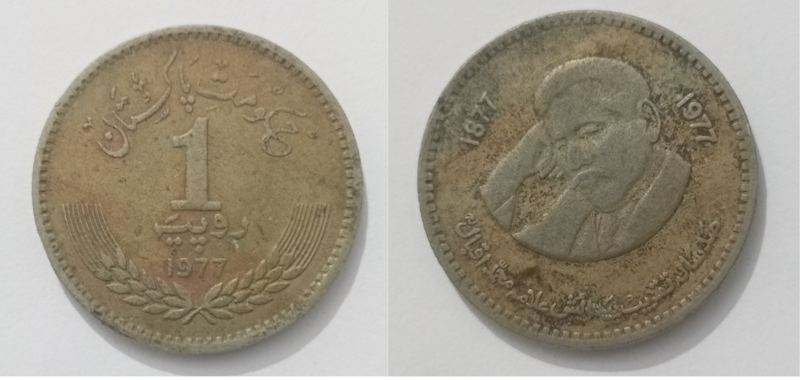
Commemorative coin issued by the State Bank of Pakistan in 1977 on Muhammad Iqbal's 100th birth anniversary.
Hindustani.Hulk
Key facts
Key facts
• Honorific Prefix — Allama Sir • Name — Muhammad Iqbal • Birth Name — Muhammad Iqbal • Born — 9 November 1877 • Birthplace — Sialkot, Punjab, British India (present-day Punjab, Pakistan) • Died — 21 April 1938 • Place of death — Lahore, Punjab, British India (present-day Punjab, Pakistan) • Resting Place — Mazar-e-Iqbal, Lahore • Children — 6 • Office — Member of the Punjab Legislative Council (1927–1930) • Occupation — * Philosopher • author • politician • Notable Works — Bang-e-Dara, Tarana-e-Milli, The Secrets of the Self, The Secrets of Selflessness, Message from the East, Persian Psalms, Javid Nama, Sare Jahan se Accha • Era — Colonial India • Region — Punjab • School Tradition — * Islamic philosophy • idealism • Institutions — Jamia Millia Islamia (co-founder) • Thesis Title — The Development of Metaphysics in Persia • Thesis Year — 1908 • Doctoral Advisor — Fritz Hommel • Language — * Punjabi • Urdu • Persian • Arabic • English • Main Interests — * Urdu literature • Persian poetry • Islamic history • Islamic revival • pan-Islamism • Notable Ideas — Allahabad Address (1930)
Early life and family
Early life and family
Iqbal was born on 9 November 1877 in Sialkot, Punjab Province, British India (now in Pakistan). A Punjabi of Kashmiri ancestry, his family traced their ancestry back to the Sapru clan of Kashmiri Pandits who were from a south Kashmiri village in Kulgam and converted to Islam in the 15th-century. Iqbal's mother-tongue was Punjabi, and he conversed mostly in Punjabi and Urdu in his daily life. In the 19th century, when the Sikh Empire was conquering Kashmir, his grandfather's family migrated to Punjab. Iqbal's grandfather was an eighth cousin of Sir Tej Bahadur Sapru, an important lawyer and freedom fighter who would eventually become an admirer of Iqbal. Iqbal often mentioned and commemorated his Kashmiri lineage in his writings. According to scholar Annemarie Schimmel, Iqbal often wrote about his being "a son of Kashmiri-Brahmans but (being) acquainted with the wisdom of Rumi and Tabrizi". Iqbal's father, Sheikh Noor Muhammad (died 1930), was a tailor, not formally educated, but a religious man. Iqbal's mother Imam Bibi, a Kashmiri from Sambrial, was described as a polite and humble woman who helped the poor and her neighbours with their problems. She died on 9 November 1914 in Sialkot. Iqbal loved his mother, and on her death he expressed his feelings of pathos in an elegy: Who would wait for me anxiously in my native place? Who would display restlessness if my letter fails to arrive? I will visit thy grave with this complaint: Who will now think of me in midnight prayers? All thy life thy love served me with devotion— When I became fit to serve thee, thou hast departed.
Early education
Early education
Iqbal was four years old when he was sent to a mosque to receive instruction in reading the Qur'an. He learned the Arabic and Persian languages from his teacher, Syed Mir Hassan, the head of the madrasa and professor of Arabic at Scotch Mission College in Sialkot, where he matriculated in 1893. He stood first in grade one and had started versifying under the pen-name of Iqbal while still in class nine, being published in literary journals as a teenager. He received an intermediate level with the Faculty of Arts diploma in 1895. The same year he enrolled at Government College, Lahore, where in 1897 he obtained his Bachelor of Arts degree in philosophy, English literature, and Arabic, and won the Khan Bahadurddin F.S. Jalaluddin medal for his performance in Arabic. In 1899, he received his Master of Arts degree from the same college and won first place in philosophy in the University of the Punjab.
Marriages
Marriages
• Illustration — Muhammad Iqbal with his son Javed Iqbal in 1930 Iqbal married four times under different circumstances. • His first marriage was in 1895 when he was 18 years old. His bride, Karim Bibi, was the daughter of Khan Bahadur Ata Muhammad Khan, a leading civil surgeon and fellow Punjabi-Kashmiri based in Gujrat. Her sister was the mother of director and music composer Khwaja Khurshid Anwar. Their families arranged the marriage, and the couple had two children; a daughter, Miraj Begum (1895–1915), and a son, Aftab Iqbal (1899–1979), who became a barrister. Aftab's son Azad Iqbal is himself a barrister as well a writer and musician, being a singer-composer in both jazz and ghazal genres. Another son is said to have died after birth in 1901. Iqbal and Karim Bibi separated somewhere between 1910 and 1913. Despite this, he continued to financially support her till his death. • Iqbal's second marriage took place on 26 August 1910 with the niece of Hakim Noor-ud-Din. • Iqbal's third marriage was with Mukhtar Begum, and it was held in December 1914, shortly after the death of Iqbal's mother the previous November. They had a son, but both the mother and son died shortly after birth in 1924. • Later, Iqbal married Sardar Begum, and they became the parents of a son, Javed Iqbal (1924–2015), who became Senior Justice of the Supreme Court of Pakistan, and a daughter, Muneera Bano (born 1930). One of Muneera's sons is the philanthropist-cum-socialite Yousuf Salahuddin.
Higher education in Europe
Higher education in Europe
Iqbal was influenced by the teachings of Sir Thomas Arnold, his philosophy teacher at Government College Lahore, to pursue higher education in the West. In 1905, he travelled to England for that purpose, as Sir Thomas Arnold had advised him to specifically study neo-Hegelian philosophy and law at Cambridge. While already acquainted with Friedrich Nietzsche and Henri Bergson, Iqbal would discover Rumi slightly before his departure to England, and he would teach the Masnavi-e-Ma'navi to his friend Swami Rama Tirtha, who in return would teach him Sanskrit. Iqbal was awarded a scholarship at Trinity College, Cambridge, and in 1906 he graduated Bachelor of Arts there. In the same year, he was called to the bar as a barrister (or advocate) from Lincoln's Inn. In 1907, Iqbal moved to Germany to complete his doctoral studies under the supervision of Friedrich Hommel, and on 4 November 1907 he graduated as a Doctor of Philosophy from the Ludwig-Maximilians-Universität München (LMU) with a doctoral thesis entitled The Development of Metaphysics in Persia. This was published in London in 1908. Among his fellow students in Munich was Hans-Hasso von Veltheim, who later happened to visit Iqbal the day before Iqbal died. • Illustration — Plaque at Portugal Place, Cambridge, commemorating Iqbal's residence there during his time at Trinity College In 1907, he had a close friendship with the writer Atiya Fyzee in both Britain and Germany. Atiya would later publish their correspondence. While Iqbal was in Heidelberg in 1907, his German professor Emma Wegenast taught him about Goethe's Faust, Heine and Nietzsche. He mastered German in three months. A street in Heidelberg has been named in his memory, "Iqbal Ufer". During his study in Europe, Iqbal began to write poetry in Persian. He preferred to write in this language because doing so made it easier to express his thoughts. He would write continuously in Persian throughout his life.
Academic career
Academic career
• Illustration — Photograph taken during Iqbal's youth in 1899 Iqbal began his career as a reader of Arabic after completing his Master of Arts degree in 1899, at Oriental College and shortly afterward was selected as a junior professor of philosophy at Government College Lahore, where he had also been a student in the past. He worked there until he left for England in 1905. In 1907 he went to Germany for PhD In 1908, he returned from Germany and joined the same college again as a professor of philosophy and English literature. In the same period Iqbal began practising law at the Chief Court of Lahore, but he soon quit law practice and devoted himself to literary works, becoming an active member of Anjuman-e-Himayat-e-Islam. In 1919, he became the general secretary of the same organization. Iqbal's thoughts in his work primarily focus on the spiritual direction and development of human society, centered around experiences from his travels and stays in Western Europe and the Middle East. He was profoundly influenced by Western philosophers such as Nietzsche, Bergson, and Goethe. He also closely worked with Ibrahim Hisham during his stay at the Aligarh Muslim University. The poetry and philosophy of Rumi strongly influenced Iqbal. Deeply grounded in religion since childhood, Iqbal began concentrating intensely on the study of Islam, the culture and history of Islamic civilization and its political future, while embracing Rumi as "his guide". Iqbal's works focus on reminding his readers of the past glories of Islamic civilization and delivering the message of a pure, spiritual focus on Islam as a source for socio-political liberation and greatness. Iqbal denounced political divisions within and amongst Muslim nations, and frequently alluded to and spoke in terms of the global Muslim community or the Ummah. Iqbal's poetry was translated into many European languages in the early part of the 20th century. Iqbal's Asrar-i-Khudi and Javed Nama were translated into English by R. A. Nicholson and A. J. Arberry, respectively. Upon the publication of Asrar-i-Khudi, Iqbal was honoured with a British knighthood.
Legal career
Legal career
• Illustration — Iqbal as a barrister-at-law Iqbal was not only a prolific writer but also a known advocate. He appeared before the Lahore High Court in both civil and criminal matters. There are more than 100 reported judgements to his name.
Final years and death
Final years and death
• Illustration — The tomb of Muhammad Iqbal at the entrance of the Badshahi Mosque in Lahore In 1933, after returning from a trip to Spain and Afghanistan, Iqbal suffered from a mysterious throat illness. He spent his final years helping Chaudhry Niaz Ali Khan to establish the Dar ul Islam Trust Institute at a Jamalpur, Pakistan estate near Pathankot, where there were plans to subsidize studies in classical Islam and contemporary social science. He also advocated for an independent Muslim state. Iqbal ceased practising law in 1934 and was granted a pension by the Nawab of Bhopal. In his final years, he frequently visited the Dargah of famous Sufi Ali Hujwiri in Lahore for spiritual guidance. After suffering for months from his illness, Iqbal died in Lahore on 21 April 1938. It is maintained that he died listening to a kafi of Bulleh Shah. His tomb is located in Hazuri Bagh, the enclosed garden between the entrance of the Badshahi Mosque and the Lahore Fort, and official guards are provided by the Government of Pakistan.
Political
Political
• Illustration — Iqbal with Muslim politicians. (L to R): M. Iqbal (third), Syed Zafarul Hasan (sixth) at Aligarh Muslim University. Iqbal first became interested in national affairs in his youth. He received considerable recognition from the Punjabi elite after his return from England in 1908, and he was closely associated with Mian Muhammad Shafi. When the All-India Muslim League was expanded to the provincial level, and Shafi received a significant role in the structural organization of the Punjab Muslim League, Iqbal was made one of the first three joint secretaries along with Shaikh Abdul Aziz and Maulvi Mahbub Alam. While dividing his time between law practice and poetry, Iqbal remained active in the Muslim League. He did not support Indian involvement in World War I and stayed in close touch with Muslim political leaders such as Mohammad Ali Jouhar and Muhammad Ali Jinnah. He was a critic of the mainstream Indian National Congress, which he regarded as dominated by Hindus, and was disappointed with the League when, during the 1920s, it was absorbed in factional divides between the pro-British group led by Shafi and the centrist group led by Jinnah. He was active in the Khilafat Movement, and was among the founding fathers of Jamia Millia Islamia which was established at Aligarh in October 1920. He was also given the offer of being the first vice-chancellor of Jamia Millia Islamia by Mahatma Gandhi, which he refused. • Illustration — Muhammad Iqbal, then president of the Muslim League in 1930 and address deliverer In November 1926, with the encouragement of friends and supporters, Iqbal contested the election for a seat in the Punjab Legislative Assembly from the Muslim district of Lahore, and defeated his opponent by a margin of 3,177 votes. He supported the constitutional proposals presented by Jinnah to guarantee Muslim political rights and influence in a coalition with the Congress and worked with the Aga Khan and other Muslim leaders to mend the factional divisions and achieve unity in the Muslim League. While in Lahore he was a friend of Abdul Sattar Ranjoor.
Iqbal, Jinnah, and the concept of "Pakistan"
Iqbal, Jinnah, and the concept of "Pakistan"
Ideologically separated from Congress Muslim leaders, Iqbal had also been disillusioned with the politicians of the Muslim League, owing to the factional conflict that plagued the League in the 1920s. Discontented with factional leaders like Shafi and Fazl-ur-Rahman, Iqbal came to believe that only Jinnah was a political leader capable of preserving unity and fulfilling the League's objectives of Muslim political empowerment. Building a strong, personal correspondence with Jinnah, Iqbal was influential in convincing Jinnah to end his self-imposed exile in London, return to India and take charge of the League. Iqbal firmly believed that Jinnah was the only leader capable of drawing Indian Muslims to the League and maintaining party unity before the British and the Congress: I know you are a busy man, but I do hope you won't mind my writing to you often, as you are the only Muslim in India today to whom the community has the right to look up to for safe guidance through the storm which is coming to North-West India and, perhaps, to the whole of India. While Iqbal espoused the idea of Muslim-majority provinces in 1930, Jinnah would continue to hold talks with the Congress through the decade and only officially embraced the goal of Pakistan in 1940. Some historians postulate that Jinnah always remained hopeful for an agreement with the Congress and never fully desired the partition of India. Iqbal's close correspondence with Jinnah is speculated by some historians as having been responsible for Jinnah's embrace of the idea of Pakistan. Iqbal elucidated to Jinnah his vision of a separate Muslim state in a letter sent on 21 June 1937: A separate federation of Muslim Provinces, reformed on the lines I have suggested above, is the only course by which we can secure a peaceful India and save Muslims from the domination of Non-Muslims. Why should not the Muslims of North-West India and Bengal be considered as nations entitled to self-determination just as other nations in India and outside India are. Iqbal, serving as president of the Punjab Muslim League, criticized Jinnah's political actions, including a political agreement with Punjabi leader Sikandar Hyat Khan, whom Iqbal saw as a representative of feudal classes and not committed to Islam as the core political philosophy. Nevertheless, Iqbal worked constantly to encourage Muslim leaders and masses to support Jinnah and the League. Speaking about the political future of Muslims in India, Iqbal said:
Madani–Iqbal debate
Madani–Iqbal debate
A famous debate was held between Iqbal and Hussain Ahmad Madani on the question of nationalism in the late 1930s. Madani's position throughout was to insist on the Islamic legitimacy of embracing a culturally plural, secular democracy as the best and the only realistic future for India's Muslims where Iqbal insisted on a religiously defined, homogeneous Muslim society. Madani and Iqbal both appreciated this point and they never advocated the creation of an absolute 'Islamic State'. They differed only in their first step. According to Madani the first step was the freedom of India for which composite nationalism was necessary. According to Iqbal the first step was the creation of a community of Muslims in the Muslim majority land, i.e. a Muslim India within India.
Revival of Islamic policy
Revival of Islamic policy
• Illustration — Iqbal in 1935 Iqbal's six English lectures were published in Lahore in 1930, and then by the Oxford University Press in 1934 in the book The Reconstruction of Religious Thought in Islam. The lectures had been delivered at Madras, Hyderabad and Aligarh. These lectures dwell on the role of Islam as a religion and as a political and legal philosophy in the modern age. In these lectures, Iqbal firmly rejects the political attitudes and conduct of Muslim politicians, whom he saw as morally misguided, attached to power and without any standing with the Muslim masses. • Illustration — Iqbal praying at the Cordoba Mosque in Spain, 1933 Iqbal expressed fears that not only would secularism weaken the spiritual foundations of Islam and Muslim society but that India's Hindu-majority population would crowd out Muslim heritage, culture, and political influence. In his travels to Egypt, Afghanistan, Iran, and Turkey, he promoted ideas of greater Islamic political co-operation and unity, calling for the shedding of nationalist differences. He also speculated on different political arrangements to guarantee Muslim political power; in a dialogue with Dr. B. R. Ambedkar, Iqbal expressed his desire to see Indian provinces as autonomous units under the direct control of the British government and with no central Indian government. He envisaged autonomous Muslim regions in India. Under a single Indian union, he feared for Muslims, who would suffer in many respects, especially concerning their existentially separate entity as Muslims. Iqbal was elected president of the Muslim League in 1930 at its session in Allahabad in the United Provinces, as well as for the session in Lahore in 1932. In his presidential address on 29 December 1930, he outlined a vision of an independent state for Muslim-majority provinces in north-western India: In his speech, Iqbal emphasised that, unlike Christianity, Islam came with "legal concepts" with "civic significance", with its "religious ideals" considered as inseparable from social order: "Therefore, if it means a displacement of the Islamic principle of solidarity, the construction of a policy on national lines, is simply unthinkable to a Muslim." Iqbal thus stressed not only the need for the political unity of Muslim communities but the undesirability of blending the Muslim population into a wider society not based on Islamic principles. Even as he rejected secularism and nationalism he would not elucidate or specify if his ideal Islamic state would be a theocracy, and criticized the "intellectual attitudes" of Islamic scholars (ulema) as having "reduced the Law of Islam practically to the state of immobility". The latter part of Iqbal's life was concentrated on political activity. He travelled across Europe and West Asia to garner political and financial support for the League. He reiterated the ideas of his 1932 address, and, during the third Round Table Conference, he opposed the Congress and proposals for transfer of power without considerable autonomy for Muslim provinces. He would serve as president of the Punjab Muslim League, and would deliver speeches and publish articles in an attempt to rally Muslims across India as a single political entity. Iqbal consistently criticised feudal classes in Punjab as well as Muslim politicians opposed to the League. Many accounts of Iqbal's frustration toward Congress leadership were also pivotal in providing a vision for the two-nation theory.
Patron of Tolu-e-Islam
Patron of Tolu-e-Islam
• Illustration — Copy of the first issue of Tolu-e-Islam Iqbal was the first patron of Tolu-e-Islam, an historical, political, religious and cultural journal of the Muslims of British India. For a long time, Iqbal wanted a journal to propagate his ideas and the aims and objectives of the All India Muslim League. In 1935, according to his instructions, Syed Nazeer Niazi initiated and edited the journal, named after Iqbal's poem "Tulu'i Islam". Niazi dedicated the first issue of the journal to Iqbal. The journal would play an important role in the Pakistan movement. Later, the journal was continued by Ghulam Ahmed Pervez, who had contributed many articles in its early editions.
Persian
Persian
Iqbal's poetic works are written primarily in Persian rather than Urdu. Among his 12,000 verses of poetry, about 7,000 verses are in Persian. In 1915, he published his first collection of poetry, the Asrar-i-Khudi (Secrets of the Self) in Persian, for which he was honoured with a British knighthood upon its publication. The poems emphasise the spirit and self from a religious perspective. Many critics have called this Iqbal's finest poetic work. In Asrar-i-Khudi, Iqbal explains his philosophy of "Khudi", or "Self". Iqbal's use of the term "Khudi" is synonymous with the word "Rooh" used in the Quran for a divine spark which is present in every human being, and was said by Iqbal to be present in Adam, for which God ordered all of the angels to prostrate in front of Adam. Iqbal condemns self-destruction. For him, the aim of life is self-realisation and self-knowledge. He charts the stages through which the "Self" has to pass before finally arriving at its point of perfection, enabling the knower of the "Self" to become a vice-regent of God. When Asrar-i-Khudi was published, its first appearance is said to have taken the younger generation of Hindustani Muslims by storm. 'Iqbal has come amongst us as a Messiah and stirred the dead into life', so wrote R.A.Nicholson, whose prose version and translation of the work first introduced Iqbal's writings to the Western public. The book is divided into eighteen chapters. Several of these attempt to explain the Self, and its relationship with the universe and the creation of God - placing the sacred nature of man at the centre of existence. Two of the chapters cover the importance of devotion and love on the Self: When the Self is made strong by Love It rules the whole world from above Even the Sage who adorned the night skies Plucks celestial buds from the Self’s sighs Its hand becomes God’s Hand The moon is split by the Self’s command The Self is the judge of all worldly disputes Its decree even Darius and Jamshid cannot refuse The remaining chapters go on to enforce further moral and religious ethical lessons through the use of parables, symbols and examples. He uses opposites to draw clear distinctions between the polished Self and the lost, egotistical and hypocritical nature of the Self. In chapter thirteen, Iqbal creates a dialogue between a diamond and a coal, and in chapter fourteen, the Sheikh and a Brahman are brought together, as well as the Ganges and the Himalaya. In one of the longest chapters, ‘On the true nature of poetry and the reformation of Islamic literature, Iqbal expresses significant reservations about poetry, and his own role as a poet. In a letter dated 1936, two years before his death, he writes: ‘I do not consider myself a poet. If I am presented in this role, I feel embarrassed. My ancestors belonged to the Sapru family of Kashmiri Brahmins who never composed poetry. I have no aptitude for music and painting either. Unfortunately, I had to take refuge in poetry to express my thoughts. Perhaps I would have been more successful in another field. In his book The Reconstruction of Religious Thought in Islam, he is openly critical of poetry that served only decorative or escapist purposes. He saw much of contemporary poetry, as well as classical, Persian and Urdu poetry, as promoting fatalism, passivity, and mythical escapism, which were antithetical to his philosophy of ‘Khudi’ (Selfhood). He believed true art should have a higher purpose. In this sense, he was against poetry as mere entertainment or idle ornamentation. In the introduction to the Secrets of the Self, he writes: Mere poetry is not the aim of this Masnavi Nor devotion to beauty, or love’s fanatic ecstasy I am of Hind, Persian is not native to me I am like the crescent moon, my cup is not full, you see Do not seek from me wit and a charming tongue Do not seek from me Khansar and Isfahan Though Urdu is refined and sweet The sweetness of Persian it cannot beat Its wondrous beauty enchanted my mind Out of the Burning Bush my pen was designed In such high places are my ideas caught That Persian alone captures my thoughts In his Rumuz-i-Bekhudi (Hints of Selflessness), Iqbal seeks to prove the Islamic way of life is the best code of conduct for a nation's viability. A person must keep his characteristics intact, he asserts, but once this is achieved, he should sacrifice his ambitions for the needs of the nation. Man cannot realise the "Self" outside of society. Published in 1917, this group of poems has as its main themes the ideal community, Islamic ethical and social principles, and the relationship between the individual and society. Although he supports Islam, Iqbal also recognises the positive aspects of other religions. Rumuz-i-Bekhudi complements the emphasis on the self in Asrar-e-Khudi, and the two collections are often put in the same volume under the title Asrar-i-Rumuz (Hinting Secrets). It is addressed to the world's Muslims. Iqbal's 1924 publication, the Payam-e-Mashriq (The Message of the East), is closely connected to the West-östlicher Diwan by the German poet Goethe. Goethe bemoans the West having become too materialistic in outlook, and expects the East to provide a message of hope to resuscitate spiritual values. Iqbal styles his work as a reminder to the West of the importance of morality, religion, and civilisation by underlining the need for cultivating feeling, ardour, and dynamism. He asserts that an individual can never aspire to higher dimensions unless he learns of the nature of spirituality. In his first visit to Afghanistan, he presented Payam-e Mashreq to King Amanullah Khan. In it, he admired the uprising of Afghanistan against the British Empire. In 1933, he was officially invited to Afghanistan to join the meetings regarding the establishment of Kabul University. The Zabur-e-Ajam (Persian Psalms), published in 1927, includes the poems "Gulshan-e-Raz-e-Jadeed" ("Garden of New Secrets") and "Bandagi Nama" ("Book of Slavery"). In "Gulshan-e-Raz-e-Jadeed", Iqbal first poses questions, then answers them with the help of ancient and modern insight. "Bandagi Nama" denounces slavery and attempts to explain the spirit behind the fine arts of enslaved societies. Here, as in other books, Iqbal insists on remembering the past, doing well in the present and preparing for the future, while emphasising love, enthusiasm and energy to fulfil the ideal life. Iqbal's 1932 work, the Javed Nama (Book of Javed), is named after and in a manner addressed to his son, who is featured in the poems. It follows the examples of the works of Ibn Arabi and Dante's The Divine Comedy, through mystical and exaggerated depictions across time. Iqbal depicts himself as Zinda Rud ("A stream full of life") guided by Rumi, "the master", through various heavens and spheres and has the honour of approaching divinity and coming in contact with divine illuminations. In a passage reliving a historical period, Iqbal condemns the Muslims who were instrumental in the defeat and death of Nawab Siraj-ud-Daula of Bengal and Tipu Sultan of Mysore by betraying them for the benefit of the British colonists, and thus delivering their country to the shackles of slavery. In the end, by addressing his son Javed, he speaks to the young people at large and guides the "new generation". Pas Chih Bayed Kard Ay Aqwam-e-Sharq includes the poem "Musafir" ("The Traveller"). Again, Iqbal depicts Rumi as a character and gives an exposition of the mysteries of Islamic law and Sufi perceptions. Iqbal laments the dissension and disunity among the Indian Muslims as well as Muslim nations. "Musafir" is an account of one of Iqbal's journeys to Afghanistan, in which the Pashtun people are counselled to learn the "secret of Islam" and to "build up the self" within themselves. His love of the Persian language is evident in his works and poetry. He says in one of his poems: fa garči Hindī dar 'uẕūbat šakkar ast fa tarz-i guftār-i Darī šīrīn tar ast This can be translated as: • Even though in euphonious Hindi is sugar – • (But) the rhyme method in Dari is sweeter. fa-Latn usually means 'bliss', 'delight', 'sweetness'; in language, literature and poetry, prs-Latn also means 'euphonious' or 'melodic'. Throughout his life, Iqbal preferred writing in Persian as he believed it allowed him to fully express philosophical concepts, and it gave him a wider audience.
Urdu
Urdu
• Illustration — Sir Muhammad Iqbal in 1935, by Lady Ottoline Morrell Muhammad Iqbal's The Call of the Marching Bell (bang-e-dara), his first collection of Urdu poetry, was published in 1924. It was written in three distinct phases of his life. The poems he wrote up to 1905—the year he left for England—reflect patriotism and the imagery of nature, including the Urdu language patriotic "Saare Jahan se Accha". The second set of poems date from 1905 to 1908, when Iqbal studied in Europe, and dwell upon the nature of European society, which he emphasised had lost spiritual and religious values. This inspired Iqbal to write poems on the historical and cultural heritage of Islam and the Muslim community, with a global perspective. Iqbal urges the entire Muslim community, addressed as the Ummah, to define personal, social and political existence by the values and teachings of Islam. Iqbal's works were in Persian for most of his career, but after 1930 his works were mainly in Urdu. His works in this period were often specifically directed at the Muslim masses of India, with an even stronger emphasis on Islam and Muslim spiritual and political reawakening. Published in 1935, Bal-e-Jibril (Wings of Gabriel) is considered by many critics as his finest Urdu poetry and was inspired by his visit to Spain, where he visited the monuments and legacy of the kingdom of the Moors. It consists of ghazals, miscellaneous poems, quatrains and epigrams and carries a strong sense of religious passion. Zarb-i-Kalim (or The Rod of Moses) is another book of philosophical poetry by Allama Iqbal in Urdu published in 1936, two years before his death, which he described as his political manifesto. It was published with the subtitle "A Declaration of War Against the Present Times". Muhammad Iqbal argues that modern problems are due to the godlessness, materialism, and injustice of modern civilization, which feeds on the subjugation and exploitation of weak nations, especially the Indian Muslims. Iqbal's final work was Armughan-e-Hijaz (The Gift of Hijaz), published posthumously in 1938. The first part contains quatrains in Persian, and the second part contains some poems and epigrams in Urdu. The Persian quatrains convey the impression that the poet is travelling through the Hijaz in his imagination. The profundity of ideas and intensity of passion are the salient features of these short poems. Iqbal's vision of mystical experience is clear in one of his Urdu ghazals, which was written in London during his student days. Some verses of that ghazal are: In Bang-e-Dra, a ghazal titled "Tere Ishq Ki Intiha Chahta Hoon" (Completion of Your Love is What I Desire): Completion of Your Love is what I desire Look at my sincerity, what little I desire It may be oppression or the promise of unveiling Something testing my perseverance I desire May the pious be happy with this paradise To be in Your company, that’s all I desire Though I am but a small heart, I exhibit such boldness To hear the same, ‘I cannot be seen’1 I desire O assembly’s companions! I exist for a speck I am the dawn’s candle, I am about to be extinguished I have divulged the secret to the packed assembly I am very insolent; punishment I desire.
English
English
Iqbal wrote two books, The Development of Metaphysics in Persia (1908) and The Reconstruction of Religious Thought in Islam (1930), and many letters in the English language. He also wrote a book on Economics that is now rare. In these, he revealed his thoughts regarding Persian ideology and Islamic Sufism – in particular, his beliefs that Islamic Sufism activates the searching soul to a superior perception of life. He also discussed philosophy, God and the meaning of prayer, human spirit and Muslim culture, as well as other political, social and religious problems. Iqbal was invited to Cambridge to participate in a conference in 1931, where he expressed his views, including those on the separation of church and state, to students and other participants:
Punjabi
Punjabi
Iqbal also wrote some poems in Punjabi, such as "Piyaara Jedi" and "Baba Bakri Wala", which he penned in 1929 on the occasion of his son Javed's birthday. A collection of his Punjabi poetry was put on display in 2016 at the Iqbal Manzil in Sialkot. Iqbal was deeply influenced by Punjabi Sufis. Once a comrade recited a poem by Bulleh Shah and he was "so much touched and overwhelmed... that tears rolled down his cheeks".
"Poet of the East"
"Poet of the East"
• Illustration — Iqbal after the conferment of a Doctorate of Literature by the University of the Punjab in 1933 Iqbal has been referred to as the "Poet of the East" by academics, institutions and the media. He is often known by the title "Allama" within Pakistan. The Vice-Chancellor of Quaid-e-Azam University, Dr. Masoom Yasinzai, stated in a seminar addressing a distinguished gathering of educators and intellectuals that Iqbal is not only a poet of the East but is a universal poet. Moreover, Iqbal is not restricted to any specific segment of the world community, but he is for all humanity. Yet it should also be borne in mind that while dedicating his Eastern Divan to Goethe, the cultural icon par excellence, Iqbal's Payam-i-Mashriq constituted both a reply as well as a corrective to the Western Divan of Goethe. For by stylizing himself as the representative of the East, Iqbal endeavored to talk on equal terms to Goethe as the representative of West. Iqbal's revolutionary works through his poetry affected the Muslims of the subcontinent. Iqbal thought that Muslims had long been suppressed by the colonial enlargement and growth of the West. For this concept, Iqbal is recognized as the "Poet of the East". The Urdu world is very familiar with Iqbal as the "Poet of the East". Iqbal is also called Muffakir-e-Pakistan ("The Thinker of Pakistan") and Hakeem-ul-Ummat ("The Sage of the Ummah"). The Pakistan government officially named him Pakistan's "national poet".
Iran
Iran
In Iran, Iqbal is known as Iqbāl-e Lāhorī (Iqbal of Lahore). Iqbal's Asrare-i-Khudi and Bal-i-Jibreel are particularly popular in Iran. At the same time, many scholars in Iran have recognized the importance of Iqbal's poetry in inspiring and sustaining the Iranian Revolution of 1979. During the early phases of the revolutionary movement, it was common to see people gathering in a park or corner to listen to someone reciting Iqbal's Persian poetry, which is why people of all ages in Iran today are familiar with at least some of his poetry, notably Zabur-i-Ajam. Former Iranian supreme leader Ali Khamenei had stated: "We have a large number of non-Persian-speaking poets in the history of our literature, but I cannot point out any of them whose poetry possesses the qualities of Iqbal's Persian poetry. Iqbal was not acquainted with Persian idiom, as he spoke Urdu at home and talked to his friends in Urdu or English. He did not know the rules of Persian prose writing. [...] In spite of not having tasted the Persian way of life, never living in the cradle of Persian culture, and never having any direct association with it, he cast with great mastery the most delicate, the most subtle and radically new philosophical themes into the mould of Persian poetry, some of which are unsurpassable yet." By the early 1950s, Iqbal became known among the intelligentsia of Iran. Iranian poet laureate Muhammad Taqi Bahar universalized Iqbal in Iran. He highly praised the work of Iqbal in Persian. In 1952, Iranian Prime Minister Mohammad Mossadeq, a national hero because of his oil nationalization policy, broadcast a special radio message on Iqbal Day and praised his role in the struggle of the Indian Muslims against British imperialism. At the end of the 1950s, Iranians published the complete Persian works. In the 1960s, Iqbal's thesis on Persian philosophy was translated from English to Persian. Ali Shariati, a Sorbonne-educated sociologist, supported Iqbal as his role model as Iqbal had Rumi. An example of the admiration and appreciation of Iran for Iqbal is that he received a place of honour in the pantheon of the Persian elegy writers. Iqbal became even more popular in Iran in the 1970s. His verses appeared on banners, and his poetry was recited at meetings of intellectuals. Iqbal inspired many intellectuals, including Ali Shariati, Mehdi Bazargan and Abdulkarim Soroush. His book The Reconstruction of Religious Thought in Islam was translated by Mohammad Masud Noruzi. Key Iranian thinkers and leaders who were influenced by Iqbal's poetry during the rise of the Iranian revolution include Khamenei, Shariati and Soroush, although much of the revolutionary guard was familiar with Iqbal's poetry. At the inauguration of the First Iqbal Summit in Tehran (1986), Khamenei stated that in its "conviction that the Quran and Islam are to be made the basis of all revolutions and movements", Iran was "exactly following the path that was shown to us by Iqbal". Shariati, who has been described as a core ideologue for the Iranian Revolution, described Iqbal as a figure who brought a message of "rejuvenation", "awakening" and "power" to the Muslim world. More recent admirers of Iqbal from Iran include former President Mahmoud Ahmadinejad and Gholam-Ali Haddad-Adel, a former Speaker of Parliament and writer.
Turkey
Turkey
Mehmet Akif Ersoy, considered the national poet of Turkey for having composed its national anthem, was directly influenced by Iqbal. In 2016, Turkey's Minister for Culture and Tourism Nabi Avcı presented the Dost Award to Walid Iqbal, the grandson of Iqbal, in order to honour Iqbal's "services to Islam", the ceremony being held in Konya, the resting place of Rumi.
Indonesia
Indonesia
Amongst the admirers of Iqbal was Indonesian revolutionary and president Sukarno who considered Iqbal "a hero of philosophy, literature, and religion". Numerous religious and political figures of Indonesia have been impacted by Iqbal, including Mohammad Natsir, who had served as the country's prime minister and who, in a speech, honoured Iqbal as a pivotal figure in Islamic intellectual history who rejuvenated Muslim self-consciousness through poetic and philosophical works. He emphasises Iqbal’s concept of khudi (selfhood) and how Iqbal critiqued the separation of religion and state, his opposition to Western materialism, capitalism, socialism, and his advocacy for an Islamic state grounded in spiritual values.
Arab world
Arab world
Iqbal has an audience in the Arab world, and in Egypt one of his poems has been sung by Umm Kulthum, the most famous modern Egyptian artist, while among his modern admirers there are influential literary figures such as Farouk Shousha. In Saudi Arabia, among the important personalities who were influenced by Iqbal there was Abdullah bin Faisal Al Saud, a member of the Saudi royal family and himself a poet.
Western countries
Western countries
• Illustration — Sign for the street Iqbal-Ufer in Heidelberg, Germany, honouring Iqbal Iqbal's views on the Western world have been applauded by Westerners, including United States Supreme Court Associate Justice William O. Douglas, who said that Iqbal's beliefs had "universal appeal". Soviet biographer N. P. Anikoy wrote: Others, including Wilfred Cantwell Smith, stated that with Iqbal's anti-capitalist holdings, he was "anti-intellect", because "capitalism fosters intellect". Freeland Abbott objected to Iqbal's views of the West, saying that they were based on the role of imperialism and that Iqbal was not immersed enough in Western culture to learn about the various benefits of the modern democracies, economic practices and science. Critics of Abbot's viewpoint note that Iqbal was raised and educated in the European way of life, and spent enough time there to grasp the general concepts of Western civilization.
Gallery
Gallery
• Illustration — At a party during the 2nd Round Table Conference in London in 1931 • Illustration — A view of the conference in West Jerusalem. Iqbal is seen sitting on the extreme right in the first row (1931). • Illustration — Iqbal reception given by the National League, London, in 1932 • Illustration — Iqbal in 1934 • Illustration — Iqbal in a reception given by citizens of Lahore in 1933 • Illustration — Iqbal at Shimla in 1930s • Illustration — Iqbal in Afghanistan with Sulmain Nadavi and Ross Masood • Illustration — alt=Poet of East A monument displaying Iqbal
Prose book in Urdu
Prose book in Urdu
• Ilm-ul-Iqtisad (1903)
English translations
English translations
• Ali, Zirrar (2026) Masnavi Iqbal: Secrets of the Self • Mir, Mustansir (2000) Tulip in the Desert: A Selection of Iqbal's Poetry • D. J. Matthews (2017). Iqbal, a Selection of the Urdu Verse • Ali, Zirrar (2021) Ghazi and the Garden: Poetry of Muhammad Iqbal by Zirrar Ali
Online
Online
• Muhammad Iqbal: poet and philosopher, in Encyclopædia Britannica Online, by Sheila D. McDonough, The Editors of Encyclopædia Britannica, Aakanksha Gaur, Gloria Lotha, J.E. Luebering, Kenneth Pletcher and Grace Young. *
Identity and origins
Identity and origins
His recorded languages were Urdu, Persian, German and Arabic. His recorded confession was Islam. He was the child of Sheikh Noor Muhammad and Imam Bibi. He married Karim Bibi, Mukhtar Begum and Sardar Begum. One child is recorded: Javid Iqbal.
Work and production
Work and production
Works recorded as notable number 8: Ilm Al-Iqtisad, The Development of Metaphysics in Persia, The Reconstruction of Religious Thought in Islam, The Secrets of the Self, The Mysteries of Selflessness, Message from the East, The Call of the Marching Bell and Persian Psalms.
Identity
Identity
Muhammad Iqbal is recorded with the occupation children's writer. Recorded as philosopher, poet, politician, lawyer and jurist.
Life and career
Dated record
Life and career
The full dated record · 2 entries
1877
Muhammad Iqbal was born on 9 November 1877.
1938
Muhammad Iqbal died on 21 April 1938.
Places
Named by the record
Places
Only places the record itself states, plotted where the house gazetteer settles their coordinates. Nothing is inferred from a name or a nationality.
Lahore and Sialkot.
Residences
Sialkot.
Birth place
Lahore.
Death place
Prose books in English
Prose books in English
• The Development of Metaphysics in Persia (1908) • The Reconstruction of Religious Thought in Islam (1930)
Poetic books in Persian
Poetic books in Persian
• Asrar-i-Khudi (1915) • Rumuz-i-Bekhudi (1917) • Payam-i-Mashriq (1923) • Zabur-i-Ajam (1927) • Javid Nama (1932) • Pas Cheh Bayed Kard ai Aqwam-e-Sharq (1936) • Armughan-e-Hijaz (1938) (in Persian and Urdu)
Poetic books in Urdu
Poetic books in Urdu
• Bang-i-Dara (1924) • Bal-i-Jibril (1935) • Zarb-i Kalim (1936) • Armughan-e-Hijaz (1938) (in Persian and Urdu)
Legacy
• Illustration — "'صد سالہ تقریب پیدائش علامہ محمد اقبال" (P, sad, one hundred) (P. sāla/sālha, years) (A taqrīb, anniversary) (P. paidāʼish, birth) of Allamah Muhammad Iqbal (R.A) on the obverse and "حکومتِ پاکستان 1 روپیہ" "Government of Pakistan, 1 Rūpiyah" on the reverse, among commemorative coins issued by the State Bank of Pakistan in 1977. • Illustration — Indian Postage Stamp of Muhammad Iqbal, 1988 Iqbal is considered the greatest Urdu poet of the 20th century. Apart from Urdu, he is also recognized as a leading Persian poet and one of the foremost Islamic philosophers of the modern era. Iqbal is widely commemorated in Pakistan, where he is regarded as the ideological founder of the state. Iqbal is the namesake of many public institutions, including the Allama Iqbal Campus Punjab University in Lahore, the Allama Iqbal Medical College in Lahore, Iqbal Stadium in Faisalabad, Allama Iqbal Open University in Pakistan, Iqbal Memorial Institute in Srinagar, Allama Iqbal Library in the University of Kashmir, the Allama Iqbal International Airport in Lahore, Iqbal Hostel in Government College University, Lahore, the Allama Iqbal Hall at Nishtar Medical College in Multan, Gulshan-e-Iqbal Town in Karachi, Allama Iqbal Town in Lahore, Allama Iqbal Hall at Aligarh Muslim University, Allama Iqbal Hostel at Jamia Millia Islamia in New Delhi and Iqbal Hall at the University of Engineering and Technology, Lahore. Iqbal Hostel at Patna College in Bihar. Allama Iqbal College in Biharsharif. Allama Iqbal Unani Medical U.G. & P.G. College & ACN Hospital in Muzaffarnagar. Allama Iqbal Institute of Management in Kerala. Iqbal Academy Lahore has published magazines on Iqbal in Persian, English and Urdu. In India, his song "Tarana-e-Hind" is frequently played as a patriotic song speaking of communal harmony. Dr. Mohammad Iqbal, an Indian documentary film directed by K.A. Abbas and written by Ali Sardar Jafri was released in 1978. It was produced by Government of India's Films Division. The Government of Madhya Pradesh in India awards the Iqbal Samman, named in honour of the poet, every year at the Bharat Bhavan to Indian writers for their contributions to Urdu literature and poetry. The Pakistani government and public organizations have sponsored the establishment of educational institutions, colleges, and schools dedicated to Iqbal and have established the Iqbal Academy Pakistan to research, teach and preserve his works, literature and philosophy. The Allama Iqbal Stamps Society was established for the promotion of Iqbal in philately and in other hobbies. His son Javed Iqbal served as a justice of the Supreme Court of Pakistan. Javaid Manzil was Iqbal's last residence. In Bangladesh, Sir Iqbal Road in Khulna named after him.
Holdings and surviving copies
Where the work is held
Holdings and surviving copies
Where material relating to Muhammad Iqbal is held.
Documents and archives
Primary material
Documents and archives
reference work
- Wikidata, structured authority record Q484141: Muhammad Iqbal
Reputable secondary · Wikimedia Foundation
- “Muhammad Iqbal”, English Wikipedia, consulted as further reading
Reputable secondary · Wikipedia
authority file
- Gemeinsame Normdatei 1399417312, Muhammad, Iqbal.
Unverified · Deutsche Nationalbibliothek
Literature
Literature
Literature
The Contemporary Relevance of Muhammad Iqbal, Muhammad Iqbal, 2015
Convergence between Henri Bergson and Muhammad Iqbal, Muhammad Iqbal, 2015
Restoring Muslim Dignity through Poetry, Philosophy and Religious Political Action1, Muhammad Iqbal, 2015
IQBAL, MUHAMMAD, Encyclopaedia Iranica Online
Scholarly footprint
Literature
Scholarly footprint
A count of publications is evidence of attention, not of standing, and is given here only as a measure.
Notes from the source article
Cited by Wikipedia
Notes from the source article
These works are cited by the source article, in its own numbering. They are recorded as its citations, not as sources VALÉORINE has verified.
- 1.Muhammad Iqbal: 'Muslim India within India', Allalahad Address - 1930. Speakola. 2015-09-11.
- 2.Client Challenge. www.scribd.com.
- 3.Mushtaq, Faraz. Life of Allama Iqbal. International Iqbal Society (Formerly DISNA).
- 4.Jalal, Ayesha. Self and Sovereignty: Individual and Community in South Asian Islam Since 1850. Routledge. 166. 4 January 2002. 978-1-134-59937-0.
- 5.Khalid Bashir Ahmad, Kashmir: Exposing the Myth behind the Narrative, SAGE Publishing India, 2017, p. 162
- 6.Justice Dr. Nasim Hasan Shah, "Role of Iqbal in the creation of Pakistan" in The All-Pakistan Legal Decisions, volume 35, part 1, 1983, p. 208
- 7.Schimmel, 1963, p. 37: Iqbal's mother-tongue was Panjabi, and even in his later poetry now and then a Panjabi-inspired expression occurs.
- 8.Gandhi, Rajmohan. Eight Lives: A Study of the Hindu-Muslim Encounter. State University of New York Press. 72. 1 January 1986. 978-0-88706-196-7.
- 9.TNN (30 May 2015), "'Happy that Iqbal is revered here'", The Times of India. Retrieved 3 April 2020.
- 10.Sevea, Iqbal Singh. The Political Philosophy of Muhammad Iqbal: Islam and Nationalism in Late Colonial India. Cambridge University Press. 16. 2012. 978-1-139-53639-4.
- 11.Schimmel, 1963, p=35
- 12.Schimmel, Annemarie. Gabriel's Wing: a study of the religious ideas of Sir Muhammad Iqbal. Brill Archive. 34–45. 1962.
- 13.Mir, Mustansir. Iqbal. I.B. Tauris. 2006. 1-84511-094-3.
- 14.Riffat Hassan, "Iqbal's Ancestry and Date of Birth" in The Pakistan Review, Volume 17 (1969), p. 5
- 15.Sharma, Jai Narain. Encyclopædia of eminent thinkers, volume 17. Concept Publishing Company. 14. 2008. 978-81-7022-684-0.
- 16.The Pakistan Review, (1969) Volume 17 , p. 5
- 17.Sharif, Imran. Allama Iqbal's 73rd death anniversary observed with reverence. Pakistan Today. 21 April 2011.
- 18.Mushtaq, Faraz. Time line. International Iqbal Society (Formerly DISNA).
- 19.Ahmed, Khaled. The Name — Not The Philosophy — Lives On. Dawn News. 9 November 2017.
- 20.Iqbal in years.
- 21.Taneja, V.R. Educational thinkers. Atlantic Publishers & Dist. 151. 2004. 81-7156-112-8.
- 22.New research on Iqbal. Dawn. 10 November 2003.
- 23.Lt. Col. K. A. Rashid, "New light on the Early life of Iqbal" in Islamic Education, volume 8 (1975), page 75. "Ata Muhammad, was a medical man and a leading Kashmiri Muslim of those days in the Punjab."
- 24.Muḥammad Saʻīd, Lahore: A Memoir, Vanguard Books (1989), p. 175
- 25.Harjap Singh Aujla, Khurshid Anwar, a prince among the music directors of the sub-continent and his exploits in British and Independent India, Khurshid Anwar Biography, Academy of Punjab in North America website, Retrieved 29 September 2015
- 26.Fedele, Roberta. From grandfather to grandson: The legacy of Mohammed Iqbal. Saudi Gazette. 31 July 2013.
- 27.Fedele, Roberta. From grandfather to grandson: The legacy of Mohammed Iqbal. Saudi Gazette. 31 July 2013.
- 28.Shah, Sabir. Justice Javed Iqbal dies two days before his 91st birthday. The News. 4 October 2015.
- 29.Khutbat e Noor, page 477
- 30.Samiuddin, Abida. Encyclopaedic dictionary of Urdu literature (2 Vols. Set). Global Vision Publishing House. 304. 2007. 978-81-8220-191-0.
- 31.Ali, Tariq. The clash of fundamentalisms: crusades, Jihads and modernity. Verso. 2002. 978-1-85984-679-7.
- 32.IQBAL, MUHAMMAD. Encyclopaedia Iranica.
- 33.Syed Abdul Vahid, Glimpses of Iqbal, Iqbal Academy Pakistan, 1974, p. 77
- 34.Lansing, East. The development of metaphysics in persia. London Luzac and Company. 2001.
- 35.Mir, Mustansir. Tulip in the desert: A selection of the poetry of Muhammad Iqbal. c.Hurts and Company, Publishers Ltd. 2. 1990. 978-967-5-06267-4.
- 36.Jackso, Roy. Fifty key figures in Islam. Taylor & Francis. 181. 2006. 978-0-415-35467-7.
- 37.Karl Klaus Walther: Hans Hasso von Veltheim (biography), Mitteldeutscher Verlag (Central German Publisher), 2005, p. 152-153
- 38.Fyzee, Atiya [married name Atiya Fyzee-Rahamin; known as Atiya Begum, and Shahinda] (1877–1967), author, social reformer, and patron of the arts Oxford Dictionary of National Biography. 2004. 978-0-19-861411-1.
- 39.Sheila McDonough, Vito Salierno, The Flame of Sinai: Hope and Vision in Iqbal, Iqbal Academy Pakistan, 2002, p. 45
- 40.Schimmel, Annemarie. Gabriel's Wing: a study of the religious ideas of Sir Muhammad Iqbal. Brill Archive. 39. 1963.
- 41.Popp, Stephan. Muhammad Iqbal. 6 May 2010.
- 42.Allama Iqbal – Biography. Iqbal Academy. 26 May 2006.
- 43.Cam Diary: Oxford remembers the Cam man. Daily Times. 28 May 2003.
- 44.32782. 29 December 1922.
- 45.قانون دان اقبال. Nawaiwaqt. 11 November 2014.
- 46.قانون دان اقبال. Nawaiwaqt. 14 October 2016.
- 47.قانون دان اقبال کی دریافت. Daily Pakistan. 3 April 2014.
- 48.لیگ, منہاج القرآن ویمن. علامہ ڈاکٹر محمد اقبال بطور ایڈووکیٹ. منہاج القرآن ویمن لیگ.
- 49.Jumhoori Publications – Biographies. jumhooripublications.com.
- 50.Unexplored aspect of Iqbal's life. The Nation. 6 April 2016.
- 51.Schimmel, Annemarie. Gabriel's Wing: a study of the religious ideas of Sir Muhammad Iqbal. Brill Archive. 55. 1962.
- 52.Azam, K.M., Hayat-e-Sadeed: Bani-e-Dar ul Islam Chaudhry Niaz Ali (A Righteous Life: Founder of Dar ul Islam Chaudhry Niaz Ali Khan), Lahore: Nashriyat, 2010 (583 pp., Urdu)
- 53.Allama Iqbal's 73rd death anniversary observed with reverence. Pakistan Today. Retrieved 30 October 2011.
- 54.Indian Council for Cultural Relations. Indian Horizons; Volumes 26–27. 43. 1977.
- 55.Duggal, Kartar Singh. Literary Encounters; Volume 1. Marwah Publications. 8. 1980.
- 56.Afzal, Rafique M. A History of the All-India Muslim League (1906–1947). Oxford University Press. 15. 2013. 978-0-19-906735-0.
- 57.Sevea, Iqbal Singh. The Political Philosophy of Muhammad Iqbal: Islam and Nationalism in Late Colonial India. Cambridge University Press. 14–. 2012. 978-1-107-00886-1.
- 58.Profile of Jamia Millia Islamia – History – Historical Note.
- 59.New Age Weekly. In Memory of Com Ranjoor
- 60.Ayesha Jalal, The Sole Spokesman, pp. 14
- 61.Allamaiqbal.com. Iqbal and Pakistan Movement.
- 62.Ahmed, Khaled. Madani-Iqbal debate over pluralism. The Express Tribune. 22 January 2011.
- 63.Rasheed, Shahid. Discourse on Nationalism: Political Ideologies of Two Muslim Intellectuals, Maulana Hussain Ahmad Madani and Allama Muhammad Iqbal. Journal of Islamic Thought and Civilization. 09. 2. 127–147. 2019. 10.32350/jitc.92.07.
- 64.Sevea, Iqbal Singh. The Political Philosophy of Muhammad Iqbal: Islam and Nationalism in Late Colonial India. Cambridge University Press. 14–. 2012. 978-1-107-00886-1.
- 65.Sirriyeh, Elizabeth. Sufis and Anti-Sufis: The Defense, Rethinking and Rejection of Sufism in the modern world. Routledge. 136. 21 October 1998. 978-0-7007-1060-7.
- 66.Naipaul, V. S. Beyond Belief: Islamic Excursions Among the Converted Peoples. 250–52.
- 67.Sang-e-Meel Publications. The Reconstruction of Religious Thought in Islam. 131. 2004.
- 68.Hussain, Adeel. Muhammad Iqbal's constitutionalism. Indian Law Review. 2. 135–158. 4 May 2018. 2473-0580.
- 69.Möller, Ulrika. Political leadership, nascent statehood and democracy : a comparative study. Routledge. 2014. 978-0-415-71096-1.
- 70.Tolu-e-Islam – Under editorship of Syed Nazeer Niazi.
- 71.Bright PK.com. Allama Iqbal – The Great Poet And Philosopher. 15 February 2012.
- 72.Tolueislam.com. Urdu Articles and Books.
- 73.32782. 29 December 1922.
- 74.Official website, Allama Iqbal Academy. Asrar-e-Khudi.
- 75.Ahmad Ali, Dr. Saeed. Realms of spiritual thought: Iqbal's concept of selfhood 'Khudi' encompassing youth's ideology. 2023.
- 76.Azad, Hasan. Reconstructing the Muslim Self: Muhammad Iqbal, Khudi, and the Modern Self. Islamophobia Studies Journal. 2. 14–28. 2014. 10.13169/islastudj.2.2.0014.
- 77.Ali, Zirrar. Masnavi Iqbal: Secrets of the Self. Ankaboot Press. 67. 2026. 9781036950644.
- 78.Ali, Zirrar. Masnavi Iqbal: Secrets of the Self. Ankaboot Press. 2026. 9781036950644.
- 79.Kuliyat Iqbal, Iqbal Academy Publications, 1990, Lahore, Pakistan
- 80.Ganjoor. 2013.
- 81.1. www.allamaiqbal.com.
- 82.Bhatti, Anil. Iqbal and Goethe. Yearbook of the Goethe Society of India. 28 June 2006.
- 83.Allama Iqbal: Pakistan's national poet & the man who gave India 'Saare Jahan se Achha'. ThePrint. 9 October 2018.
- 84.Mir Ayoob Ali Khan. Remembering Iqbal and his sare jahan se achcha Hyderabad News – Times of India. The Times of India. 7 June 2015.
- 85.Iqbal Academy Pakistan. Introduction "Zarb i Kalim".
- 86.Ali, Zirrar. Ghazi and the Garden: Poetry of Muhammad Iqbal by Zirrar. Ankaboot Press. 39. 2021. 9781399901505.
- 87.Iqbal's Punjabi poetry put on display. The Nation. 5 October 2016.
- 88.Sud, Kider Nath. Iqbal and His Poems; A Reappraisal. Sterling Publishers. 41. 1969.
- 89.Nation observes Allama Iqbal's 74th death anniversary. The Newstribe newspaper. 21 April 2012.
- 90.Feature: Allama Iqbal—the spiritual father of Pakistan. Daily Dawn. 8 November 2003.
- 91.Taus-Bolstad, Stacy. Pakistan in Pictures. Lerner. 70. 2008. 978-1-58013-452-1.
- 92.Sheikh, Naveed Shahzad. The New Politics of Islam: Pan-Islamic Foreign Policy in a World of States. Routledge. 83. 2007. 978-0-415-44453-8.
- 93.Jalal, Ayesha. Self and Sovereignty: Individual and Community in South Asian Islam Since 1850. Routledge. 565. 2000. 978-0-415-22078-1.
- 94.Yahya, MD. Traditions of Patriotism in Urdu Poetry: A Critical Study with Special Reference to the Poet of the East Allama Iqbal and His Poetry. Journal of Contemporary Research. 1. 2. 2013. 2319-5789.
- 95.Platts, John T. (John Thompson). A dictionary of Urdu, classical Hindi, and English. W. H. Allen & Co. 1884.
- 96.Preston.Edu.PK. Seminar on Allama Iqbal held at Preston University.
- 97.Parray, Tauseef Ahmad. Democracy in Islam: The Views of Several Modern Muslim Scholars. Amu-In Academia.Edu. 143.
- 98.Urdu Studies.com. How to Read Iqbal. 2.
- 99.Orient Institut.Org. This document contains both interventions from Prof. Dharampal-Frick and Mrs. Al Sanyoura Baasiri- Gita Dharampal-Frick – (South Asia Institute, University of Heidelberg). 5–12.
- 100.The Political Philosophy of Muhammad Iqbal. Osama Sajid. 25 March 2011.
- 101.Iqbal and the Iranians Iqbal. Nasir Riaz. 25 March 2011.
- 102.Khamenei.de. Iqbal.
- 103.Qureshi, A.Ali. Love letter to Persia. The Friday Times.
- 104.Love letter to Persia. The Friday Times. 25 April 2014.
- 105.Sevea, Iqbal Singh. The Political Philosophy of Muhammad Iqbal. Cambridge University Press. 25 March 2011. 978-1-139-53639-4.
- 106.Khamenei, Ali. Iqbal: Manifestation of the Islamic Spirit. ABC International. 25 March 2011. 978-1-871031-20-1.
- 107.Imperialist powers blamed for dividing Muslims. Dawn. 16 April 2009.
- 108.Hammond, Andrew. Late Ottoman Origins of Modern Islamic Thought: Turkish and Egyptian Thinkers on the Disruption of Islamic Knowledge. Cambridge University Press. 121. 2022.
- 109.Turkey honours Allama Iqbal for services to Islam. The Express Tribune. 18 December 2016.
- 110.Malik, Dr Nadeem Shafique. GLOBAL APPRECIATION OF ALLAMA IQBAL. Journal of Research (Languages and Islamic Studies). 1. 47–56. 31 December 2001.
- 111.Natsir, Mohammad. IQBAL DAY IN INDONESIA. Iqbal Review. April 1967.
- 112.Pakistani Embassy celebrates poet Muhammad Iqbal's anniversary. Egypt Independent. 11 November 2014.
- 113.SHAHID, Mohammad Haneef, "IQBAL AND THE SAUDI SCHOLARS", IQBAL REVIEW 29, no. 1: April 1988 (1988): pp. 157–167
- 114.Luxury edition of works by poet Muhammad Iqbal. University of Heidelberg. 25 March 2011.
- 115.Review, Iqbal. American, West European and Soviet Attitudes to Iqbal. 1985.
- 116.Kiernan, V.G. Poems from Iqbal: Renderings in English Verse with Comparative Urdu Text. Oxford University Press and Iqbal Academy Pakistan. xi–xiii. 2013. 978-0-19-906616-2.
- 117.Anjum, Zafar. Iqbal: The Life of a Poet, Philosopher and Politician. Random House. 16–. 13 October 2014. 978-81-8400-656-8.
- 118.Robinson, Francis. The Cambridge Illustrated History of the Islamic World. Cambridge University Press. 283–. 1996. 978-0-521-66993-1.
- 119.McDonough, Sheila D. Muhammad Iqbal. Encyclopedia Britannica. 5 November 2020.
- 120.Kiernan, V.G. Poems from Iqbal: Renderings in English Verse with Comparative Urdu Text. Oxford University Press and Iqbal Academy Pakistan. xi–xiii. 2013. 978-0-19-906616-2.
- 121.Lelyveld, David. Encyclopedia of Islam and the Muslim World: A-L. Macmillan. 356. 2004. 978-0-02-865604-5.
- 122.Iqbal, Sir Muhammad. Shikwa and Jawab-i-shikwa. Oxford University Press. 1981. 978-0-19-561324-7.
- 123.Craig, Edward. Concise Routledge Encyclopedia of Philosophy. 2000. 404.
- 124.Ahmad Parray, Tauseef. Islam and Democracy in the 21st Century. Oxford University Press. 2023.
- 125.Embree, Ainslie Thomas. Sources of Indian Tradition: Modern India and Pakistan. Columbia University Press. 1988. 978-0-231-06414-9.
- 126.Xinhua / CRI News. Flight operation partially resumed at Pakistan's Lahore airport. 3 March 2019.
- 127.Hostel. Patna College. 29 June 2026.
- 128.Allama Iqbal College. 29 June 2026.
- 129.Allama Iqbal Unani MEDICAL U.G. & P.G. College & ACN Hospital. 29 June 2026.
- 130.Allama Iqbal Institute of Management. aiim.net.in. 29 June 2026.
- 131.Iqbal, Muhammad. The Secrets of the Self. LULU Press. 114. 2008. 978-1-4099-0959-0.
- 132.Bharatiya Jnanpith. Ali Sardar Jafri. 204. 2001. 978-81-263-0671-8.
- 133.Dr Mohammad Iqbal (1978). Indiancine.ma.
- 134.Bharat Prakashan. Organiser. 51. 13. 1999.
- 135.Javaid Manzil last residence of Allama Iqbal looking for visitors By M Abid Ayub . Ilmkidunya.com. Retrieved 30 October 2011.
- 136.খুলনার স্যার ইকবাল রোডে কমিউনিটি ব্যাংকের দ্বিতীয় উপ-শাখা উদ্বোধন. Dhakatimes News.
- 137.Allama Muhammad Iqbal. www.allamaiqbal.com.
Bibliography printed in the source article · 15
- Ali, Zirrar (2021) Ghazi and the Garden: Poetry of Muhammad Iqbal by Zirrar Ali. .
- Ali, Zirrar (2026) Masnavi Iqbal: Secrets of the Self. .
- Shafique, Khurram Ali. Iqbal: His Life and Our Times. ECO Cultural Institute & Iqbal Academy Pakistan. 2014. 978-0-9571416-6-7.
- Ram Nath, Kak. Autumn Leaves: Kashmiri Reminiscences. Vitasta. 1995. 81-86588-00-0.
- Mustansir, Mir. Iqbal. I.B. Tauris. 2006. 1-84511-094-3.
- Muhammad, Munawwar. Iqbal-Poet Philosopher of Islam. Iqbal Academy Pakistan. 2003. 969-416-061-8.
- Sailen, Debnath. Secularism: Western and Indian. Atlantic Publishers. January 2010. 978-81-269-1366-4.
- V.S., Naipaul. Beyond Belief: Islamic Excursions Among the Converted Peoples. Random House. 1998. 0-375-50118-5.
- Annemarie, Schimmel. Gabriel's Wing: a study of the religious ideas of Sir Muhammad Iqbal. E. J. Brill. 1963.
- Special report: The enduring vision of Iqbal 1877–1938. DAWN. 9 November 2017.
- Anjum, Zafar. Iqbal: The Life of a Poet, Philosopher and Politician. Random House India. 2014. 9788184006568.
- Burzine Waghmar, Annemarie Schimmel: Iqbal and Indo-Muslim Studies, Encyclopædia Iranica, New York: Encyclopædia Iranica Foundation, published online, 16 April 2018.
- Md Mahmudul Hasan, "Iqbal's and Hassan's Complaints: A Study of 'To the Holy Prophet' and 'SMS to Sir Muhammad Iqbal . The Muslim World 110.2 (2020): 195–216. Iqbal's and Hassan's Complaints: A Study of "To the Holy Prophet" and "SMS to Sir Muhammad Iqbal"
- S.Aydin, Mehmet. İKBAL, Muhammed – An article published in Turkish Encyclopedia of Islam. TDV Encyclopedia of Islam. Türkiye Diyanet Vakfı İslâm Araştırmaları Merkezi. 22 (Ihvan-i Safa – Iskit). 17–23. 2000. 978-975-389-449-4.
- Farrukhabadi, Rehmat. اقبال اور عورت [Iqbal and Women] in Urdu. Ajaib Store Publications. 1962.
References
Citations
References
Each reference names the institution holding it, so a reader may go to the document itself.
authority file
Gemeinsame Normdatei 1399417312, Muhammad, Iqbal.Deutsche Nationalbibliothek
Partially resolvedreference work
Wikidata, structured authority record Q484141: Muhammad IqbalWikimedia Foundation
Partially resolvedreference work
Partially resolved
Further particulars
Held on the record
Further particulars
Open the remaining particulars
Muhammad Iqbal studied at Murray College, University of Cambridge, Trinity College and Ludwig-Maximilians-Universität München. His recorded influences include Leo Tolstoy, Johann Wolfgang von Goethe, Georg Wilhelm Friedrich Hegel, Friedrich Nietzsche and Aristotle.
The Encyclopedia exists whether or not anything is for sale. Corrections are recorded rather than overwritten, and every version of this record is kept. Published 15 August 2026.
Elsewhere in Books
38,960 published records in this field, each with its sources named.
- Muḥammad Ibn-DāniyālAuthor
- Muḥammad Ibn-ʿAlī aš-ŠaukānīAuthor
- Muhammad Ibrahim JoyoAuthor
- Muhammad ImaraAuthor
- Muhammad Izhar ul HaqAuthor
- Muhammad Jailani Abu TalibAuthor
- Muhammad Jamal SaqrAuthor
- Muhammad JunagarhiAuthor
Best supported in this field
For owners
Own a work by Muhammad Iqbal?
A specialist will read what you send and tell you what the house can establish, what it cannot, and whether the object is suited to sale. There is no charge and no obligation. The object stays with you throughout; nothing is shipped to us unless it is arranged in writing beforehand.