
Michael Gielen
Michael Andreas Gielen (20 July 19278 March 2019) was an Austrian conductor and composer known for promoting contemporary music in opera and concert. Principally active in Europe, his performances are characterized by precision and vivacity, aiding his ability to interpret the complex contemporary music he specialized in. He first worked in Buenos Aires, where he lived with his family between 1938 and 1950.
Also recorded as Michael Andreas Gielen
Michael Gielen

Magnussen, Friedrich (1914-1987) · Stadtarchiv Kiel · CC BY-SA 3.0 de
- Name
- Michael Gielen
- Birth Name
- Michael Andreas Gielen
- Born
- 20 July 1927
- Birthplace
- Dresden, Germany
- Died
- 8 March 2019
- Place of death
- Mondsee, Austria
- Occupation
- * Conductor
- Awards
- * Hessian Cultural Prize
- Full name
- Michael Andreas Gielen.
- Nationality
- Austria.
- Fields
- classical and contemporary classical.
- Teachers
- Erich Kleiber.
VALÉORINE Encyclopedia
VALÉORINE documentary reading
Documentary summary
Michael Andreas Gielen (20 July 19278 March 2019) was an Austrian conductor and composer known for promoting contemporary music in opera and concert. Principally active in Europe, his performances are characterized by precision and vivacity, aiding his ability to interpret the complex contemporary music he specialized in. He first worked in Buenos Aires, where he lived with his family between 1938 and 1950.
Admitted source layer · organised and presented by VALÉORINE
Note VALÉORINE
Michael Gielen (1927–2019) was an Austrian composer, conductor and pianist. Born Michael Andreas Gielen in Dresden, the composer died in Mondsee. Michael Gielen was a member of Academy of Arts, Berlin and Bavarian Academy of Fine Arts.
Genres include classical, classical music and contemporary classical, among others. Languages used include German. The composer received City of Vienna Prize for Music, Culture Medal of Upper Austria and Echo Klassik – Conductor of the Year, among others.
Composed from admitted, traceable facts · 26 September 2026
VALÉORINE
Reference Check
Propose documentary evidence for Michael Gielen. A contribution is never written directly as fact: identity, source, rights and evidence gates still decide.
Sign in to contribute
World of VALÉORINE
Documentary connections
Only confirmed graph relationships appear here. Images are shown only when their identity and reuse rights both pass the documentary gate.
Documentary evidence
Documentary basis
Authority files
wikidata · Q213913 · wikipedia · Michael Gielen
In this article
Biography
Biography
In Europe, he first worked in Vienna and then in Sweden as the Generalmusikdirektor (GMD) of the Royal Swedish Opera. He conducted notable world premieres such as György Ligeti's Requièm, Karlheinz Stockhausen's Carré, and Bernd Alois Zimmermann's opera Die Soldaten and his Requiem für einen jungen Dichter. He directed the Oper Frankfurt from 1977 to 1987, installing more contemporary operas, winning stage directors such as Hans Neuenfels and Ruth Berghaus, and reviving operas such as Schreker's Die Gezeichneten. During his era, the company became one of the leading operas. Gielen was also principal conductor of the National Orchestra of Belgium (1969–1973), the Cincinnati Symphony Orchestra (1980–1986) and the Southwest German Radio Symphony Orchestra (1986–1999). His works were premiered with performers such as Joan Carroll, Siegfried Palm, Aloys Kontarsky and the LaSalle Quartet.
Training under Erich Kleiber is recorded. The recorded working language is German. Subjects and genres recorded for the work are classical and contemporary classical. Distinctions recorded are Knight Commander's Cross of the Order of Merit of the Federal Republic of Germany, Great Silver Medal of Honour for Services to the Republic of Austria, Musikpreis der Stadt Duisburg and Culture Medal of Upper Austria.
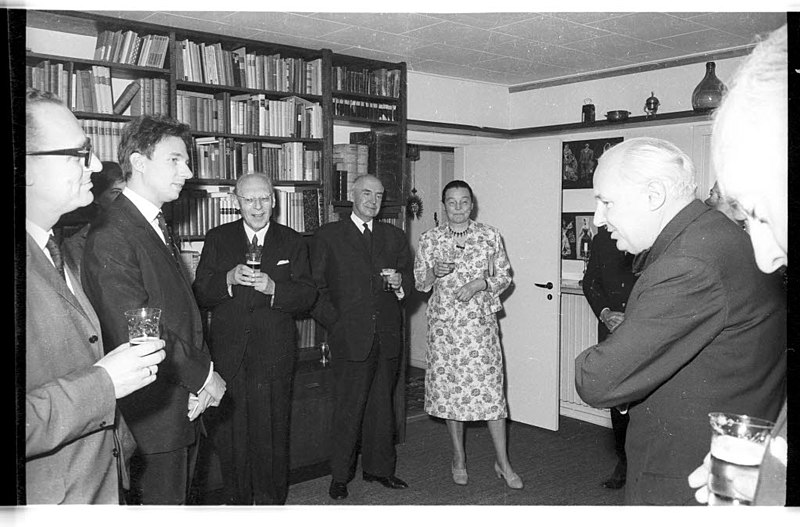
Generalintendant Joachim Klaiber (1.v.r.) spricht vor den Gästen, u.a. Oberbürgermeister Hans Müthling (3.v.r.), Komponist Aribert Reimann (5.v.r.) und der Leiter der Stockholmer Oper Michael Gielen (7.v.r.).
Magnussen, Friedrich (1914-1987) · Stadtarchiv Kiel

Generalintendant Joachim Klaiber (2.v.r.) spricht vor den Gästen, u.a. Komponist Aribert Reimann (6.v.r.) und der Leiter der Stockholmer Oper Michael Gielen (7.v.r.) und Bürgermeister Rudolf Titzck (1.v.r.).
Magnussen, Friedrich (1914-1987) · Stadtarchiv Kiel
Key facts
Key facts
• Name — Michael Gielen • Birth Name — Michael Andreas Gielen • Born — 20 July 1927 • Birthplace — Dresden, Germany • Died — 8 March 2019 • Place of death — Mondsee, Austria • Occupation — * Conductor • Composer • Organization — * Royal Swedish Opera • Oper Frankfurt • Southwest German Radio Symphony Orchestra • Awards — * Hessian Cultural Prize • Theodor W. Adorno Award • Frankfurter Musikpreis • Duisburger Musikpreis • Ernst von Siemens Music Prize • Order of Merit of the Federal Republic of Germany
Early years
Early years
Gielen was born in Dresden to Rose (née Steuermann) and Josef Gielen. His father was a theatre and opera director from 1924 at the Staatstheater Dresden, who staged the premiere of Kaiser/Weill's Der Protagonist at the Semperoper in 1926. His mother Rose came from a Jewish family in Sambor (then Austria-Hungary, now Ukraine). She was an actress who had given up acting when their first child Carola was born, but appeared occasionally, for example as a speaker in the premiere of Arnold Schoenberg's Pierrot lunaire in Dresden in 1919, rehearsed with her brother Eduard Steuermann. The football player Zygmunt Steuermann was their younger brother. The boy Michael first attended a reformed school from 1934 until it was closed by the Nazis. Both children were baptized and raised Catholic to counter Nazi indoctrination. Clemens Krauss called Josef Gielen to the Staatsoper Berlin in 1936, where Michael attended primary school for a year, and then the Kaiserin-Augusta-Gymnasium. When his father's contract was dissolved in 1937, he found a position at the Vienna Burgtheater. The family followed there in 1938. Michael attended a grammar school and took piano lessons. Josef Gielen successfully staged at the Teatro Colón in Buenos Aires, Argentina, in 1938 and 1939, and managed to get immigration papers for his wife and the two children. In 1940, the family left for Argentina, leaving most of their belongings behind.
Career
Career
Gielen began his career as a pianist in Buenos Aires, where he studied with Erwin Leuchter. As a répétiteur at the Teatro Colón at age 20, he played the basso continuo to the recitatives, in the style of the time, in a performance of Bach's St Matthew Passion conducted by Wilhelm Furtwängler. In 1949, he gave an early performance of Arnold Schoenberg's complete piano works. In this period he also shortly studied philosophy. In 1950, Gielen moved to Vienna where his father had become director of the Burgtheater. Michael Gielen was conductor and répétiteur, who conducted at the Wiener Staatsoper from 1954 to 1960, assisting conductors such as Karl Böhm, Herbert von Karajan and Clemens Krauss. He conducted contemporary music outside the opera house. • Illustration — Gielen (right) after the premiere of Ein Traumspiel by Aribert Reimann (centre), June 1965 His next operatic appointment, from 1960, was at the Royal Swedish Opera, where he was Generalmusikdirektor (GMD) for the first time, until 1965. He conducted a production of Stravinsky's The Rake's Progress, which Ingmar Bergman staged as a radicalised Christian Passion (radikalisierte christliche Passion), in the presence of the composer. He took to freelance conducting in 1965, including the premiere of Bernd Alois Zimmermann's opera Die Soldaten in Cologne that year, a work that had been deemed to be impossible to perform. He premiered Aribert Reimann's opera Ein Traumspiel on 20 June 1965 at the Opernhaus Kiel. He then had a contract with the Netherlands Opera. From 1977 to 1987, Gielen was GMD at the Oper Frankfurt, where he worked with the dramaturge Klaus Zehelein towards more contemporary operas. In 1979, he revived Franz Schreker's opera Die Gezeichneten there, which had premiered in Frankfurt in 1918. During his time in Frankfurt, later called the Gielen Era, he collaborated with stage directors such as Hans Neuenfels for Verdi's Aida and Ruth Berghaus for Wagner's Der Ring des Nibelungen. The time was described as the Ära Gielen/Zehelein (Gielen/Zehelein era) and made Frankfurt an internationally recognised opera. Gielen was also principal conductor of the Belgian National Orchestra (1969–73) and the Cincinnati Symphony Orchestra (1980–86). He was from 1986 to 1999 the conductor of the SWR Sinfonieorchester Baden-Baden und Freiburg (Southwest German Radio Symphony Orchestra), and made it known as the leading orchestra for premieres, notably at the Donaueschinger Musiktage. From 1991, he collaborated in Berlin with the Staatsoper Unter den Linden and the Berliner Sinfonie-Orchester (now Konzerthausorchester Berlin). He demonstrated a mastery of the most complex contemporary scores, and conducted many premieres, including Helmut Lachenmann's Fassade and Klangschatten – mein Saitenspiel, György Ligeti's Requiem, and Karlheinz Stockhausen's Carré. He premiered Zimmermann's Requiem für einen jungen Dichter in Düsseldorf in 1969. In 1973 he recorded Schoenberg's opera Moses und Aron, used as a soundtrack for the film Moses und Aron. In October 2014, Gielen announced his retirement from conducting for health reasons, particularly seriously deteriorated eyesight. He died in Mondsee, Austria, on 8 March 2019 of pneumonia.
Places
Named by the record
Places
Only places the record itself states, plotted where the house gazetteer settles their coordinates. Nothing is inferred from a name or a nationality.
Dresden.
Birth place
Mondsee.
Death place
Compositions
Gielen began to compose in 1946, and kept composing throughout his career as a conductor. He was influenced by the tradition of the Second Viennese School, and his small oeuvre includes settings of poems by Paul Claudel, Stefan George, and Pablo Neruda. His die glocken sind auf falscher spur after Hans Arp was premiered in 1970 with soprano Joan Carroll, cellist Siegfried Palm, pianist Aloys Kontarsky, Wilhelm Bruck, Christoph Caskel and the composer at the Saarländischer Rundfunk festival, "Musik im 20.Jahrhundert" His string quartet Un vieux souvenir after Baudelaire's Les Fleurs du mal, composed from 1983, was premiered in 1985 in Cincinnati by the LaSalle Quartet. His compositions are listed by the Akademie der Künste: • 1946 Violin Sonata • 1948 Der Einsame for bass and piano, after Friedrich Nietzsche • 1949 Variations for string quartet • 1950 Chorale variations on "Christus der uns selig macht" • 1954 Musik 1954 for baritone, strings, piano, timpani and trombone • 1959 Variationen für 40 Instrumente, four poems by Stefan George for choir and orchestra • 1960–1963 Pentaphonie "Un dia sobresale" – "Ein Tag tritt hervor" after Pablo Neruda • 1967–1969 die glocken sind auf falscher spur. Melodramen und Zwischenspiele nach Gedichten von Hans Arp • 1971–1974 Mitbestimmungsmodell for orchestra players and a conductor • 1976 Einige Schwierigkeiten bei der Überwindung der Angst for orchestra • 1983 Un vieux souvenir, string quartet • 1988 Pflicht und Neigung for winds, percussion and keyboard instruments • 1989 Rückblick for three cellos • 1991 Sonata for cello solo • 2001 Klavierstück in sieben Sätzen for piano
Recordings
With the SWR, Gielen recorded various symphonies, including a complete cycle of both Mahler and Beethoven, as well as select ones by Brahms. Recordings of later composers include works by Bruckner, Stravinsky, Schoenberg, Berg and Webern; his recording of Moses und Aron is its first commercial stereo recording. Among the many works by modern and contemporary composers he recorded were those by Kagel, Ligeti, Nono, Zimmermann and Rihm. His recordings—and conducting in general—are noted for their relentless precision, exactness and veracity over sentimentality. These characteristics were particularly helpful in performing complex contemporary works.
Awards
• 1985: Hessian Cultural Prize • 1986: Theodor W. Adorno Award • 1999: Frankfurter Musikpreis • 2006: Duisburger Musikpreis • 2010: Ernst von Siemens Music Prize • June 2010: Knight Commander's Cross of the Order of Merit of the Federal Republic of Germany (Großes Verdienstkreuz mit Stern)
Literature
• Michael Gielen: Unbedingt Musik. Erinnerungen. Insel, Frankfurt am Main 2005;. • Michael Gielen, Paul Fiebig: Mahler im Gespräch. Die zehn Sinfonien. Metzler, Stuttgart 2002;.
Notes from the source article
Cited by Wikipedia
Notes from the source article
These works are cited by the source article, in its own numbering. They are recorded as its citations, not as sources VALÉORINE has verified.
- 1.Hutton, Mary Ellyn. Michael Gielen in Good Company. musicincincinnati.com. 23 March 2010.
- 2.Hillebrand, Jörg. Michael Gielen – "Ich ziehe mich zurück". Deutsche Welle. 15 July 2007.
- 3.Zmarł wybitny dyrygent. Miał 91 lat Deutsche Welle (Polish program), 9 march 2019.
- 4.Brachmann, Jan. Zum Tod von Michael Gielen / Der Vision eines Elysiums verweigerte er sich. Faz.net. FAZ. 9 March 2019.
- 5.Jacobi, Johannes. Ein Traumspiel / Oper (nach Strindberg) von Aribert Reimann Stadttheater in Kiel. Die Zeit. 25 June 1965.
- 6.Neuhoff, Bernhard. Dirigent und Komponist / Zum Tod von Michael Gielen. BR. 8 March 2019.
- 7.Peters, Rainer. The Ernst von Siemens Music Prize-Winner Michael Gielen. Ernst von Siemens Musikstiftung. 2010.
- 8.Rockwell, John. Opera: Wagner's 'Ring des Nibelungen' in Nigeria. The New York Times. 28 April 1987.
- 9.Gelfand, Janelle. Conductor Gielen enjoying his reunion with CSO. The Cincinnati Enquirer. 89. 7 April 1995.
- 10.Dietz Krebs, Betty. CSO audiences face director's challenge. Dayton Daily News. 104. 14 September 1980.
- 11.Cooklis, Ray. Michael Gielen Accepts West German Post. The Cincinnati Enquirer. 15. 12 September 1983.
- 12.Michael Gielen beendet Dirigenten-Karriere. WDR (Kulturnachrichten). 30 October 2014.
- 13.Allen, David. Michael Gielen, renowned German conductor, at 91. The Boston Globe. C8. 14 March 2019.
- 14.Allen, David. Michael Gielen, Uncompromising German Maestro, Is Dead at 91. The New York Times. 13 March 2019.
- 15.Roth, Wilhelm. Dirigent, der in Frankfurt einst eine Ära begründete, wird 90 Jahre alt: Unermüdlich trieb Michael Gielen die Moderne voran. Frankfurter Neue Presse. March 2019.
- 16.Schreiber, Wolfgang. Tod von Michael Gielen / Die Wahrheitsliebe der Musik. Süddeutsche Zeitung. 8 March 2019.
- 17.Schwinger, Wolfram. Gielen, Michael. Grove Music Online. Oxford University Press. 2001. 978-1-56159-263-0.
- 18.Michael Gielen. Akademie der Künste. 2019.
- 19.die glocken sind auf falscher spur. Breitkopf & Härtel. 2019.
- 20.Maurer Zenck, Claudia. Michael Gielen. Lexikon verfolgter Musiker und Musikerinnen der NS-Zeit. Universität Hamburg. 2014.
- 21.Schott. Requiem für einen jungen Dichter. 15 December 1969.
- 22.Boisits, Barbara. Gielen, Michael Andreas. Oesterreichisches Musiklexikon online. 2019.
Bibliography printed in the source article · 7
- artist. Michael Gielen.
- Michael Gielen composers21.com
- Michael Gielen (Conductor) Bach Cantatas Website
- Rhein, John von. Taking risks. Chicago Tribune. 57. 13 January 2001.
- Eckle, Georg Albrecht. Der Leuchturm. Der Tagesspiegel. 19 July 2007.
- Koch, Gerhard R. Anti-Schamane / Michael Gielen zum achtzigsten Geburtstag. neue musikzeitung. July 2007.
- Weber, M. Ein Vermittler, ein Missionar. Die Zeit. 12 July 2007.
References
Citations
References
Each reference names the institution holding it, so a reader may go to the document itself.
reference work
Secondary witnessreference work
Secondary witness
The Encyclopedia exists whether or not anything is for sale. Corrections are recorded rather than overwritten, and every version of this record is kept. Published 20 August 2026.
Elsewhere in Music memorabilia
43,117 published records in this field, each with its sources named.
- Michael GarrettPerson
- Michael GarrickPerson
- Michael GarrisonPerson
- Michael GibbsPerson
- Michael GilesPerson
- Michael GlinkaPerson
- Michael GordonPerson
- Michael GorePerson
Best supported in this field
For owners
Own a work by Michael Gielen?
A specialist will read what you send and tell you what the house can establish, what it cannot, and whether the object is suited to sale. There is no charge and no obligation. The object stays with you throughout; nothing is shipped to us unless it is arranged in writing beforehand.