
Hans von Bülow
Freiherr Hans Guido von Bülow (8 January 1830 – 12 February 1894)[1] was a German conductor, pianist, and composer of the Romantic era. Alongside Carl Tausig, Bülow was perhaps the most prominent of the early students of the Hungarian composer, pianist and conductor Franz Liszt; he gave the first public performance of Liszt's Sonata in B minor in 1857. He became acquainted with, fell in love with and eventually married Liszt's daughter Cosima, who later left him for Wagner.
Also recorded as Hans Guido Freiherr von Bülow · Guido von Bülow
Hans von Bülow
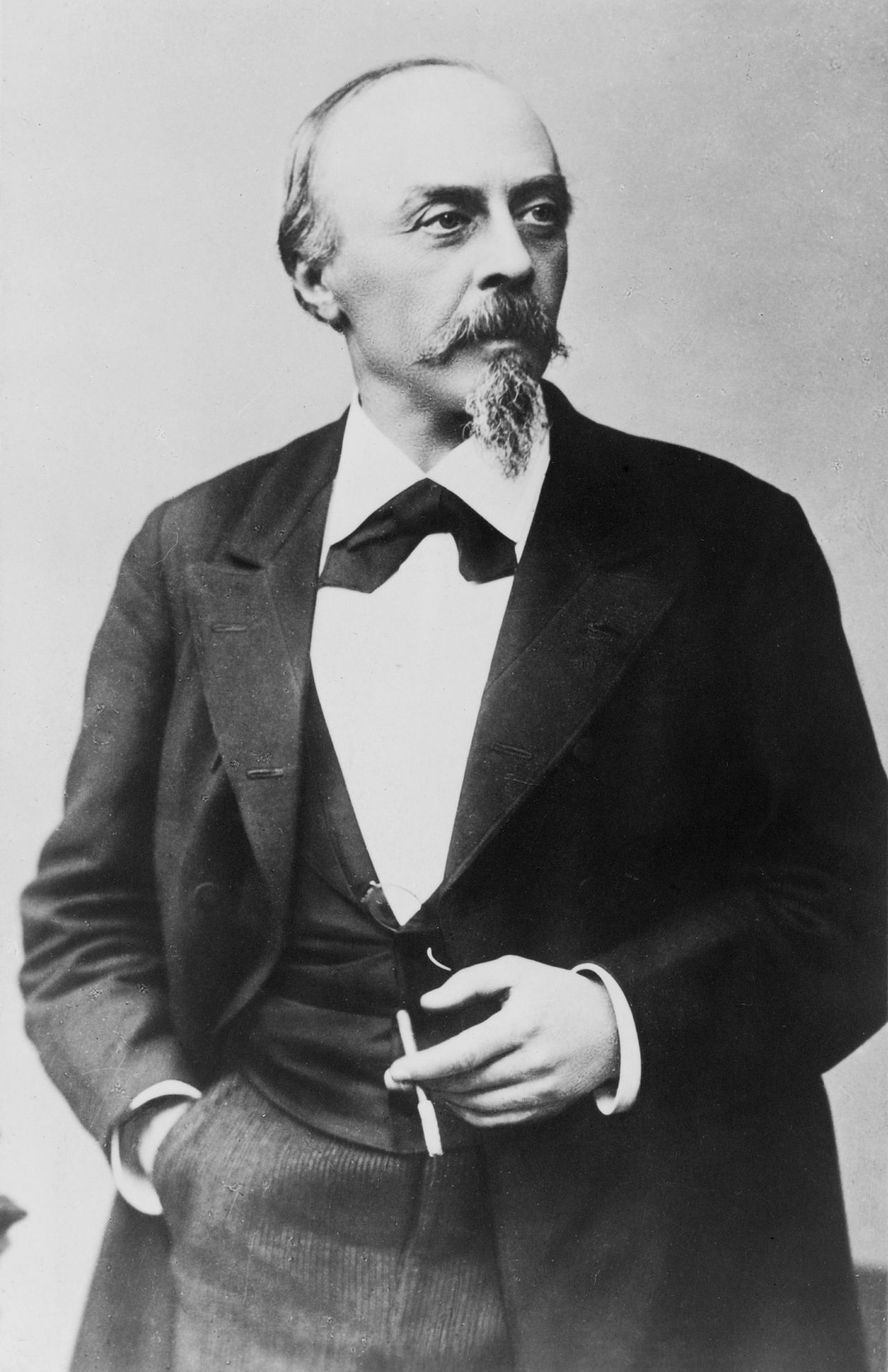
E. Bieber · This image is available from the United States Library of Congress 's Prints and Photographs division under the digital ID cph.3c03945. This tag does not indicate the copyright status of the attached · Public domain
- Name
- Hans von Bülow
- Birthplace
- Dresden
- Died
- 12 February 1894
- Place of death
- Cairo, Egypt
- Occupation
- * Conductor
- Spouse
- * Cosima Liszt
- Full name
- Hans Guido von Bülow.
- Born
- 1830. · Dresden.
- Nationality
- Kingdom of Saxony.
- Fields
- conducting, piano performance and music.
- Education
- Leipzig University.
- Teachers
- Friedrich Wieck and Franz Liszt.
VALÉORINE Encyclopedia
VALÉORINE documentary reading
Documentary summary
Freiherr Hans Guido von Bülow (8 January 1830 – 12 February 1894)[1] was a German conductor, pianist, and composer of the Romantic era. Alongside Carl Tausig, Bülow was perhaps the most prominent of the early students of the Hungarian composer, pianist and conductor Franz Liszt; he gave the first public performance of Liszt's Sonata in B minor in 1857. He became acquainted with, fell in love with and eventually married Liszt's daughter Cosima, who later left him for Wagner.
Admitted source layer · organised and presented by VALÉORINE
Note VALÉORINE
No house-authored Note is published until its assertions and sources pass the VALÉORINE evidence contract. The documentary article remains available in full while that enrichment is being consolidated.
Documentary enrichment in progress · no unsupported statement published
Reference Check
Propose documentary evidence for Hans von Bülow. A contribution is never written directly as fact: identity, source, rights and evidence gates still decide.
Sign in to contribute
World of VALÉORINE
Documentary connections
Only confirmed graph relationships appear here. Images are shown only when their identity and reuse rights both pass the documentary gate.

Documentary evidence
Evidence Panel
not yet certified
- Identity
- resolved
- Independent source families
- 0
- Admitted assertions
- 0
- Open conflicts
- 0
Authority files
wikidata · Q155540 · wikipedia · Hans von Bülow
In this article
Biography
Biography
Noted for his interpretation of the works of Ludwig van Beethoven, he was one of the earliest European musicians to tour the United States.
Hans von Bülow studied at Leipzig University. Training under Friedrich Wieck and Franz Liszt is recorded. Karl Heinrich Barth, Agathe Backer Grøndahl and Asger Hamerik are recorded as having studied under Hans von Bülow. The recorded working language is German. The field of work recorded is conducting, piano performance and music. Subjects and genres recorded for the work are classical music. Places of work recorded in the authority are Prague. Employment is recorded with Klindworth-Scharwenka Conservatory. Distinctions recorded are Royal Philharmonic Society Gold Medal.

Hans von Bülow (1830-1894), german pianist, conductor and composer
Carte de Visite Woodburytype - Print (Repro by/von Günter Josef Radig)
Key facts
Key facts
• Name — Hans von Bülow • Birthplace — Dresden • Died — 12 February 1894 • Place of death — Cairo, Egypt • Occupation — * Conductor • Pianist • Composer • Family — Bülow family • Spouse — * Cosima Liszt • Marie Schanzer
Life and career
Life and career
Bülow was born in Dresden into the old and prominent House of Bülow. He was the son of novelist Karl Eduard von Bülow and his wife, Franziska Elisabeth Stoll von Berneck. From the age of nine, he was a student of Professor Friedrich Wieck (the father of Clara Schumann). However, his parents insisted that he study law instead of music, and they sent him to Leipzig. There he met Franz Liszt, and on hearing some music of Richard Wagner—specifically, the premiere of Lohengrin in 1850—he decided to ignore the dictates of his parents and make himself a career in music instead. He studied the piano in Leipzig with the famous pedagogue Louis Plaidy. He obtained his first conducting job in Zürich, on Wagner's recommendation, in 1850. Bülow had a strongly acerbic personality and a sharp tongue; this alienated many musicians whom he worked with. He was dismissed from his Zurich job for this reason, but at the same time he was beginning to win renown for his ability to conduct new and complex works without a score. In 1851, he became a student of Liszt, marrying his daughter Cosima in 1857. They had two daughters: Daniela, born in 1860, and Blandina, born in 1863. During the 1850s and early 1860s he was active as a pianist, conductor, and writer, and became well known throughout Germany as well as Russia. In 1857, he premiered Liszt's Piano Sonata in B minor in Berlin. • Illustration — Undated portrait of Hans von Bülow In 1864 he became the Hofkapellmeister in Munich, and it was at this post he achieved his principal renown. He conducted the premieres of two Wagner operas, Tristan und Isolde and Die Meistersinger von Nürnberg, in 1865 and 1868 respectively; both were immensely successful. Meanwhile, however, Cosima had been carrying on an affair with Richard Wagner and gave birth to their daughter Isolde in 1865. Two years later, they had another daughter, Eva. Although Cosima and Wagner's affair was now open knowledge, Bülow still refused to grant his wife a divorce. It was only when she gave birth to a third child, Siegfried, that the conductor at last relented. Their divorce was finalized in 1870, after which Cosima and Wagner married. Bülow never spoke to Wagner again, and he did not see his former wife for 11 years afterwards. However, he apparently continued to respect the composer on a professional level, as he still conducted his works and mourned Wagner's death in 1883. In July 1882 he married the actress Marie Schanzer. In 1867 Bülow became director of the newly reopened Königliche Musikschule in Munich. He taught piano there in the manner of Liszt. He remained as director of the Conservatory until 1869. Bülow's students in Berlin included Asger Hamerik and Joseph Pache. In addition to championing the music of Wagner, Bülow was a supporter of the music of Brahms and Tchaikovsky. He was the soloist in the world premiere of the Tchaikovsky Piano Concerto No. 1 in B-flat minor in Boston in 1875. He was also a devotee of Frédéric Chopin's music; he came up with epithets for all of Chopin's Opus 28 Preludes,[2] but these have generally fallen into disuse. Only the D-flat major Prelude No. 15 is widely known by his title, the "Raindrop".[3] He was the first to perform (from memory) the complete cycle of Beethoven's piano sonatas,[4] and with Sigmund Lebert, he co-produced an edition of the sonatas. • Illustration — Hans von Bülow, c. 1889 For the winter season of 1877–1878, he was appointed as conductor of the orchestral subscription concerts presented at the newly opened St Andrew's Hall in Glasgow by Glasgow Choral Union, touring with their orchestra to repeat these programmes in other Scottish cities. Among the works he conducted there was the recently revised version of Brahms Symphony No 1. From 1878 to 1880, he was Hofkapellmeister in Hanover but was forced to leave after fighting with a tenor singing the "Knight of the Swan [Schwan]" role in Lohengrin; Bülow had called him the "Knight of the Swine [Schwein]". In 1880 he moved to Meiningen where he took the equivalent post, and where he built the Meiningen Court Orchestra into one of the finest in Germany; among his other demands, he insisted that the musicians learn to play all their parts from memory. It was during his five years in Meiningen that he met Richard Strauss (though the meeting actually took place in Berlin). His first opinion of the young composer was not favorable, but he changed his mind when he was confronted with a sample of Strauss's "Serenade". Later on, he used his influence to give Strauss his first regular employment as a conductor.[5] Like Strauss, Bülow was attracted to the ideas of Max Stirner, whom he reputedly had known personally. In April 1892 Bülow closed his final performance with the Berlin Philharmonic, where he had been serving as Principal Conductor since 1887, with a speech "exalting" the ideas of Stirner. Together with John Henry Mackay, Stirner's biographer, he placed a memorial plaque at Stirner's last residence in Berlin. Some of his orchestral innovations included the addition of the five-string double bass and the pedal timpani; the pedal timpani have since become standard instruments in the symphony orchestra. His accurate, sensitive, and profoundly musical interpretations established him as the prototype of the virtuoso conductors who flourished at a later date. He was also an astute and witty musical journalist. In the late 1880s he settled in Hamburg, but continued to tour, both conducting and performing on the piano. Bülow suffered from chronic neuralgiform headaches, which were caused by a tumor of the cervical radicular nerves.[8] After about 1890 his mental and physical health began to fail, and he sought a warmer, drier climate for recovery; he died in a hotel in Cairo, Egypt, at the age of 64, ten months after his final concert performance.
As conductor
As conductor
• Wagner, Tristan und Isolde, Munich, 10 June 1865 • Wagner, Die Meistersinger von Nürnberg, Hofoper, Munich, 21 June 1868
As pianist
As pianist
• Beethoven, complete cycle of piano sonatas • Liszt, Sonata in B minor, Berlin, 22 January 1857 • Liszt, Totentanz for Piano and Orchestra, The Hague, 15 April 1865 • Tchaikovsky, Piano Concerto No. 1, Boston, 25 October 1875
Piano transcriptions
Piano transcriptions
• Christoph Willibald Gluck – Iphigenie in Aulis • Richard Wagner: • Tristan und Isolde • Overture from Die Meistersinger von Nürnberg • Paraphrase of the quintet from Act III of Die Meistersinger • Faust Overture • Carl Maria von Weber: • Konzertstück in F minor • Both piano concertos
Identity and origins
Identity and origins
The authorities additionally record the headings Hans Guido Freiherr von Bülow and Guido von Bülow. His recorded language was German. He was the child of Karl Eduard von Bülow and Franciska Stoll. He married Cosima Wagner and Marie von Bülow. 2 children are recorded: Daniela von Bülow and Blandine Gravina.
Life and career
Dated record
Life and career
Explore 1830–1896
The full dated record · 4 entries
1830
Hans von Bülow born at Dresden.
1859
Hans von Bülow und die Berliner Kritik Ein Beitrag zur Zeitgeschichte. P. R. F. Bülow, Hans v (1859) is digitised and catalogued by Internet Archive.
1894
Hans von Bülow died at Cairo.
1896
The early correspondence of Hans von Bulow is dated 1896.
Places
Named by the record
Places
Only places the record itself states, plotted where the house gazetteer settles their coordinates. Nothing is inferred from a name or a nationality.
Dresden.
Birth place
Cairo.
Death place
Compositions
• 6 Lieder, Op. 1 • Rigoletto-Arabesken, Op. 2 • Mazurka-Impromptu. Op. 4 • 5 Lieder, Op. 5 • Invitation à la Polka, Op. 6 • Rêverie fantastique, Op. 7 • Song cycle Die Entsagende, Op. 8 • Overture and March to Shakespeare's Julius Caesar, Op. 10 • Ballade, Op. 11 • Chant polonais (after F. H. Truhn), Op. 12 • Mazurka-Fantasie, Op. 13 • Elfenjagd. Impromptu, Op. 14 • Des Sängers Fluch, Ballad for orchestra, Op. 16 • Rimembranze dell'opera Un ballo in maschera, Op. 17 • Trois Valses caractéristiques, Op. 18 • Tarantella, Op. 19 • Nirvana: symphonisches Stimmungsbild, Op. 20 • Il Carnevale di Milano, piano, Op. 21 • Vier Charakterstücke, orchestra, Op. 23 • Two Romances, Op. 26 • Lacerta. Impromptu, Op. 27 • Königsmarsch, Op 28 • 5 Gesänge for mixed choir, Op. 29 • 3 Lieder von August Freiherrn von Loen, Op. 30
Notes from the source article
Cited by Wikipedia
Notes from the source article
These works are cited by the source article, in its own numbering. They are recorded as its citations, not as sources VALÉORINE has verified.
- 1.Hans von Bulow. Encyclopædia Britannica.
- 2.ChopinMusic.net.
- 3.The complete list of titles is given in .
- 4.Carnegie Room Concerts ; the next pianist to do so would be Artur Schnabel in 1927. Naxos
- 5.Marek, George R. Richard Strauss – The Life of a Non-Hero. Gollancz. 52. 1967. 0-575-01069-X.
- 6.Ross, Alex. Beethoven Unbound. The New Yorker. 14 October 2001.
- 7.Ideas of Max Stirner. The New York Times. 19. 20 April 1907.
- 8.Wöhrle J, Haas F, "Hans von Bülow: Creativity and Neurological Disease in a Famous Pianist and Conductor", in Bogousslavsky J, Hennerici MG (eds): Neurological Disorders in Famous Artists – Part 2. Front Neurol Neurosci. Basel, Karger, 2007, vol. 22, pp. 193–205
Bibliography printed in the source article · 3
- Fifield, Christopher. Bülow, Hans (Guido) Freiherr von. 2013.
- Holden, Raymond. The Virtuoso Conductors: The Central European Tradition from Wagner to Karajan. Yale University Press. 2005. 0-300-09326-8.
- Walker, Alan. Hans von Bülow: A Life and Times. Oxford University Press. 2009. 978-0-19-536868-0.
References
Citations
References
Each reference names the institution holding it, so a reader may go to the document itself.
reference work
Partially resolvedreference work
Partially resolved
Further particulars
Held on the record
Further particulars
Open the remaining particulars
Hans von Bülow studied at Leipzig University. He trained under Friedrich Wieck and Franz Liszt. Each of those relationships is stated by the authority record rather than inferred from style.
Hans von Bülow worked in conducting, piano performance and music. He was employed by Klindworth-Scharwenka Conservatory. He belonged to Berlin Philharmonic. He worked at Prague. Recorded as composer, pianist, conductor, music educator and piano teacher. Recorded at birth as Hans Guido von Bülow.
Career and activity
The Encyclopedia exists whether or not anything is for sale. Corrections are recorded rather than overwritten, and every version of this record is kept. Published 14 August 2026.
Elsewhere in Music memorabilia
42,307 published records in this field, each with its sources named.
- Hans UlrikPerson
- Hans van HemertPerson
- Hans VogtPerson
- Hans von BendaPerson
- Hans von KoesslerPerson
- Hans von RokitanskyPerson
- Hans VonkPerson
- Hans W. BrimiPerson
Best supported in this field
For owners
Own a work by Hans von Bülow?
A specialist will read what you send and tell you what the house can establish, what it cannot, and whether the object is suited to sale. There is no charge and no obligation. The object stays with you throughout; nothing is shipped to us unless it is arranged in writing beforehand.