
Mauser 1918 T-Gewehr
The Tankgewehr M1918 (Tankgun), also known as the Mauser 13mm anti-tank rifle and T-Gewehr in English, is a German anti-tank rifle —the first rifle designed for the sole purpose of destroying armored targets—and the only anti-tank rifle to see service in World War I. Approximately 16,900 were produced.
Mauser 1918 T-Gewehr
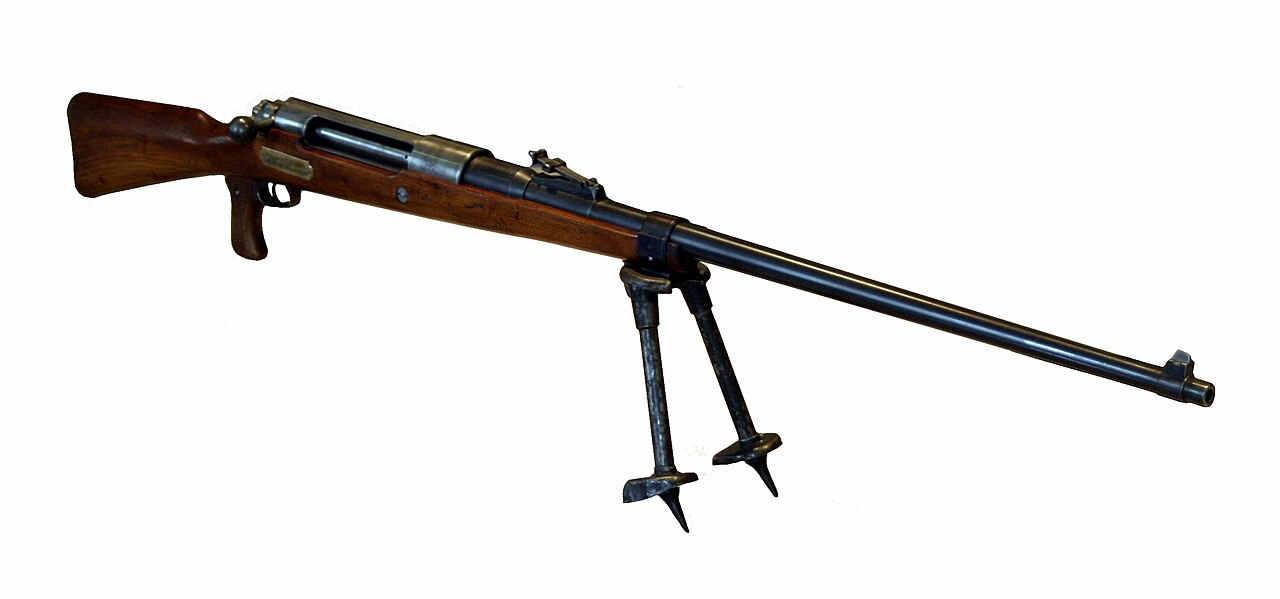
Rama · CC BY-SA 2.0 fr
- Name
- Mauser Mod. 1918 13.2 mm Tankgewehr
- Field
- anti-tank rifle
- Region
- German Empire
VALÉORINE Encyclopedia
VALÉORINE documentary reading
Documentary summary
The Tankgewehr M1918 (Tankgun), also known as the Mauser 13mm anti-tank rifle and T-Gewehr in English, is a German anti-tank rifle —the first rifle designed for the sole purpose of destroying armored targets—and the only anti-tank rifle to see service in World War I. Approximately 16,900 were produced.
Admitted source layer · organised and presented by VALÉORINE
Reference Check
Propose documentary evidence for Mauser 1918 T-Gewehr. A contribution is never written directly as fact: identity, source, rights and evidence gates still decide.
Sign in to contribute
World of VALÉORINE
Documentary connections
Only confirmed graph relationships appear here. Images are shown only when their identity and reuse rights both pass the documentary gate.

Documentary evidence
Documentary basis
Authority files
wikidata · Q428119
In this article
Key facts
Key facts
• Name — Mauser Mod. 1918 13.2 mm Tankgewehr • Origin — German Empire • Type — Anti-tank rifle Anti-materiel rifle • Is Ranged — yes • Service — 1918–1933 • Used By — * German Empire • Weimar Republic • Sweden • Republic of the Rif • Wars — * World War I • German Revolution of 1918–1919 • Rif War • Manufacturer — Mauser • Production Date — January 1918 – April 1919 • Number — 16,900 • Variants — M1918 shortened Magazine-fed • Weight — 15.9 kg, 18.5 kg loaded with the bipod • Length — 169.1 cm • Part Length — 98.4 cm • Crew — two-man crew • Cartridge — 13.2 mm TuF (Tank und Flieger) • Caliber — 13.2 mm (.525 inches) • Action — bolt-action • Rate — single-shot • Range — 500 m • Feed — manual • Sights — 100–500 m (notched V) • Velocity — 780 m/s
History
History
During the First World War the onset of static, trench warfare saw the rise in the use of armour plate for personal defense, and the development and use of armour-piercing ammunition to counter this. Both Britain and Germany used high-powered rifles, such as elephant guns from their African colonies, for this purpose. The first use of armoured fighting vehicles (tanks) was by the British at the Battle of Flers–Courcelette in September 1916 and were followed by the French. By June 1917, the German Army faced the Mark IV tank, and found that the standard armour-piercing 7.92 mm K bullet was no longer effective. This prompted the development by the Germans of a heavy-calibre and high-velocity rifle as an anti-tank weapon. The makers of the gun were inspired by weapons used to hunt African big game, like the elephant gun. The Mauser Company responded with the 13mm T-gewehr and began mass production at Oberndorf am Neckar in May 1918. The first of these off the production lines were issued to specially raised anti-tank detachments. 14,700 T-Gewehrs were produced before the Armistice, and production ceased in April 1919. Approximately 1,490 were produced after the cessation of hostilities.
Operation
Operation
The rifle was a single-shot bolt-action rifle using a modified Mauser action, with rounds manually loaded into the chamber. The weapon had a pistol grip and bipod, but no method of reducing recoil, such as a soft buttpad or muzzle brake. This could cause problems for the shooter with repeated firing. The iron sights were composed of a front blade and tangent rear, graduated in 100-meter increments from 100 to 500 meters. The rifle was operated by a two-man crew of a gunner and ammunition bearer, who were both trained to fire the weapon. Due to the tremendous blunt force of the recoil, it was designed to be shot in a static position, either prone or from inside a trench. • Illustration — Imperial German Army soldiers firing a Mauser 1918 T-Gewehr
Post-war service
Post-war service
The United States Army tested the T-Gewehr after the war, as did the other Allied Powers. Poland obtained a few T-Gewehrs during border skirmishes at the German border in 1920. The Reichswehr kept some M1918s in service into the 1930s (805 were in the secret arsenals of the Reichswehr in 1925). Sweden bought a number from Germany, and used them under the designation Pansarvärnsgevär m/21. During the Rif War, the Rifian rebels obtained some smuggled Mauser 1918s to counter the Spanish Renault and Schneider tanks. In 1939, a Soviet team led by V.N. Shokolov retro-engineered the T-Gewehr, modified to fire the Soviet 12.7×108mm B-32 bullets. Small numbers were hand-produced by the Bauman Institute in the emergency of July 1941. After the Winter War, Finland bought 100 T-Gewehr from Great Britain but they were never used and Finland scrapped them in 1944.
Cartridge
Cartridge
• Illustration — Comparison of a standard.303 British rifle cartridge and a 13.2 mm T-Gewehr cartridge The armour-piercing hardened steel cored 13.2×92mm (.525-inch) semi-rimmed cartridge, often simply called "13 mm", was originally planned for a new, heavy Maxim MG.18 water-cooled machine gun, the Tank und Flieger (TuF) meaning for use against "tank and aircraft", which was under development and to be fielded in 1919. The rounds weighed 51.5 g (795 gn) with an initial velocity of 785 m/s. • Range — Penetration @ 90° • 100 m — 26 mm • 200 m — 23.5 mm • 400 m — 21.5 mm • 500 m — 18 mm
Surviving examples
Surviving examples
Examples of the Mauser 1918 anti-tank rifle can be found in several museums: • Argentina • Museo de Armas, Circulo Militar, Buenos Aires • Museo de Armas, Colegio Militar de la Nación, El Palomar • Museo de la Ciudad, San Carlos de Bariloche • Australia • Army Museum Bandiana in Wodonga • Queensland Museum, Brisbane • Mialls Gun Shop, Melbourne • Australian War Memorial, Canberra • Rocky Hill War Memorial, Goulburn • Austria • Museum of Military History, Vienna • Belgium • In Flanders Fields Museum, Ypres • In Royal Museum of the Armed Forces and Military History, Brussels • Passchendaele Museum, Zonnebeke • Canada • On display in the lobby of the McGill club, Montreal, being the gift made in 1919 by a Canadian general • The Officers and Non-Commissioned Officers Mess of the South Alberta Light Horse in Medicine Hat, Alberta • The Officers Mess of the Barrack Green Armories in Saint John, New Brunswick • China • In Huaihai Campaign Commemoration Hall, Xuzhou City, Jiangsu Province • France • The Musée de l'Armée at the Invalides, Paris • The Batterie Todt museum near Cape Gris Nez • Germany • Herzog Anton Ulrich Museum in Braunschweig • Museum im Schwedenbau in Oberndorf am Neckar • Italy • The National Museum of Artillery in Turin • Latvia • Latvian War Museum • Luxembourg • National Museum of Military History in Diekirch • United Kingdom • Lancashire Infantry Museum, Preston • Imperial War Museum, London • Canterbury Heritage Museum Canterbury • King's Own Royal Border Regiment museum • 22nd Cheshire Regiment museum • Royal Armouries Museum in Leeds • Norwich Castle Museum, Norwich • Redoubt Fortress and Museum, Eastbourne • King's Shropshire Light Infantry museum, Shrewsbury castle • Norris Museum, St Ives, Huntingdonshire • Heugh Battery Museum, Hartlepool • Worcester Art Gallery And Museum, Worcester. • Royal Ulster Rifles Museum, Belfast • United States • U.S. Army Armor & Cavalry Collection, Fort Benning • The National World War I Museum and Liberty Memorial in Kansas City, Missouri • NRA National Firearms Museum in Fairfax, Virginia • Woodrow Wilson Presidential Library, Staunton, Virginia • Iowa Gold Star Military Museum, Camp Dodge, Iowa • Maryland Museum of Military History in Baltimore, Maryland • North Dakota Heritage Center in Bismarck, North Dakota • Clark Brothers gun store Opal Virginia • Klamath County Museums in Klamath Falls, Oregon • International Ordnance Museum in St Jo, Texas • National Museum of the Marine Corps in Quantico, Virginia • Virginia War Museum in Newport News, Virginia
Chronology
Dated record
Chronology
Explore 1918
The full dated record · 5 entries
1918
Mauser 1918 T-Gewehr is classified as an anti-tank rifle.
1918
Mauser 1918 T-Gewehr is associated with German Empire.
1918
Mauser 1918 T-Gewehr is recorded as a kind of anti-tank rifle.
1918
Mauser 1918 T-Gewehr is recorded as weapon model.
1918
Mauser 1918 T-Gewehr was manufactured by Mauser.
Notes from the source article
Cited by Wikipedia
Notes from the source article
These works are cited by the source article, in its own numbering. They are recorded as its citations, not as sources VALÉORINE has verified.
- 1.Robert Ball. Mauser Military Rifles of the World, 5th Edition. Gun Digest Books. 193. 2011. 978-1-4402-1544-5.
- 2.Ball, Robert M. Mauser Military Rifles of the World (Mauser Military Rifles of the World). Gun Digest Books. 183. 2006. 978-0-89689-296-5.
- 3.Stephen Bull. Encyclopedia of military technology and innovation. Greenwood Publishing Group. 15. 2004. 978-1-57356-557-8.
- 4.WW1 Anti-Tank rifles.
- 5.Grant, Neil. Mauser Military Rifles. Osprey Publishing. 41. 20 Mar 2015. 978-1-4728-0594-2.
- 6.Sverige Mall.
- 7.Charpentier, Loïc. Des chars au Maroc: Renault FT et Schneider espagnols dans la campagne du Rif. Batailles et Blindés. Caraktère. 65. 72–81. February 2015.
- 8.Johnson, Melvin M. Jr. Rifles and Machine Guns. William Morrow & Company. 384. 1944.
- 9.Natzvaladze, Yury. The Trophies Of The Red Army During The Great Patriotic War 1941–1945. Volume 1. Land O'Sun Printers. 9. 1996.
- 10.Mauser T-Gewehr Anti Tank Rifle. Australian War Memorial.
- 11.Goulburn Post. Rocky Hill war items 'nationally significant'. December 2015.
References
Citations
References
Each reference names the institution holding it, so a reader may go to the document itself.
reference work
Secondary witness
Connections
Knowledge graph
Connections
Each connection was recorded deliberately, with the basis for it kept on the internal record.
Broader subject
1- anti-tank rifleTerminology
Established from a fact already recorded on a verified source.
Place
1- German EmpirePlace
Established from a fact already recorded on a verified source.
Further particulars
Held on the record
Further particulars
Open the remaining particulars
Mauser 1918 T-Gewehr is connected to 1 other published record in the VALÉORINE Encyclopedia.
Within the Encyclopedia
The Encyclopedia exists whether or not anything is for sale. Corrections are recorded rather than overwritten, and every version of this record is kept. Published 16 August 2026.
Elsewhere in Militaria
6,095 published records in this field, each with its sources named.
- Matra R.550 MagicTerminology
- maulstickTerminology
- Mauser 1909Terminology
- Mauser 1914Terminology
- Mauser BK 27Terminology
- Mauser C96Terminology
- Mauser HScTerminology
- Mauser M 98Terminology
Best supported in this field
For owners
Own an object connected with Mauser 1918 T-Gewehr?
A specialist will read what you send and tell you what the house can establish, what it cannot, and whether the object is suited to sale. There is no charge and no obligation. The object stays with you throughout; nothing is shipped to us unless it is arranged in writing beforehand.