
Stielhandgranate
"Stick hand grenade") is a series of World War I and World War II–era German hand grenade designs, also known as the Potato masher (Kartoffelstampfer), Doorknocker (Türklopfer), or Jam-pot and stick grenade (by the British in WWI). The first models were introduced by the Imperial German Army during World War I and the final design was introduced during World War II by the German Wehrmacht.
Stielhandgranate
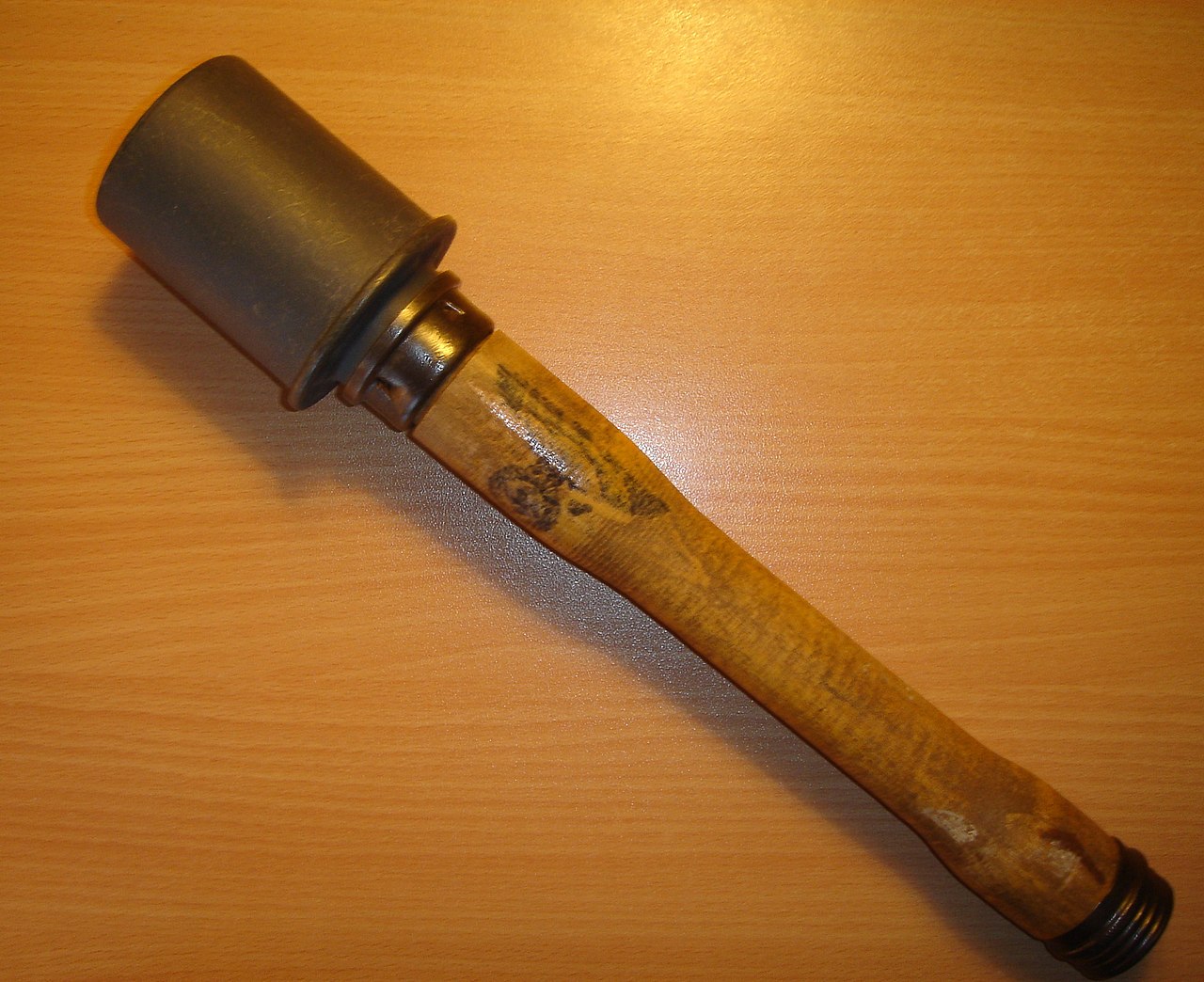
Quickload at English Wikipedia · Public domain
- Name
- Stielhandgranate
- Field
- hand grenade
- Period
- 1915
- Region
- German Empire
VALÉORINE Encyclopedia
VALÉORINE documentary reading
Documentary summary
"Stick hand grenade") is a series of World War I and World War II–era German hand grenade designs, also known as the Potato masher (Kartoffelstampfer), Doorknocker (Türklopfer), or Jam-pot and stick grenade (by the British in WWI). The first models were introduced by the Imperial German Army during World War I and the final design was introduced during World War II by the German Wehrmacht.
Admitted source layer · organised and presented by VALÉORINE
Note VALÉORINE
No house-authored Note is published until its assertions and sources pass the VALÉORINE evidence contract. The documentary article remains available in full while that enrichment is being consolidated.
Documentary enrichment in progress · no unsupported statement published
Reference Check
Propose documentary evidence for Stielhandgranate. A contribution is never written directly as fact: identity, source, rights and evidence gates still decide.
Sign in to contribute
World of VALÉORINE
Documentary connections
Only confirmed graph relationships appear here. Images are shown only when their identity and reuse rights both pass the documentary gate.


Documentary evidence
Evidence Panel
not yet certified
- Identity
- resolved
- Independent source families
- 0
- Admitted assertions
- 0
- Open conflicts
- 0
Authority files
wikidata · Q697655 · wikipedia · Stielhandgranate
In this article
Key facts
Key facts
• Name — Stielhandgranate • Type — Hand grenade • Origin — German Empire • Is Explosive — yes • Service — 1915–1945 (Germany) • Used By — See Stielhandgranate • Wars — * World War I • Spanish Civil War • Second Sino-Japanese War • World War II • Cold War • Design Date — 1915–1943 • Production Date — 1915–1945 • Variants — See Stielhandgranate • Spec Label — Stielhandgranate 15 • Filling — Ammonal • Detonation — 5.5 or 7 seconds timer
Background
Background
Germany entered World War I with a single standard grenade type, the Kugelhandgranate. These grenades were heavy, weighing in 1 kg each and could not be thrown farther than 15-20 m, leading to demands for a lighter alternative.
Hairbrush grenade
Hairbrush grenade
Early in the war, German soldiers made use of improvised stick grenades commonly known as the 'hairbrush grenade', which were thought as having a longer throwing range and improved accuracy over the Kugelhandgranate, which would lead to the development of the introduction of the first Stielhandgranate in 1915, though these stopgaps (also known as the 'paddle grenade') remained in use until 1916. The German hairbrush grenade was a metal box filled with explosives and nailed to a wooden handle with a spring igniter, fuze, and detonator similar to the ones used on the Stielhandgranate. The early versions of these crude grenades had to be lit by hand (often with a smoking pipe, cigar or cigarette) before throwing. The British and the French also made their own copies, such as the Grenade No. 12 Hairbrush, and the Pétard Raquette.
Design
Design
The original Stielhandgranate 15 relied on its blast effect, which had an effective radius of on open field. The warhead was made of a thin sheet of steel approximately long with a diameter of and a metal clip to allow soldiers to carry the complete grenade on their belts, though soldiers frequently carried them inside empty sandbags tied in pairs and slung around the neck. The explosive filler composition varied among the various private manufacturers contracted by the government, usually black powder, potassium perchlorate, barium nitrate, or ammonium nitrate mixed with aluminium powder before they were replaced in 1916 with TNT. The warhead was usually coated with paraffin wax to provide some degree of waterproofing and was mounted on a hollow wooden handle long that housed the detonator and pull cord. The complete Stielhandgranate 15 weighted. Subsequent versions featured improved fuses and a screw-cap cover on the detonator pull cord, while the warhead size was reduced. The model 1924 stick grenade used during World War II had a handle long and weighing in It was lighter than its predecessors. The end of the pull cord also had a small porcelain ball attached. • Illustration — Demonstration of a German Stielhandgranate 24, 1946. To arm the grenade, the soldier yanked the pull cord which in turn pulled a rough steel rod through the igniter within the fuse. The rod's abrasive contact would cause sparks and a flame to light, setting the fuse burning. The time delay fuse varied from 5.5 to 7 seconds as marked on the side of the warhead or the handle, although short burning fuses (2–3 seconds) were issued to Stormtroopers. The warhead was stencilled with the reminder Vor Gebrauch Sprengkapsel Einsetzen ("Before use insert detonator"). Percussion fused versions of the Stielhandgranate were introduced in late 1915 with an improved version entering service in 1916. These grenades used a spring-powered plunger that was activated after the warhead hit the ground and had a safety lever fitted on the handle. When the grenade was thrown, the lever flew off arming the grenade. Due to the impact grenades' tendency of failing to explode after landing on mud or on their sides, they were not liked by the troops. In comparison to the British Mills bomb, the Stielhandgranate could be thrown further since the handle imparted extra momentum. While the Mills was more lethal, producing over 700 fragments upon detonation, the stick grenade produced little fragmentation and a louder report, resulting in a greater morale effect. According to Saunders, the morale effect of the stick grenade was no less important than the lethality, since by 1917, the main purpose of the hand grenade became a matter of forcing the enemy into the lethal zone of small arms and machine gun fire.
German service
German service
While the 'stick grenade' or 'potato masher' was possibly the most recognizable of the hand grenades employed by the Germans in World War I, they also employed a large variety of designs during the conflict, including the ball grenade (Kugelhandgranate), egg grenade (Eierhandgranate), and the discus grenade (Diskushandgranate), besides improvised (de) designs using during the early years and closing months of the conflict, with the latter being made out a wide variety of materials such as wood or concrete. These emergency designs would reappear in the late stages of World War II, in Wehrmacht service. • Illustration — German stormtroopers posing with stick grenades, 1917 Unlike the British or the French, all German soldiers received training on grenade throwing, allowing regular riflemen to immediately lob grenades against enemy incursions, with the dedicated grenade thrower squad only entering in action if the riflemen failed to dislodge the enemy raiders. Stormtroopers carried dozens of stick grenades in empty sandbags slung across their chests when leading assaults. The Germans often used the stielhandgranate for assaulting enemy fortifications, where it proved to be effective when detonated within the confines of a trench system, building or bunker. When faced against well-defended positions, stormtroopers taped grenades together into bundle charges and planted them over the enemy parapets or into the slits of concrete bunkers. These improvised charges were also deployed as anti-tank weapons when more powerful weapons weren't available. By 1918, the Stielhandgranate almost completely replaced all other types of grenades used by the Imperial German Army. It was considered as an effective design, though they were heavy and cumbersome to carry.
Austro-Hungarian service
Austro-Hungarian service
• Illustration — Austro-Hungarian stormtroopers with stick grenades, 1917 The Austro-Hungarian Army started the war with several types of domestically produced hand grenades, but their unreliability often resulted in injuries to the thrower. In 1915–16, the army was re-equipped with German-supplied Stielhandgranate and Eierhandgranate grenades, which were more effective and safer to operate than the Austrian designs. In March 1915, the Austro-Hungarians officially issued their own egg grenade and the Rohr stick grenade, a short cast iron cylinder enclosed in a cardboard tube that served as a throwing handle. Austro-Hungarian stormtroopers made effective use of bundle charges to breach enemy barbed wire emplacements and blockhouses, often wiring several grenades together to a plank of wood in order to create stronger charges. Elite assault mountain units scaled mountain peaks to infiltrate enemy positions and overrun them by throwing grenades from above and from the flanks of an enemy mountain outpost.
Variants
Variants
• Illustration — Two WWI-era Stielhandgranate • Stielhandgranate 15 − Introduced in 1915, it had a long handle with a thin steel sheet head long with a diameter of containing of explosive filler: usually black powder, potassium perchlorate, barium nitrate or ammonium nitrate mixed with aluminium powder. The warhead was coated with paraffin wax to provide some degree of waterproofing and a featured a clip to hang on a belt • Stielhandgranate 16 − A modified M1915 with improved fuze and waterproofing, a screw-cap covering the ignition pull cord, and a more powerful trinitrotoluene filling. A variant with a steel handle was commonly known as the Wilhelm • Stielhandgranate 17 − A modified M1916, the steel warhead was reduced in size to a length of and a diameter of. Construction of the head was also changed by using stamped sheet metal instead of crimped steel • Illustration — A Swedish Stielhandgranate 24 (spränghandgranat m/39) • Stielhandgranate 24 − A further refinement of the WWI-era models. The handle is long, while the warhead contained of TNT or (substitute) black powder filling and overall weight of. Maximum throwing range is up to, depending on the strength and skill of the thrower • Illustration — Stielhandgranate 43 with a splitterring fragmentation sleeve • Stielhandgranate 43 − Similar to the M24, but with the pull cord igniter from the Model 39 grenade screwed on top the warhead and fitted with a solid-wood handle. The head of the grenade was fastened to the handle by four screws and could be removed for practice • Nebelhandgranate 39 − Standard smoke grenade with the warhead filled with a chemical mixture to generate white smoke. The composition was powdered zinc and hexachloroethane that was released through eight holes located at the base of the warhead which also had a thin white band painted for identification • Nebelhandgranate 39B − Virtually identical to the Nebelhandgranate 39, but with raised ridges on the handle and thicker white band • Illustration — A Swedish Übungs-Stielhandgranate 24 (övningshandgranat m/39) • Übungs-Stielhandgranate 24 − Dummy grenade for practice. It can be distinguished by the bright-red perforated warhead. It could be outfitted with a special charge that produced a loud report and puff of smoke to simulate an explosion when used. It was also used by Sweden under the designation Övningshandgranat m39 • Behelfs-Handgranate Holz − A last-ditch grenade produced late in the war, it resembled the Model 24, but entirely made of wood. It used the same igniter system, but relied solely on its blast effect • Behelfs Handgranate Beton − An improvised grenade used in the North African campaign, it resembled a M24 but it used a thick concrete warhead filled with of explosives
Derivatives
Derivatives
• China – The Chinese made a wide variety of defensive stick grenades featuring scored, serrated, and smooth warheads while the explosive filling ranged from picric acid, TNT or nitroglycerin mixed with potassium nitrate, or sawdust and Amatol; according to Janes, these grenades produce more dust than fragments while the picric acid grenades are dangerously unstable. • China: Type 67 hand grenade • China: Type 77 hand grenade • Finland: Varsikranaatti m/32 – Finnish stick grenade, it was slightly smaller and lighter than the M24, while it retained the metal clip used on World War I-era models • Finland: Varsikranaatti m/41 − Virtually identical to the m/32, but with the belt clip omitted • Japan: Type 98 stick hand grenade − A Japanese derivative based on the Chinese stick grenades, it was smaller than the Model 24, but it produced more fragments since it used a cast iron warhead thick • Sweden: Spränghandgranat m/43 − Swedish all-metal stick grenade, featuring a more rounded warhead and other minor modifications
Users
Users
The German Stielhandgranate-series has been used in many conflicts, including both world wars. Official and unofficial users of all versions of the Stielhandgranate • User||rowspan=2|Type of service||rowspan=2|Self-manufactured||colspan=5| Type of model in use • Model 1915 — Model 1916 — Model 1917 — Model 1924 — Model 1943 • Official users • German Empire — Full military service • Weimar Republic — Full military service • Nazi Germany — Full military service • Sweden — Full military service • Ottoman Empire — Yildirim Army Group (Stormtroopers) • Republic of China (1912–1949) — German-trained divisions • Unofficial users • Austria-Hungary — Leased/purchased • Kingdom of Hungary (1920–46) — Leased/purchased • Independent State of Croatia —? • Finland — Leased/purchased • Soviet Union — Captured/scavenged • Latvia — Captured/scavenged • France — Captured/scavenged Foreign designs • User||rowspan=2|Type of service||colspan=3| Version • Chinese copies — Type 98 — Type 67 • Empire of Japan — Captured/local design produced • Republic of China (1912-49) — Local design produced • Local design produced • North Vietnam — Leased/purchased

Original Stielhandgranate 1917 (Rope is not original)
Snipersnoop
Chronology
Dated record
Chronology
The full dated record · 2 entries
1915
Stielhandgranate first recorded.
1915
Stielhandgranate is recorded from 1915.
Primary material
Documents and archives
institutional register
- Internet Archive holdings naming Stielhandgranate
Unverified · Internet Archive
- Wikidata, structured authority record Q697655: Stielhandgranate
Unverified · Wikimedia Foundation
reference work
- “Stielhandgranate”, English Wikipedia, consulted as further reading
Reputable secondary · Wikipedia
References
Citations
References
Each reference names the institution holding it, so a reader may go to the document itself.
institutional register
Internet Archive holdings naming StielhandgranateInternet Archive
Partially resolvedreference work
Partially resolvedinstitutional register
Wikidata, structured authority record Q697655: StielhandgranateWikimedia Foundation
Unverified
Connections
Knowledge graph
Connections
Each connection was recorded deliberately, with the basis for it kept on the internal record.
Broader subject
2- hand grenadeTerminology
Established from a fact already recorded on a verified source.
- Model 43 grenadeTerminology
Established from a fact already recorded on a verified source.
The Encyclopedia exists whether or not anything is for sale. Corrections are recorded rather than overwritten, and every version of this record is kept. Published 14 August 2026.
Elsewhere in Militaria
6,095 published records in this field, each with its sources named.
- StG 45(M)Terminology
- STG-556Terminology
- sticky bombTerminology
- sticky foamTerminology
- Stielhandgranate 24Terminology
- stilettoTerminology
- Sting Ray torpedoTerminology
- stinkpotTerminology
Best supported in this field
For owners
Own an object connected with Stielhandgranate?
A specialist will read what you send and tell you what the house can establish, what it cannot, and whether the object is suited to sale. There is no charge and no obligation. The object stays with you throughout; nothing is shipped to us unless it is arranged in writing beforehand.