
Dreyse M1907
The Dreyse Model 1907 is a semi-automatic pistol designed by Louis Schmeisser. The gun was named after Nikolaus von Dreyse, the designer and inventor of the Dreyse Needle Gun. The Waffenfabrik von Dreyse company was acquired by Rheinische Metallwaren & Maschinenfabrik Sömmerda in 1901, although the Dreyse Model pistols were marketed under the Dreyse name.
Dreyse M1907
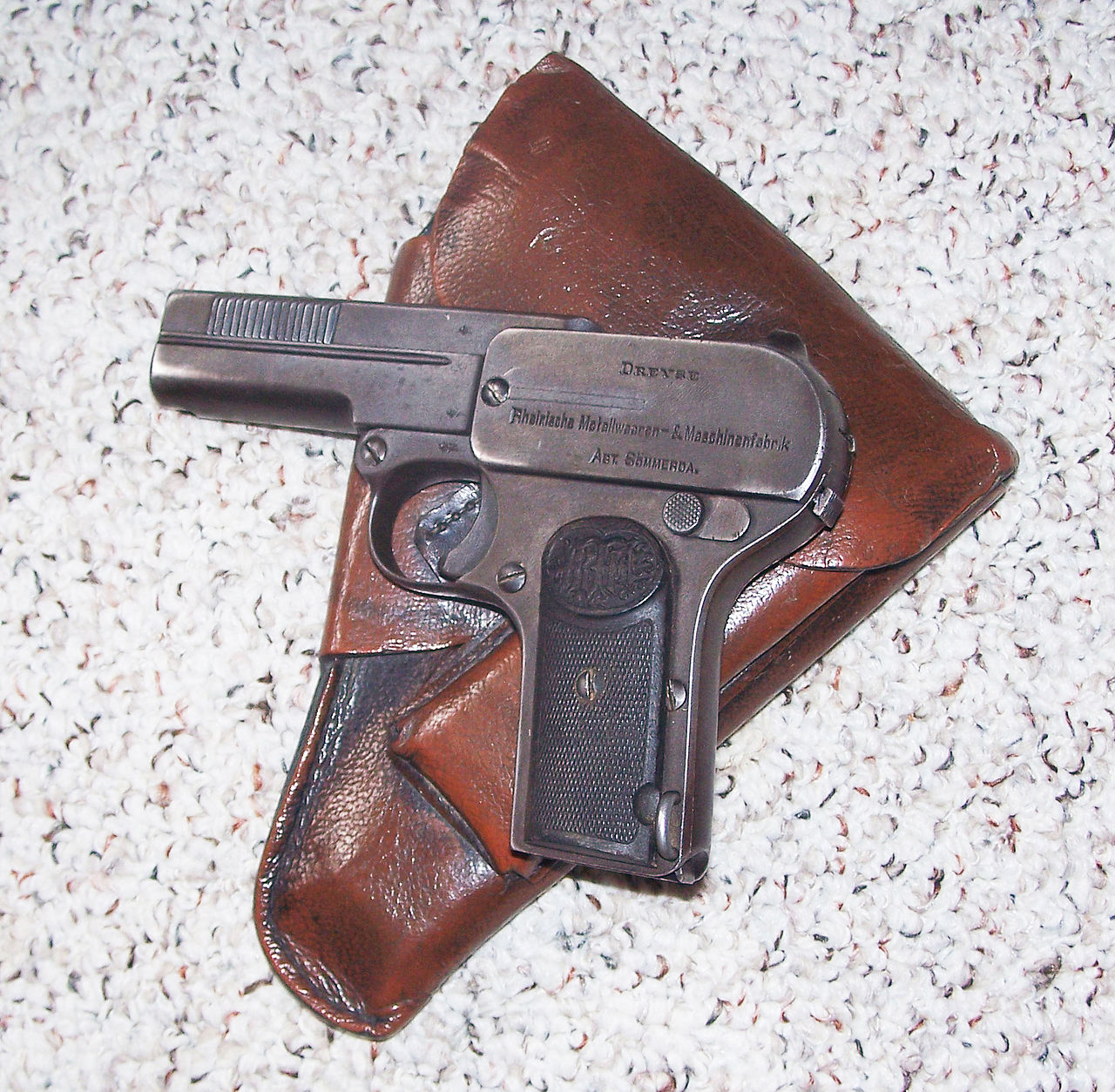
Spencerpklein at en.wikipedia · Spencerpklein at English Wikipedia · CC BY 3.0
- Field
- semi-automatic pistol.
- Region
- German Empire.
VALÉORINE Encyclopedia
VALÉORINE documentary reading
Documentary summary
The Dreyse Model 1907 is a semi-automatic pistol designed by Louis Schmeisser. The gun was named after Nikolaus von Dreyse, the designer and inventor of the Dreyse Needle Gun. The Waffenfabrik von Dreyse company was acquired by Rheinische Metallwaren & Maschinenfabrik Sömmerda in 1901, although the Dreyse Model pistols were marketed under the Dreyse name.
Admitted source layer · organised and presented by VALÉORINE
Note VALÉORINE
No house-authored Note is published until its assertions and sources pass the VALÉORINE evidence contract. The documentary article remains available in full while that enrichment is being consolidated.
Documentary enrichment in progress · no unsupported statement published
Reference Check
Propose documentary evidence for Dreyse M1907. A contribution is never written directly as fact: identity, source, rights and evidence gates still decide.
Sign in to contribute
World of VALÉORINE
Documentary connections
Only confirmed graph relationships appear here. Images are shown only when their identity and reuse rights both pass the documentary gate.

Documentary evidence
Evidence Panel
original value insufficient · checked 25 September 2026
- Identity
- resolved
- Independent source families
- 0
- Admitted assertions
- 0
- Open conflicts
- 0
Authority files
wikidata · Q5307366 · wikipedia · Dreyse M1907
In this article
Dreyse company
Dreyse company
The pistol had an interesting feature for the time: when the gun was ready to fire, the firing pin projected through the back of the breech block, serving as an early handgun-cocking indicator. For cleaning, the frame, receiver and slide pivoted forward on a pin in front of the trigger guard. The pistol and its derivatives (Dreyse Model 1907 Pocket Pistol, Dreyse Model 1912 Parabellum) was of simple blowback recoil operation, though of unusual design. The same company also manufactured a 6.35 mm pocket version (also named Model 1907). In 1912 the 9 mm Parabellum Dreyse Model 1912 emerged as the gun's successor. Marked as the RM & M Dreyse, it was chambered for 9 mm Parabellum. Despite the gun's limited production time, the gun is relatively common today, in large part due to its use by Volkssturm and Volksgrenadier late in World War II, enabling many Allied personnel to bring examples home as war trophies.
The Waffenfabrik von Dreyse was founded around 1841 to manufacture the famous Dreyse Needle gun for the Prussian Army, and they also made needle-pistols and caplock revolvers. The Dreyse Factory went into decline after the German Army adopted the Mauser in 1872. In 1901 Rheinische Metallwaren- & Maschinenfabrik of Sömmerda purchased Waffenfabrik von Dreyse.
Development
Development
The Model 1907 Dreyse pistol was designed by Louis Schmeisser (who had previously worked with Theodor Bergmann on the Bergmann machine gun) in 1905–1906 and were marketed from 1907 onward. The first gun, the 7.65 mm Auto is the most unusual. Most of the cranked slide lies along the top of the barrel, with a short section projecting down behind the chamber to serve as the breech block. The breech block is confined within a flat-sided frame with a bridge to carry the back sight and arrest the upper section of the slide. The recoil spring surrounds the barrel, enclosed in the frame and held by a collar engaging the front end of the slide through a spring catch. Pulling back on the finger grips at the front of the slide brings the breech block into view behind the frame. The Dreyse pistol is fired by a striker whose tail protrudes back through the rear of the breech block when the chamber is loaded. The entire top section of the frame and slide can be pivoted on a pin in front of the trigger guard, being locked in the firing position by a catch at the rear of the frame. This final refinement is essential to dismantling; removal of the cranked slide is impossible otherwise. The Dreyse design was strongly influenced by John Browning's FN M1900, though the Browning has its recoil spring above the barrel, while the Dreyse has a concentric recoil spring. Nonetheless, the overall shape is the same, as is the grip angle and surface design, the magazine release, the positioning of the manual safety and the breech blocks.
Design modifications
Design modifications
The only major modification concerned the firing mechanism. Prior to 1915, the cocked striker had been held by the sear before being released by the trigger; pulling the trigger subsequently pushed the striker back before releasing it, compressing the striker spring to a greater extent. Another wartime change involved a recess cut in the top front of the slide to facilitate removal of the recoil-spring retaining bush.
Variants
Variants
Early pistols are marked "Dreyse Rheinische Metallwaren- & Maschinenfabrik ABT. Sommerda" on the left side of the frame and an "RMF" monogram on the grips. Later pistols are usually marked "Dreyse Rheinmetal ABT. Sommerda". A few pistols made in 1914 lack the Dreyse marking. The pistol was also marketed commercially for police forces, including the Royal Saxon Gendarmerie, examples of which are marked as "K. Sachs. Gend."
Military users
Military users
Primarily used by Austrian troops during World War I, especially officers of the Austro-Hungarian Habsburg Empire. Also used by officers of Imperial Germany during World War I. Examples issued to the Imperial German Army will have an acceptance proof above the ejection port on the right as well as the normal Crown N commercial proofs on the left side of the frame and slide near the trigger. Examples saw use by Wehrmacht troops (especially officers) during World War II. Nearing the end of the war many examples were issued to the Volksgrenadiere and Volkssturm, the latter often with so-called "last-ditch" Presstoff holsters. Large numbers of these were brought back to the United States by returning servicemen, which accounts for their availability in the country today. Typically the paper Presstoff holsters have not survived. A few thousand were purchased by the Czechoslovakia military in 1921 and 1922, but they were removed from service in 1923 due to unspecified accidents with them. In 1912 the pope's Swiss Guard acquired thirty of these pistols for use by officers and non-commissioned officers. They remained in service until 1990 when they were replaced by the SIG P225 pistol as the P75. During World War II this pistol found its way to the Norwegian resistance. Quite a few of these pistols have, alongside home-made Sten-guns and illegal radios, been found hidden within the house-walls of Norwegian resistance members and sympathisers. There has not been described any action in Norway with any Dreyse-pistols. As for the unspecified "accidents" with these pistols, the rear latch which holds the hinged upper part, may come loose. If this happens, the striker will move forward and ignite the cartridge. An unconfirmed civilian incident happened in the 1980s, where the shooter pierced his foot with the 7.65 mm as a result of the latch coming loose.
Users
Users
Austria-Hungary Finland German Empire Nazi Germany Lithuania: 110 batches, obtained in 1919-1920 Ottoman Empire Vatican City: 30 batches, replaced by SIG P75
Notable examples
Notable examples
The Deutsches Panzermuseum in Munster, Germany has an M1907 as the first display in its exhibit of German Army sidearms.
In popular culture
In popular culture
The Dreyse M1907 appeared in the earlier versions of the board game Cluedo, mislabelled as a revolver. The "Dreyse 1906" is depicted in Fritz Lang's 1933 film The Testament of Dr. Mabuse by former detective Hofmeister, and is the favorite weapon of the assassin Hardy, to kill Dr. Kramm. After Hardy's death, Inspector Lohmann muses that Hardy must have used the "1906 Dreyse" pistol because he was used to it, even though "these guns have been out of style for a long time." The film was banned in Germany by Joseph Goebbels, and was not shown in Germany until 1951. The M1907 appears as the police service weapon of Inspector Gereon Rath, the male protagonist of the 2017 German limited run series, Babylon Berlin, which is set in the German Weimar Republic.
Places
Named by the record
Places
Only places the record itself states, plotted where the house gazetteer settles their coordinates. Nothing is inferred from a name or a nationality.
German Empire.
Country
Dreyse M1907 is associated with German Empire.
Country
Primary material
Documents and archives
reference work
- “Dreyse M1907”, English Wikipedia, consulted as further reading
Reputable secondary · Wikipedia
authority record
- Wikidata, structured authority record Q5307366: Dreyse M1907
Unverified · Wikidata
Notes from the source article
Cited by Wikipedia
Notes from the source article
These works are cited by the source article, in its own numbering. They are recorded as its citations, not as sources VALÉORINE has verified.
- 1.Wood, J. B. The Gun Digest Book of Automatic Pistols. Gun Digest Books. 303. 2007. 978-0-89689-473-0.
- 2.7.65mm Dreyse Pistol Model 1907. Manowar's Hungarian Weapons & History.
- 3.Wood, J.B. The Gun Digest Book of Firearms Assembly/Disassembly Part I - Automatic Pistols (Pt. 1). Krause Publications. 248. 1999. 0-87341-783-6.
- 4.Oertle, Vincenz. Vom "Remington" zum Sturmgewehr 90 : die Schusswaffen der Päpstlichen Schweizergarde: Geschichte und Bestandesaufnahme. Thesis. 22. 2001. 978-3-908544-44-9.
References
Citations
References
Each reference names the institution holding it, so a reader may go to the document itself.
reference work
Partially resolvedauthority record
Unverified
Connections
Knowledge graph
Connections
Each connection was recorded deliberately, with the basis for it kept on the internal record.
Broader subject
1- semi-automatic pistolTerminology
Established from a fact already recorded on a verified source.
The Encyclopedia exists whether or not anything is for sale. Corrections are recorded rather than overwritten, and every version of this record is kept. Published 14 August 2026.
Elsewhere in Militaria
6,095 published records in this field, each with its sources named.
- DragonfireTerminology
- Dragunov SVUTerminology
- DRDO Glide BombsTerminology
- DRDO Smart Anti-Airfield WeaponTerminology
- Dreyse needle gunTerminology
- drill purpose rifleTerminology
- drop pointTerminology
- Dror light machine gunTerminology
Best supported in this field
For owners
Own an object connected with Dreyse M1907?
A specialist will read what you send and tell you what the house can establish, what it cannot, and whether the object is suited to sale. There is no charge and no obligation. The object stays with you throughout; nothing is shipped to us unless it is arranged in writing beforehand.