
Matthijs Musson
Matthijs Musson (28 October 1598, Antwerp, Spanish Netherlands – 3 November 1678, Antwerp, Spanish Netherlands) was a painter and art dealer based in Antwerp, who played an important role in popularizing artists of the 17th-century Antwerp school by marketing them throughout Europe.
Also recorded as Matthys Musson
Matthijs Musson
Matthijs Musson · Public domain
- Born
- 1598 · Antwerp.
- Nationality
- Southern Netherlands
- Occupation
- painter
VALÉORINE Encyclopedia
VALÉORINE documentary reading
Documentary summary
Matthijs Musson (28 October 1598, Antwerp, Spanish Netherlands – 3 November 1678, Antwerp, Spanish Netherlands) was a painter and art dealer based in Antwerp, who played an important role in popularizing artists of the 17th-century Antwerp school by marketing them throughout Europe.
Admitted source layer · organised and presented by VALÉORINE
Reference Check
Propose documentary evidence for Matthijs Musson. A contribution is never written directly as fact: identity, source, rights and evidence gates still decide.
Sign in to contribute
World of VALÉORINE
Documentary connections
Only confirmed graph relationships appear here. Images are shown only when their identity and reuse rights both pass the documentary gate.
Documentary evidence
Documentary basis
Authority files
wikidata · Q6791663 · wikipedia · Matthijs Musson
In this article
Life
Life
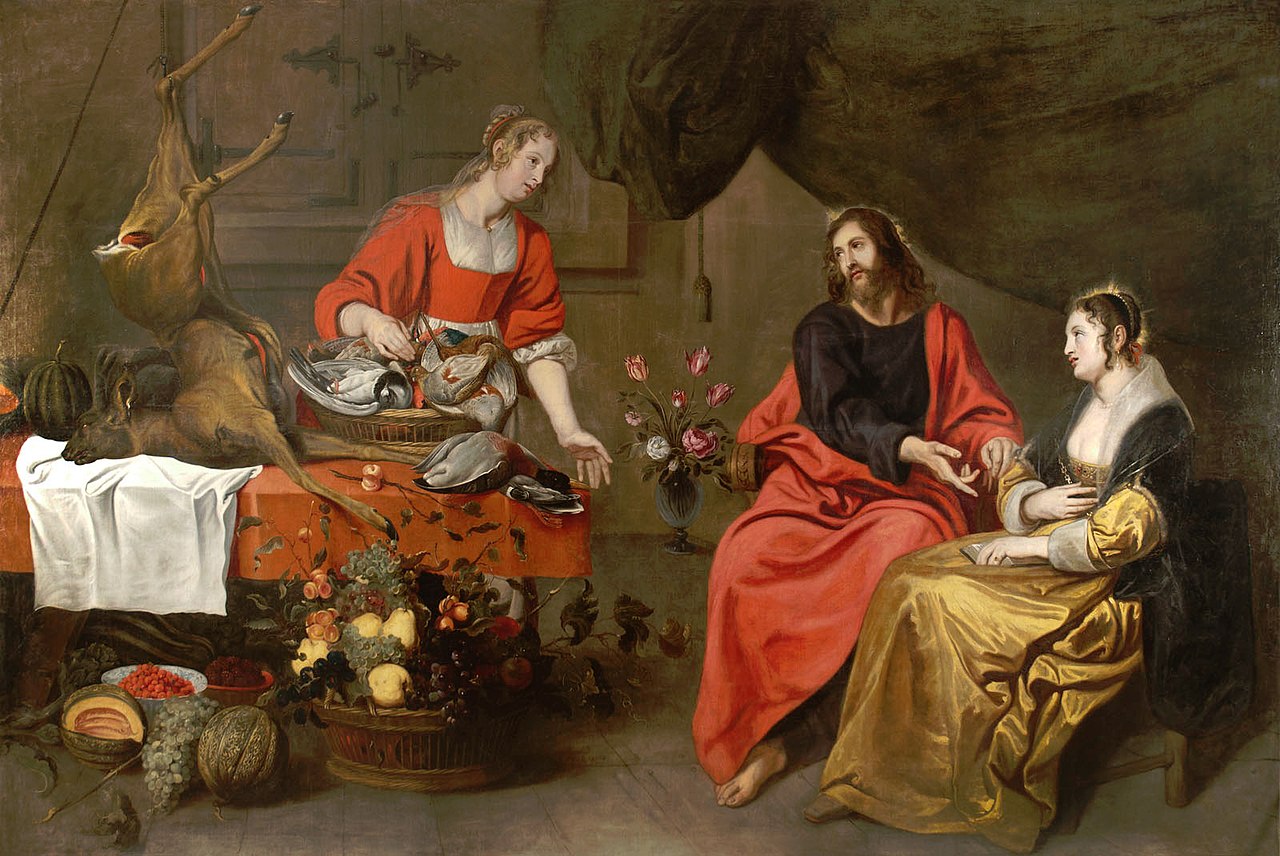
• Illustration — Jesus in the House of Martha and Mary Matthijs Musson was born in Antwerp as the son of Robert Musson, an innkeeper. Matthijs is possibly a pupil in the workshop of Rubens and becomes a master in the Antwerp Guild of Saint Luke in 1622. Matthijs married on 24 February 1632 Maria Borremans who died on 12 May 1646 without issue. In the year 1646-1647 he was deacon of the Antwerp Guild of Saint Luke. Musson remarried on 15 September 1647 Maria Fourmenois who had been widowed two times before. Her last husband was the glass and ebony dealer Cornelis de Wael. After his marriage to Fourmenois, Musson started to deal in art and his wife played an important role in this trading business. Musson had contacts with dealers throughout Europe. In Flanders, he was active mainly in Antwerp and Brussels. About 60 painters worked for Musson and Fourmenois including Joos de Momper, David Teniers the Younger, Abraham Willemsens, Victor Wolfvoet II and Willem van Herp. After discovering that works of painters from Mechelen, a city situated between Brussels and Antwerp, were of high quality and relatively inexpensive he started sourcing from this city. As a trained painter, he did not limit himself to trading. He gave detailed instructions to his artists and for instance paid Pieter van Lint to make changes to a human figure in one of his paintings. In 1657 Matthijs Musson bought the art works from the estate of Frans Snyders, which included great works by Rubens and van Dyck as well as examples by Pieter Bruegel the Elder, Joachim Patinir, Jan Brueghel the Younger, Joos van Cleve, and Frans Ykens. Many of his correspondences have been published and studies of his business relationships with other dealers across Europe have contributed to an understanding of the 17th-century art trade and its economics.
Work
Work
Only very few artistic works of Matthijs Musson are known. His style was clearly influenced by his master Rubens in his preference for ornamental opulence, sumptuous still lifes and a dramatic sense of narration. The human figures in his compositions are more stylised and svelte in comparison with the Rubenesque models. A work entitled Jesus at the home of Martha and Mary (Collection of the Banco Bilbao Vizcaya Argentaria) uses a biblical subject as a pretext to create a sumptuous still life. His rendition of the vase of flowers in the centre of the composition is reminiscent of works by the Flemish artist Jan Philip van Thielen, for whom Musson acted as a dealer.
Notes from the source article
Cited by Wikipedia
Notes from the source article
These works are cited by the source article, in its own numbering. They are recorded as its citations, not as sources VALÉORINE has verified.
- 1.J. de Maere, Jennifer A. Martin, and Marie Wabbes. Illustrated Dictionary of 17th Century Flemish Painters. Brussels: Renaissance du livre, 1994; p. 294.
- 2.Stefan de VRIES, Le commerce de l’art entre les Flandres et l’Espagne, 1648-1713, Master thesis 1: Histoire de l’art Université Paris Sorbonne-Paris IV UFR Histoire de l’Art et Archéologie, 2007
- 3.Matthijs Musson at the Netherlands Institute for Art History
- 4.Karlien Jordens, Het management van een zeventiende eeuwse kunstfirma. Case study: de Firma Forchoudt, Master thesis submitted in 2009 - 2010 at the Rijksuniversiteit Gent
- 5.Abraham Willemsens (active 1627-1672), A peasant family in a yard at Christies
- 6.[https://www.christies.com/en/lot/lot-5800670 Frans Snyders (Antwerp 1579-1657), 'A partridge, snipe, sparrow, finch, and other birds with a basket of grapes and langoustines in Wan-li kraak porcelain bowls, a mounted stoneware jug, saltcellar, and glasses on a tabletop] at Christie's
- 7.Neil De Marchi, Hans J. Van Miegroet and Matthew E. Raiff, "Dealer-Dealer Pricing in the Mid Seventeenth-Century Antwerp to Paris Art Trade," in Michael North and David Ormrod, Art Markets in Europe, 1400-1800, Aldershot: Ashgate, 1998; pp. 113–130.
- 8.Matthijs Musson, 'Jesus in the House of Martha and Mary' at the BBVA Collection)
References
Citations
References
Each reference names the institution holding it, so a reader may go to the document itself.
reference work
Secondary witnessreference work
Secondary witness
The Encyclopedia exists whether or not anything is for sale. Corrections are recorded rather than overwritten, and every version of this record is kept. Published 18 August 2026.
Elsewhere in Paintings
18,792 published records in this field, each with its sources named.
- Matthijs BalenArtist
- Matthijs Bril the YoungerArtist
- Matthijs HaringsArtist
- Matthijs MarisArtist
- Matthijs NaiveuArtist
- Matthijs RölingArtist
- Mattia BattiniArtist
- Mattia BortoloniArtist
Best supported in this field
For owners
Own a work by Matthijs Musson?
A specialist will read what you send and tell you what the house can establish, what it cannot, and whether the object is suited to sale. There is no charge and no obligation. The object stays with you throughout; nothing is shipped to us unless it is arranged in writing beforehand.