
Matthias Buchinger
Matthias Buchinger (lang; June 2, 1674 – January 17, 1740), sometimes called Matthew Buckinger in English, was a German artist, magician, calligrapher, and performer who was born without hands or feet and was 2 ft tall. Buchinger was especially noted for his micrography, in which illustrations consist of very small text.
Matthias Buchinger
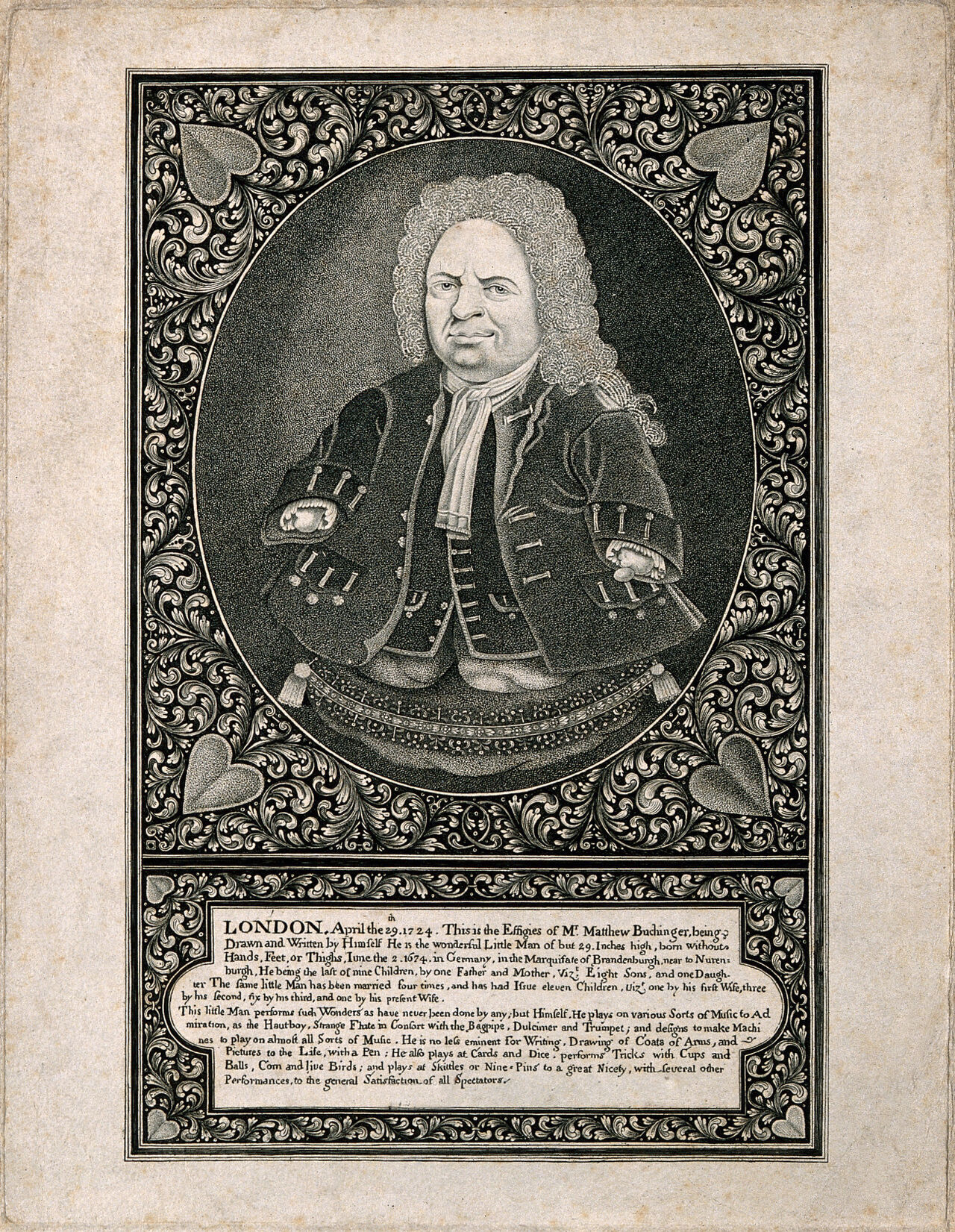
Matthias Buchinger · Wellcome Collection, London · Wellcome Collection · Public Domain Mark
- Name
- Matthias Buchinger
- Born
- 2 June 1674
- Birthplace
- Ansbach, Principality of Ansbach, Holy Roman Empire
- Died
- 17 January 1740
- Place of death
- Cork, Kingdom of Ireland
- Occupation
- Artist, magician, calligrapher
- Nationality
- Holy Roman Empire
- Languages
- German
VALÉORINE Encyclopedia
VALÉORINE documentary reading
Documentary summary
Matthias Buchinger (lang; June 2, 1674 – January 17, 1740), sometimes called Matthew Buckinger in English, was a German artist, magician, calligrapher, and performer who was born without hands or feet and was 2 ft tall. Buchinger was especially noted for his micrography, in which illustrations consist of very small text.
Admitted source layer · organised and presented by VALÉORINE
Note VALÉORINE
Matthias Buchinger (1674–1739) was a calligrapher, composer and draftsperson, among other activities and a national of the Holy Roman Empire. Born in Ansbach, the calligrapher died in Cork. Languages used include German.
Composed from admitted, traceable facts · 28 September 2026
VALÉORINE
Reference Check
Propose documentary evidence for Matthias Buchinger. A contribution is never written directly as fact: identity, source, rights and evidence gates still decide.
Sign in to contribute
World of VALÉORINE
Documentary connections
Only confirmed graph relationships appear here. Images are shown only when their identity and reuse rights both pass the documentary gate.
Documentary evidence
Documentary basis
Authority files
wikidata · Q6791523 · wikipedia · Matthias Buchinger
In this article
Key facts
Key facts
• Name — Matthias Buchinger • Born — 2 June 1674 • Birthplace — Ansbach, Principality of Ansbach, Holy Roman Empire • Died — 17 January 1740 • Place of death — Cork, Kingdom of Ireland • Occupation — Artist, magician, calligrapher
Biography
Biography
Buchinger was born in Ansbach, Holy Roman Empire, without hands or legs, now considered to be phocomelia. An artist and performer, he "traveled all over Northern Europe to entertain kings and aristocrats as well as hoi polloi with amazing feats of physical dexterity" and was known as "The Greatest German Living" and "Little Man from Nuremberg". He travelled to England trying to get a court appointment with King George I, but was unsuccessful; he then moved to Ireland, where he gave public demonstrations in Dublin in 1720 and in Belfast in 1722. He also is rumored to have had children by as many as 70 mistresses. Buchinger's fame was so widespread that in the 1780s the term "Buckinger's boot" existed in England as a euphemism for the vagina (because the only "limb" he had was his penis). Buchinger died in Cork, Ireland, at the age of 65. • Illustration — The detailed writing embedded in the engraving Despite having small, finlike appendages for hands, his engravings were incredibly detailed. One such engraving, a self-portrait, was so detailed that a close examination of the curls of his hair revealed that they were in fact seven biblical psalms and the Lord's Prayer, inscribed in miniature letters. Buchinger was also an accomplished magician, making balls disappear from under cups and birds to appear from nowhere. It also was said that he was unbeatable at cards and would dazzle audiences with his amazing displays of marksmanship. Buchinger made (or mended) the oldest existing model in a bottle in 1719. It is a model of miners underground and can be seen in Snowshill Manor. He had tremendous dexterity, in spite of his disability. Buchinger's musical skills included the ability to play a half-dozen musical instruments including the dulcimer, hautboy, trumpet, and flute, and several of his own invention.
Family
Family
Buchinger was married four times and had 14 children. His first three wives (Elsche Shoomaker, Margeth Afsawein, Ann Catharin Kemchmeyer) all died shortly after giving birth and his fourth wife, Ann Elizabeth Teys, outlived him.
Identity and overview
Identity and overview
The canonical record carries the following identifying particulars.
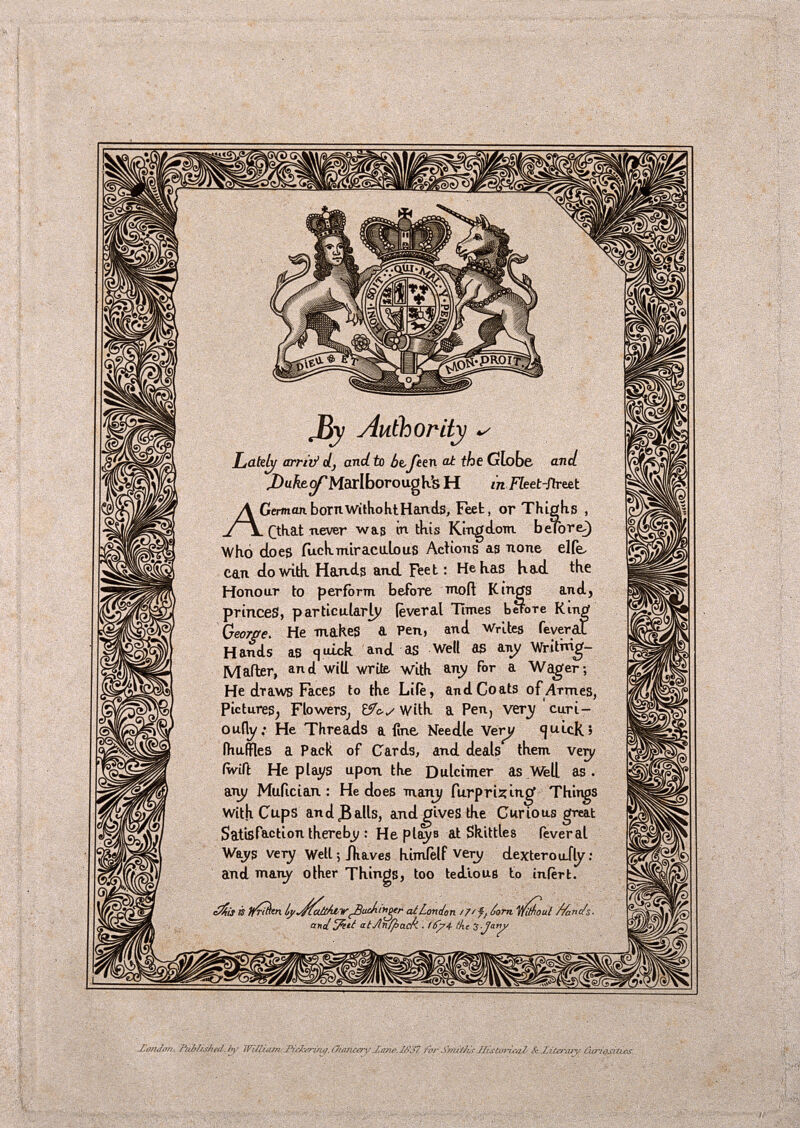
A notice advertising himself by Matthias Buchinger, a phocomelic man. Etching, 1837, in facsimile of a printed notice, 1716., 1837, by Matthias Buchinger
Matthias Buchinger · Wellcome Collection, London · Wellcome Collection
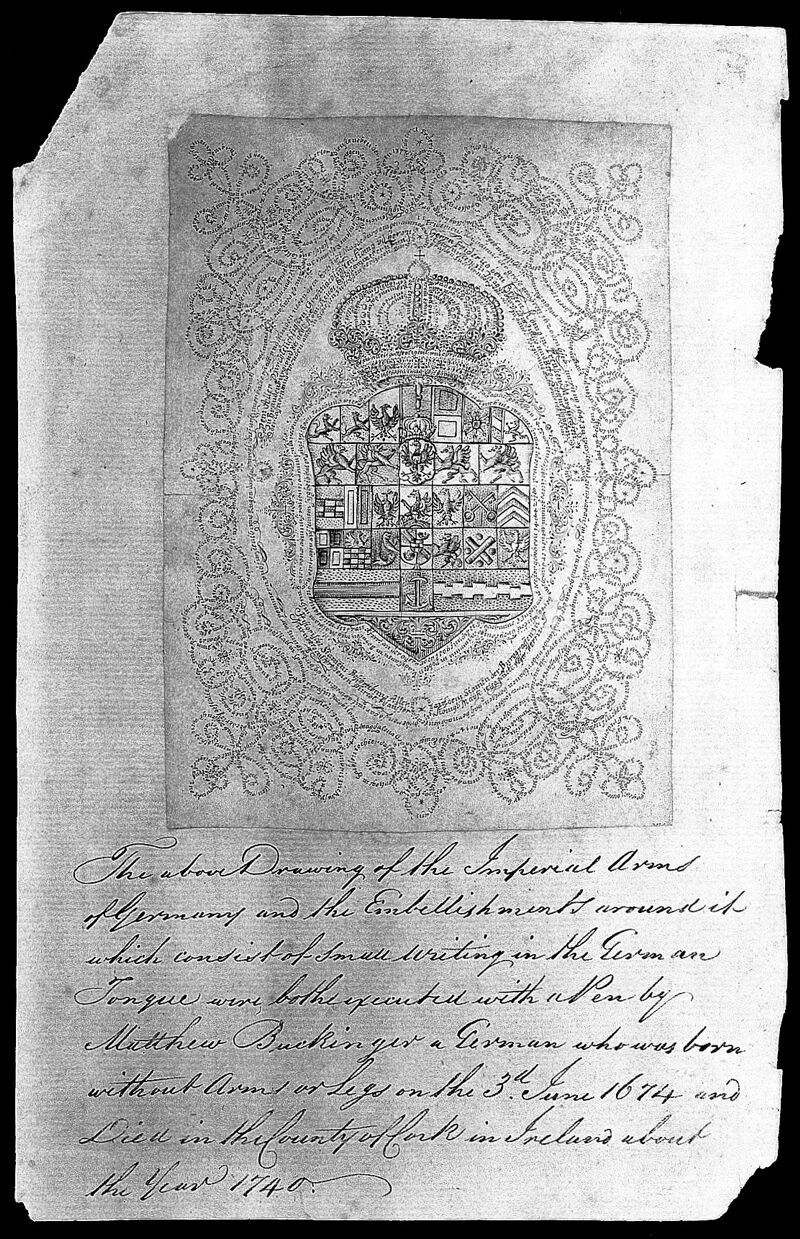
Genealogical table of the Franconian line of the Hohenzollern arranged in circular writing in the shape of the Prussian royal crown surrounding the complete set of coats of arms of the line. Engraving by M. Buchinger., by Matthias Buchinger
Matthias Buchinger · Wellcome Collection, London · Wellcome Collection
Places
Named by the record
Places
Only places the record itself states, plotted where the house gazetteer settles their coordinates. Nothing is inferred from a name or a nationality.
Ansbach.
Birth place
Cork.
Death place
Legacy
The Metropolitan Museum of Art presented 16 of his graphic works in a historical show entitled, "Wordplay: Matthias Buchinger's Drawings From the Collection of Ricky Jay". Jay, a magician and "collector of antique marvels", tracked down Buchinger's works for more than 30 years. He chronicled his pursuit of all things Buchinger in a book called Matthias Buchinger: 'The Greatest German Living' by Ricky Jay, Whose Peregrinations in Search of the 'Little Man of Nuremberg' Are Herein Revealed. An artwork by Buchinger was featured on the BBC television programme, Flog It!, filmed at RAF Hendon (Series 14, Episode 18). The piece sold at Chiswick Auctions in London for £600.
Notes from the source article
Cited by Wikipedia
Notes from the source article
These works are cited by the source article, in its own numbering. They are recorded as its citations, not as sources VALÉORINE has verified.
- 1.Dublin Penny Journal at the National Library of Ireland. Matthew Buchinger. April 27, 1833.
- 2.Morse, Erik. The Little Man of Nuremberg. The Paris Review. 2016-03-17.
- 3.Johnson, Ken. Astounding Feats in Pen, Ink and Magnifying Glass. The New York Times. January 14, 2016.
- 4.Penaud, J. T. Human Marvels:Matthew Buchinger – The Little Man of Nuremberg. Thehumanmarvels.com. 29 March 2006.
- 5.Jay, Ricky. Desperately Seeking Susan. The New York Times. June 1, 2009.
- 6.Grose, Francis. The Vulgar Tongue. S. Hooper. 1785.
- 7.Jackson, Holbrook. The Anatomy of Bibliomania. University of Illinois Press. 2001. 0-252-07043-7.
- 8.https://static.nationaltrust.org.uk/waf/waf.html?_event_transid=3365497891
- 9.Kraven, Vlad. Time Travel Part 1: Matthew Buchinger. Vlad Kraven: Magician, Artist, Writer. 3 March 2011.
- 10.Ragauskas, Aivas. Paul, the Wonder Boy from Vokė. LDKistorija.lt. Vilnius University.
- 11.Schjeldahl, Peter, "Seeing and Believing: the mysteries of Matthias Buchinger", The New Yorker, January 25, 2016
- 12.Peter Schjeldahl. Seeing and Believing: The Mysteries of Matthias Buchinger. The New Yorker. January 25, 2016.
Bibliography printed in the source article · 2
- Randi, James. Conjuring. (1992)
- Blaine, David. Mysterious Stranger. (2002)
References
Citations
References
Each reference names the institution holding it, so a reader may go to the document itself.
reference work
Secondary witnessreference work
Secondary witness
The Encyclopedia exists whether or not anything is for sale. Corrections are recorded rather than overwritten, and every version of this record is kept. Published 16 August 2026.
Elsewhere in Music memorabilia
42,832 published records in this field, each with its sources named.
- Matthew WilderPerson
- Matthias BamertPerson
- Matthias BertschPerson
- Matthias BuchholzPerson
- Matthias EisenbergPerson
- Matthias FreihofPerson
- Matthias GohlPerson
- Matthias GreitterPerson
Best supported in this field
For owners
Own a work by Matthias Buchinger?
A specialist will read what you send and tell you what the house can establish, what it cannot, and whether the object is suited to sale. There is no charge and no obligation. The object stays with you throughout; nothing is shipped to us unless it is arranged in writing beforehand.