
Matthäus Merian
Illustration — Engraving of Matthäus Merian by Joachim von Sandrart • Illustration — Frankfurt c. 1612; engraving by Matthäus Merian • Illustration — The castle and the town of Regensberg in Topographia Helvetiae, c. 1650 • Illustration — Gustav II Adolf in Polish 'delia' coat, painting by Matthäus Merian, 1632 • Illustration — Alchemical illustration, Musaeum Hermeticum, 1678 • Illustration — Discursus XXXI, Epigramma XXXI, from Atalanta Fugiens, 1618 Matthäus Merian der Ältere (or "Matthew", "the Elder", or "Sr."; 22 September 1593 – 19 June 1650) was a Swiss-born engraver who worked in Frankfurt, Germany for most of his career, where he also ran a publishing house.
Also recorded as Matthias Merian · Matthaus I Merian · Matthew Merian · Vom alten Merian
Matthäus Merian
![A field surrounded by wooded hills, with a saffron crocus in the foreground and verses below. Etching by Matthäus Merian the elder ca. 1646., [1646?], by Matthäus Merian](https://iiif.wellcomecollection.org/image/V0044102/full/1280,/0/default.jpg)
Matthäus Merian · Wellcome Collection, London · Wellcome Collection · Public Domain Mark
- Born
- 1593
- Nationality
- Holy Roman Empire · Switzerland
- Occupation
- cartographer · publisher · graphic artist · painter · copper engraver · printmaker · illustrator · visual artist
- Movements
- Baroque
- Known for
- Merian map of Paris · Topographia Germaniae · Theatrum Europaeum
VALÉORINE Encyclopedia
VALÉORINE documentary reading
Documentary summary
Illustration — Engraving of Matthäus Merian by Joachim von Sandrart • Illustration — Frankfurt c. 1612; engraving by Matthäus Merian • Illustration — The castle and the town of Regensberg in Topographia Helvetiae, c. 1650 • Illustration — Gustav II Adolf in Polish 'delia' coat, painting by Matthäus Merian, 1632 • Illustration — Alchemical illustration, Musaeum Hermeticum, 1678 • Illustration — Discursus XXXI, Epigramma XXXI, from Atalanta Fugiens, 1618 Matthäus Merian der Ältere (or "Matthew", "the Elder", or "Sr."; 22 September 1593 – 19 June 1650) was a Swiss-born engraver who worked in Frankfurt, Germany for most of his career, where he also ran a publishing house.
Admitted source layer · organised and presented by VALÉORINE
Note VALÉORINE
No house-authored Note is published until its assertions and sources pass the VALÉORINE evidence contract. The documentary article remains available in full while that enrichment is being consolidated.
Documentary enrichment in progress · no unsupported statement published
Reference Check
Propose documentary evidence for Matthäus Merian. A contribution is never written directly as fact: identity, source, rights and evidence gates still decide.
Sign in to contribute
Documentary evidence
Evidence Panel
not yet certified
- Identity
- resolved
- Independent source families
- 0
- Admitted assertions
- 0
- Open conflicts
- 0
Authority files
wikidata · Q57968
In this article
Early life and marriage
Early life and marriage
He was a member of the patrician Basel Merian family.
Born in Basel, Merian learned the art of copperplate engraving in Zürich. He next worked and studied in Strasbourg, Nancy, and Paris, before returning to Basel in 1615. The following year he moved to Oppenheim, Germany where he worked for the publisher Johann Theodor de Bry, who was the son of renowned engraver and traveler Theodor de Bry. In 1617, Merian married Maria Magdalena de Bry, daughter of the publisher, and was for a time associated with the de Bry publishing house. In 1620, when Oppenheim was destroyed by fire during the Spanish occupation, they moved back to Basel, but three years later returned to Germany, this time to Frankfurt. They had four daughters and three sons, including Matthäus Merian the Younger. Maria Magdalena de Bry died in 1645 and the following year Matthäus married Johanna Sibylla Heim. Five years later, Matthäus died, leaving his wife with two small children, Anna Maria Sibylla Merian (born 1647), who later became a pioneering naturalist and illustrator, and a son, Maximilian, who died before his third birthday.
Later career
Later career
In 1623, Merian took over the publishing house of his father-in-law after de Bry's death. In 1626, he became a citizen of Frankfurt and could henceforth work as an independent publisher. He spent most of his working life in Frankfurt. Early in his life, he had created detailed town plans in his unique style, e.g. a plan of Basel (1615) and a plan of Paris (1615). With Martin Zeiler (1589–1661), a German geographer, and later (c. 1640) with his own son, Matthäus Merian (der Jüngere, i.e. "the Younger" or "Jr.") (1621–1687), he produced a series of Topographia. The 21-volume set was collectively known as the Topographia Germaniae. It includes numerous town plans and views, as well as maps of most countries and a World Map—it was such a popular work that it was re-issued in many editions. He also took over and completed the later parts and editions of the Grand Voyages and Petits Voyages, originally started by de Bry in 1590, and included volumes India Orientalis and America Occidentalis. Merian's work inspired the Suecia Antiqua et Hodierna by Erik Dahlberg. The German travel magazine Merian is named after him. He was also noted for the finesse of his alchemical illustrations, in books such as the Musaeum Hermeticum (1678) and Atalanta Fugiens (1618). He undertook the engravings for the encyclopaedic work of insect natural history De Serpentibus, compiled by John Jonston. This tradition would be taken up by his daughter. Matthäus Merian died after several years of illness in 1650 in Langenschwalbach, near Wiesbaden. After his death, his sons Matthäus Jr. and Caspar took over the publishing house. They continued publishing the Topographia Germaniae and the Theatrum Europaeum under the name Merian Erben (i.e. Merian Heirs).
![A wooded valley with a plant of the Araceae family in the foreground and verses below. Etching by Matthaeus Merian the elder, c. 1629., [1629], by Matthäus Merian](https://iiif.wellcomecollection.org/image/V0044101/full/800,/0/default.jpg)
A wooded valley with a plant of the Araceae family in the foreground and verses below. Etching by Matthaeus Merian the elder, c. 1629., [1629], by Matthäus Merian
Matthäus Merian · Wellcome Collection, London · Wellcome Collection
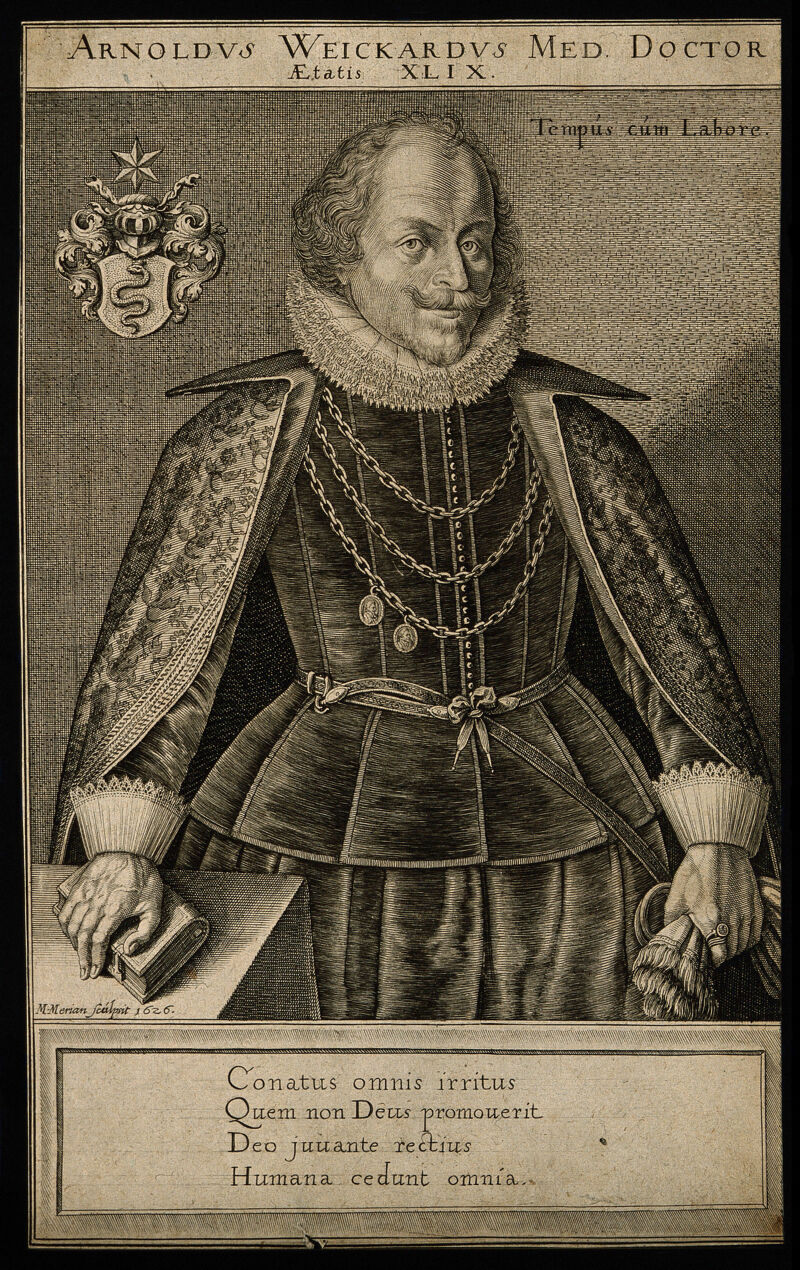
Arnold Weickard. Line engraving by M. Merian, 1626., 1626, by Matthäus Merian
Matthäus Merian · Wellcome Collection, London · Wellcome Collection
Life and career
Dated record
Life and career
Explore 1593–1650
The full dated record · 3 entries
1593
Matthäus Merian born at Basel.
1593
Freyburg In Uchtlandt Matthaeus Merian Der Vorrnehmsten In Germany, Matthäus Merian ( 1593 1650) In Franch, Mateos Em Portugues. 28 is digitised and catalogued by Internet Archive.
1650
Matthäus Merian died at Bad Schwalbach.
Primary material
Documents and archives
scholarly publication
- Merian, Matthäus (painter), Oxford Art Online, 2003
Scholarly · Crossref registry · 2003
reference work
- Wikidata, structured authority record Q57968: Matthäus Merian
Reputable secondary · Wikimedia Foundation
Notes from the source article
Cited by Wikipedia
Notes from the source article
These works are cited by the source article, in its own numbering. They are recorded as its citations, not as sources VALÉORINE has verified.
- 1.Davis, Natalie Zemon. Women on the Margins: Three Seventeenth-Century Women. Harvard University Press. 142. 1997.
Bibliography printed in the source article · 8
- Coolidge, William Augustus Brevoort. 18. 164–165.
- Lucas Heinrich Wüthrich: Das druckgraphische Werk von Matthäus Merian d.Ä.. vol.1 and 2: Basel 1966, vol.3 Hamburg 1993, vol.4: Hamburg 1996.
- Catalog zu Ausstellungen im Museum für Kunsthandwerk Franckfurt am Mayn (15. September – 7. November 1993) und im Kunstmuseum Basel (27. November 1993 – 13. Februar 1994) als unsterblich Ehren-Gedächtnis zum 400. Geburtstag des hochberühmten Delineatoris (Zeichners), Incisoris (Stechers) et Editoris (Verlegers) Matthaeus Merian des Aelteren. Museum für Kunsthandwerk, Frankfurt am Main 1993, .
- Ulrike Valeria Fuss: Matthaeus Merian der Ältere. Von der lieblichen Landschaft zum Kriegsschauplatz – Landschaft als Kulisse des 30jährigen Krieges. Frankfurt am Main, 2000, .
- Jörg Diefenbacher: Die Schwalbacher Reise. Mannheim 2002, .
- Ulrike Valeria Fuss: Momentaufnahme und Monumentalansicht. Ein Vergleich zwischen Valentin Wagner und Matthäus Merian d. Ä. In: Valentin Wagner (um 1610–1655): Ein Zeichner im Dreißigjährigen Krieg. Aufsätze und Werkkatalog. Darmstadt 2003, .
- Lucas Heinrich Wüthrich: Matthaeus Merian d. Ä. Eine Biographie. Hoffmann und Campe, Hamburg 2007 (Lizenzausgabe: Wissenschaftliche Buchgesellschaft, Darmstadt 2007)
- Götz J. Pfeiffer: Bild-Zeitung und Moral-Büchlein - der Dreissigjährige Krieg in Druckgraphiken von Matthäus Merian und Abraham Hogenberg, Jacques Callot und Hans Ulrich Franck, in: Der Dreissigjährige Krieg in Hanau und Umgebung, hrsg. vom Hanauer Geschichtsverein, Hanau, 2011, pp. 255–275.
References
Citations
References
Each reference names the institution holding it, so a reader may go to the document itself.
scholarly publication
Merian, Matthäus (painter), Oxford Art Online, 2003Crossref registry
Verifiedreference work
Wikidata, structured authority record Q57968: Matthäus MerianWikimedia Foundation
Partially resolved
The Encyclopedia exists whether or not anything is for sale. Corrections are recorded rather than overwritten, and every version of this record is kept. Published 14 August 2026.
Elsewhere in Paintings
18,623 published records in this field, each with its sources named.
- Matteo PonzoneArtist
- Matteo RosselliArtist
- Matteo SandonaArtist
- Matthäus GüntherArtist
- Mattheus Ignatius van BreeArtist
- Mattheus TerwestenArtist
- Mattheus van HelmontArtist
- Mattheus VerheydenArtist
Best supported in this field
For owners
Own a work by Matthäus Merian?
A specialist will read what you send and tell you what the house can establish, what it cannot, and whether the object is suited to sale. There is no charge and no obligation. The object stays with you throughout; nothing is shipped to us unless it is arranged in writing beforehand.