
M61 Vulcan
The M61 Vulcan is a hydraulically, electrically, or pneumatically driven, six-barrel, air-cooled, electrically fired Gatling-style rotary cannon which fires 20 mm caliber rounds at an extremely high rate (typically 6,000 rounds per minute). The M61 and its derivatives have been the principal cannon armament of United States military fixed-wing aircraft since 1959. Designed in 1946 by General Electric, the Vulcan entered service with the U.S. military in 1959.
Also recorded as Vulcan · T171 · M61 · General Electric M61 Vulcan
M61 Vulcan
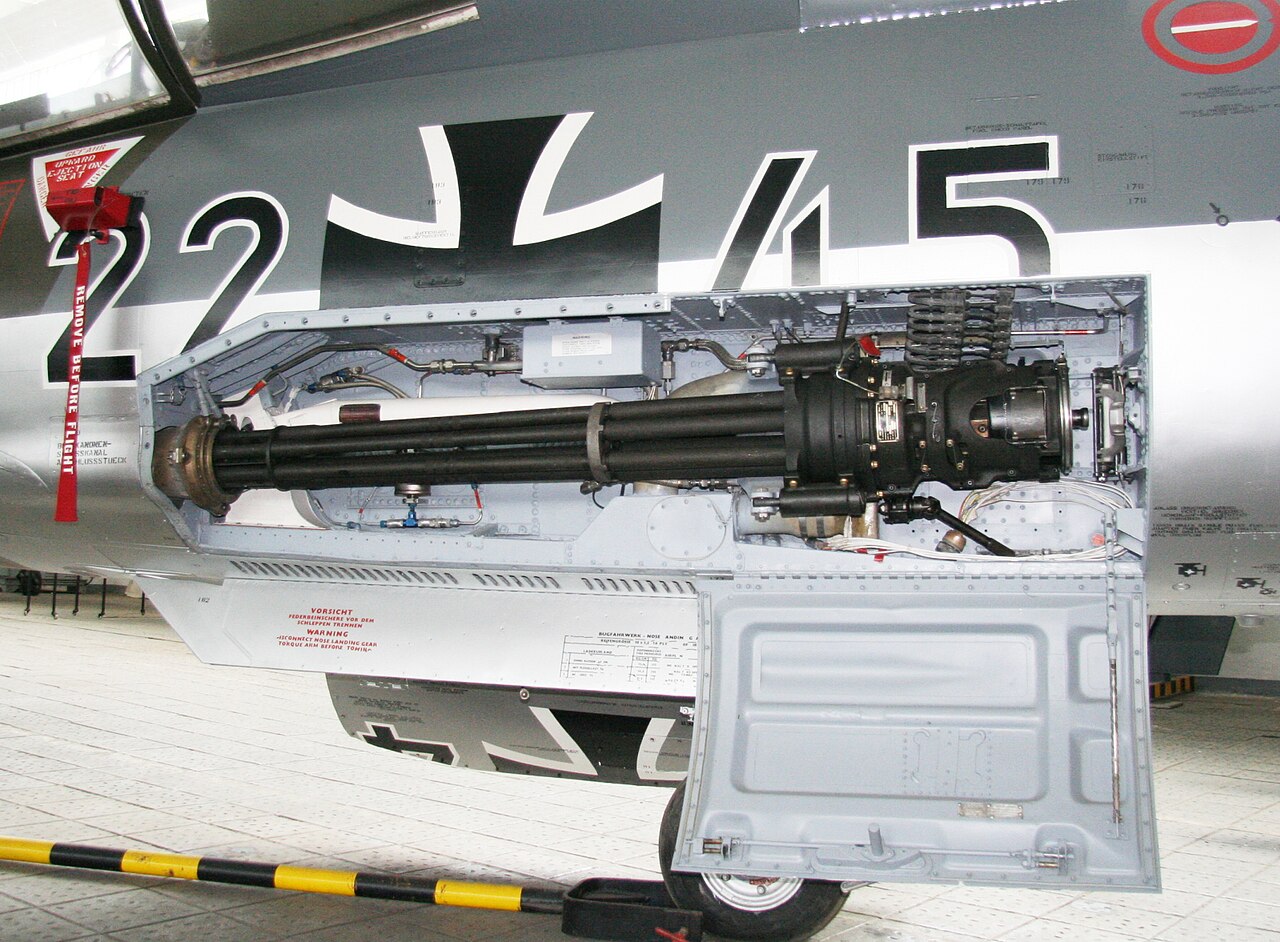
Michael Wolf · CC BY-SA 3.0
- Name
- M61 Vulcan
- Field
- rotary cannon · autocannon
- Period
- 1949
- Region
- United States
VALÉORINE Encyclopedia
VALÉORINE documentary reading
Documentary summary
The M61 Vulcan is a hydraulically, electrically, or pneumatically driven, six-barrel, air-cooled, electrically fired Gatling-style rotary cannon which fires 20 mm caliber rounds at an extremely high rate (typically 6,000 rounds per minute). The M61 and its derivatives have been the principal cannon armament of United States military fixed-wing aircraft since 1959. Designed in 1946 by General Electric, the Vulcan entered service with the U.S. military in 1959.
Admitted source layer · organised and presented by VALÉORINE
Note VALÉORINE
No house-authored Note is published until its assertions and sources pass the VALÉORINE evidence contract. The documentary article remains available in full while that enrichment is being consolidated.
Documentary enrichment in progress · no unsupported statement published
Reference Check
Propose documentary evidence for M61 Vulcan. A contribution is never written directly as fact: identity, source, rights and evidence gates still decide.
Sign in to contribute
World of VALÉORINE
Documentary connections
Only confirmed graph relationships appear here. Images are shown only when their identity and reuse rights both pass the documentary gate.


Documentary evidence
Evidence Panel
not yet certified
- Identity
- resolved
- Independent source families
- 0
- Admitted assertions
- 0
- Open conflicts
- 0
Authority files
wikidata · Q725972 · wikipedia · M61 Vulcan
In this article
Overview
Overview
It is also manufactured under license in Japan by Sumitomo Heavy Industries for Japan's Self-Defense Force and by SNT Dynamics in South Korea.
Key facts
Key facts
• Name — M61 Vulcan • Origin — United States • Type — Rotary cannon • Is Ranged — yes • Service — 1959–present • Used By — United States, some NATO members, Japan, South Korea, Saudi Arabia, and others • Wars — * Vietnam War • Iran–Iraq War • Gulf War • War in Afghanistan • Iraq War • War in Iraq (2013–2017) • Yemeni Civil War (2014–present) • Saudi Arabian-led intervention in Yemen • Turkish military operation in Idlib Governorate • Russo-Ukrainian War • Designer — General Electric • Design Date — 1946 • Manufacturer — General Dynamics Sumitomo Heavy Industries SNT Dynamics • Variants — See below • Weight — M61A2: (light barrel), (heavy barrel) • Cartridge — 20×102mm Vulcan • Caliber — 20 mm (0.8 in) • Barrels — 6-barrel (progressive RH parabolic twist, 9 grooves) • Action — Hydraulically operated, electrically fired, rotary cannon • Rate — 6,000 rounds per minute • Velocity — with PGU-28/B round • Range — About • Feed — Belt or linkless feed system
Development
Development
At the end of World War II, the United States Army Air Forces began to consider new directions for future military aircraft guns. The higher speeds of jet-powered fighter aircraft meant that achieving an effective number of hits would be extremely difficult without a much higher volume of fire. While captured German designs (principally the Mauser MG 213C) showed the potential of the single-barrel revolver cannon, the practical rate of fire of such a design was still limited by ammunition feed and barrel wear concerns. The Army wanted something more advanced, combining an extremely high rate of fire with exceptional reliability. In 1947, the Air Force became a separate branch of the military. The new Air Force made a request for a new aircraft gun. A lesson of World War II air combat was that German, Italian, and Japanese fighters with center line-mounted weapons could attack American aircraft from long range with their cannon main armament. American fighters with.50 caliber (12.7 mm) main armament, such as the P-51 and P-47, had to be close to enemy aircraft in order to cause significant damage to strong parts deep inside the jet. The Hispano cannon carried by the P-38 and P-61, while formidable against propeller-driven planes, had a relatively low rate of fire in the age of jets, while other Allied cannons were notoriously unreliable. In response to this requirement, the Armament Division of General Electric resurrected an old idea: the multi-barrel Gatling gun. The original Gatling gun had fallen out of favor because of the need for an external power source to rotate the barrel assembly, but the new generation of turbojet-powered fighters offered sufficient electric power to operate the gun, and electric operation was more reliable than gas-operated reloading. With multiple barrels, the rate of fire per barrel could be lower than a single-barrel revolver cannon while providing a greater overall rate of fire. The idea of powering a Gatling gun from an external electric power source was not a novel idea at the end of World War II, as Richard Jordan Gatling had done just that with a patent he filed in 1893. In 1946, the Army issued General Electric a contract for "Project Vulcan", a six-barrel weapon capable of firing 7,200 rounds per minute (rpm). Although European designers were moving towards heavier weapons for better hitting power, the U.S. initially concentrated on a powerful 0.60 in caliber cartridge designed for a pre-war anti-tank rifle, expecting that the cartridge's high muzzle velocity would be beneficial for improving hit ratios on high-speed targets. The first GE prototypes of the 0.60 in caliber T45 were ground-fired in 1949; it achieved 2,500 rpm, which was increased to 4,000 rpm by 1950. Due to air combat experience in the Korean War, the USAF decided that high velocity alone might not be sufficient to ensure target destruction and tested alternatives based on the 0.60 in caliber cartridge. These variants of the T45 were known as the T171 and T150 respectively and were first tested in 1952. Eventually, the standard 20×102 mm cartridge was determined to have the desired balance of projectile/explosive mass and muzzle velocity, resulting in an optimum balance of range, accuracy and kinetic energy on target. The development of the Lockheed F-104 Starfighter revealed that the T171 Vulcan (later redesignated M61) suffered problems with its linked ammunition, being prone to misfeed and presenting a foreign object damage hazard with discarded links. A linkless ammunition feed system was developed for the upgraded M61A1, which subsequently became the standard cannon armament of U.S. fighters. In 1993, General Electric sold its aerospace division, including GE Armament Systems along with the design and production tooling for the M61 and GE's other rotary cannon, to Martin Marietta. After Martin's merger with Lockheed, the rotary cannon became the responsibility of Lockheed Martin Armament Systems. Lockheed Martin Armament Systems was later acquired by General Dynamics, which produces the M61 and its variants As of 2000.
Ammunition
Ammunition
Until the late 1980s, the M61 primarily used the M50 series of ammunition, which includes armor-piercing incendiary, high-explosive incendiary, and training rounds. The gun typically fires a 3.5 oz projectile at a muzzle velocity of about 3380 ft/s. A new PGU-28/B round was developed in the mid-1980s: a semi-armor-piercing high-explosive incendiary (SAPHEI) round, providing improvements in range, accuracy, and power over the preceding M56A3 HEI round. The PGU-28/B is a "low-drag" round designed to reduce in-flight drag and deceleration, and has a slightly increased muzzle velocity of 3450 ft/s. However, the PGU-28/B has not been without problems. A 2000 USAF safety report noted 24 premature detonation mishaps (causing serious damage in many cases) in 12 years with the SAPHEI round, compared to only two such mishaps in the entire recorded history of the M56 round. The report estimated that the PGU-28/B had a potential failure rate 80 times higher than USAF standards permit. Due to safety issues, it was limited to emergency wartime use in 2000. Practically no powered rotary cannon is supplied with sufficient ammunition for a full minute of firing, due to weight (at 6,000 rpm, the projectiles alone would represent a mass of about for one minute of firing; and by including the brass shell, filling and primer the weight is approximately double that at). In order to avoid using 600 to 1,000 rounds carried by aircraft all at once, a burst controller is generally used to limit the number of rounds fired at each trigger pull. Bursts from two or three up to 40 or 50 can be selected. The size of the airframe and available internal space limits the size of the ammunition drum and thus the ammunition capacity. When vehicle-mounted, the only limiting factor is the vehicle's safe carry weight, so commensurately larger ammo storage is available. The main types of combat rounds include: • Designation — Type — Projectile weight [grains] — Bursting charge [grains] — Muzzle velocity [m/s] — Description • M53 — API —? — incendiary — 1,030 — RHA penetration at 0 degree impact angle and range. • M56A3/A4 — HEI — HE and incendiary — 1,030 — Nose fuzed round, no tracer. effective radius to produce casualties to exposed personnel. Fragmentation hazard out to. RHA penetration at 0 degree obliquity at range. • PGU-28A/B — SAPHEI — 1,050 — Multi-purpose fuzeless round with an incendiary charge in the nose setting off the HE behind it with a slight delay to maximize lethality against aircraft. No tracer or self-destruct. A zirconium pellet at the bottom of the HE cavity provides additional incendiary effect.
Applications and first combat use
Applications and first combat use
• Illustration — M61A1 Vulcan firing test aboard an F-105 Thunderchief. The Vulcan was first used in aerial combat on 4 April 1965, when four North Vietnamese Vietnam People's Air Force (VPAF) MiG-17s) attacked a force of 10 North American F-100 Super Sabres (two of which were assigned weather reconnaissance duties) escorting 48 Vulcan-armed and "bomb-laden" F-105 Thunderchiefs, shooting down two of the latter. The MiG leader and only survivor from the four MiGs, Captain Tran Hanh, reported that U.S. jets had pursued them and that F-105s had shot down three of his aircraft, killing lieutenants Pham Giay, Le Minh Huan and Tran Nguyen Nam. Captain Donald Kilgus, piloting an F-100, received an official probable kill with his four M39 20 mm cannons during the engagement; however no other US pilot reported destroying any MiGs during the battle, leaving open the possibility that at least two of the MiG-17s may have been downed by their own anti-aircraft fire. The first confirmed Vulcan gun kill occurred on 29 June 1966 when Major Fred Tracy, flying his F-105 with the 421st TFS, fired 200 rounds of 20 mm into a MiG-17 that had just fired a 23 mm shell which entered one side of his cockpit and exited the other. When the VPAF MiG flew in front of him after making its pass, Tracy opened fire on it. The gun was installed in the Air Force's A-7D version of the LTV A-7 Corsair II where it replaced the earlier United States Navy A-7's Colt Mk 12 cannon and was adopted by the Navy on the A-7C and A-7E. It was integrated into the newer F-4E Phantom II variants. The F-4 was originally designed without a cannon as it was believed that missiles had made guns obsolete. Combat experience in Vietnam showed that a gun could be more effective than guided missiles in many combat situations and that an externally carried gun pod was less effective than an internal gun; the first generation of gun pods such as the SUU-16 were not oriented with the sights of the fighter. The improved pods were self-powered and properly synchronized to the sights, while the USAF versions of the F-4 were hastily fitted with internal M61 cannons in a prominent fairing under the nose, well before the war ended (Navy Phantoms never received cannons, continuing to rely on air-to-air missiles alone). The next generation of fighters built post-Vietnam incorporated the M61 gun internally. Combat kills using the M61 Vulcan in the Vietnam War 1966–1972 • Date/year — Firing aircraft — M61 Vulcan variant — Aircraft downed — USAF unit/comments • 29 June 1966 — F-105D Thunderchief — M61A1 — MiG-17 — 421st Tactical Fighter Squadron • 18 August 1966 — F-105D — M61A1 — MiG-17 — 34th TFS • 21 September 1966 — F-105D — M61A1 — MiG-17 — 333rd TFS • 21 September 1966 — F-105D — M61A1 — MiG-17 — 421st TFS • 4 December 1966 — F-105D — M61A1 — MiG-17 — 469th TFS • 1967 — F-105D/F-105F — M61A1 — (5) MiG-17 — 333rd TFS • 1967 — F-105D — M61A1 — (8) MiG-17 — 354th TFS • 1967 — F-105D/F-105F — M61A1 — (4) MiG-17 — 357th TFS • 1967 — F-4C Phantom II — SUU-16 gunpod — (2) MiG-17 — 480th TFS • 13 May 1967 — F-105D — M61A1 — MiG-17 — 44th TFS • 3 June 1967 — F-105D — M61A1 — MiG-17 — 13th TFS: Captain Ralph Kuster • 23 August 1967 — F-105D — M61A1 — MiG-17 — 34th TFS • 24 October 1967 — F-4D — SUU-23 gunpod — MiG-21 — 433rd TFS • 1967 — F-4D — SUU-23 — (3) MiG-17 — 435th TFS • 3 January 1968 — F-4D — SUU-23 — MiG-17 — 433rd TFS; pilot, Major B J Bogoslofski, WSO, Captain Richard L Huskey • 14 February 1968 — F-4D — SUU-23 — MiG-17 — 555th TFS • 1972 — F-4E — M61A1 — (3) MiG-21 — 35th TFS; the F4E was the first Phantom II to enter the war with an internal Vulcan gun. • 2 June 1972 — F-4E — M61A1 — MiG-19 — 58th TFS; first kill at supersonic speed (Mach 1.2); Major Phil Handley/WSO 1LT J. J. Smallwood • 9 September 1972 — F-4E — M61A1 — MiG-21 — 555th TFS • 15 October 1972 — F-4E — M61A1 — MiG-21 — 307th TFS • Total MiG-17 — |32 • Total MiG-19 — 1 • Total MiG-21 — 6 • Total — 39 • Illustration — An M61 mounted on a US Army M163 armored vehicle. The Vulcan was later fitted into the weapons bay of some Convair F-106 Delta Dart and General Dynamics F-111 Aardvark models. It was also adopted as standard in the "teen"-series air superiority fighters: the Grumman F-14 Tomcat, the McDonnell Douglas F-15 Eagle, General Dynamics F-16 Fighting Falcon, and McDonnell Douglas F/A-18 Hornet. Other aircraft include the Italian/Brazilian AMX International AMX (on Italian aircraft only), and the F-22 Raptor. It was fitted in a side-firing installation on the Fairchild AC-119 and some marks of the Lockheed AC-130 gunships, and was used in the tail turrets of both the Convair B-58 Hustler and Boeing B-52H Stratofortress bombers. Japan's Mitsubishi F-1 carried one internally mounted JM61A1 Vulcan with 750 rounds. • Illustration — An F-22 firing its M61A2 rotary cannon Two gun pod versions, the SUU-16/A (also designated M12 by the US Army) and improved SUU-23/A (US Army M25), were developed in the 1960s, often used on gunless versions of the F-4. The SUU-16/A uses the electric M61A1 with a ram-air turbine to power the motor. This proved to cause serious aerodynamic drag at higher speeds, while speeds under 400 mph did not provide enough airflow for the maximum rate of fire. The subsequent SUU-23/A uses the GAU-4/A self-powered Vulcan, with an electric inertia starter to bring it up to speed. Both pods ejected empty cases and unfired rounds rather than retaining them. Both pods contained 1,200 rounds of ammunition, with a loaded weight of 1615 and respectively. During service in the Vietnam War, the pods proved to be relatively inaccurate: the pylon mounting was not rigid enough to prevent deflection when firing, and repeated use would misalign the pod on its pylon, making matters worse. A variant with much shorter barrels, designated the M195, was also developed for use on the M35 Armament Subsystem as used on the AH-1G Cobra helicopter. This variant fed from ammunition boxes fitted to the landing skid and was developed to provide the AH-1 helicopter with a longer-range suppressive fire system before the adoption of the M97 universal turret mounting the M197 cannon. The M61 is also the basis of the US Navy Mk 15 Phalanx close-in weapon system and the M163 VADS Vulcan Air Defense System, using the M168 variant. On 13 December 2024, the Ukrainian Air Force claimed an F-16 shot down six Russian cruise missiles in one sortie. Two were shot down with “medium-range missiles”, another two with “short-range missiles” and finally two with the M61 Vulcan 20 mm cannon. The pilot wasn't identified for security reasons but said: "A few bursts from the cannon – and an explosion... then another one! 'A secondary detonation,' I thought, but, as it turned out, there were two missiles". On 20 August 2026, a Romanian Air Force F-16 destroyed an explosive naval drone near the Neptun Deep offshore platform using the onboard cannon. The drone was confirmed to not be Ukrainian as in the past incidents and the incident was attributed to Russia.
Variants
Variants
• M61A1 • M61A2 – The M61A2 shares the same features as the M61A1 but is 20% lighter.
Chronology
Dated record
Chronology
The full dated record · 1 entries
1949
M61 Vulcan first recorded.
Places
Named by the record
Places
Only places the record itself states, plotted where the house gazetteer settles their coordinates. Nothing is inferred from a name or a nationality.
- United States
Description
• Illustration — An M61 Vulcan and the feed system for an F/A-18, on a stand Each of the cannon's six barrels fires once in turn during each revolution of the barrel cluster. The multiple barrels provide both a very high rate of fire—around 100 rounds per second—and contribute to prolonged weapon life by minimizing barrel erosion and heat generation. The average time between jams or failures is in excess of 10,000 rounds, making it an extremely reliable weapon. The success of the Vulcan Project and its progeny, the very-high-speed Gatling gun, has led to guns of the same configuration being referred to as "Vulcan cannons", which can sometimes confuse nomenclature on the subject. Most aircraft versions of the M61 are hydraulically driven and primed electrically. The gun rotor, barrel assembly and ammunition feed system are rotated by a hydraulic drive motor through a system of flexible drive shafts. The round is fired by an electric priming system where an electric current from a firing lead passes through the firing pin to the primer as each round is rotated into the firing position. • Illustration — Gun installation on West German F-104. The self-powered version, the GAU-4 (called M130 in Army service), is gas-operated, tapping gun gas from three of the six barrels to operate the gun gas-driven mechanism. The self-powered Vulcan weighs about 10 lb more than its electric counterpart, but requires no external power source to operate, except for an electric inertia starter to initiate gun rotation, allowing the first rounds to be chambered and fired. The initial M61 used linked ammunition, but the ejection of spent links created considerable (and ultimately insuperable) problems. The original weapon was soon replaced by the M61A1, with a linkless feed system. Depending on the application, the feed system can be either single-ended (ejecting spent cases and unfired rounds) or double-ended (returning casings back to the magazine). A disadvantage of the M61 is that the bulk of the weapon, its feed system, and ammunition drum make it difficult to fit it into a densely packed airframe. • Illustration — De-classified Tactical Weapons Effects Tests of the U.S. Air-Force Century-Series aircraft. The feed system must be custom-designed for each application, adding to the complete weapon. Most aircraft installations are double-ended, because the ejection of empty cartridges can cause a foreign-object damage hazard for jet engines and because the retention of spent cases assists in maintaining the center of gravity of the aircraft. The first aircraft to carry the M61A1 was the C model of the F-104, starting in 1959. A lighter version of the Vulcan developed for use on the F-22 Raptor, designated M61A2, is mechanically the same as the M61A1, but with thinner barrels to reduce overall weight to 202 lb. The rotor and housing have also been modified to remove any piece of metal not absolutely needed for operation and replaces some metal components with lighter-weight materials. The F/A-18E/F Super Hornet also uses this version. The Vulcan's rate of fire is typically 6,000 rounds per minute, although some versions (such as that of the AMX and the F-106 Delta Dart) are limited to a lower rate, and others (A-7 Corsair, F-15 Eagle) have a selectable rate of fire of either 4,000 or 6,000 rounds per minute. The M61A2's lighter barrels allow a somewhat higher rate of fire, up to 6,600 rounds per minute. • Illustration — An M61 Vulcan at the Miramar Airshow • Illustration — An M61 ammunition belt • Illustration — M61 on display • Illustration — M61 Vulcan on display • Illustration — PGU-27 AB training rounds, Brussels 2015
Literature
Scholarly footprint
A count of publications is evidence of attention, not of standing, and is given here only as a measure.
Notes from the source article
Cited by Wikipedia
Notes from the source article
These works are cited by the source article, in its own numbering. They are recorded as its citations, not as sources VALÉORINE has verified.
- 1.» 20mm M61A1/M61A2 Gatling Gun.
- 2.Ministry of Defense (Japan). Air Self-Defense Force Aircraft Mounted Weapons.
- 3.SNT Dynamics. Gun & Artillery Systems.
- 4.https://archive.org/stream/The_Machine_Gun_V5/The_Machine_Gun_V5_djvu.txt M61 Al, CHAG, and GAU-8/A Machine Guns, History of Vulcan
- 5.Image shack. Elec key Gatling.
- 6.Archived copy of US Patent #502,185 by R.J. Gatling, for an electric-powered Gatling-gun
- 7.Wahl, Paul F. The Gatling Gun. Aircraft Armament & Small Arms Product Support Integration Directorate. 5 October 2005.
- 8.PEO Ammunition Systems. dau.mil.
- 9.M61A1 GAU 4 20-MM Vulcan Cannon.
- 10.Federation of American Scientists. M61 20mm cannon. 23 April 2000.
- 11.Tucker, Spencer C. Persian Gulf War Encyclopedia: A Political, Social, and Military History: A Political, Social, and Military History. ABC-CLIO. 2014-08-20. 978-1-61069-416-2.
- 12.U.S. Hypersonic Weapons and Alternatives. www.cbo.gov. 2023-01-31.
- 13.Air Force Manual 11W1-12-4-32
- 14.Chinn, George M. The Machine Gun. 5. 26–27, 31–32. 1987.
- 15.General Dynamics-OTS to supply M61A1 Vulcan 20mm guns for F-16s through FMS. airrecognition.com.
- 16.Bowman, Martin W. Lockheed F-104 Starfighter: A History. Pen and Sword Aviation. 2017-11-30. 978-1-4738-6329-3.
- 17.Projects.
- 18.Federation of American Scientists. GAU-4 20mm Vulcan M61A1/M61A2 20mm Automatic Gun.
- 19.GlobalSecurity.org. PGU-27A/B TP/PGU-28A/B SAPHEI/ GU-30A/B TP-T.
- 20.General Dynamics Ordnance and Tactical Systems. 20MM PGU-28 A/B.
- 21.Airborne Weapons Corrective Action Program. Ammunition Active. 1–6. 30 November 2001.
- 22.Jane's International Defense Review: IDR, Volume 36, Issues 1–6. Jane's Information Group, 2003. "In 2000, the newer-technology PGU-28/B ammunition for the M61 was restricted to emergency wartime use after a series of mishaps."
- 23.Pgu-27A/B Tp/ Pgu-28A/B Saphei / Pgu-30A/B Tp-T.
- 24.Department of the Army. FM 1-140 Helicopter Gunnery. 1996.
- 25.JMU. ORDATA: Ordnance Identification Tool.
- 26.Toperczer (MiG-17/MiG-19 Units) p. 65
- 27.Hobson p. 17
- 28.Anderton p. 71
- 29.Toperczer (MiG-17/MiG-19 Units) pp. 30, 31, 88
- 30.McCarthy Jr. p. 38, photograph of 23 mm cannon exit hole on Maj. Tracy's F-105
- 31.Michel III p. 56
- 32.Chant, Christopher. A Compendium of Armaments and Military Hardware. Routledge. 65–70, 106, 114–15, 341–43, 363, 389, 404–5. 1987. 978-0-7102-0720-3.
- 33.F-16 Fighting Falcon.
- 34.F-15 Eagle. Air Force.
- 35.F-14A Tomcat | National Naval Aviation Museum.
- 36.Boeing: Historical Snapshot: F/A-18 Hornet Fighter.
- 37.McCarthy Jr. pp. 148–157. Excludes combination air-to-air missile/gun kills.
- 38.McCarthy Jr. p. 38
- 39.Campbell & Hill p. 43/photo of his F-105 plate # 213
- 40.Davies, Osprey #45, p. 86
- 41.Michel III pp. 181, 267
- 42.Davies, Osprey #55, pp. 37–38
- 43.Gervasi, 1984. p. 239
- 44.20mm Cannon.
- 45.M163 Vulcan.
- 46.Martin Fornusek. In historic record, Ukrainian F-16 pilot downs 6 cruise missiles in single mission, Air Force claims. The Kyiv Independent. 2024-12-13.
- 47.Ciobanu, Ramona. Momentul în care avionul F-16 trage în drona marină, lângă platforma Neptun Deep. Imaginile publicate de MApN. HotNews. 20 August 2026.
- 48.Romania destroys drone near gas project, blames Russia. dw.com. 20 August 2026.
Bibliography printed in the source article · 8
- Anderton, David A. North American F-100 Super Sabre. Osprey Publishing. 1987. 978-0-85045-662-2.
- Campbell, John M. Roll Call: Thud: A Photographic Record of the F-105 Thunderchief. Schiffer Publishing. 1996. 0-7643-0062-8.
- Davies, Peter E. U.S. Air Force F-4 Phantom II MiG Killers 1965–68. Osprey Publishing. 45. 2004. 1-84176-656-9.
- Davies, Peter E. USAF F-4 Phantom II MiG Killers 1972–73. Osprey Publishing. 55. 2005. 1-84176-657-7.
- Hobson, Chris. Vietnam Air Losses, United States Air Force, Navy and Marine Corps Fixed-Wing Aircraft Losses in Southeast Asia 1961–1973. Midland Publishing. 2001. 1-85780-115-6.
- McCarthy, Donald J., Jr. MiG Killers, A Chronology of U.S. Air Victories in the Vietnam War 1965–1973. Specialty Press. 2009. 978-1-58007-136-9.
- Michel, Marshall L., III. Clashes, Air Combat Over North Vietnam 1965–1972. Naval Institute Press. 1997. 978-1-59114-519-6.
- Toperczer, Istvan. MiG-17 and MiG-19 Units of the Vietnam War. Osprey Publishing. 25. 2008. 978-1-84176-162-6.
References
Citations
References
Each reference names the institution holding it, so a reader may go to the document itself.
reference work
Partially resolvedreference work
Partially resolved
The Encyclopedia exists whether or not anything is for sale. Corrections are recorded rather than overwritten, and every version of this record is kept. Published 14 August 2026.
Elsewhere in Militaria
6,095 published records in this field, each with its sources named.
- M6 Gun Motor CarriageTerminology
- M6 mineTerminology
- M60 105mm CartridgeTerminology
- M60 rifle grenadesTerminology
- M621 cannonTerminology
- M67 grenadeTerminology
- M6C-210Terminology
- M7 bayonetTerminology
Best supported in this field
For owners
Own an object connected with M61 Vulcan?
A specialist will read what you send and tell you what the house can establish, what it cannot, and whether the object is suited to sale. There is no charge and no obligation. The object stays with you throughout; nothing is shipped to us unless it is arranged in writing beforehand.