
7.5 cm tornpjäs m/57
The 7.5 cm tornpjäs m/57 (75 mm turret gun model 1957) was developed for the Swedish Coastal Artillery in the 1950s as a light and comparatively cheap gun that would replace a large number of mostly obsolete systems for short-range coastal defense. Eventually, 30 three-gun batteries in three distinct series were built. Sixteen guns were exported to Norway, and a mobile version of the gun called the 7.5/65 was built, making the total number of guns manufactured well over 100.
7.5 cm tornpjäs m/57
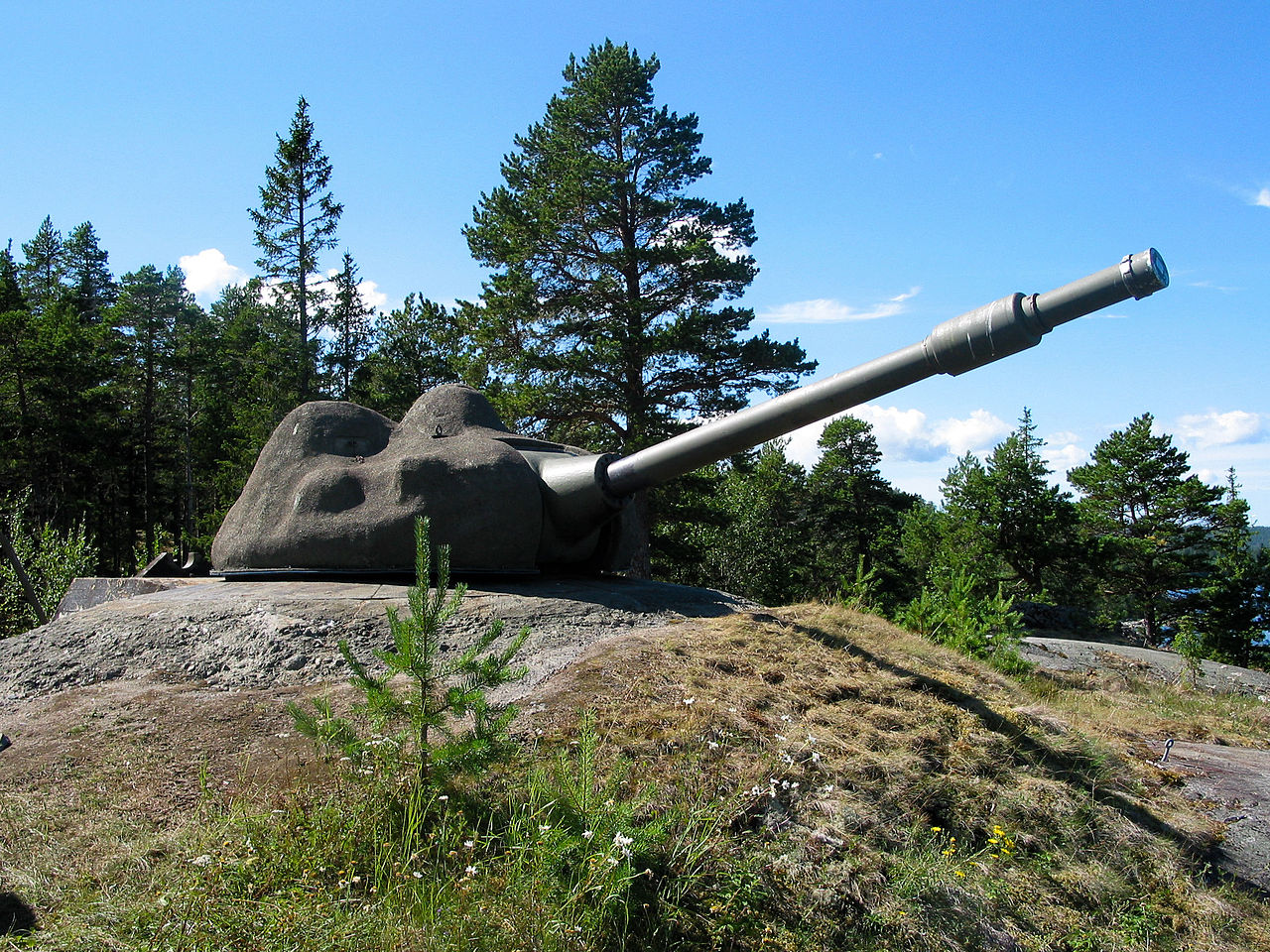
Cliffaksw · CC BY-SA 3.0
- Name
- 7.5 cm tornpjäs m/57
- Field
- autocannon
- Region
- Sweden
VALÉORINE Encyclopedia
VALÉORINE documentary reading
Documentary summary
The 7.5 cm tornpjäs m/57 (75 mm turret gun model 1957) was developed for the Swedish Coastal Artillery in the 1950s as a light and comparatively cheap gun that would replace a large number of mostly obsolete systems for short-range coastal defense. Eventually, 30 three-gun batteries in three distinct series were built. Sixteen guns were exported to Norway, and a mobile version of the gun called the 7.5/65 was built, making the total number of guns manufactured well over 100.
Admitted source layer · organised and presented by VALÉORINE
Reference Check
Propose documentary evidence for 7.5 cm tornpjäs m/57. A contribution is never written directly as fact: identity, source, rights and evidence gates still decide.
Sign in to contribute
World of VALÉORINE
Documentary connections
Only confirmed graph relationships appear here. Images are shown only when their identity and reuse rights both pass the documentary gate.

Documentary evidence
Documentary basis
Authority files
wikidata · Q4642906 · wikipedia · 7.5 cm tornpjäs m/57
In this article
Key facts
Key facts
• Name — 7.5 cm tornpjäs m/57 • Origin — Sweden • Type — Coastal Artillery • Is Ranged — YES • Is Artillery — YES • Service — 1962–2000 (Sweden) 1972–present (Norway) • Used By — Sweden Norway • Designer — Bofors • Design Date — 1957 • Manufacturer — Bofors • Production Date — 1957–1975 • Number — 90+ • Variants — 7.5/65 mobile Coastal Artillery gun • Part Length — 4.245 m L/57 • Crew — 7 • Caliber — 75 mm L/57 • Action — Semi automatic • Rate — 25 rounds/min • Velocity — 827 m/s • Max Range — 12.2 km • Feed — 320 anti-ship rounds 280 HE rounds • Breech — Vertical sliding-wedge • Carriage — Armored fixed turret • Elevation — −5°/+20° • Traverse — 360°
History
History
Most of the older light coastal defenses, mainly consisting of old naval artillery, had been hastily built during World War II to meet an immediate need for short-range coastal defense but were past their useful age and had not been designed with nuclear weapons in mind. The 105 mm fully automatic gun system (105 mm tapj m/50) that was under construction at the time was plagued by manufacturer delays and other problems, so the decision was made to go for a lighter, simpler system that would be deployed for short-range defense of important points, while studying which alternative (conventional artillery, rocket artillery or missiles) would suit the need for heavier firepower.
Turret and gun system
Turret and gun system
The gun is mounted in an armored turret with the magazine situated at least 5 meters below ground. The turret is usually fitted with a fiberglass camouflage hood, making it hard to spot for the untrained eye. Another distinct feature is the fork which the barrel rests in when the gun is not active. This was done to reduce ground shockwave effects from nuclear weapons. When not used the barrel is fitted with a fiberglass cover for camouflage. 7,5/57 is an air-cooled semi-automatic gun with a vertically sliding breech block and a monoblock barrel fitted with a fume extractor. It uses fixed ammunition which is fed from a magazine below the gun by means of an elevator. Loading of the elevator as well as the gun is by hand, but the elevator bottom features a revolving drum which acts as a buffer. Spent cartridges are ejected into a pipe arrangement and slide downwards to a room opposite to the magazine. Normally, each gun is served by 7 men with 3 in the turret itself (gun captain, traverse operator and elevation operator) and 4 ammunition handlers in the magazine. Additional crew is needed for the ranging stations, command center, galley and for close-in protection. The gun had a rate of fire of 25 rounds per minute and could fire a 5.52 kg High Explosive shell to a range of 12000 m. Alternative rounds included an armour-piercing anti-ship shell, with a range of 11400 m and a High Capacity Extended Range shell, with a range of 16000 m.
Series 1
Series 1
The first 8 batteries were built with a central installation featuring fire control, power supply and accommodation, and with tunnels leading to each gun. Adaptions were made and some installations did not feature tunnels to each unit, but the dependence on the central unit is a common denominator. Sometimes, parts of the battery were brilliantly camouflaged, for example, Battery OD (which is now the Femörefortet museum) had its entrance cleverly disguised as a small house with a garage in its bottom floor, the garage being the entrance to the installation. The construction technology used involved blasting a central tunnel in which a concrete building was erected. Smaller tunnels usually connected each individual unit with some exceptions due to terrain restrictions.
Series 2
Series 2
The second series, consisting of 10 batteries, was a step towards increasing survivability by reducing each unit's dependence on the central facility and by increasing the distance between each unit. This was not perfect however, for example the guns still depended on power from the main unit. The construction technology employed was mostly the same as for Series 1, except that large shafts were blasted in which the concrete structures were placed. This was then covered with a concrete "lid".
Series 3
Series 3
Series 3 (12 batteries) was a major upgrade to the 7.5/57 system. Here, a lot more emphasis was placed on nuclear survivability and the individual units were further spread out. Each unit was also made completely self-sufficient and the accommodations were improved to increase comfort. To improve protection against ground shockwaves, the older concrete structures which had been rigidly built inside the tunnels were replaced with steel framed structures which were placed on elastic dampers thus decoupling them from the surrounding rock. EMP protection was also installed. While the Series 1 and 2 had a mechanical fire control system, Series 3 received a much more modern analog electronic system. Since each unit was standardized training did not necessarily have to take place at the same battery as the recruits' wartime assignments. This standardization also helped reduce costs.
Common characteristics
Common characteristics
Auxiliary power was provided by 2 Scania diesel generators, with enough fuel for 60 days of operation. Water was supplied by a saltwater intake (for toilets, showers etc.) and a drilled well for fresh water. Each battery had a number of dummy turrets which basically consisted of the fiberglass hood, a steel pipe and a heat source which was placed inside the dummy turret to give it an IR signature. Dummy rangefinders and targeting radars was also built. A number of shelters (type SK10) and prepared foxholes were provided for the close-in defense troops.
Fire Control, Series 1 and 2
Fire Control, Series 1 and 2
The first fire control system developed for 7.5/57 was Ci 710 (Central Instrument 710). This consisted of a mechanical ballistics computer, a periscope and a radar installed in the battery command post. An additional search periscope and radar PPI was provided as well as an optical rangefinder in the reserve command post. This was replaced with the world's first operative military laser rangefinder, an Ericsson design called AML 701, starting in 1968. The Ci 710 computer was built by Arenco and would take its input from either the radar, periscope or laser rangefinder and produce parallax corrected firing parameters for the three guns. The gun crew was provided with analog displays which would show traverse and elevation which they then had to manually follow.
Fire Control, Series 3
Fire Control, Series 3
For the new Series 3 batteries a new fire control system called ArtE 719 was developed by Philips Elektronikindustrier AB (PEAB). This eliminated the periscopes, replacing them with a remote controlled low-light TV system with an integrated laser rangefinder thus enabling the command post to be located away from the ranging station. Also, the radar was completely replaced with a more modern unit. It featured an analog electronic calculation unit which could track 2 targets simultaneously, as well as digital transmission of normalized target parameters to a computer at each gun emplacement where its individual firing parameters would be calculated. The gun crew, however, still had to lay their gun manually as automatic control was not included. The two target trackers allowed for engaging two targets simultaneously, with the guns firing a number of salvos on target 1 and then shifting to target 2 and firing on it while the shells to target 1 were in the air, after which the cycle was repeated as necessary. Short-term rate of fire was about one shell every other second.
Series 1
Series 1
• No. — Designator — Name — Location — Completed • 1 — LN — Ljugarn — Sjausterhammar, Gotland — 1962 • 2 — DL2/HÖ2/HU — Hemsö — Havstoudd, Hemsö — 1964 • 3 — OD — Oxelösund — Femöre battery — 1964 • 4 — HO3 — Holmsund — Bredskär — 1964 • 5 — KM2 — Karlshamn — Sternö, Blekinge — 1964 • 6 — SI — Simrishamn — Gladsax, Skåne — 1964 • 7 — MB — Mörtö-Bunsö — Island near Dalarö — 1965 • 8 — KN — Kolgårdsholmen — Kolguskär, near Landsort — 1966
Series 2
Series 2
• No. — Designator — Name — Location — Completed • 9 — RU — Råstensudde — Northern Singö — 1967 • 10 — AD — Arkösund — Bergön, Bråviken — 1967 • 11 — MÖ — Malmö — Lernacken — 1967 • 12 — YD2 — Ystad — Svarte — 1967 • 13 — GÖ — Galterö — Island near Gothenburg — 1968 • 14 — SE2 — Slite — St Olofsholm, Gotland — 1968 • 15 — SL4 — Sundsvall — Nyhamn — 1968 • 16 — LÅ — Långskär — Söderarm — 1969 • 17 — LK — Lysekil — St Kornö — 1970 • 18 — VG2/HÖ3 — Hemsö — Härnön near Härnösand — 1970
Series 3
Series 3
• No. — Designator — Name — Location — Completed • 19 — GI — Gisslingö — Söderarm — 1971 • 20 — FÅ — Fårö — Ryssnäs — 1971 • 21 — JV — Järnavik — Tärnö-Harö, Blekinge — 1971 • 22 — KP — Kappelshamn — Kappelshamn Bay, Gotland — 1972 • 23 — EN — Ellenabben — Aspö, Blekinge — 1972 • 24 — RN4 — Roten — Southern Singö, Uppland — 1972 • 25 — TE2 — Trelleborg — Maglarp — 1973 • 26 — SA2 — Söderarm — Båtskär, Uppland — 1973 • 27 — MS4/YG — Mellsten — Yttre Gården, Nynäshamn — 1973 • 28 — BÅ — Bråviken — Kungshamn, Nyköping — 1974 • 29 — MD — Marstrand — Koön — 1975 • 30 — KO2 — Korsö — Vindalsö — 1975
Norwegian forts
Norwegian forts
• No. — Name — Location — Completed — Number of guns • 1 — Bolærne — Oslofjord — 1972/1974 — 3 • 2 — Visterøy/Buarøy — Korsfjord, outside Bergen — 1972 — 2 • 3 — Breiviknes — Ullsfjord — 1976 — 3 • 4 — Årøybukt — Lyngenfjord — 1977 — 3 • 5 — Rauøy — Oslofjord — 1979 — 3 • 6 — Skjeljanger — Hjeltefjord, outside Bergen — 1983 — 2
7.5/57-95
7.5/57-95
In the 1990s, the 7.5/57 system was nearing the time for its MLU. To try out new features, Battery RU was selected as a trials unit and extensively modified. Modifications included: • Improved camouflage, signature reduction • Protection from laser guided munitions using a water fog system • Fire control replaced with ArtE 727 • Improved ventilation system This was evaluated in the late 1990s when the Swedish government decided to disband most of the coastal artillery and focus on amphibious units caused all work on the MLU to be aborted.
Scrapping
Scrapping
In the late 1990s, the Swedish Armed Forces decided that some 7.5/57 units were to be disbanded. This was eventually extended to all 7.5/57 units and scrapping of those units not slated to become memorials started immediately. In the case of Battery OD a private group managed to save it from scrapping and it is now a museum. Scrapping involves removing the gun turrets, all equipment and environmental hazards. After this every opening is sealed with concrete, the area around the battery cleaned up and in most cases any bans on trespassing, photography etc. are lifted unless the military plans to use the area for other purposes.
Surviving examples
Surviving examples
Sweden • Series 1 Battery HU (Hemsö fortress) is a State Construction Memorial and owned by Statens Fastighetsverk. • Series 3 Battery EN3 (Ellenabben/Aspö) is also a State Construction Memorial and owned by Statens Fastighetsverk. Only one turret of the battery has been preserved. • Series 1 Battery OD (Femöre Fortress) is owned by a museum association. It has been partially dismantled below ground to save on maintenance costs. • Various individual guns and other bits and pieces have been placed at museums like Beredskapsmuseet, Skåne and at Fårösund, Gotland. Norway • Series 3 Battery Bolærne is preserved, including radar and two rangefinder turrets. • Armoured part of the turret with the gun of Skjeljanger battery is placed at the Tellevik battery (Atlantic wall museum). • Another Norway turrets were scrapped at considerable costs. Scrapping was started at 2009
Places
Named by the record
Places
Only places the record itself states, plotted where the house gazetteer settles their coordinates. Nothing is inferred from a name or a nationality.
- Sweden
Named but not plotted · 1
7.5 cm tornpjäs m/57 is associated with Sweden.
Country
Primary material
Documents and archives
reference work
- “7.5 cm tornpjäs m/57”, English Wikipedia, consulted as further reading
Reputable secondary · Wikipedia
authority record
- Wikidata, structured authority record Q4642906: 7.5 cm tornpjäs m/57
General reference · Wikidata
References
Citations
References
Each reference names the institution holding it, so a reader may go to the document itself.
reference work
Secondary witnessauthority record
General reference
Connections
Knowledge graph
Connections
Each connection was recorded deliberately, with the basis for it kept on the internal record.
Place
1- SwedenPlace
Established from a fact already recorded on a verified source.
The Encyclopedia exists whether or not anything is for sale. Corrections are recorded rather than overwritten, and every version of this record is kept. Published 16 August 2026.
Elsewhere in Militaria
6,095 published records in this field, each with its sources named.
- 7.5 cm PaK 39Terminology
- 7.5 cm PaK 40Terminology
- 7.5 cm Pak 41Terminology
- 7.5 cm Pak 97/38Terminology
- 7.5 FKTerminology
- 7.5×54mm FrenchTerminology
- 7.5×55mm SwissTerminology
- 7.5×57mm MASTerminology
Best supported in this field
For owners
Own an object connected with 7.5 cm tornpjäs m/57?
A specialist will read what you send and tell you what the house can establish, what it cannot, and whether the object is suited to sale. There is no charge and no obligation. The object stays with you throughout; nothing is shipped to us unless it is arranged in writing beforehand.