
M39 cannon
The M39 cannon is a 20 mm caliber single-barreled revolver cannon developed for the United States Air Force in the late 1940s. It was used on a number of fighter aircraft from the early 1950s through the 1980s. The M61 Vulcan has replaced it in most roles.
Also recorded as Pontiac M39
M39 cannon
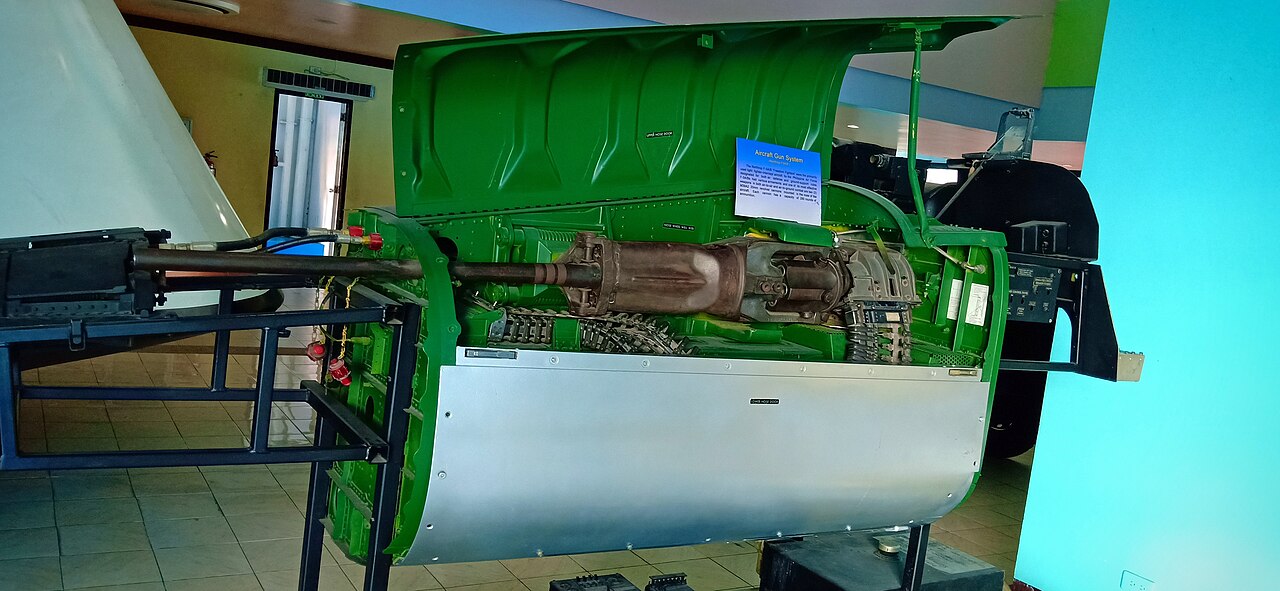
Rhk111 · CC BY-SA 4.0
- Name
- M39
- Field
- revolver cannon · autocannon
- Region
- United States
VALÉORINE Encyclopedia
VALÉORINE documentary reading
Documentary summary
The M39 cannon is a 20 mm caliber single-barreled revolver cannon developed for the United States Air Force in the late 1940s. It was used on a number of fighter aircraft from the early 1950s through the 1980s. The M61 Vulcan has replaced it in most roles.
Admitted source layer · organised and presented by VALÉORINE
Note VALÉORINE
No house-authored Note is published until its assertions and sources pass the VALÉORINE evidence contract. The documentary article remains available in full while that enrichment is being consolidated.
Documentary enrichment in progress · no unsupported statement published
Reference Check
Propose documentary evidence for M39 cannon. A contribution is never written directly as fact: identity, source, rights and evidence gates still decide.
Sign in to contribute
World of VALÉORINE
Documentary connections
Only confirmed graph relationships appear here. Images are shown only when their identity and reuse rights both pass the documentary gate.


Documentary evidence
Evidence Panel
not yet certified
- Identity
- resolved
- Independent source families
- 0
- Admitted assertions
- 0
- Open conflicts
- 0
Authority files
wikidata · Q1880975 · wikipedia · M39 cannon
In this article
Key facts
Key facts
• Name — M39 • Origin — United States • Type — Single-barrel autocannon • Is Ranged — yes • Service — 1952–present • Designer — Ford Motor Company • Design Date — 1951 • Manufacturer — Pontiac, Ford, FMC Corporation, and others • Number — 35,500+ • Variants — M39, M39A1, M39A2, M39A3 • Weight — 80.9 kg (178.5 lb) • Length — 1.83 m • Cartridge — 20×102mm • Caliber — 20 mm • Barrels — Single barrel (progressive RH parabolic twist, 9 grooves) • Action — five-chamber revolver • Rate — 1,500 rpm • Velocity — 1,030 m/s (3,300 ft/s) • Illustration — The M39 cannon with its 20 mm ammunition chute
Development
Development
The M39 was developed by the Springfield Armory, based on the World War II–era design of the German Mauser MG 213, a 20 mm (and 30 mm) cannon developed for the Luftwaffe, which did not see combat use. The same design inspired the 30 mm British ADEN cannon and the French DEFA, but American designers chose a smaller 20 mm round to increase the weapon's rate of fire and muzzle velocity at the expense of hitting power. The 20×102mm round was later chosen by France for the M621 cannon. Initially designated the T-160, the new gun was installed for combat testing on a number of F-86 Sabre aircraft under the "GunVal" program in late 1952, and used in action over Korea in early 1953. The results of the program were startling, with the GUNVAL F-86F's having downed 6 MIG fighters and damaged 12 others. This signaled the end of the M3.50 caliber as the preferred fighter weapon system ongoing. It was subsequently adopted as standard armament of the F-86H fighter-bomber, F-100 Super Sabre, F-101A and F-101C Voodoo, and the F-5 Freedom Fighter. The M39 was also used on the B-57B tactical bomber. Current models of the F-5 Tiger II still use the M39A2 version of this weapon. The M39A2 was introduced in 1964. The weapon is gas operated and consists of a five–chamber magazine running parallel to the barrel. Sealing was provided by a forcing cone that was pressed into the barrel. The sealing movement was at no time more than 1/4". A feeder mechanism ensured the proper placement of the rounds for ramming. This was powered by a feeder shaft that received kinetic force via the rotating magazine drum. This in turn was powered by propellant gas. The exterior of the 5-cylinder drum was studded with bearings that acted on a shifting cam located below the rammer/extractor platform. The gun could be set up for either right- or left-hand feed by switching the feeder head around. Some 35,000 were produced before being superseded by the M61 cannon which outperformed the M39 in almost every way. The only US aircraft still flying with the M39 is the Northrop F-5, an aircraft now only used for training. Extensive work had to be done on the forcing cone, heat dissipation, cook-off prevention, link testing, and reinforcement, to raise the mean time between failures to 1-in-1000 rounds fired. Four arms manufacturers, three independent companies, and a university research department, were involved in getting the weapon working correctly. In Vietnam in 1967 the 116th Assault Helicopter Company operating out of Củ Chi Base Camp used the M39 mounted inverted on the forward hardpoints on the underside of a UH-1 helicopter, with ammunition feed out the left cargo door through a chute. The unit's report for May through July 1967 states, "A low-level type of attack has been used on bunker lines with a good deal of success. It consists of locating and pinpointing the target area, then turning out, dropping down to about 50 ft (at 120 knots) and when about 500 m from the target, popping up to about 150 ft, turning hell, death and destruction onto the target, turning off, and being gone before Charlie recovers from the shock....It is most effective on huts or heavily wooded tree lines. A hut is almost totally destroyed, i.e., to the point of setting it on fire and reducing it to ashes, and a tree line is so effectively covered that many of the trees are defoliated or limbs, etc., blown off. In situations where the enemy is using less than bunker-type cover, the 20mm coverage is so effective that it is quite reasonable to assume that those individuals who were in the area are either dead or severely wounded." As to the ammunition, the same unit report says, "The ammunition is M-56AZ high explosive incendiary #12 link. It weighs almost one pound per round and has a bursting radius of 9 m. It is spin-actuated at about 50 m. It detonates upon contact with anything." While a major leap forward in aircraft armament, all revolver cannon suffer from the effects of barrel wear, heat dissipation, and parts life. The final improved version of the M39 had barrel changes mandated at 4000 rounds. The system would be replaced by the M61 Vulcan in aircraft for this and MTBF as well as weight considerations.
T-75 cannon
T-75 cannon
• Illustration — ROCMC Humvee with T-75M 20mm Cannon • Illustration — T-75S 20mm Cannon Mounted on FACG-77 The M39 served as the basis for the T-75 autocannon developed by Taiwan (Republic of China), as a more-powerful partial replacement for the M2HB machine gun onboard naval vessels and the HMMWV tactical vehicle, with its latest use being within the XTR-101 and XTR-102 weapon stations.
T-82T 20mm Twin Anti-Aircraft Cannon
T-82T 20mm Twin Anti-Aircraft Cannon
• Illustration — T-82T 20mm Twin Cannon • Illustration — T-82 20mm Twin Cannon The T-82 20mm Twin Anti-Aircraft Cannon as the basis for the T-75 autocannon developed by Taiwan (Republic of China).
Projectile specifications
Projectile specifications
• Projectile weight: 101 g • Types • M56A3:HE-I with a 10.7 g RDX explosive charge and a 1.3 g incendiary charge • M242:HE-I-T • M53:AP-I steel tip has a 50% chance of penetrating 6.3 mm of rolled homogenous armor at a range of 1000 m and striking angle of 0°. • M52:AP-I-T • M55A2:TP • M220:TP-T
Places
Named by the record
Places
Only places the record itself states, plotted where the house gazetteer settles their coordinates. Nothing is inferred from a name or a nationality.
- United States
References
Citations
References
Each reference names the institution holding it, so a reader may go to the document itself.
reference work
Partially resolvedreference work
Partially resolved
Connections
Knowledge graph
Connections
Each connection was recorded deliberately, with the basis for it kept on the internal record.
Broader subject
1- revolver cannonTerminology
Established from a fact already recorded on a verified source.
The Encyclopedia exists whether or not anything is for sale. Corrections are recorded rather than overwritten, and every version of this record is kept. Published 14 August 2026.
Elsewhere in Militaria
6,095 published records in this field, each with its sources named.
- M320 Grenade Launcher ModuleTerminology
- M34 grenadeTerminology
- M36 Gun Motor CarriageTerminology
- M360 105mm CartridgeTerminology
- M39 Enhanced Marksman RifleTerminology
- M4 Survival RifleTerminology
- M4-WAC-47Terminology
- M42 DusterTerminology
Best supported in this field
For owners
Own an object connected with M39 cannon?
A specialist will read what you send and tell you what the house can establish, what it cannot, and whether the object is suited to sale. There is no charge and no obligation. The object stays with you throughout; nothing is shipped to us unless it is arranged in writing beforehand.