
M1917 bayonet
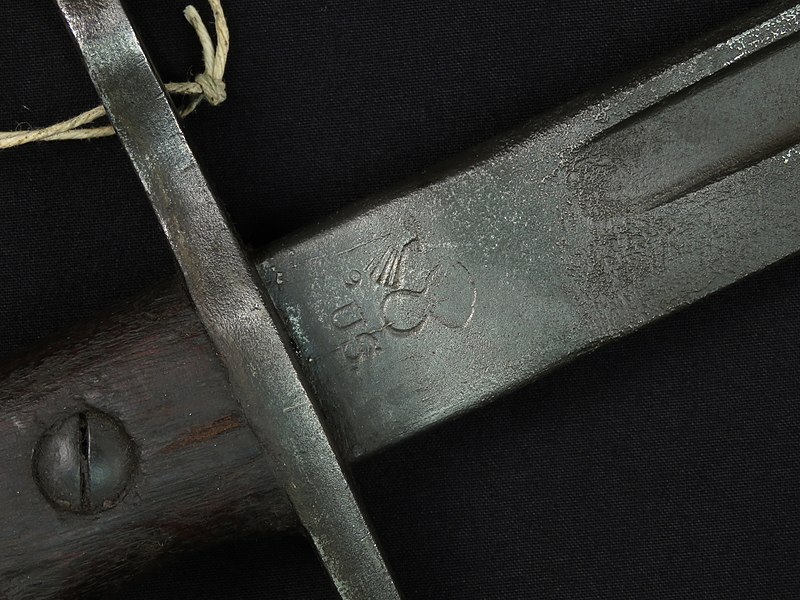
The M1917 bayonet was a bayonet designed to be used with the US M1917 Enfield.30 caliber rifle, as well as seven different models of U.S. trench shotguns. The blade was 17 in long with an overall length of 22 in. It does not fit the M1903.30 caliber (Springfield) or the M1.30 caliber (Garand) US service rifles as they have different bayonet ring (barrel) and attachment stud dimensions.
M1917 bayonet

Curiosandrelics · CC BY-SA 3.0
- Name
- M1917 bayonet
- Field
- bayonet
- Region
- United States
Reference Check
Propose documentary evidence for M1917 bayonet. A contribution is never written directly as fact: identity, source, rights and evidence gates still decide.
Sign in to contribute
World of VALÉORINE
Documentary connections
Only confirmed graph relationships appear here. Images are shown only when their identity and reuse rights both pass the documentary gate.

Documentary evidence
Documentary basis
Authority files
wikidata · Q5307442 · wikipedia · M1917 bayonet
In this article
Key facts
Key facts
• Name — M1917 bayonet • Type — Sword bayonet • Is Bladed — yes • Used By — United States United Kingdom • Wars — World War I Banana Wars World War II Korean War Vietnam War • Manufacturer — Remington Arms Winchester Arms Eddystone Arms General Cutlery Canadian Arsenals Limited. • Production Date — 1910s–1930s, 1960s • Number — ~2,000,000 • Weight — 1.2 lb • Length — 22 in • Part Length — 17 in • Sheath Type — M1917 scabbard
History
History
The M1917 bayonet was used first during World War I by American soldiers on the Western Front. A sword bayonet design, the M1917 bayonet design was based on the British Pattern 1913 bayonet, itself derived from the Pattern 1907 bayonet, which incorporated a long 17 in blade. While designed primarily for the M1917 rifle, the bayonet was fitted for use on all the "trench" shotguns at the time. The M1917 bayonet, being a direct copy of the British P14 bayonet, retained the transverse cuts in the grip panels. These panels served to differentiate the P1914 bayonet from the P1907 bayonet in British service as the only difference between the two was the height of the muzzle ring. In US service these transverse cuts served no official purpose. US surcharged P1914 bayonets exist and will exhibit the British proofs being cancelled out and US marks applied. The M1917 was used frequently during the several different Banana Wars. The U.S. continued to use the World War I-made M1917 bayonets during World War II because of large stockpiles left over. The new trench guns being procured and issued were still designed to use the old M1917 bayonet. The bayonet was again called on during the Korean War for issue with the various trench guns still in service. In 1966 procurement orders were let for brand new production M1917 bayonets. The contracts were issued to General Cutlery of Fremont, Ohio, and Canadian Arsenals Ltd., the old Long Branch Arsenal of Quebec, Canada. Stockpiles had finally run out, and new Winchester 1200 trench shotguns were being issued. These were used in limited quantities during the Vietnam War. It was not until towards the end of the Vietnam War that new military shotguns were designed to use the newer knife bayonets. Such as the Stevens Model 77E with the M5 Bayonet, or the United States Marine Corps "Model 870 Mark 1" shotgun with the M7 bayonet. M1917 bayonets were still in used by the US Army as late as the early 2000s for use with the M1200 shotgun.
Usage
Usage
• M1917 rifle • P14 rifle • Winchester Model 1897 trench gun • Winchester Model 1912 trench gun • Stevens Model 520-30 trench gun • Stevens Model 620 trench gun • Remington Model 10 trench gun • Ithaca Model 37 trench gun • Winchester Model 1200 trench gun
M1917 Enfield Rifle Bayonet - Bayonet, sword. 1997.3044.056.
The Smithsonian Institution

M1917 Enfield Rifle Bayonet - Bayonet, sword. 1997.3044.056. Scabbard, bayonet, 1997.3044.056.1.
The Smithsonian Institution
Places
Named by the record
Places
Only places the record itself states, plotted where the house gazetteer settles their coordinates. Nothing is inferred from a name or a nationality.
- United States
Text attribution
Licensing
Text attribution
Part of the biographical narrative on this page reuses licensed material. Its origin, revision and licence are recorded here.
The biographical narrative on this page is based on the Wikipedia article M1917 bayonet, revision 1358529487 (EN edition), by its contributors. VALÉORINE has edited that text and built its own documentary record around it. The reused material is available under CC BY-SA 4.0, and this page's reuse of it is offered under the same licence. Everything else on this page — the chronology, the holdings, the evidence, the plates and the connections — is VALÉORINE's own record. Sources and licences.
Notes from the source article
Cited by Wikipedia
Notes from the source article
These works are cited by the source article, in its own numbering. They are recorded as its citations, not as sources VALÉORINE has verified.
References
Citations
References
Each reference names the institution holding it, so a reader may go to the document itself.
reference work
Secondary witnessreference work
Secondary witness
Connections
Knowledge graph
Connections
Each connection was recorded deliberately, with the basis for it kept on the internal record.
Broader subject
1- bayonetTerminology
Established from a fact already recorded on a verified source.
The Encyclopedia exists whether or not anything is for sale. Corrections are recorded rather than overwritten, and every version of this record is kept. Published 16 August 2026.
Elsewhere in Militaria
6,095 published records in this field, each with its sources named.
- M1903 SpringfieldTerminology
- M1905 bayonetTerminology
- M1909Terminology
- M1909/37Terminology
- M1917 EnfieldTerminology
- M1917 revolverTerminology
- M1918 240 mm howitzerTerminology
- M1918 Browning automatic rifleTerminology
Best supported in this field
For owners
Own an object connected with M1917 bayonet?
A specialist will read what you send and tell you what the house can establish, what it cannot, and whether the object is suited to sale. There is no charge and no obligation. The object stays with you throughout; nothing is shipped to us unless it is arranged in writing beforehand.