
Louis Vivin
Illustration — Vivin's Le Moulin de la Galette, oil on canvas, 1926 Louis Vivin (28 July 1861 – 28 May 1936) was a French primitivist painter.
Also recorded as louis vivin
Louis Vivin

Louis Vivin · Musée d'art naïf et d'arts singuliers, Laval, France. · Public domain
- Born
- 1861 · Hadol.
- Died
- 1936 · Paris.
- Nationality
- France
- Occupation
- painter
- Languages
- French
VALÉORINE Encyclopedia
VALÉORINE documentary reading
Documentary summary
Illustration — Vivin's Le Moulin de la Galette, oil on canvas, 1926 Louis Vivin (28 July 1861 – 28 May 1936) was a French primitivist painter.
Admitted source layer · organised and presented by VALÉORINE
Reference Check
Propose documentary evidence for Louis Vivin. A contribution is never written directly as fact: identity, source, rights and evidence gates still decide.
Sign in to contribute
World of VALÉORINE
Documentary connections
Only confirmed graph relationships appear here. Images are shown only when their identity and reuse rights both pass the documentary gate.

Documentary evidence
Documentary basis
Authority files
wikidata · Q1563526 · wikipedia · Louis Vivin
In this article
Biography
Biography
Vivin was born in Hadol, France. He showed great enthusiasm for painting as a child, but his career took him in a completely different direction: until 1922 he worked for the mobile branch of the French postal service – "travel[ing] about the country a good deal, but always in a windowless railway mail car, lighted from above and walled by tiers of pigeonholes" – pursuing his art only in his spare hours. During this time he produced a series of maps showing the location of each post office in every postal district of France; this won him two years' seniority, the rank of inspector and the ribbon of the Palmes académiques, but the postal authorities decided that it would be too expensive to have the maps printed. In 1889 he moved to Paris, where he lived with his wife in a small fifth-floor flat – two rooms and kitchen – in the district of Montmartre. He visited the Louvre and the Musée du Luxembourg: "The old masters left him unimpressed, but he liked Corot and Courbet, and fell in love with Meissonier. One night he had a vision: Meissonier appeared in a dream and told him that he could be a great artist if he tried." Once he retired, on a pension, in 1923, Vivin finally became a full-time artist. He was self-taught and a representative of naïve painting. Eventually, he was discovered by the German art critic Wilhelm Uhde (1874–1947), an association which helped him start exhibiting and build a reputation as a serious artist. Towards the end of his life he had a stroke, followed by another, which affected his speech and left him unable to paint. He died in Paris, aged 75, on 28 May 1936, and was buried in the Cimetière parisien de Pantin.
Works
Works
The subjects of Vivin's paintings were still life, hunting subjects, and the city of Paris, and "illustrated books, magazine, loose flower prints, [and] chromolithographed picture postcards" were his models. He was also known for painting from his memory. Vivin was a contemporary of Henri Rousseau, Camille Bombois, André Bauchant, and Séraphine Louis, known collectively as the "Sacred Heart Painters" and as masters of French naïve painting. Vivin was influenced by the work and details of Jean-Louis-Ernest Meissonier’s paintings. His works depicted genre scenes, flower pieces, hunting scenes and views of Paris, "notable for their charmingly wobbly perspective effects". Louis Vivin’s first one-man exhibition was placed at the Galerie des Quatre Chemins, and it was organized by Wilhelm Uhde in 1927. His work is noted for its melancholy mood, although this is less pronounced in his later work, which focused more on blocks of color and form.
Lists of his selected artworks
Lists of his selected artworks
Southampton City Art Gallery • Venice: Canal Scene with a Church • La main chaude • Les Invalides • Venice: Canal Scene with a Bridge Auction Christie's • La place des Halles et l'eglise Saint-eustache, Paris, 1935 • Sacre coeur • Vue de sacre coeur Private collections • Casino de Biarritz • The Flower Market, 1914 • Gare Montparnasse, Paris • Luncheon on the Grass, 1925 • Paris, Eglise de la Trinité, 1925 • Paris, Montmartre: Cirque Medrano, 1925
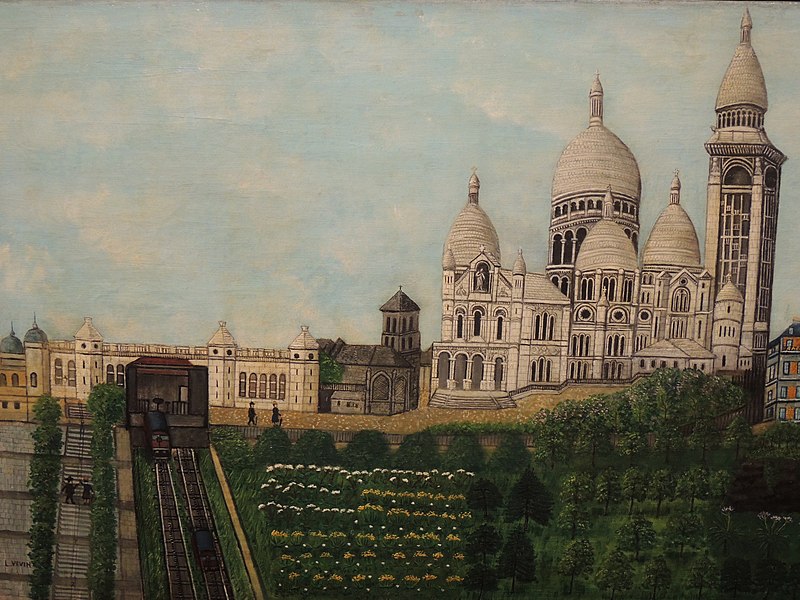
Louis Vivin, Le Sacré-Cœur, huile sur toile
Louis Vivin · Musée Maillol

Museum of naive arts and singular arts, int he Old Castle of Laval (Mayenne, France): Louis Vivin, Paris, Panthéon, 1936
Fab5669
Places
Named by the record
Places
Only places the record itself states, plotted where the house gazetteer settles their coordinates. Nothing is inferred from a name or a nationality.
Hadol.
Birth place
Paris.
Death place
Primary material
Documents and archives
reference work
- “Louis Vivin”, English Wikipedia, consulted as further reading
Reputable secondary · Wikipedia
authority record
- Wikidata, structured authority record Q1563526: Louis Vivin
General reference · Wikidata
References
Citations
References
Each reference names the institution holding it, so a reader may go to the document itself.
reference work
Secondary witnessauthority record
General reference
People, houses and institutions
Knowledge graph
People, houses and institutions
Teachers, collaborators, publishers and institutions recorded against this person, each on a stated basis.
Died at
1- ParisPlace
Established from a fact already recorded on a verified source.
The Encyclopedia exists whether or not anything is for sale. Corrections are recorded rather than overwritten, and every version of this record is kept. Published 17 August 2026.
Elsewhere in Paintings
19,183 published records in this field, each with its sources named.
- Louis TestelinArtist
- Louis ValtatArtist
- Louis Van LintArtist
- Louis VigéeArtist
- Louis Welden HawkinsArtist
- Louis-Abraham van LooArtist
- Louis-Aimé GrosclaudeArtist
- Louis-Albert CarvinArtist
Best supported in this field
For owners
Own a work by Louis Vivin?
A specialist will read what you send and tell you what the house can establish, what it cannot, and whether the object is suited to sale. There is no charge and no obligation. The object stays with you throughout; nothing is shipped to us unless it is arranged in writing beforehand.