
Lois Howe
Lois Lilley Howe (September 25, 1864 – September 13, 1964) was an American architect and founder of the first all female architecture firm in Boston, Massachusetts.
Also recorded as Lois Lilley Howe
Lois Howe

Daderot · Public domain
- Name
- Lois Lilley Howe
- Born
- 25 September 1864
- Birthplace
- Cambridge, Massachusetts
- Died
- 13 September 1964
- Awards
- American Institute of Architecture Fellow
- Nationality
- United States
- Occupation
- architect
- Education
- Massachusetts Institute of Technology
- Languages
- English
VALÉORINE Encyclopedia
VALÉORINE documentary reading
Documentary summary
Lois Lilley Howe (September 25, 1864 – September 13, 1964) was an American architect and founder of the first all female architecture firm in Boston, Massachusetts.
Admitted source layer · organised and presented by VALÉORINE
Reference Check
Propose documentary evidence for Lois Howe. A contribution is never written directly as fact: identity, source, rights and evidence gates still decide.
Sign in to contribute
World of VALÉORINE
Documentary connections
Only confirmed graph relationships appear here. Images are shown only when their identity and reuse rights both pass the documentary gate.

Documentary evidence
Documentary basis
Authority files
wikidata · Q18640652 · wikipedia · Lois Howe
In this article
Key facts
Key facts
• Name — Lois Lilley Howe • Born — 25 September 1864 • Birthplace — Cambridge, Massachusetts • Died — 13 September 1964 • Place of death — Cambridge, Massachusetts • Awards — American Institute of Architecture Fellow • Practice — Howe, Manning & Almy, Inc.
Biography
Biography
• Illustration — Lois Lilley Howe House (1889-1964), 6 Appleton Street, Cambridge, Massachusetts, USA (National Register of Historic Places) Howe was born in Cambridge, Massachusetts. Howe studied at the School of the Museum of Fine Arts, Boston from 1882-1886 rather than attending Harvard Annex (later known as Radcliffe College). She later studied architecture at the Massachusetts Institute of Technology, which, by virtue of its land grant status, was one of only six American schools of architecture that admitted women before 1910. Howe graduated in 1890. In a class of only 66 students, she was the only woman. After graduation she worked in the offices of Allen and Kenway (later renamed Allen & Collens). She placed second, after Sophia Hayden, in a competition to design the Women's Building at the Chicago World's Fair. Howe opened her own architecture office in 1894. At first, her projects consisted of new or remodeled houses for friends and acquaintances, but her efforts soon began to pay off in more commissions. By 1900, she had enough work to set up an office in downtown Boston. In 1907, she advocated for an innovative use of plaster, authoring articles in Architectural Review and Architectural Record. She had a passion for history and architecture details, which emerged not only in her work, but also in a book she published in 1913 with Constance Fuller, another MIT graduate, entitled Details of Old New England Houses. In 1913, she partnered with Eleanor Manning and in 1926 Mary Almy joined the firm which then became Howe, Manning & Almy, Inc. Architect Eliza Newkirk Rogers worked for Howe before starting her own practice in 1913. For a short time around 1920, the landscape architect Elizabeth Greenleaf Pattee worked for Howe. During her career, Howe was president of the Business Women's Club of Boston and president of the MIT Women's Association. She served on the Boston Society of Architect's Small House Bureau, the AIA Committee on Small Houses, and was appointed to the Board of Directors of the Housing Association of Metropolitan Boston. Howe was 73 when she retired in 1937; Howe, Manning & Almy, Inc. dissolved and her partners launched independent practices. Long after she finished practicing architecture, she continued to practice history, giving talks at the Cambridge Historical Society, trying to recall for younger members Cambridge as it was in her girlhood. Howe died in 1964, just short of her one-hundredth birthday.
Projects
Projects
Originally, Howe founded her firm in Boston on Tremont Street in Boston taking commissions for renovations and new housing. One early renovation was the Hooper-Eliot House in 1902, where she "added the broken scroll–pedimented doorway." • Illustration — Hooper-Eliot House, 1872, Sturgis and Brigham; 1902, Lois Lilley Howe. 25 Reservoir St. With her firm partners, Howe, Manning & Almy completed over 426 commissions and 500 projects (most of which are still standing) over 43 years of practice. The geography, design, and craftsmanship have resulted in "comfortable and attractive dwellings" whose value have appreciated, compared to similar properties in the region. One of Howes first original designs was 1 Kennedy Road in Cambridge, MA. This home was dates to 1894 and was created by Howe for her newlywed friends. While the original building showed Howes untested design skills, in 1913 she renovated the home to the one still found today. • Commission Number — Building Name — Year — Location — Other Information — Reference • 243 — Walnut Hill School — 1913 — 12 Highland St, Natick, Massachusetts 01760 • 398 — Suffrage Coffee House — 1917 • 408 — Lucy Stone Hospital — 1918 • 414 — Boston Army and Navy Canteen — 1918 • 537 — The College Club of Boston — 1923 • 574 — McCall's Magazine — 1923-24 • 586 — Chec-R Shoe Store — 1923 • 596 — Women’s Republican Club — 1924 • 640 — Simmons University — 1925-26 — 300 Fenway, Boston, MA 02115
Identity and overview
Identity and overview
The canonical record carries the following identifying particulars.
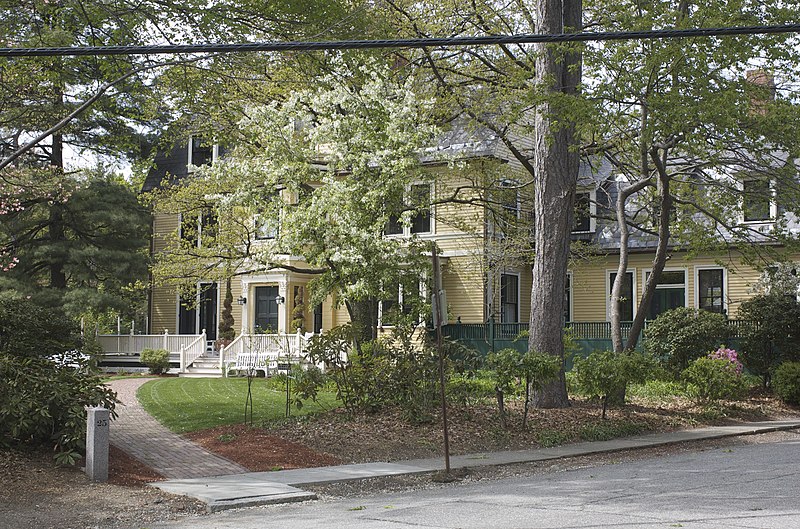
The Hooper-Eliot House at 25 Reservoir Road, Cambridge, Massachusetts. Listed on the National Register of Historic Places.
Tim Pierce
Legacy
Lois Lilley Howe's papers reside in the collection for Howe, Manning, and Almy at MIT. The Lois Lilley Howe photographic collection is housed at the Cambridge Historical Society.
Awards and recognition
She received her first acclaim in 1893 where she was a second place winning in the national competition for the Woman's Building at the World's Columbian Exhibition in Chicago. In 1901, Howe became the second woman member of the American Institute of Architecture (AIA). In 1931, she was elected the first female Fellow of the AIA. Many of their designs were featured in articles and books of House Beautiful and Architecture, extolling the best small houses.
Notes from the source article
Cited by Wikipedia
Notes from the source article
These works are cited by the source article, in its own numbering. They are recorded as its citations, not as sources VALÉORINE has verified.
- 1.Pioneering Women of American Architecture. pioneeringwomen.bwaf.org.
- 2.Lois Lilley Howe: Pioneer Career Woman, Architect, Cambridge Citizen. History Cambridge.
- 3.Constructing a Place for Female Architects: Lois Lilley Howe, Class of 1890 (from Technology Review). MITARCHA. 2019-04-08.
- 4.Cole, Taylor, Doris, Karen Cord. The Lady Architects: Lois Lilley Howe, Elenaor Manning and Mary Almy, 1893-1937. Midmarch Arts Press. 1990. 1-187675-01-6.
- 5.Sarah Allaback. The first American women architects. University of Illinois Press. 104. 23 May 2008. 978-0-252-03321-6.
- 6.Gilder, Karen Van. Lois Lilley Howe -- NRHP Travel Itinerary. www.nps.gov.
- 7.Lois Lilley Howe. Back Bay Houses: Genealogies of Back Bay Houses.
- 8.Lois Lilley Howe Photographic Collection, (1884-1912) Cambridge Historical Society. cambridgehistory.org.
- 9.Hays, Johanna. Louise Blanchard Bethune: America's First Female Professional Architect. McFarland, 2014, pp. 20-21.
- 10.Boston Globe. Lois Howe, 99, Dies; Early Woman Architect. 15 September 1964.
- 11.Pioneering Women of American Architecture. pioneeringwomen.bwaf.org.
- 12.pls4e. Hooper-Eliot House. SAH ARCHIPEDIA. 2018-07-17.
- 13.Original Designs. History Cambridge.
- 14.Cambridge History Minute: The Story Behind the 'Potter House'. Cambridge, MA Patch. 2016-11-18.
- 15.Damme, Marieke Van. Lois Lilley Howe pioneered as female architect, and her homes are still found throughout city. Cambridge Day. 2021-01-25.
- 16.Guide to the Records of Howe, Manning & Almy, Inc. and the Papers of Lois Lilley Howe, Eleanor Manning O'Connor, and Mary Almy MC.0009. libraries.mit.edu.
- 17.Year 53 – 1913: Details from Old New England Houses, measured and drawn by Lois L. Howe and Constance Fuller 150 Years in the Stacks.
Bibliography printed in the source article · 3
- Pioneering Women of American Architecture, Lois Lilley Howe
- Howe, Lois. An Alumna's Architectural Career. Technology Review. 66. 21, 38. December 1963.
- Lois Lilley Howe History Hub - History Cambridge
References
Citations
References
Each reference names the institution holding it, so a reader may go to the document itself.
reference work
Secondary witnessreference work
Secondary witness
The Encyclopedia exists whether or not anything is for sale. Corrections are recorded rather than overwritten, and every version of this record is kept. Published 16 August 2026.
Elsewhere in Design
11,558 published records in this field, each with its sources named.
- Lodovico Barbiano di BelgiojosoDesigner
- Lodovico BerettaDesigner
- Lodovico BurnaciniDesigner
- Logi Már EinarssonDesigner
- Lone WiggersDesigner
- Lord Livingstone RamsayDesigner
- Lorenz LechlerDesigner
- LorenzettoDesigner
Best supported in this field
For owners
Own a work by Lois Howe?
A specialist will read what you send and tell you what the house can establish, what it cannot, and whether the object is suited to sale. There is no charge and no obligation. The object stays with you throughout; nothing is shipped to us unless it is arranged in writing beforehand.