
Konrad Zuse
Konrad Ernst Otto Zuse (lang; 22 June 1910 – 18 December 1995) was a German civil engineer, pioneering computer scientist, inventor and businessman. His greatest achievement was the world's first programmable computer; the functional program-controlled Turing-complete Z3 became operational in May 1941. Thanks to this machine and its predecessors, Zuse is regarded by some as the inventor and father of the modern computer.
Also recorded as Zuse
Konrad Zuse

Heinz Nixdorf MuseumsForum · Heinz Nixdorf MuseumsForum, durch Norbert Ryska, Geschäftsführer des Heinz Nixdorf MuseumsForum · CC BY-SA 3.0 de
- Name
- Konrad Zuse
- Born
- 22 June 1910
- Birth Name
- Konrad Ernst Otto Zuse
- Birthplace
- Berlin, Prussia, German Empire
- Died
- 18 December 1995
- Place of death
- Hünfeld, Hesse, Germany
- Field
- * Computer science
- Education
- Technische Universität Berlin
- Known for
- * Z3, Z4
- Awards
- * Werner von Siemens Ring in 1964
- Nationality
- Germany.
- Occupation
- inventor, entrepreneur, computer scientist, engineer, civil engineer and painter.
VALÉORINE Encyclopedia
VALÉORINE documentary reading
Documentary summary
Konrad Ernst Otto Zuse (lang; 22 June 1910 – 18 December 1995) was a German civil engineer, pioneering computer scientist, inventor and businessman. His greatest achievement was the world's first programmable computer; the functional program-controlled Turing-complete Z3 became operational in May 1941. Thanks to this machine and its predecessors, Zuse is regarded by some as the inventor and father of the modern computer.
Admitted source layer · organised and presented by VALÉORINE
Note VALÉORINE
Konrad Zuse (1910–1995) was a civil engineer, computer scientist and engineer, among other activities, of German nationality. The civil engineer worked in Germany. Among the works are Z1, Z11, Z2 and Z3, among others.
Composed from admitted, traceable facts · 27 September 2026
VALÉORINE
Reference Check
Propose documentary evidence for Konrad Zuse. A contribution is never written directly as fact: identity, source, rights and evidence gates still decide.
Sign in to contribute
Documentary evidence
Evidence Panel
not yet certified
- Identity
- resolved
- Independent source families
- 0
- Admitted assertions
- 0
- Open conflicts
- 0
Authority files
gnd · 1114670375 · wikidata · Q60093 · wikipedia · Konrad Zuse
In this article
Biography
Biography
Zuse was noted for the S2 computing machine, considered the first process control computer. In 1941, he founded one of the earliest computer businesses, producing the Z4, which became the world's first commercial computer. From 1943 to 1945 he designed Plankalkül, the first high-level programming language. In 1969, Zuse suggested the concept of a computation-based universe in his book Rechnender Raum (Calculating Space). Much of his early work was financed by his family and commerce, but after 1939 he was given resources by the government of Nazi Germany. Due to World War II, Zuse's work went largely unnoticed in the United Kingdom and United States. Possibly his first documented influence on a US company was IBM's option on his patents in 1946. The Z4 also served as the inspiration for the construction of the ERMETH, the first Swiss computer and one of the first in Europe.
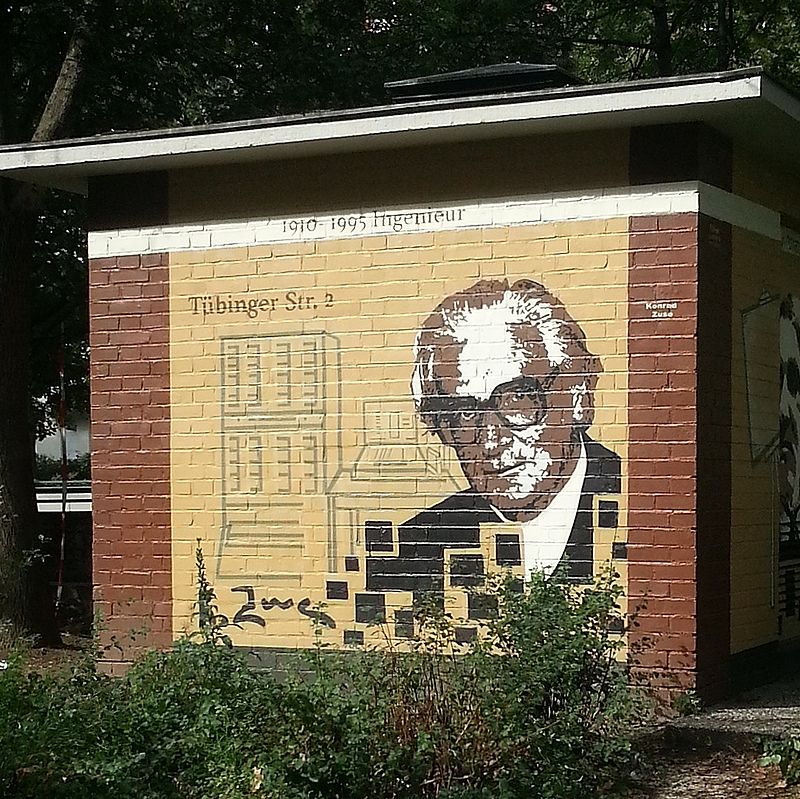
Image of Konrad Zuses (1910–1995) in the Bundesallee street in Berlin. Besides, his birth place is Tübinger street 2 is mentioned.
Mellebga

This picture shows a vacuum tube from a ZUSE Z22 computer.
Sammlung der Medien und Wissenschaft
Key facts
Key facts
• Name — Konrad Zuse • Born — 22 June 1910 • Birth Name — Konrad Ernst Otto Zuse • Birthplace — Berlin, Prussia, German Empire • Died — 18 December 1995 • Place of death — Hünfeld, Hesse, Germany • Field — * Computer science • Computer engineering • Workplaces — Aerodynamic Research Institute • Education — Technische Universität Berlin • Known for — * Z3, Z4 • Plankalkül • Calculating Space (cf. digital physics) • Montagestraße SRS 72 • Helixturm • Awards — * Werner von Siemens Ring in 1964 • Harry H. Goode Memorial Award in 1965 (together with George Stibitz) • Wilhelm Exner Medal, 1969 • Order of Merit of the Federal Republic of Germany in 1972 • Computer History Museum Fellow Award in 1999
Early life and education
Early life and education
Konrad Zuse was born in Berlin on 22 June 1910. In 1912, his family moved to East Prussian Braunsberg (now Braniewo in Poland), where his father was a postal clerk. Zuse attended the Collegium Hosianum in Braunsberg, and in 1923, the family moved to Hoyerswerda, where he passed his Abitur in 1928, qualifying him to enter university. He enrolled at Technische Hochschule Berlin (now Technische Universität Berlin) and explored both engineering and architecture, but found them boring. Zuse then pursued civil engineering, graduating in 1935.
Career
Career
After graduation, Zuse worked for the Ford Motor Company, using his artistic skills in the design of advertisements. He started work as a design engineer at the Henschel aircraft factory in Schönefeld near Berlin. This required the performance of many routine calculations by hand, leading him to theorize and plan a way of doing them by machine. Beginning in 1935, he experimented in the construction of computers in his parents' flat on Wrangelstraße 38, moving with them into their new flat on Methfesselstraße 10, the street leading up the Kreuzberg, Berlin. Working in his parents' apartment in 1936, he produced his first attempt, the Z1, a floating-point binary mechanical calculator with limited programmability, reading instructions from a perforated 35 mm film. • Illustration — Zuse Z1 replica in the German Museum of Technology in Berlin In 1937, Zuse submitted two patents that anticipated a von Neumann architecture. In 1938, he finished the Z1 which contained some 30,000 metal parts and never worked well due to insufficient mechanical precision. On 30 January 1944, the Z1 and its original blueprints were destroyed with his parents' flat and many neighbouring buildings by a British air raid in World War II. Zuse completed his work entirely independently of other leading computer scientists and mathematicians of his day. Between 1936 and 1945, he was in near-total intellectual isolation.
1939–1945
1939–1945
• Illustration — Plaque commemorating Zuse's work, attached to the ruin of Methfesselstraße 7, Berlin In 1939, Zuse was called to military service, where he was given the resources to ultimately build the Z2. In September 1940 Zuse presented the Z2, covering several rooms in the parental flat, to experts of the Deutsche Versuchsanstalt für Luftfahrt (DVL; German Research Institute for Aviation). The Z2 was a revised version of the Z1 using telephone relays. In 1940, the German government began funding him and his company through the Aerodynamische Versuchsanstalt (AVA, Aerodynamic Research Institute, forerunner of the DLR), which used his work for the production of glide bombs. Zuse built the S1 and S2 computing machines, which were special purpose devices which computed aerodynamic corrections to the wings of radio-controlled flying bombs. The S2 featured an integrated analog-to-digital converter under program control, making it the first process-controlled computer. In 1941 Zuse started a company, Zuse Apparatebau (Zuse Apparatus Construction), to manufacture his machines, renting a workshop on the opposite side in Methfesselstraße 7 and stretching through the block to Belle-Alliance Straße 29 (renamed and renumbered as Mehringdamm 84 in 1947). In 1941, he improved on the basic Z2 machine, and built the Z3. On 12 May 1941 Zuse presented the Z3, built in his workshop, to the public. The Z3 was a binary 22-bit floating-point calculator featuring programmability with loops but without conditional jumps, with memory and a calculation unit based on telephone relays. The telephone relays used in his machines were largely collected from discarded stock. Despite the absence of conditional jumps, the Z3 was a Turing complete computer. However, Turing-completeness was never considered by Zuse (who was unaware of Turing's work and had practical applications in mind) and only demonstrated in 1998 (see History of computing hardware). The Z3, the first fully operational electromechanical computer, was partially financed by German government-supported DVL, which wanted their extensive calculations automated. A request by his co-worker Helmut Schreyer—who had helped Zuse build the Z3 prototype in 1938 —for government funding for an electronic successor to the Z3 was denied as "strategically unimportant". • Illustration — Statue of Zuse in Bad Hersfeld In 1937, Schreyer had advised Zuse to use vacuum tubes as switching elements; Zuse at this time considered it a "crazy idea" (Schnapsidee in his own words). Zuse's workshop on Methfesselstraße 7 (along with the Z3) was destroyed in an Allied Air raid in late 1943 and the parental flat with Z1 and Z2 on 30 January the following year, whereas the successor Z4, which Zuse had begun constructing in 1942 in new premises in the Industriehof on Oranienstraße 6, remained intact. On 3 February 1945, aerial bombing caused devastating destruction in the Luisenstadt, the area around Oranienstraße, including neighbouring houses. This event effectively brought Zuse's research and development to a complete halt. The partially finished, telephone relay-based Z4 computer was then packed and moved from Berlin on 14 February, arriving in Göttingen approximately two weeks later. These machines contributed to the Henschel Werke Hs 293 and Hs 294 guided missiles developed by the German military between 1941 and 1945, which were the precursors to the modern cruise missile. The circuit design of the S1 was the predecessor of Zuse's Z11. Zuse believed that these machines had been captured by occupying Soviet troops in 1945. While working on his Z4 computer, Zuse realised that programming in machine code was too complicated. He started working on a PhD thesis detailing the first high-level programming language, Plankalkül ("Plan Calculus") and, as an elaborate example program, the first real computer chess engine.
1945–1995
1945–1995
After the 1945 Luisenstadt bombing, he fled from Berlin to the rural Allgäu. In the extreme deprivation of post-war Germany Zuse was unable to build computers. Zuse founded one of the earliest computer companies: the Zuse-Ingenieurbüro Hopferau. Capital was raised in 1946 through ETH Zurich and an IBM option on Zuse's patents. In 1947, according to the memoirs of the German computer pioneer Heinz Billing from the Max Planck Institute for Physics, there was a meeting between Alan Turing and Konrad Zuse in Göttingen. The encounter had the form of a colloquium. Participants were John Womersley, Turing, Arthur Porter from England and a few German researchers like Zuse, Helmut Schreyer, Alwin Walther, and Billing. (For more details see Herbert Bruderer, Konrad Zuse und die Schweiz). It was not until 1949 that Zuse was able to resume work on the Z4. He would show the computer to the mathematician Eduard Stiefel of the ETH Zurich. The two men settled a deal to lend the Z4 to the ETH. • Illustration — Zuse's workshop at Neukirchen, 2010 In November 1949, Zuse founded another company, Zuse KG, in Haunetal-Neukirchen; in 1957, the company's head office moved to Bad Hersfeld. The Z4 was finished and delivered to the ETH Zurich in July 1950, where it proved very reliable. At that time, it was the only working digital computer in Central Europe, and the second computer in the world to be sold or loaned, beaten only by the BINAC, which never worked properly after it was delivered. Other computers, all numbered with a leading Z, up to Z43, were built by Zuse and his company. Notable are the Z11, which was sold to the optics industry and to universities, and the Z22, the first computer with a memory based on magnetic storage. Unable to do any hardware development, he continued working on Plankalkül, eventually publishing some brief excerpts of his thesis in 1948 and 1959; the work in its entirety, however, remained unpublished until 1972. The PhD thesis was submitted at University of Augsburg, but it was rejected because Zuse forgot to pay the DM 400 university enrollment fee. The rejection did not bother him. Plankalkül slightly influenced the design of ALGOL 58 but was itself implemented only in 1975 in a dissertation by Joachim Hohmann. Heinz Rutishauser, one of the inventors of ALGOL, wrote: "The very first attempt to devise an algorithmic language was undertaken in 1948 by K. Zuse. His notation was quite general, but the proposal never attained the consideration it deserved." Further implementations followed in 1998 and then in 2000 by a team from the Free University of Berlin. Donald Knuth suggested a thought experiment: What might have happened had the bombing not taken place, and had the PhD thesis accordingly been published as planned? • Illustration — Z64 Graphomat plotter In 1956, Zuse began to work on a high precision, large format plotter. It was demonstrated at the 1961 Hanover Fair, and became well known also outside of the technical world thanks to Frieder Nake's pioneering computer art work. Other plotters designed by Zuse include the ZUSE Z90 and ZUSE Z9004. • Illustration — An elementary process in Zuse's Calculating Space: Two digital particles A and B form a new digital particle C. In 1967, Zuse suggested that the universe itself is running on a cellular automaton or similar computational structure (digital physics); in 1969, he published the book Rechnender Raum (translated into English as Calculating Space). HelixturmBetween 1989 and 1995, Zuse conceptualized and created a purely mechanical, extensible, modular tower automaton he named "helix tower" ("Helixturm"). The structure is based on a gear drive that employs rotary motion (e.g. provided by a crank) to assemble modular components from a storage space, elevating a tube-shaped tower; the process is reversible, and inverting the input direction will deconstruct the tower and store the components. In 2009, the Deutsches Museum restored Zuse's original 1:30 functional model that can be extended to a height of 2.7 m. Zuse intended the full construction to reach a height of 120 m, and envisioned it for use with wind power generators and radio transmission installations. Between 1987 and 1989, Zuse recreated the Z1, suffering a heart attack midway through the project. It cost 800,000 DM (approximately $500,000) and required four individuals (including Zuse) to assemble it. Funding for this retrocomputing project was provided by Siemens and a consortium of five companies.
Personal life
Personal life
• Illustration — Zuse Memorial in Hünfeld, Hesse Konrad Zuse married Gisela Brandes in January 1945, employing a carriage, himself dressed in tailcoat and top hat and with Gisela in a wedding veil, for Zuse attached importance to a "noble ceremony". Their son Horst, the first of five children, was born in November 1945. While Zuse never became a member of the Nazi Party, he is not known to have expressed any doubts or qualms about working for the Nazi war effort. Much later, he suggested that in modern times, the best scientists and engineers usually have to choose between either doing their work for more or less questionable business and military interests in a Faustian bargain, or not pursuing their line of work at all. After Zuse retired, he focused on his hobby of painting. He signed his paintings as "Kuno [von und zu] See". Zuse was an atheist. Zuse died on 18 December 1995 in Hünfeld, Hesse (near Fulda) from heart failure.
Career and activity
Career and activity
Konrad Zuse worked in computer science. He was employed by Henschel & Sohn, Aerodynamics Research Institute, Zuse KG and Siemens. He belonged to German Academy of Sciences Leopoldina and Akademischer Verein Motiv Berlin. He worked at Germany.
Identity
Identity
Konrad Zuse is recorded with the occupation computer scientist. Recorded with the occupation civil engineer. Recorded as inventor, entrepreneur, computer scientist and engineer.
Life and career
Dated record
Life and career
Explore 1910–1995
The full dated record · 3 entries
1910
Konrad Zuse was born on 22 June 1910.
1952
Bedienungsanweisung für Zuse Z4 (1952) is digitised and catalogued by Internet Archive.
1995
Konrad Zuse died on 18 December 1995.
Recognition and collections
Where the work is held
Recognition and collections
Konrad Zuse received Wilhelm Leuschner Medal, Werner von Siemens Ring, Great Cross with Star and Sash of the Order of Merit of the Federal Republic of Germany, Ernst Reuter Medal, Rudolf-Diesel-Medaille and Wilhelm Exner Medal.
Documents and archives
Primary material
Documents and archives
Institutional database
- Wikidata, structured authority record Q60093: Konrad Zuse
Scholarly · Wikimedia Foundation
authority file
- Gemeinsame Normdatei 1114670375, Visionen - Konrad Zuse.
Unverified · Deutsche Nationalbibliothek
reference work
- “Konrad Zuse”, English Wikipedia, consulted as further reading
Reputable secondary · Wikipedia
Awards and honours
• Illustration — Magnetic drum storage inside a Z31 (which was first displayed in 1963) Zuse received several awards for his work: • Werner von Siemens Ring in 1964 (together with Fritz Leonhardt and Walter Schottky) • Harry H. Goode Memorial Award in 1965 (together with George Stibitz) • Wilhelm Exner Medal in 1969. • Bundesverdienstkreuz in 1972 – Great Cross of Merit • Computer History Museum Fellow Award in 1999 "for his invention of the first program-controlled, electromechanical, digital computer and the first high-level programming language, Plankalkül." The Zuse Institute Berlin is named in his honour. The Konrad Zuse Medal of the Gesellschaft für Informatik, and the Konrad Zuse Medal of the Zentralverband des Deutschen Baugewerbes (Central Association of German Construction), are both named after Zuse. A replica of the Z3, as well as the original Z4, is in the Deutsches Museum in Munich. The Deutsches Technikmuseum in Berlin has an exhibition devoted to Zuse, displaying twelve of his machines, including a replica of the Z1 and several of Zuse's paintings. The 100th anniversary of his birth was celebrated by exhibitions, lectures and workshops.
Notes from the source article
Cited by Wikipedia
Notes from the source article
These works are cited by the source article, in its own numbering. They are recorded as its citations, not as sources VALÉORINE has verified.
- 1.Springer Vieweg / Springer Fachmedien Wiesbaden GmbH. Selbstreproduzierende Maschinen: Konrad Zuses Montagestraße SRS 72 und ihr Kontext. 2016. 978-3-658-12941-5.
- 2.Lehrstuhl für Restaurierung, Kunsttechnologie und Konservierungswissenschaft, Technische Universität München (TUM). Der Helixturm von Konrad Zuse – Analyse, Dokumentation und Instandsetzung eines höhenverstellbaren Turmmodells, 1989 bis 1995, im Deutschen Museum in München. 2009.
- 3.The helix tower by Konrad Zuse: Automated con- and deconstruction. 2010.
- 4.editor, ÖGV. (2015). Wilhelm Exner Medal. Austrian Trade Association. ÖGV. Austria.
- 5.13m02s.
- 6.Rojas, Raúl. Konrad Zuse's Legacy: The Architecture of the Z1 and Z3. IEEE Annals of the History of Computing. 19. 2. 5–16. 1997. 10.1109/85.586067.
- 7.Flippo, Hyde. Konrad Zuse: The first programmable, digital computer. german-way.com. The German Way & More.
- 8.von Leszczynski, Ulrike. Z like Zuse: German inventor of the computer. monstersandcritics.com. Deutsche Presse-Agentur. 27 June 2010.
- 9.Bellis, Mary. Biography of Konrad Zuse, Inventor and Programmer of Early Computers. thoughtco.com. Dotdash Meredith. 15 May 2019.
- 10.Who is the Father of the Computer?.
- 11.Bruderer, Herbert. Milestones in Analog and Digital Computing. Springer. 13, 961. 2021. 978-3030409739.
- 12.Bruderer, Herbert. Milestones in Analog and Digital Computing. Springer. 14. 2021. 978-3030409739.
- 13.Zuse, Konrad (1943), "Ansätze einer Theorie des allgemeinen Rechnens unter besonderer Berücksichtigung des Aussagenkalküls und dessen Anwendung auf Relaisschaltungen" [Inception of a universal theory of computation with special consideration of the propositional calculus and its application to relay circuits], unpublished manuscript, Zuse Papers 045/018.
- 14.A book on the subject: (full text of the 1945 manuscript)
- 15.Rechnender Raum. Elektronische Datenverarbeitung. 8. 336–344. 1967.
- 16.Friedrich Vieweg & Sohn. Rechnender Raum. 1. 1969. 3-528-09609-8.
- 17.World Scientific. A Computable Universe: Understanding & Exploring Nature as Computation. 2012.
- 18."Weapons Grade: How Modern Warfare Gave Birth To Our High-Tech World", David Hambling. Carroll & Graf Publishers, 2006. , . Retrieved 14 March 2010.
- 19.Schmidhuber, Jürgen. 1941: Konrad Zuse completes the first working general-purpose computer, based on his 1936 patent application. Universita della Svizzera Italiana. 19 August 2021.
- 20.Bruderer, Herbert. Milestones in Analog and Digital Computing. Springer. 1009, 1087. 2021. 978-3030409739.
- 21.Schofield, Jack. Konrad Zuse: First on the digital track. The Guardian. 13. 20 December 1995.
- 22.Talk given by Horst Zuse to the Computer Conservation Society at the Science Museum (London) on 18 November 2010
- 23.Lee, J. A. N. Konrad Zuse. computer.org. IEEE Computer Society and the Institute of Electrical and Electronics Engineers Inc. 1995.
- 24.Nicolai. Der Computer – eine Erfindung aus Kreuzberg, Methfesselstraße 10/Oranienstraße 6. 5: Kreuzberg. 418–429. 1994. 3-87584-474-2.
- 25."Konrad Zuse" , Gap System. Retrieved 14 March 2010.
- 26."Mathematicians during the Third Reich and World War II" , Technical University of Munich. Retrieved 14 March 2010.
- 27.Springer-Verlag. The Computer, My Life. 12–13, 75. 1993. 978-3-540-56453-9.
- 28.Lippe, Wolfram-M. Die Geschichte der Rechenautomaten.
- 29.Kathrin Chod, Herbert Schwenk and Hainer Weißpflug, Berliner Bezirkslexikon: Friedrichshain-Kreuzberg, Berlin: Haude & Spener / Edition Luisenstadt, 2003, p. 52. .
- 30.St. Amant, Kirk; Still, Brian. Handbook of research on open source software Idea Group. 2007. . Retrieved 14 March 2010.
- 31.Außenseiter Verlag. Bomber über Kreuzberg. Kreuzberger Chronik. 131. October 2011.
- 32."Germany's Secret Weapons in World War II", Roger Ford. Zenith Imprint, 2000. , . Retrieved 14 March 2010.
- 33., Atypon Link. Retrieved 14 March 2010.
- 34.Konrad Zuse: Der Plankalkül . PhD thesis, 1945
- 35.Knuth & Pardo: The early development of programming languages. In Nicholas Metropolis (Ed): History of Computing in the Twentieth Century, p. 203.
- 36.Konrad Zuse im Schloss zu Hopferau. www.hopferau.de.
- 37.Schmidhuber, Jürgen. 1941: Konrad Zuse completes the first working general-purpose computer, based on his 1936 patent application. Universita della Svizzera Italiana. 19 August 2021.
- 38.Bruderer, Herbert. Did Alan Turing interrogate Konrad Zuse in Göttingen in 1947?.
- 39.Kapitel 14 – Die ersten programmierbaren Rechner. 13 April 2010.
- 40.Bruderer (2021), p. 1098
- 41.Part 7 (continued): The Zuse KG. 28 December 2008.
- 42.The Life and Work of Konrad Zuse. 18 April 2010.
- 43.Ursula Walk, geb. 1925. www.get-it.tu-berlin.de.
- 44.Rojas, Raúl. The First Computers: History and Architectures. MIT Press. 292. 2002. 978-0-262-68137-7.
- 45.Joachim Hohmann: Der Plankalkül im Vergleich mit algorithmischen Sprachen. Reihe Informatik und Operations Research, S. Toeche-Mittler Verlag, Darmstadt 1979, .
- 46.Graphomat Z64 (in German). www.zuse.de.
- 47.Pioneer Work: Frieder Nake. www.heikewerner.com.
- 48.Rechnender Raum (PDF), Elektronische Datenverarbeitung, 8: 336–344, 1967.
- 49.Deutsches Museum. Automata and punched card machines: Helix tower. 2015.
- 50.Michael Imhof Verlag. Konrad Zuse: Erfinder, Unternehmer, Philosoph und Künstler. 69–75 [70–71]. 26 October 2011. 978-3-86568-743-2.
- 51.Rojas, Paul. Reconstruction of the Z1 Computer. Paul Rojas, Professor of Artificial Intelligence. August 2015.
- 52.Springer-Verlag. Der Computer – Mein Lebenswerk. X. 1984. 3-540-56292-3.
- 53.History Computer. Konrad Zuse – Biography, History and Inventions. 4 January 2021.
- 54.Jane Smiley. The Man Who Invented the Computer: The Biography of John Atanasoff, Digital Pioneer. Random House Digital, Inc. 2010. 978-0-385-52713-2.
- 55.Martin Campbell-Kelly. OBITUARY : Konrad Zuse. The Independent. 21 December 1995.
- 56.Lee, J. A. N. Konrad Zuse. ei.cs.vt.edu. 30 September 2004.
- 57.Computer History Museum. Konrad Zuse: 1999 Fellow. computerhistory.org.
- 58.Zwernemann-Blech, Irene. Zuse-Jahr 2010. www.horst-zuse.homepage.t-online.de.
- 59.Zuse-Jahr 2010 – zum 100. Geburtstag des Computerpioniers Konrad Zuse Deutsches Technikmuseum Berlin, 19 April 2010
Bibliography printed in the source article · 15
- Zuse, Konrad. Direction-bound engraving tool with program control. U.S. Patent 3163936
- U.S. Patents 3234819; 3306128; 3408483; 3356852; 3316442
- Jürgen Alex, Hermann Flessner, Wilhelm Mons, Horst Zuse: Konrad Zuse: Der Vater des Computers. Parzeller, Fulda 2000,
- Raul Rojas (ed.): Die Rechenmaschinen von Konrad Zuse. Springer, Berlin 1998, .
- Wilhelm Füßl (ed.): 100 Jahre Konrad Zuse. Einblicke in den Nachlass, München 2010, .
- Jürgen Alex: "Wege und Irrwege des Konrad Zuse." In: Spektrum der Wissenschaft (German edition of Scientific American) 1/1997, .
- Hadwig Dorsch: Der erste Computer. Konrad Zuses Z1 – Berlin 1936. Beginn und Entwicklung einer technischen Revolution. Mit Beiträgen von Konrad Zuse und Otto Lührs. Museum für Verkehr und Technik, Berlin 1989.
- Clemens Kieser: "'Ich bin zu faul zum Rechnen': Konrad Zuses Computer Z22 im Zentrum für Kunst und Medientechnologie Karlsruhe." In: Denkmalpflege in Baden-Württemberg, 4/34/2005, Esslingen am Neckar, S. 180–184, .
- Mario G. Losano (ed.), Zuse. L'elaboratore nasce in Europa. Un secolo di calcolo automatico, Etas Libri, Milano 1975, pp. XVIII–184.
- Arno Peters: Was ist und wie verwirklicht sich Computer-Sozialismus: Gespräche mit Konrad Zuse. Verlag Neues Leben, Berlin 2000, .
- Paul Janositz: Informatik und Konrad Zuse: "Der Pionier des Computerbaus in Europa – Das verkannte Genie aus Adlershof." In: Der Tagesspiegel Nr. 19127, Berlin, 9. März 2006, Beilage Seite B3.
- Jürgen Alex: Zum Einfluß elementarer Sätze der mathematischen Logik bei Alfred Tarski auf die drei Computerkonzepte des Konrad Zuse. TU Chemnitz 2006.
- VDI-Verlag. Zur Entstehung des Computers – Von Alfred Tarski zu Konrad Zuse […] – Tertium non datur. 2007. 978-3-18-150051-4.
- Herbert Bruderer: Konrad Zuse und die Schweiz. Wer hat den Computer erfunden? Charles Babbage, Alan Turing und John von Neumann Oldenbourg Verlag, München 2012, XXVI, 224 Seiten,
- Raúl Rojas: Konrad Zuse's Early Computers. The Quest for the Computer in Germany, Springer Nature Switzerland Springer, Cham, 2023
References
Citations
References
Each reference names the institution holding it, so a reader may go to the document itself.
Institutional database
Wikidata, structured authority record Q60093: Konrad ZuseWikimedia Foundation
Verifiedauthority file
Gemeinsame Normdatei 1114670375, Visionen - Konrad Zuse.Deutsche Nationalbibliothek
Partially resolvedreference work
Partially resolved
Further particulars
Held on the record
Further particulars
Open the remaining particulars
Identity and origins. Recorded at birth as Konrad Ernst Otto Zuse. The authorities additionally record the heading Zuse. His recorded language was German. One child is recorded: Horst Zuse.
The Encyclopedia exists whether or not anything is for sale. Corrections are recorded rather than overwritten, and every version of this record is kept. Published 14 August 2026.
Elsewhere in Paintings
18,717 published records in this field, each with its sources named.
- Konrad KujauArtist
- Konrad MägiArtist
- Konrad WinklerArtist
- Konrad WitzArtist
- Konrāds UbānsArtist
- Konstancija BrundzaitėArtist
- Konstantin BogaevskyArtist
- Konstantin ChebotaryovArtist
Best supported in this field
For owners
Own a work by Konrad Zuse?
A specialist will read what you send and tell you what the house can establish, what it cannot, and whether the object is suited to sale. There is no charge and no obligation. The object stays with you throughout; nothing is shipped to us unless it is arranged in writing beforehand.