
Kanō Naonobu
Illustration — Taira no Kanemori, 1648, from the Thirty-Six Immortals of Poetry Kanō Naonobu (狩野 尚信, 25 November 1607 – 7 May 1650) was a Japanese painter of the Kanō school of painting during the early Edo period. He was the younger brother of Kanō Tan'yū, with whom he completed a number of prominent commissions for the Tokugawa shogunate. His style differed somewhat from Tan'yū's in his bold use of negative space and his mastery of ink wash painting.
Also recorded as Jitekisai · Shume · Kano Naonobu · Kanou Naonobu
Kanō Naonobu
Kano Naonobu · The Cleveland Museum of Art · Gift from the Collection of George Gund III · CC0
- Born
- 1607 · Kyoto.
- Died
- 1650 · Edo.
- Nationality
- Japan
- Occupation
- painter
VALÉORINE Encyclopedia
VALÉORINE documentary reading
Documentary summary
Illustration — Taira no Kanemori, 1648, from the Thirty-Six Immortals of Poetry Kanō Naonobu (狩野 尚信, 25 November 1607 – 7 May 1650) was a Japanese painter of the Kanō school of painting during the early Edo period. He was the younger brother of Kanō Tan'yū, with whom he completed a number of prominent commissions for the Tokugawa shogunate. His style differed somewhat from Tan'yū's in his bold use of negative space and his mastery of ink wash painting.
Admitted source layer · organised and presented by VALÉORINE
Reference Check
Propose documentary evidence for Kanō Naonobu. A contribution is never written directly as fact: identity, source, rights and evidence gates still decide.
Sign in to contribute
Documentary evidence
Documentary basis
Authority files
wikidata · Q3192787 · wikipedia · Kanō Naonobu
In this article
Life and career
Life and career
Naonobu also used the art name Jitekisai (自適斎).
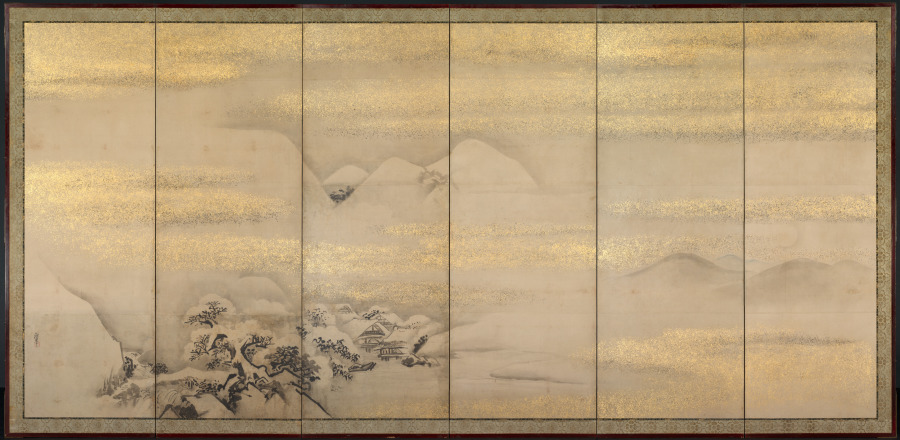
Naonobu was born in Kyoto on the 6th day of the 10th month of the 12th year of Keichō (25 November 1607). He was the second son of the Kanō school painter Kanō Takanobu and the younger brother of Kanō Tan'yū, who was to continue the line and become one of the foremost painters of the school. The Tokugawa shogunate invited Naonobu to the administrative capital Edo (modern Tokyo) in 1630, where he established himself at the Takekawa workshop affiliated with the Kanō school and became a Goyō eshi, an exclusive position painting for the shogunate. He studied under his brother Tan'yū and a lesser known Kanō artist, Kanō Kō-i (d. 1625). The two completed a number of prominent commissions for the shogunate. Naonobu's skills differed somewhat from Tan'yū's, particularly taking after his mentor Kanō Kō-i and delving into ink wash painting and his bold use of negative space. His work had a more Japanese feel deriving from nativist Yamato-e traditions. On gilt sliding doors and partitions he tended to suggest the form of the subject rather than delineate it. Works such as the Fujimi saigyō-zu byōbu screen show his interest in contrasts, depicting an enormous, barely-delineated Mount Fuji against a background of mostly negative space with a tiny seated figure gazing up at it. In his personal life Naonobu had the nickname Shume (主馬). He enjoyed trips to Kyoto and visiting the artist and aristocrat Kobori Masakazu. Naonobu went missing on the 7th day of the 4th month of the 3rd year of Keian (7 May 1650). He was said to have died of illness, though rumours circulated that he had drowned while fishing or had set off for China. • Illustration — Fujimi saigyō-zu byōbu, ink on paper, 155.8 cm × 363.4 cm • Illustration — One of a pair of byōbu depicting The Four Sages of Mount Shang (商山四皓).
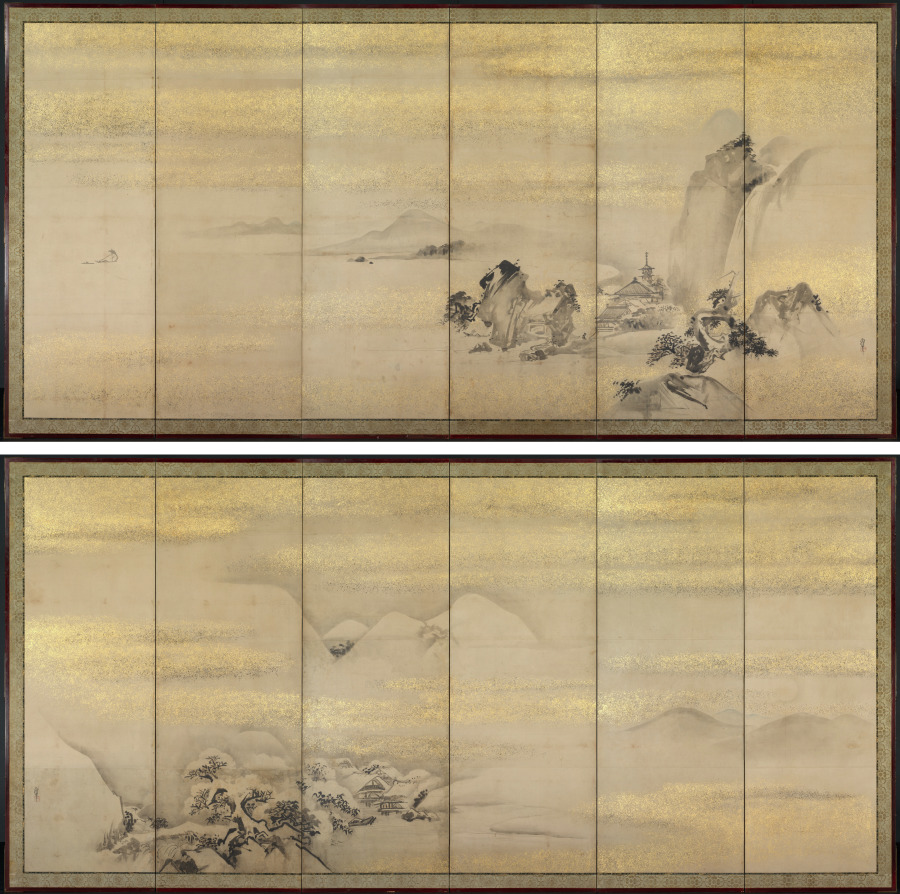
Summer and Winter Landscapes, 1600s, by Kanō Naonobu
Kano Naonobu · The Cleveland Museum of Art · Gift from the Collection of George Gund III
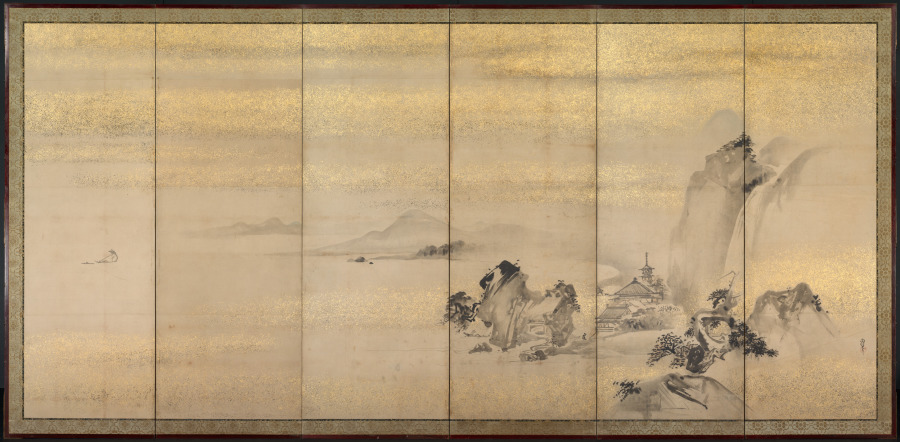
Summer and Winter Landscapes (one of a pair), 1600s, by Kanō Naonobu
Kano Naonobu · The Cleveland Museum of Art · Gift from the Collection of George Gund III
Places
Named by the record
Places
Only places the record itself states, plotted where the house gazetteer settles their coordinates. Nothing is inferred from a name or a nationality.
Kyoto.
Birth place
Edo.
Death place
Notes from the source article
Cited by Wikipedia
Notes from the source article
These works are cited by the source article, in its own numbering. They are recorded as its citations, not as sources VALÉORINE has verified.
Bibliography printed in the source article · 2
- cite book
- cite book
References
Citations
References
Each reference names the institution holding it, so a reader may go to the document itself.
reference work
Secondary witnessreference work
Secondary witness
The Encyclopedia exists whether or not anything is for sale. Corrections are recorded rather than overwritten, and every version of this record is kept. Published 17 August 2026.
Elsewhere in Paintings
19,456 published records in this field, each with its sources named.
- Kanō MichinobuArtist
- Kanō MitsunobuArtist
- Kanō MotonobuArtist
- Kanō NaizenArtist
- Kanō SadanobuArtist
- Kanō SanrakuArtist
- Kanō SansetsuArtist
- Kanō Shōsen'inArtist
Best supported in this field
For owners
Own a work by Kanō Naonobu?
A specialist will read what you send and tell you what the house can establish, what it cannot, and whether the object is suited to sale. There is no charge and no obligation. The object stays with you throughout; nothing is shipped to us unless it is arranged in writing beforehand.