
kanjira
The kanjira, khanjira, khanjiri or ganjira, a South Indian frame drum, is an instrument of the tambourine family. The Kanjira's emergence in South Indian Carnatic music, as well as the development of the modern form of the instrument, is credited to Manpoondia Pillai. In the 1880s, Manpoondia Pillai was a temple lantern-bearer who sought to study drumming.
Also recorded as kañjīrā · kanjeera
kanjira
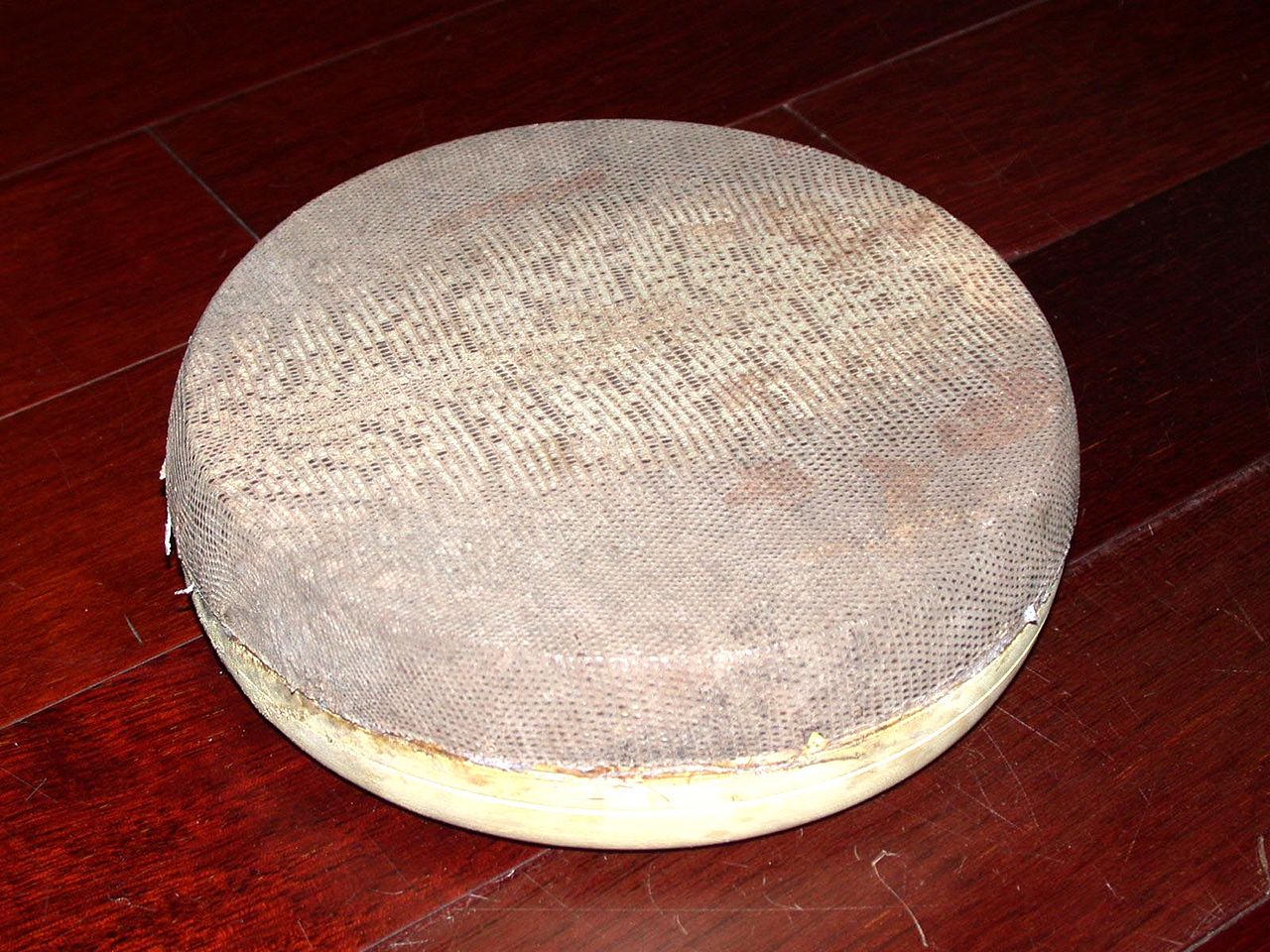
Sven.petersen · Public domain
- Field
- Membranophone
VALÉORINE Encyclopedia
VALÉORINE documentary reading
Documentary summary
The kanjira, khanjira, khanjiri or ganjira, a South Indian frame drum, is an instrument of the tambourine family. The Kanjira's emergence in South Indian Carnatic music, as well as the development of the modern form of the instrument, is credited to Manpoondia Pillai. In the 1880s, Manpoondia Pillai was a temple lantern-bearer who sought to study drumming.
Admitted source layer · organised and presented by VALÉORINE
Note VALÉORINE
No house-authored Note is published until its assertions and sources pass the VALÉORINE evidence contract. The documentary article remains available in full while that enrichment is being consolidated.
Documentary enrichment in progress · no unsupported statement published
Reference Check
Propose documentary evidence for kanjira. A contribution is never written directly as fact: identity, source, rights and evidence gates still decide.
Sign in to contribute
Documentary evidence
Evidence Panel
not yet certified
- Identity
- resolved
- Independent source families
- 0
- Admitted assertions
- 0
- Open conflicts
- 0
Authority files
wikidata · Q7997355 · wikipedia · Kanjira
In this article
Overview
Overview
He modified the kanjira to a frame drum with a single pair of jingles and brought the instrument to a classical stage. It is used primarily in concerts of Carnatic music (South Indian classical music) as a supporting instrument for the mridangam.
Key facts
Key facts
• Background — percussion • Names — ganjira • Classification — Frame drum • Hornbostel Sachs — 211.311 • Hornbostel Sachs Desc — Directly struck membranophone
Construction
Construction
Similar to the Western tambourine, it consists of a circular frame made of the wood of the jackfruit tree, between 7 and 9 inches in width and 2 to 4 inches in depth. It is covered on one side with a drumhead made of monitor lizard skin (specifically the Bengal monitor, Varanus bengalensis, now an endangered species in India), while the other side is left open. The traditional lizard skin is prohibited worldwide due to protection of species regulations. Even well-known Kanjira players, however, attest to the great advantages of using goat skin as an alternative. After playing for a while, the goat skin gets more and more flexible and offers a wider range of possible modulations. The frame has a single slit which contain three to four small metal discs (often old coins) that jingle when the kanjira is played.
Play
Play
The kanjira is a relatively difficult Indian drum to play, especially in South Indian Carnatic music, for reasons including the complexity of the percussion patterns used in Indian music. It is normally played with the palm and fingers of the right hand, while the left hand supports the drum. The fingertips of the left hand can be used to bend the pitch by applying pressure near the outer rim. It is not tuned to any particular pitch, unlike the mridangam or the ghatam. Normally, without tuning, it has a very high pitched sound. To get a good bass sound, the performer reduces the tension of the drumhead by sprinkling water on the inside of the instrument. This process may have to be repeated during a concert to maintain a good sound. However, if the instrument is too moist, it will have a dead tone, requiring 5–10 minutes to dry. Tone is also affected by external temperature and moisture conditions. Performers typically carry a couple of kanjiras so that they can keep at least one in perfectly tuned condition at any given time. Depending on dexterity, surprising glissando effects like on the Tabla are possible.
Nepal
Nepal
• Illustration — Nepalese performance using a variety of Khaijadi tambourines. In Nepal the Kanjira is called Khaijadi (खैंजडी). The country has a variety of tambourines besides the Khaijadi, including the Daanf, Damphu (डम्फू) and Hring. The instrument is used in dances and chants at festivals. One example is the Khanjadi bhajan (खैंजडी भजन), hymns sung in the Chhetri-Brahmin society. It is customary to sing this khanjadi bhajan in the Kathmandu Valley as well as in most parts of the eastern hills. Most of the performers are from the regional Brahmin community, but all castes are entertained as spectators and listeners. The event includes dancers dancing in pairs while Chudka hymns are sung by the musicians and audience. The event uses Puranic Hindu scriptures. This type of hymn uses a mixture of both verse and prose. At the beginning, part of the story is presented in prose. Then the lyrical hymn begins. To sing a hymn, one has to study the religious texts extensively and be able to give it its original form. The voice of the psalmist should also be such that it can attract everyone. In the same way, there should be singers who can play the khanjadi used in the psalms skillfully and know how to dance.
Players
Players
• G. Harishankar • V. Nagarajan • C. P. Vyasa Vittala • Bangalore Amrit • B. Shree Sundarkumar • V. Selvaganesh • Swaminathan Selvaganesh • A.S.N.Swamy • B.S. Purushotham • G. Guru Prasanna • N. Ganesh Kumar • S Sunil Kumar • Nerkunam Sankar • Anirudh Athreya • Hariharasharma • KV Gopalakrishnan • Sunaad Anoor • Kadirvel • B.N. Chandramouli • Kadanad Ananthakrishnan • Ragesh V Ramakrishnan
Primary material
Documents and archives
reference work
- “Kanjira”, English Wikipedia, consulted as further reading
Reputable secondary · Wikipedia
authority record
- Wikidata, structured authority record Q7997355: kanjira
Unverified · Wikidata
References
Citations
References
Each reference names the institution holding it, so a reader may go to the document itself.
reference work
Partially resolvedauthority record
Unverified
Connections
Knowledge graph
Connections
Each connection was recorded deliberately, with the basis for it kept on the internal record.
Broader subject
1- MembranophoneTerminology
Established from a fact already recorded on a verified source.
The Encyclopedia exists whether or not anything is for sale. Corrections are recorded rather than overwritten, and every version of this record is kept. Published 14 August 2026.
Elsewhere in Collectables
20,755 published records in this field, each with its sources named.
- KampfgruppeWork
- KangarooWork
- kanglingTerminology
- Kanji Sonomama Rakubiki Jiten DSWork
- kankara sanshinTerminology
- kanklėsTerminology
- kannelTerminology
- Kanojo × Kanojo × KanojoWork
Best supported in this field
For owners
Own an object connected with kanjira?
A specialist will read what you send and tell you what the house can establish, what it cannot, and whether the object is suited to sale. There is no charge and no obligation. The object stays with you throughout; nothing is shipped to us unless it is arranged in writing beforehand.