
Kamla Bhasin
Kamla Bhasin (24 April 1946 – 25 September 2021) was an Indian developmental feminist activist, poet, author and social scientist. Bhasin's work, that began in 1970, focused on gender education, human development and the media. She lived in New Delhi, India.
Kamla Bhasin

Hasive · CC BY-SA 4.0
- Name
- Kamla Bhasin
- Born
- 24 April 1946
- Birthplace
- Shaheedanwali, Mandi Bahauddin, Punjab, British India (now in Punjab, Pakistan)
- Died
- 25 September 2021
- Place of death
- Delhi, India
- Occupation
- feminist activist, poet, author
- Education
- Master's in Arts
- Nationality
- India
- Languages
- Hindi
VALÉORINE Encyclopedia
VALÉORINE documentary reading
Documentary summary
Kamla Bhasin (24 April 1946 – 25 September 2021) was an Indian developmental feminist activist, poet, author and social scientist. Bhasin's work, that began in 1970, focused on gender education, human development and the media. She lived in New Delhi, India.
Admitted source layer · organised and presented by VALÉORINE
Reference Check
Propose documentary evidence for Kamla Bhasin. A contribution is never written directly as fact: identity, source, rights and evidence gates still decide.
Sign in to contribute
World of VALÉORINE
Documentary connections
Only confirmed graph relationships appear here. Images are shown only when their identity and reuse rights both pass the documentary gate.
Documentary evidence
Documentary basis
Authority files
wikidata · Q16107221 · wikipedia · Kamla Bhasin
In this article
Biography
Biography
She was best known for her work with Sangat - A Feminist Network and for her poem Kyunki main ladki hoon, mujhe padhna hai. In 1995, she recited a refurbished, feminist version of the popular poem Azadi (Freedom) in a conference. She was also the South Asia coordinator of One Billion Rising. She resigned from her job at the U.N. in 2002, to work with Sangat, of which she was a founder member and adviser. She believed in a form of advocacy that combines feminist theory and community action. She worked with underprivileged women from tribal and working communities, often using posters, plays and other non literary methods to get through to communities with low literacy rates. She had always maintained that in order to usher effective change, sloganeering must be accompanied by community mobilization.
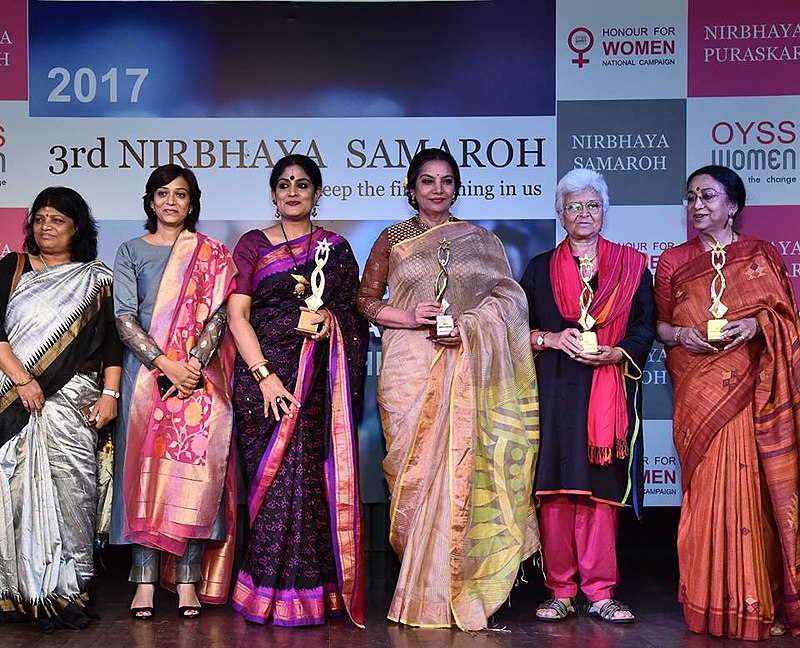
Nirbhaya Samaroh founder women activist Manasi Pradhan with recipients of 2017 Nirbhaya Puraskar Shabana Azmi, Kamla Bhasin, Meenakshi Gopinath and Geeta Chandran
Oysswomen
Key facts
Key facts
• Name — Kamla Bhasin • Born — 24 April 1946 • Birthplace — Shaheedanwali, Mandi Bahauddin, Punjab, British India (now in Punjab, Pakistan) • Died — 25 September 2021 • Place of death — Delhi, India • Occupation — feminist activist, poet, author • Language — Hindi, English • Education — Master's in Arts • Alma Mater — Rajasthan University, University of Münster • Notable Works — Borders & Boundaries: Women in India's Partition (book)
Early and personal life
Early and personal life
Kamla Bhasin called herself 'The Midnight Generation', a reference to the generation of Indians born around the time of independence, 'at the stroke of the midnight hour..'. She was the fourth of six siblings. Her father was a doctor in Rajasthan. She grew up around villages in India and it helped her form an understanding about women's issues in villages in India. This experience would be instrumental in her life and future career. She went to a government university for her bachelor's and master's. She later said that she found the experience uninspiring and graduated with second division. Bhasin met her (ex) husband in Rajasthan while working for Seva Mandir. She had later recounted that her husband was an incredibly feminist man and espoused progressive ideas. Her husband suggested that their children take both their surnames and was supportive when Bhasin's 70-year-old mother moved in with them. However, things turned sour after incidents of domestic abuse and infidelity by him. She considered her greatest loss to be the suicide of her adult daughter, who was really important to her. She also had a son who became disabled after a severe reaction to a vaccine.
Beginning of politicization
Beginning of politicization
Bhasin earned a M.A. from Rajasthan University and then went on to study Sociology of Development at University of Münster in West Germany with a fellowship. Afterward, she taught at the Orientation Centre of the German Foundation for Developing Countries in Bad Honnef for around a year. She then wanted to return to India, and implement what she learned there. Hence, she started working for Seva Mandir, which works primarily in natural resource sustainability. There she learnt about how caste is endemic in Indian society, and how discrimination manifests itself even in governance. That was manifest in the fact that Brahmin's wells would never go dry as they received state funds to drill every year. This was when she realized that caste and feminism were intersectional.
Work at UN and subsequent founding of Sangat
Work at UN and subsequent founding of Sangat
After that, she started working with the Food and Agriculture Organization, and was assigned to identify innovative development work in Asian countries and create networks between people –across countries. She lamented later that at that time, in the 70s when the subcontinent was gripped in mutual animosity and war, it was difficult to create networks and come together as South Asians. She thus, moved to Bangladesh in 1976 and worked with Gonoshasthaya Kendra, a rural public health organization. It was where she met Zafrullah Chowdhury, a Bangladeshi public health worker and activist, who changed her perspective about a lot of things. She later described him as one of the few men who thought 'out of the box' in South Asia. She quit her job at the UN in 2002, to work full-time on her feminist network, Sangat which she had been working on for a while. She then, in association with Sangat, organized workshops on understanding feminist theory and develop a feminist awakening. The organization has organized the "Sangat Month Long Course" since 1984, helping more than 650 women in South Asia develop a better understanding of gender, poverty, social justice, sustainable development, peace, democracy and human rights. "The method of our capacity building course is multi-dimensional and participatory. For one month, the participants try and understand what patriarchy is." she said.
Points of view and advocacy
Points of view and advocacy
Capitalist patriarchy She spoke out against capitalism as an agent of the patriarchy, for objectifying women's bodies. However her revulsion of capitalism emerged from a much deeper political stand. She argued that the nature of the modern family is based in the concept of ownership. "This all started when private property came into existence. People wanted to pass on their legacy, but men did not know who their children were, only women were known as mothers because there were no families. That is when patriarchy came.", she said. Moreover, she argued that modern neoliberal capitalism, and its obscene digits like the pornography industry and the cosmetics industry, both billion dollar industries, reduces women to their bodies. Moreover, these industries promote a form of dehumanization of women, that contributes to a culture of violence and abuse. "So once you are a body – what's the harm in raping you or groping you?" Kamla asks. She derides capitalism as a system when everything is saleable and profits matter more than people. Cultural change "India needs a cultural revolution", said Bhasin. She resented that South Asia's women are shackled by a myriad of social customs and beliefs that embrace and straddle the patriarchy. "Often religion is used as a shield to justify patriarchy. When you question something, you are told, yeh toh hamara sanskar hai, riwaaj hai (This is our culture, our traditions). And when this is done, it means logic has ended, belief has come in.", she told The Hindu in a 2013 interview. She challenged patriarchal ideas in language, and questioned the validity and history of everyday words. The Hindi word swami, that is often used for a partner, for instance, implies 'lord' or 'owner', as does the word 'husband', which originates from animal husbandry. She adjudged all these customs against the constitution of India that offers every woman the right to equality and the promise of a dignified life.
Death
Death
Bhasin died on 25 September 2021 at the age of 75 due to cancer.
Places
Named by the record
Places
Only places the record itself states, plotted where the house gazetteer settles their coordinates. Nothing is inferred from a name or a nationality.
Shaheedanwali.
Birth place
New Delhi.
Death place
Views on feminist theory
Bhasin rejected the notion that feminism is a western concept. She stressed that Indian feminism has its roots in its own struggles and tribulations. She said that she didn't become a feminist by reading other feminists, she became one as a part of a larger natural evolution from merely a development worker, to a feminist development worker. She said that it is the story of many others. When asked what she had to say on the premise that the term feminism antagonizes a lot of people, she said, "People are not happy with feminism, and even if I call it XYZ, they will still be against. It is because they mind the fact that we want freedom, we want equality, and there are lots of people, customs, and traditions who don't want to give women freedom." While she agreed that theory and action have to go hand in hand for change to come, she believed that feminist theory is important. Her workshops routinely consulted with and worked with social scientists, feminists and academics. They can be described as a marriage between action and theory. She maintained that feminism is not a war between men and women. She said it is a fight between two ideologies. One that elevates men and gives them power, and the other, that advocates for equality. Bhasin has been criticized for her Trans-exclusionary remarks and views, for which she eventually apologised.
Writings and other works
Writings and other works
She wrote books and booklets about understanding patriarchy and gender, that have been translated into near about 30 languages. These are now used by many NGOs to help people understand gender issues. Her book, Laughing Matters, that she co-authored with Bindia Thapar, first published in 2005 was republished in 2013 and now has a Hindi version (Hasna Toh Sangharsho Mein Bhi Zaroori Hai), Feminism & Its Relevance in South Asia. Other important writings by her include: Borders & Boundaries: Women in India's Partition, Understanding Gender, What Is Patriarchy? In her writings and politics, she envisioned a feminist movement that transcends class, borders and other binary social divisions. She was an integral part of the One Billion Rising movement in South Asia. She went to Nepal to flag off the 2017 edition of the movement in Kathmandu, Nepal. At a 2013 One Billion Rising event in New Delhi, she recited her famous Azadi poem to much acclaim and public participation.
Children's books and rhymes
Children's books and rhymes
Kamla Bhasin is also known for writing humorous and insightful Children's Books and Rhymes which made the concept of patriarchy, gender roles and masculinity easily understandable to young kids. Her famous feminist books for children include Laal Pari, Ulti Sulti Meeto and Dhammak Dham. These books were translated in difference languages and illustrated for kids to understand the concept of gender equality by challenging gender stereotypes and traditional gender roles in the society.
Notes from the source article
Cited by Wikipedia
Notes from the source article
These works are cited by the source article, in its own numbering. They are recorded as its citations, not as sources VALÉORINE has verified.
- 1.The Dawn. Let's change the world: Kamla Bhasin. 29 July 2005.
- 2.Shifa, Nazneen. "The Womens Movement is a larger thing" - Interview with Kamla Bhasin. South Asia Citizens Web.
- 3.Durrani, Ammara. An Indian who talks about love with Pakistan is seen as a traitor: Kamla Bhasin. Herald Magazine. 10 May 2017.
- 4.Men are not biologically violent. Dhaka Tribune. 28 April 2016.
- 5.Capitalist patriarchy – the new enemy. The Daily Star. 30 April 2016.
- 6.Kamla Bhasin on why 'azadi' was never Kashmir's alone. www.dailyo.in.
- 7.When she fights for her - The Himalayan Times. The Himalayan Times. 11 October 2015.
- 8.Bhagat, Shalini Venugopal. Kamla Bhasin, a First-Wave South Asian Feminist, Dies at 75. The New York Times. 4 October 2021.
- 9.Pisharoty, Sangeeta Barooah. She lives it!. The Hindu. 26 April 2013.
- 10.Kamla Bhasin: 40 years in solidarity with Bangladesh. bdnews24.com.
- 11.Menon, Ritu. Borders & Boundaries: Women in India's Partition. Rutgers University Press. 1 January 1998. 9780813525525.
- 12.Understanding Gender (Kali Monographs). Goodreads.
- 13.Nepali Times The Brief » Blog Archive » South Asia rising. www.nepalitimes.com.
- 14.I remember Kamla Bhasin through her children’s books The Daily Star. www.thedailystar.net.
- 15.Shrestha, Sahina. She for her Nepali Times Buzz Nepali Times. nepalitimes.com.
- 16.Turf not TERF: Feminism, Solidarity and Trans Persons. Centre for Law & Policy Research.
- 17.Swati. Kamla Bhasin, a complicated legacy: Examining the activist-writer's work and politics. NEWS9LIVE. 2021-09-27.
- 18.Sengupta, Sohini. Mainstream Feminist Spaces And Their Exclusion Of The Trans Community. Feminism in India. 2022-07-12.
- 19.Chimamanda Adichie's Essay and the Rise of Trans Exclusionary Feminism. The Wire.
- 20.Kamla Bhasin, noted activist and author, passes away at 75. Hindustan Times. 25 September 2021.
- 21.The Indian Express. Feminist icon Kamla Bhasin passes away. 25 September 2021.
References
Citations
References
Each reference names the institution holding it, so a reader may go to the document itself.
reference work
Secondary witnessreference work
Secondary witness
People, houses and institutions
Knowledge graph
People, houses and institutions
Teachers, collaborators, publishers and institutions recorded against this person, each on a stated basis.
Citizenship
1- IndiaPlace
Established from a fact already recorded on a verified source.
The Encyclopedia exists whether or not anything is for sale. Corrections are recorded rather than overwritten, and every version of this record is kept. Published 15 August 2026.
Elsewhere in Books
39,427 published records in this field, each with its sources named.
- Kameran MukriAuthor
- Kamil BednářAuthor
- Kamila ShamsieAuthor
- Kamini RoyAuthor
- Kamla K. KapurAuthor
- KamleshwarAuthor
- Kamo no MabuchiAuthor
- Kamo no Yasunori no musumeAuthor
Best supported in this field
For owners
Own a work by Kamla Bhasin?
A specialist will read what you send and tell you what the house can establish, what it cannot, and whether the object is suited to sale. There is no charge and no obligation. The object stays with you throughout; nothing is shipped to us unless it is arranged in writing beforehand.