
Josip Urbanija
Joseph Urbania (also Josef Urbanija or Josip Vrbanija) (February 16, 1877 – June 10, 1943) was a 20th-century Slovene sculptor, who lived and worked in Austria for much of his life. His media was large-scale wood, stone, bronze and plaster religious sculptures for European cathedrals.
Also recorded as Joseph Urbania · Josef Urbanija
Josip Urbanija

This image is available from the Digital Library of Slovenia under the reference number GZRHZ8JC This tag does not indicate the copyright status of the attached work. A normal copyright tag is still r · Public domain
- Name
- Joseph Urbania
- Birth Name
- Josip Vrbanija
- Born
- 16 February 1877
- Birthplace
- Ljublijana, Slovenia
- Died
- 10 June 1943
- Place of death
- Vienna, Austria
- Field
- Sculpture
- Training
- Academy of Fine Arts Vienna
- Movement
- Poetical Realism and The Vienna Secession
- Nationality
- Kingdom of Yugoslavia · Kingdom of Serbs and Croats and Slovenes · Cisleithania
- Occupation
- sculptor
- Fields
- art of sculpture
VALÉORINE Encyclopedia
VALÉORINE documentary reading
Documentary summary
Joseph Urbania (also Josef Urbanija or Josip Vrbanija) (February 16, 1877 – June 10, 1943) was a 20th-century Slovene sculptor, who lived and worked in Austria for much of his life. His media was large-scale wood, stone, bronze and plaster religious sculptures for European cathedrals.
Admitted source layer · organised and presented by VALÉORINE
Reference Check
Propose documentary evidence for Josip Urbanija. A contribution is never written directly as fact: identity, source, rights and evidence gates still decide.
Sign in to contribute
World of VALÉORINE
Documentary connections
Only confirmed graph relationships appear here. Images are shown only when their identity and reuse rights both pass the documentary gate.

Documentary evidence
Documentary basis
Authority files
wikidata · Q18604231 · wikipedia · Joseph Urbania
In this article
Key facts
Key facts
• Name — Joseph Urbania • Birth Name — Josip Vrbanija • Born — 16 February 1877 • Birthplace — Ljublijana, Slovenia • Died — 10 June 1943 • Place of death — Vienna, Austria • Field — Sculpture • Training — Academy of Fine Arts Vienna • Movement — Poetical Realism and The Vienna Secession • Illustration — Joseph Urbania: "Mother Mary with Rosary" (1907)
Early life
Early life
Joseph Urbania's mother Lucija was a housekeeper in the home of sculptor Franz Ksaver (1821–1888), who was the father of renowned sculptor Ivan Zajec. Urbania's step-father Josip Groselj (1854-1941) was one of his son's early teachers and an artistic assistant and heir to the senior Zajec workshop. Zajec's influence can be seen in much of Urbania's early work. At age 21, Joseph Urbania joined the Slovenian Army, during which time he was commissioned by Captain H. Wesshuber, to carve a large figure called Homeland (exhibited in Ljubljana, 1903). Upon completion of his military service - and with the savings from his art commissions - Urbania moved to Vienna to study and work. From 1906–1914, with the commissioned support of the Viennese Provincial Committee, Urbania resumed his full-time study of painting, drawing and sculpture at the Heinrich Strehblow Akademie of Arts (now part of the Academy of Fine Arts Vienna) under sculpture Professor Hans Bitterlich (1860-1949). In a discussion of Urbania and other sculptors of the early 20th Century, Mateja Breščak, the Chief Curator of the National Gallery of Slovenia, said, "Students at the Vienna Academy – after acquiring basic sculpting skills from professors Edmund Hellmer, Caspar von Zumbusch, Karl Kundmann and Hans Bitterlich – were familiarized with religious motifs, but all turned toward secular motifs." Nonetheless, she said, "The sculpture of that time did not merge into artistic societies with common ideological goals." Instead, she said, "The Slovenian sculptors between 1890 and 1920 worked in an academically realistic, neo-baroque, neo-classical style, while they focused on social, mythological, biblical, historical and poetic motifs. The most visible and most influential sculptural personality of this new era is certainly Auguste Rodin, who also influenced our sculptors."
Career
Career
• Illustration — Joseph Urbania: After the Battle (1905) While living in Vienna, Urbania produced commissioned sculpture and paintings and exhibited his work there. He began to be recognized publicly for his achievements and received the Gundel Art Prize for sculpture in 1910 and the Preleuthner Prize in 1912. Urbania lived briefly in Sarajevo in 1915-1918 where, together with a team of artists, he created a monument to WWI soldiers at the Kovaci Cemetery. After the war, he relocated permanently to Vienna where he lived and worked until his death in 1943. Before WWI, Urbania began to produce anti-war allegory works. His massive wood-carving The Last Battle (1905), a scene from the Russo-Japanese War, was donated to the Dežel Museum in 1906 and is now on display at the National Gallery of Slovenia. Other anti-war pieces include: Hail Caesar (1915) After the Battle (1908) and Hannibal at the Gates (1908). His large carved-wood relief Z Doma (or Far from Home, 1908) was a sentimental self-portrait framed in branches and leaves. In 1914, Urbania began but never finished the gigantic plaster figures Spring and Effort (also called Water and Electricity) for the cancelled Provincial House in Ljubljana (the plasters are currently disassembled in the National Gallery). His figure Passages of the Danube was commissioned for the Michaelerplatz, in Vienna, but was removed during WWII and is now missing. • Illustration — Joseph Urbania: Hannibal at the Gates (1908) A devout Roman Catholic, Urbania was best known for the sculptures he created for cathedrals and monasteries. Two monumental plaster reliefs – Christ Healing and Daniel in the Lion’s Den – were later moved to the National Gallery of Slovenia in Ljubljana. Small bronze copies of these popular pieces occasionally appear for public sale. Other religious-themed pieces include: a maple wood carving of Christus Ascending (1931, now in Kenosha, Wisconsin); several marble statues at the Parish Church of St. Elisabeth, including Immaculata and Two Cherubim (with sculptor Alojzij Progar); St. Hubertus (1909) and St. Anthony and Child (1934); and an important burial chapel piece called Resurrection (1910, made by the artists' group at the Grošlje Workshop for a burial chapel in Škofja Loka), sometimes credited as the sole work of Ivan Zajec. • Illustration — Joseph Urbania: Christus Ascending (1931) Other statues and reliefs include: The Carrier of the Vase (1909); Absolvo Te (1910); Rokoborca (The Wrestlers) in 1913; Danica-Zarji (1913); Sejalec (1914); Monument to the Fallen (WWI Soldiers Cemetery in Sarajevo) in 1918; a carved wood statue In Nature (Flying Left) in 1922; a marble Holy Family (1926 – now in Chicago); Turn (1930); a bronze figure Girl with Grapes and Bear (1935); and a pear wood carved Mother (Ladies with a Child) in 1939. • Illustration — Joseph Urbania: Christus Ascending (1931) as it appeared in the home of Oscar U. Zerk in 1945 Completing a portion of his work as part of an unsigned team of artists at the Grošelj Workshop in Ljubljana Urbania's contributions stand out nonetheless for the vividness of his figures, the stunning naturalism, the realism of the human body, plainly beautiful faces, idealized branches and leaves, and exaggerated emotion, which can be seen in all his subsequent work. His unsigned reliefs and statues – at St. Mohor and Fortunat Cathedral in Groblje pri Prekopi, Angels on the Great Altar in the Ljubljana Cathedral at St. Cyril and Methodius Square, and Mother of God with St. Dominic and Rosary (1906) at Loško Potok – were all created by Urbania as the lead sculptor in the Groblje pri Prekopi Workshop. Urbania's Christus Ascending was featured in the home of wealthy American Industrialist Oscar U. Zerk. The 1931 white maple carved work became internationally famous in 1954, when thieves broke into Zerk's Wisconsin mansion and stole more than $200,000 worth of paintings, gems and art. The thieves were captured by the FBI, and the art returned.
Commentary
Commentary
• Illustration — Joseph Urbania: Potop (1913) Reviews of exhibitions may be found in the Slovenska biografija: The Last Battle, 1905 (Lj., See DS 1905, 325; S 1905, No. 39, 67; SN 1905, No. 68; LZ 1906, 383); Z Doma, 1908 (painter in Vienna, see S 1908, No. 119); The Carrier of the Vase, 1909 (ib., See S 1909, No. 160); Hanibal Ante Portas and Sv. Hubertus, 1909 (both on the first art exhibition in Jp.). According to the Slovenian Biographical Lexicon, Urbania's contemporaries described his work (see V. Levstik, LZ 1909, 528, as "possessing a happy warmth and homey simplicity, although the technique is well-schooled and immaculate." Still others (F. Kozak in connection with the Krekov monument's draft, LZ 1918, 295), argued, "much of his art is idealized and depicted in a kind of modern Baroque and poetic realism." More critically, some considered his work "old-fashioned" (S. Mikuž, Um 1939/40, 10-5), and some said, "he blushed between folk art and visions of great pathos, although his talent was not up to date." • Illustration — Joseph Urbania: Rokoborca (The Wrestlers) (1913)
Identity
Identity
Josip Urbanija is recorded as a citizen of Kingdom of Serbs, Croats and Slovenes. Recorded with the occupation sculptor.

Absolvo te.
This image is available from the Digital Library of Slovenia under the reference number MCXN5971 This tag does not indicate the copyright status of the attached work. A normal copyright tag is still r
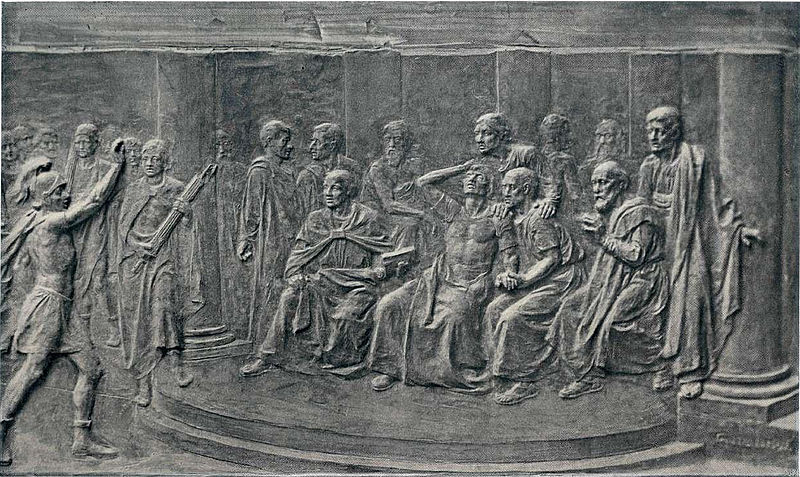
Hanibal pred vratmi.
This image is available from the Digital Library of Slovenia under the reference number XX45U7MP This tag does not indicate the copyright status of the attached work. A normal copyright tag is still r
Life and career
Dated record
Life and career
The full dated record · 2 entries
1877
Josip Urbanija was born on 16 February 1877.
1943
Josip Urbanija died on 10 July 1943.
Places
Named by the record
Places
Only places the record itself states, plotted where the house gazetteer settles their coordinates. Nothing is inferred from a name or a nationality.
Ljubljana.
Birth place
Vienna.
Death place
Primary material
Documents and archives
reference work
- “Joseph Urbania”, English Wikipedia, consulted as further reading
Reputable secondary · Wikipedia
authority record
- Wikidata, structured authority record Q18604231: Josip Urbanija
General reference · Wikidata
Notes from the source article
Cited by Wikipedia
Notes from the source article
These works are cited by the source article, in its own numbering. They are recorded as its citations, not as sources VALÉORINE has verified.
- 1.Zajec, Ivan (1869–1952) - Slovenska biografija. Slovenska-biografija.si.
- 2.Josip Groselj (1854-1941), pg.117.
- 3.Academy of Fine Arts. Akbild.ac.at.
- 4.Intervju z Matejo Breščak o kiparstvu. Rtvslo.si.
- 5.Urbanija, Josip (1877–1943) – Slovenska biografija. Slovenska-biografija.si.
- 6.Category:Martyrs' Memorial Cemetery Kovači – Wikimedia Commons. Commons.wikimedia.org.
- 7.Tolažnica v zadnjem boju; Prizor iz rusko-japonske vojne. Europeana.eu.
- 8.Digitalna knjižnica Slovenije – dLib.si. Dlib.si.
- 9.Digitalna knjižnica Slovenije – dLib.si. Dlib.si.
- 10.Digitalna knjižnica Slovenije – dLib.si. Ddlib.si.
- 11.Digitalna knjižnica Slovenije – dLib.si. Dlib.si.
- 12.(20th century) Two Biblical Scenes: Christ Healing and Daniel and the Lions Den, signed both sign. The-saleroom.com. 7 November 2015.
- 13.English: A carved image of the Christus Ascending in maple wood, 1931. Commons.wikimedia.org. 30 July 2017.
- 14.Joseph Urbania – Wikimedia Commons. Commons.wikimedia.org.
- 15.Progar, Alojzij (1857–1918) – Slovenska biografija. Slovenska-biografija.si.
- 16.Category:St. Elisabeth-Kirche (Wien-Wieden) – Wikimedia Commons. Commons.wikimedia.org.
- 17.Kranj – History & culture. Euparky.eu.
- 18.Slovenščina: Absolvo te. Commons.wikimedia.org. 30 July 2017.
- 19.Slovenščina: Rokoborca. Commons.wikimedia.org. 30 July 2017.
- 20.Dancing girl balancing on a bear by JosephUrbania. Artnet.com.
- 21.Ljubljana – Kipi svetnikov in škofje na ljubljanski stolnici. Vanderkrogt.net.
- 22.Digitalna knjižnica Slovenije – dLib.si. Dlib.si.
- 24.Untitled Document. Zerkovitz.hu.
- 25.Kenosha, WI. Pinterest.
- 26.The Framing Business » Rise of the Milwaukee Mafia, 1892-1961. Archive.is. 21 February 2013.
- 27.San Bernardino Sun 10 February 1954 — California Digital Newspaper Collection. Cdnc.ucr.edu.
References
Citations
References
Each reference names the institution holding it, so a reader may go to the document itself.
reference work
Secondary witnessauthority record
General reference
The Encyclopedia exists whether or not anything is for sale. Corrections are recorded rather than overwritten, and every version of this record is kept. Published 16 August 2026.
Elsewhere in Sculpture
6,174 published records in this field, each with its sources named.
- Joseph-Marius RamusArtist
- Josephine GiraldelliArtist
- Joshua BorkovskyArtist
- Josiah McElhenyArtist
- Josue DuponArtist
- Jovan KratohvilArtist
- Jovan SoldatovićArtist
- Jovette MarchessaultArtist
Best supported in this field
For owners
Own a work by Josip Urbanija?
A specialist will read what you send and tell you what the house can establish, what it cannot, and whether the object is suited to sale. There is no charge and no obligation. The object stays with you throughout; nothing is shipped to us unless it is arranged in writing beforehand.