
José Teófilo de Jesus
José Teófilo de Jesus (Salvador, Bahia, 1758?-Salvador, Bahia, July 19, 1847) was a Brazilian painter and gilder. He is the most noted representative of the Escola Baiana or Bahian School of painting. His work was eclectic, characterized by the passage from the Baroque to the Rococo, with reference to Neoclassical traits.
José Teófilo de Jesus

José Teófilo de Jesus · Museu Afro Brasil (São Paulo) · Public domain
- Name
- José Teófilo de Jesus
- Birth Name
- Salvador, Bahia, Brazil
- Died
- 19 July 1847
- Known for
- painter, gilder
- Born
- 1758 · Salvador.
- Nationality
- Brazil
- Occupation
- painter
- Languages
- Portuguese
VALÉORINE Encyclopedia
VALÉORINE documentary reading
Documentary summary
José Teófilo de Jesus (Salvador, Bahia, 1758?-Salvador, Bahia, July 19, 1847) was a Brazilian painter and gilder. He is the most noted representative of the Escola Baiana or Bahian School of painting. His work was eclectic, characterized by the passage from the Baroque to the Rococo, with reference to Neoclassical traits.
Admitted source layer · organised and presented by VALÉORINE
Note VALÉORINE
José Teófilo de Jesus (1758–1847) was a Brazilian painter. The painter was born and died in Salvador. Languages used include Portuguese.
Composed from admitted, traceable facts · 27 September 2026
VALÉORINE
Reference Check
Propose documentary evidence for José Teófilo de Jesus. A contribution is never written directly as fact: identity, source, rights and evidence gates still decide.
Sign in to contribute
Documentary evidence
Documentary basis
Authority files
wikidata · Q10310572 · wikipedia · José Teófilo de Jesus
In this article
Biography
Biography
De Jesus was of pardo, or mixed ethnic ancestry and lived into his nineties; little else is known of his life. His production was apparently vast, but many of his works are only identified by oral tradition. Although he is known as one of the great names of the Brazilian Baroque, and one of its final artists, details of his life and a full account of his works remain unclear.
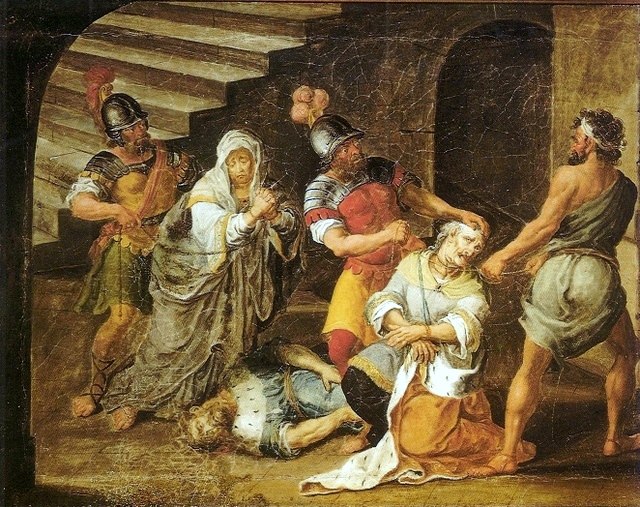
José Teófilo de Jesus - A morte de Judas Macabeu
José Teófilo de Jesus · Scan, MAB/Safra catalogue.

A Divina Pastora, teto da Matriz de Divina Pastora, Sergipe
José Teófilo de Jesus · [1]
Key facts
Key facts
• Name — José Teófilo de Jesus • Birth Name — Salvador, Bahia, Brazil • Died — 19 July 1847 • Place of death — Salvador, Bahia, Brazil • Known for — painter, gilder • Style — Baroque, Rococo • Illustration — Nossa Senhora do Pilar, ceiling painting of the Parish Church of Our Lady of Pilar, Salvador, Bahia • Illustration — África, Bahia Museum of Art, Salvador, Bahia
Education and training
Education and training
De Jesus was a freeman and pardo, or Brazilian of mixed ethnic ancestry. He became an apprentice of José Joaquim da Rocha (1737 - 1807) in the mid-18th century. He assisted Da Rocha in painting and filling of secondary figures on ceiling and panels. De Jesus was part of a generation of painters who traveled to Portugal and Italy for training. He arrived in Lisbon in 1794 with Da Rocha's assistance, and worked with the foremost painters of the day, such as Vieira Lusitano, and Pompeo Batoni, an Italian working at the Basílica da Estrela in Lisbon. While there, De Jesus was instructed by the painter Pedro Alexandrino de Carvalho (1729 - 1810) The story of De Jesus's travel and study in Portugal was held as legend until the late 20th century; the archaeologist and historian Carlos Ott (1908–1997) discovered correspondence dating to 1794 confirming De Jesus's work in Europe. De Jesus received his first commissions upon his return to Brazil in 1801. He completed four panels in the Church of the Third Order of Saint Francis in 1802 for the cost of 80$000. These works are now lost. He completed a painting of Our Lord of the Good End (Nosso Senhor do Bonfim) in 1803 for the Santa Casa and Our Lady of Mercy Church; this painting has also disappeared. His name disappears from the record for about ten years after these works, a period in which he likely worked in private homes and chapels. De Jesus inherited many of the clients of Da Rocha upon his death in 1807, and began his great works starting in 1815 at the Church of the Third Order of Mount Carmel He received 3:400$000 for his painting and gilding work at the church.
Works
Works
José Teófilo de Jesus large-scale works include the ceilings of the naves of churches in Salvador, the Recôncavo region of the interior of the state of Bahia, and in the state of Sergipe. His works in Salvador include the ceilings of the naves of the Church of the Third Order of Saint Francis, Church of Our Lady of Barroquinha, and the church of Casa Pia and College of the Orphans of Saint Joachim in Salvador. De Jesus completed two major work in the Church of Nosso Senhor do Bonfim: Cristo e a Adúltera, completed approximately 183); and 34 small paintings along the corridor of the same church. They were completed between 1838 and 1839. De Jesus also painted the ceiling of the nave of the Parish Church of the Blessed Sacrament (Matriz do Santíssimo Sacramento) on Itaparica Island, a short distance from Salvador. His works in the Recôncavo include the ceiling of the nave of the Church of the Third Order of Saint Francis in Cachoeira. His works in Sergipe include the ceiling and nave of Parish Church of Our Lady of the Divine Shepherd in the municipality of Divina Pastora. Numerous secular works of De Jesus, which probably date to the early 19th century, are preserved in Bahia Art Museum in Salvador.
Marriage and death
Marriage and death
The extent of the private life of De Jesus is summarized in his marriage record at the Parish of Santana: "José Teófilo de Jesus, pardo [Brown], legitimate son of Antonio Feliciano Borges and Josefa de Santana, born in the city of Salvador, where he married Vicência Rosa de Jesus of Costa da Mina, preta forra [a formerly enslaved Black woman], of Gulf of Guinea region (Costa da Mina), on February 20, 1808; the place of marriage was at the Church of Santana, the age of the painter was not declared. This was testified by José Joaquim Viana e Manoel Inácio." He died in Salvador on July 19, 1847, after falling from scaffolding while painting in the Parish Church of Our Lady of the Divine Shepherd.
Primary material
Documents and archives
reference work
- “José Teófilo de Jesus”, English Wikipedia, consulted as further reading
Reputable secondary · Wikipedia
authority record
- Wikidata, structured authority record Q10310572: José Teófilo de Jesus
General reference · Wikidata
Notes from the source article
Cited by Wikipedia
Notes from the source article
These works are cited by the source article, in its own numbering. They are recorded as its citations, not as sources VALÉORINE has verified.
- 1.José Teófilo. Museu Afro Brasil.
- 2.Araújo, Emanoel. A Mão afro-brasileira : significado da contribuição artística e histórica. TENENGE, Técnica Nacional de Engenharia. 29–32. 1988. 9788585231019.
- 3.Itaú Cultural. José Teófilo de Jesus. ENCICLOPÉDIA Itaú Cultural de Arte e Cultura Brasileiras. 2017.
- 4.ABC-CLIO. Art and artists--Brazil. Iberia and the Americas: culture, politics, and history. 2018.
- 5.José Teófilo de Jesus. Guia das Artes.
- 6.Manuel Querino, Artistas Bahianos, Bahia: Oficinas da Empresa "A Bahia," 1911.
- 7.José Teófilo. Cultura Visual. 25–37. 6 May 2010.
References
Citations
References
Each reference names the institution holding it, so a reader may go to the document itself.
reference work
Secondary witnessauthority record
General reference
The Encyclopedia exists whether or not anything is for sale. Corrections are recorded rather than overwritten, and every version of this record is kept. Published 20 August 2026.
Elsewhere in Paintings
19,397 published records in this field, each with its sources named.
- José Rodríguez de la OlivaArtist
- José Ruiz BlascoArtist
- José SabogalArtist
- José Salomé PinaArtist
- José Tomás ErrázurizArtist
- José Víctor CrowleyArtist
- José Villegas CorderoArtist
- José Wasth RodriguesArtist
Best supported in this field
For owners
Own a work by José Teófilo de Jesus?
A specialist will read what you send and tell you what the house can establish, what it cannot, and whether the object is suited to sale. There is no charge and no obligation. The object stays with you throughout; nothing is shipped to us unless it is arranged in writing beforehand.