
John Landseer
John Landseer (1762/3? – 20 February 1852) was an English landscape engraver.
Also recorded as John George Landseer
John Landseer

Edwin Landseer · Art UK · Public domain
- Born
- 1769 · Lincoln.
- Nationality
- Kingdom of Great Britain · United Kingdom of Great Britain and Ireland
- Occupation
- printmaker
- Teachers
- William Byrne
- Honours
- Fellow of the Society of Antiquaries
- Languages
- English
VALÉORINE Encyclopedia
VALÉORINE documentary reading
Documentary summary
John Landseer (1762/3? – 20 February 1852) was an English landscape engraver.
Admitted source layer · organised and presented by VALÉORINE
Reference Check
Propose documentary evidence for John Landseer. A contribution is never written directly as fact: identity, source, rights and evidence gates still decide.
Sign in to contribute
World of VALÉORINE
Documentary connections
Only confirmed graph relationships appear here. Images are shown only when their identity and reuse rights both pass the documentary gate.

Documentary evidence
Documentary basis
Authority files
wikidata · Q6243939 · wikipedia · John Landseer
In this article
Birth
Birth
Training under William Byrne is recorded. Benjamin Rudolphe Comte is recorded as having studied under John Landseer. The recorded working language is English. Work by John Landseer is recorded in the collections of National Gallery of Victoria, The Nelson-Atkins Museum of Art, National Library of Wales, Yale Center for British Art and Vanderbilt Museum of Art. Distinctions recorded are Fellow of the Society of Antiquaries.
• Illustration — Two St. Bernard dogs with an avalanche victim, one tries to revive him while the other alerts the rescue party. Line engraving by J. Landseer, 1831, after E. Landseer. Landseer was born in Lincoln in 1769, according to Cosmo Monkhouse, or in London in 1761, according to his son Edwin's biographer, F.G. Stephens. However, according to the England and Wales Christening Index 1530–1980, he was born on 23 January 1765 and baptised on 3 February 1765 at Westminster. The inscription on the memorial above the family grave in Highgate Cemetery, erected 24 years after his death by his surviving children, states that he died in his 90th year, which suggests that he was born in 1762 or 1763.
Career
Career
The son of a jeweller, he was apprenticed to the engraver William Byrne. As a 16-year-old apprentice, he contributed the frame surrounding a Byrne engraving for the frontispiece of Antiquities of Great Britain: Vol. I., in 1785, a work published in 1786. He then went to work for the publisher Thomas Macklin, noted for his illustrated edition of the Bible. He started a series Views of the Isle of Wight after pictures by Ibbetson and Turner, but publication was halted when he had only executed three plates. His largest series of engravings was Twenty Views of the South of Scotland, after James Moore. Others included one after drawings of animals by Dutch artists, and another of Biblical subjects, after Raphael and others. In 1806, he delivered a series of lectures on engraving at the Royal Institution, in which he defended engraving its status as an independent art, and criticised the issuing of inferior plates by commercially minded publishers. The series was terminated after the sixth lecture, following protests by Josiah Boydell, who claimed that Landseer had unfairly criticised his uncle John Boydell, the leading publisher of engravings, who had died in 1804. He published the lectures in 1807, with added comments reinforcing his criticism of Boydell. Also in 1806, he was elected an Associate Engraver of the Royal Academy despite his dispute with the institution over their failure to admit engravers as full members. He had previously only exhibited there once, in 1792. Some leading engravers – including Landseer's teacher, William Byrne – chose to boycott the academy completely over the issue, but Landseer hoped to challenge its rules from within. His protests, which included petitioning the Prince Regent, proved ineffective, however and the academy's policy was not changed until after his death. In 1813, he lectured at the Surrey Institution on The Philosophy of Art. Henry Crabb Robinson, who heard Landseer speak there, described him as "animated in style, but his animation is produced by indulgence in sarcasms, and in emphatic diction." For a while he pursued an interest in archaeology, becoming a Fellow of the Society of Antiquaries, and publishing two books on Babylonian antiquities, before returning to engraving. In 1826 he was appointed Engraver to the King, and in 1831 published a plate of Alpine Mastiffs Reanimating a Distressed Traveller after a picture painted by his son Edwin eleven years earlier, at the age of eighteen. • Illustration — Family grave of John Landseer in Highgate Cemetery (west) Landseer died in London on 20 February 1852 and was buried in Highgate Cemetery.
Family
Family
• Illustration — Jane Potts by Joshua Reynolds - detail from The Cottagers On 15 December 1793, Landseer married Jane Potts, who he had met at the house of his employer, Thomas Macklin. She moved in artistic circles, and had modelled for a reaper in The Gleaners, painted for Macklin by Sir Joshua Reynolds. They had fourteen children: seven survived to reach adolescence, and four of them Thomas, Edwin, Charles and Jessica, became notable in the art world.
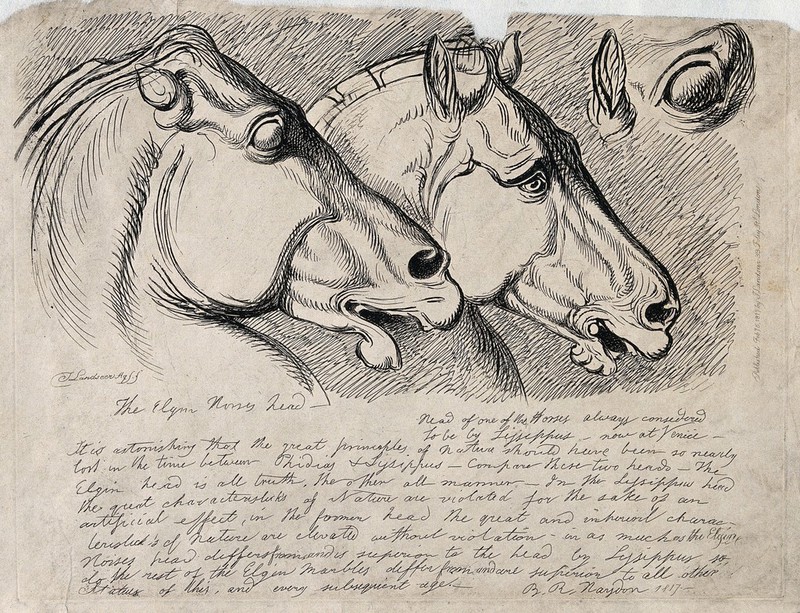
Heads of the horses in the Elgin marbles. Etching by J. Landseer., 1817, by John Landseer
John Landseer · Wellcome Collection, London · Wellcome Collection
Places
Named by the record
Places
Only places the record itself states, plotted where the house gazetteer settles their coordinates. Nothing is inferred from a name or a nationality.
Lincoln.
Birth place
London.
Death place
Writings
• Observations on the Engraved Gems brought from Babylon to England by Abraham Lockett Esq, considered with reference to Scripture History (1817). • Sabæan History (1823). • Description of Fifty of the Earliest Pictures in the National Gallery (1834; only the first volume was published). He published two short-lived periodicals: The Review of Publications in Art in 1808, and The Probe, set up in opposition to the Art-Union's journal. in 1837. He contributed articles on schools of engraving to Rees's Cyclopædia namely the French school (Volume 15, 1810); the German (Volume 16, 1810), the Low Countries (Volume 21, 1812) and the Italian (Volume 19, 1811). He also engraved a series of plates, with monograms etc. of French, German, Low Countries and Italian engravers. All his articles are of monograph length and may have re-cycled his Royal Institution material.
Primary material
Documents and archives
Institutional database
- Wikidata, structured authority record Q6243939: John Landseer
Scholarly · Wikimedia Foundation
reference work
- “John Landseer”, English Wikipedia, consulted as further reading
Reputable secondary · Wikipedia
Notes from the source article
Cited by Wikipedia
Notes from the source article
These works are cited by the source article, in its own numbering. They are recorded as its citations, not as sources VALÉORINE has verified.
- 1.Manson (1902), p.11
- 2.Hearne & Byrne. Frontispiece - The West Front of Malmesbury Abbey, Wiltshire. ANTIQUITIES OF GREAT-BRITAIN, ILLUSTRATED IN VIEWS OF MONASTERIES, CASTLES, AND CHURCHES, NOW EXISTING. Wikimedia. 1786.
- 3.Manson (1902), pp.13–4
- 4.Manson (1902), pp.12–4
- 5.Stephens (1880), p.7
- 6.Stephens (1880), p.3
- 7.Manson (1902), pp.12–4
- 8.Manson (1902), p.15
- 9.Manson (1902), p.15–6
- 10.Stephens (1880), p.11
- 11.Stephens (1880), p.12
- 12.Stephens (1880), p.12
- 13.Stephens (1880), p.12
- 14.Manson (1902), p.12
- 15.Manson (1902), p.17
Bibliography printed in the source article · 3
- Manson, James A. Sir Edwin Landseer R.A. Walter Scott Publishing Co. 1902.
- William Cosmo. Monkhouse. Landseer, John. 31.
- Stephens, Frederic G. Sir Edwin Landseer. Sampson Low, Marston. 1880.
References
Citations
References
Each reference names the institution holding it, so a reader may go to the document itself.
Institutional database
Wikidata, structured authority record Q6243939: John LandseerWikimedia Foundation
Institutional witnessreference work
Secondary witness
The Encyclopedia exists whether or not anything is for sale. Corrections are recorded rather than overwritten, and every version of this record is kept. Published 17 August 2026.
Elsewhere in Prints
4,138 published records in this field, each with its sources named.
- John KayEngraver
- John Keyse SherwinEngraver
- John KirkwoodEngraver
- John KoernerEngraver
- John Le KeuxEngraver
- John Lewis BrownEngraver
- John LinnellEngraver
- John LoringEngraver
Best supported in this field
For owners
Own a work by John Landseer?
A specialist will read what you send and tell you what the house can establish, what it cannot, and whether the object is suited to sale. There is no charge and no obligation. The object stays with you throughout; nothing is shipped to us unless it is arranged in writing beforehand.