
John Keyse Sherwin
Illustration — engraving of a Joshua Reynolds self-portrait John Keyse Sherwin (175124 September 1790) was an English engraver and history-painter.
Also recorded as John Sherwin · J. K. Sherwin · Sherwin · Mr. J. K. Sherwin
John Keyse Sherwin
John Keyse Sherwin · Wellcome Collection, London · Wellcome Collection · Public Domain Mark
- Born
- 1751 · East Dean.
- Died
- 1790 · London.
- Nationality
- Kingdom of Great Britain
- Occupation
- painter · artist · draftsperson · exlibrist · engraver · etcher
- Fields
- history
- Languages
- English
VALÉORINE Encyclopedia
VALÉORINE documentary reading
Documentary summary
Illustration — engraving of a Joshua Reynolds self-portrait John Keyse Sherwin (175124 September 1790) was an English engraver and history-painter.
Admitted source layer · organised and presented by VALÉORINE
Reference Check
Propose documentary evidence for John Keyse Sherwin. A contribution is never written directly as fact: identity, source, rights and evidence gates still decide.
Sign in to contribute
World of VALÉORINE
Documentary connections
Only confirmed graph relationships appear here. Images are shown only when their identity and reuse rights both pass the documentary gate.

Documentary evidence
Documentary basis
Authority files
wikidata · Q6243041 · wikipedia · John Keyse Sherwin
In this article
Biography
Biography
James Caldwall is recorded as having studied under John Keyse Sherwin. The recorded working language is English. Subjects and genres recorded for the work are history. Work by John Keyse Sherwin is recorded in the collections of Auckland Art Gallery, Australian National Maritime Museum, Metropolitan Museum of Art, Vanderbilt Museum of Art and National Library of Wales.
Sherwin was born at East Dean in Sussex. His father was a wood-cutter employed in shaping bolts for shipbuilders, and the son followed the same occupation till his seventeenth year, when, having shown an aptitude for art by copying some miniatures, he was adopted by his father's landlord, William Mitford. Sherwin was sent to study in London, first under John Astley, and then for three years under Francesco Bartolozzi – for whom he is believed to have executed a large portion of the plate of Clytie, after Annibale Carracci, published as the work of his master. Sherwin entered as a student of the Royal Academy, and gained a silver medal, and in 1772 a gold medal for his painting of "Coriolanus taking Leave of his Family". From 1774 till 1780 he was an exhibitor of chalk drawings and of engravings in the Royal Academy. Establishing himself in St James's Street as a painter, designer and engraver, he attained popularity and began to mix in fashionable society. His drawing of the "Finding of Moses", a work of but slight artistic merit, which introduced portraits of the princess royal of England and other leading ladies of the aristocracy, hit the public taste, and, as reproduced by his burin, sold largely. In 1785 he succeeded William Woollett as engraver to the king, and he also held the appointment of engraver to the Prince of Wales. His professional income rose to about £12,000 a year; but he was constantly in pecuniary difficulties, for he was shiftless, indolent, and without method, open-handed and even prodigal in his benefactions – and prodigal, too, in less reputable directions, for he became a reckless gambler, and habits of intemperance grew upon him. He did however have a notable student, John Thomas Smith who trained with him for three years. Sherwin died in extreme penury on 24 September 1790according to George Steevens, the editor of Shakespeare, at The Hog in the Pound, an obscure alehouse in Swallow Street, or, as stated by his pupil J.T. Smith, in the house of Robert Wilkinson, a printseller in Cornhill. It is as an engraver that Sherwin is most esteemed; and it may be noted that he was ambidextrous, working indifferently with either hand upon his plates. His drawing is correct, his line excellent and his textures are varied and intelligent in expression. Such of his plates as the "Holy Family" after Nicolas Poussin, "Christ Bearing the Cross" after Murillo, the portrait of the marquis of Buckingham after Thomas Gainsborough and that of Pitt occupy a high place among the productions of the English school of line-engravers. He also worked after Pine, Dance and Kauffman.
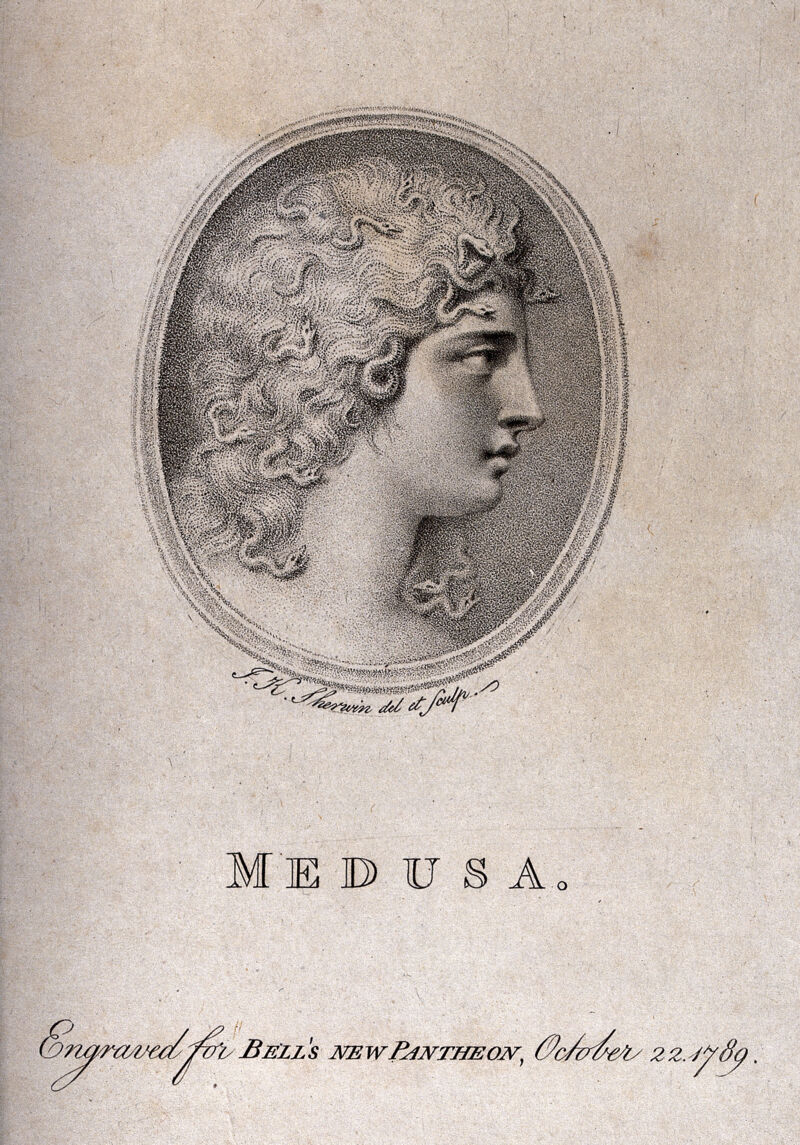
Medusa. Stipple engraving by J.K. Sherwin, 1789., 1789, by John Keyse Sherwin
John Keyse Sherwin · Wellcome Collection, London · Wellcome Collection
Places
Named by the record
Places
Only places the record itself states, plotted where the house gazetteer settles their coordinates. Nothing is inferred from a name or a nationality.
East Dean.
Birth place
London.
Death place
Primary material
Documents and archives
reference work
- “John Keyse Sherwin”, English Wikipedia, consulted as further reading
Reputable secondary · Wikipedia
authority record
- Wikidata, structured authority record Q6243041: John Keyse Sherwin
General reference · Wikidata
Citations
References
Each reference names the institution holding it, so a reader may go to the document itself.
reference work
Secondary witnessauthority record
General reference
The Encyclopedia exists whether or not anything is for sale. Corrections are recorded rather than overwritten, and every version of this record is kept. Published 16 August 2026.
Elsewhere in Prints
4,138 published records in this field, each with its sources named.
- John Ingvard KjargaardEngraver
- John JacksonEngraver
- John JonesEngraver
- John KayEngraver
- John KirkwoodEngraver
- John KoernerEngraver
- John LandseerEngraver
- John Le KeuxEngraver
Best supported in this field
For owners
Own a work by John Keyse Sherwin?
A specialist will read what you send and tell you what the house can establish, what it cannot, and whether the object is suited to sale. There is no charge and no obligation. The object stays with you throughout; nothing is shipped to us unless it is arranged in writing beforehand.