
John Byron
Vice-Admiral of the White John Byron (8 November 1723 – 1 April 1786) was a Royal Navy officer, explorer, and colonial administrator. He earned the nickname "Foul-Weather Jack" in the British press due to his frequent encounters with bad weather at sea. However, Byron's ship, HMS Wager, made it only to southern Chile, where it was wrecked.
Also recorded as Byron, John
John Byron
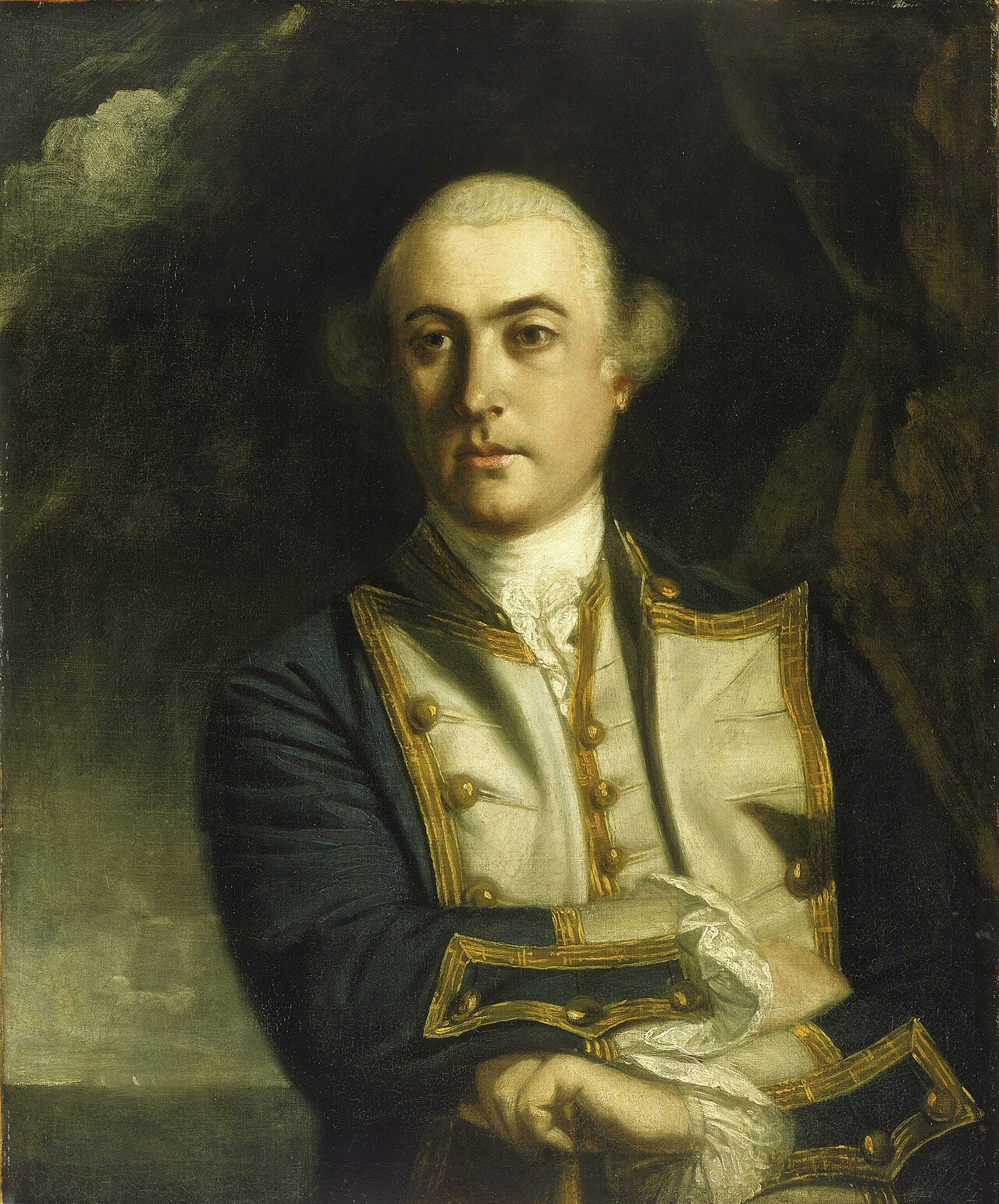
Joshua Reynolds · National Maritime Museum, Greenwich, London · Public domain
- Born
- 1723.
- Died
- 1786.
- Nationality
- Kingdom of Great Britain.
- Occupation
- explorer, poet, naval officer, governor, admiral and discoverer.
VALÉORINE Encyclopedia
VALÉORINE documentary reading
Documentary summary
Vice-Admiral of the White John Byron (8 November 1723 – 1 April 1786) was a Royal Navy officer, explorer, and colonial administrator. He earned the nickname "Foul-Weather Jack" in the British press due to his frequent encounters with bad weather at sea. However, Byron's ship, HMS Wager, made it only to southern Chile, where it was wrecked.
Admitted source layer · organised and presented by VALÉORINE
Note VALÉORINE
John Byron (1723–1786) was an admiral, discoverer and explorer, among other activities, of British nationality. The admiral was born in Newstead Abbey and died in London. Languages used include English.
Composed from admitted, traceable facts · 27 September 2026
VALÉORINE
Reference Check
Propose documentary evidence for John Byron. A contribution is never written directly as fact: identity, source, rights and evidence gates still decide.
Sign in to contribute
Documentary evidence
Evidence Panel
not yet certified
- Identity
- resolved
- Independent source families
- 0
- Admitted assertions
- 0
- Open conflicts
- 0
Authority files
gnd · 1255370335 · wikidata · Q507665 · wikipedia · John Byron
In this article
Early career
Early career
He returned to England with the captain of the ship. Byron was appointed governor of Newfoundland following Hugh Palliser, who left in 1768. He circumnavigated the world as a commodore with his own squadron in 1764–1766. Byron fought in several battles of the Seven Years' War and the American War of Independence, and rose to vice admiral before he died in 1786. His grandsons include the poet Lord Byron and the admiral and explorer George Byron, 7th Baron Byron. One of Byron's great-granddaughters was the mathematician and pioneer in informatics Ada Lovelace.
Byron was the second son of William Byron, 4th Baron Byron and Frances Berkeley, the daughter of William, 4th Baron Berkeley. After studying at Westminster School, he joined the Royal Navy at the age of 14, making his first voyage aboard HMS Romney in 1738–40.
Anson's voyage around the world
Anson's voyage around the world
In 1740, he accompanied George Anson on his voyage around the world as a midshipman aboard one of the several ships in the squadron. On 14 May 1741, HMS Wager was shipwrecked on the coast of Chile on what is now called Wager Island, and Byron was one of the survivors. Under the tenuous command of Captain David Cheape, who was only promoted to the position mid-voyage following the death of his predecessor, the survivors bickered amongst themselves and split into factions. A large group of sailors, including Byron, eventually defied Cheape's authority and sailed east to Portuguese Brazil, targeting Rio Grande do Sul on the Atlantic coast. Days into the journey, Byron and several others returned to the captain and his remaining small party. Cheape's party consisted of 19 men after the deserters rejoined the camp. This included the surgeon Elliot and Lieutenant Hamilton, as well as Byron and fellow midshipman Alexander Campbell. They rowed up the coast but were punished by continuous rain, headwinds, and waves that threatened the boats. One night, while the men slept on shore, one of the boats capsized while at anchor and was swept out to sea with its two boatkeepers. One of the men got ashore, but the other drowned. As it was now impossible for them all to fit in the remaining boat, four marines were left ashore with muskets to fend for themselves. The winds prevented them from getting around the headland, so they returned to pick up the marines, only to find them gone. They returned to Wager Island in early February 1742. With one death on the journey, there were now 13 in the group. Martín Olleta, a Chono chieftain, guided the men up the coast to the Spanish settlements on Chiloé Island, where they set out again. Two men died; after burying the bodies, the six seamen rowed off in the boat, never to be seen again, while Cheape, Hamilton, Byron, Campbell, and the dying Elliot were on shore looking for food. Olleta then agreed to take the remaining four on by canoe for their only remaining possession, a musket. The party likely travelled across Presidente Ríos Lake in the inland Taitao Peninsula, a lake that Chile officially discovered in 1945. Eventually they made it to be taken prisoner by the Spanish. The Spaniards treated them well and they were eventually taken to the inland capital of Santiago where they were released on parole. The Spaniards heard that Anson had been generous in the treatment of the prisoners he had taken, and this kindness was returned. Byron and the other three men stayed in Santiago till late 1744 and were offered passage on a French ship bound for Spain. Three accepted the passage. Campbell elected to take a mule across the Andes and joined the Spanish Admiral Pizarro in Montevideo on the Asia only to find Isaac Morris and the two seamen who had been abandoned in Freshwater Bay on the Atlantic coast. After time in prison in Spain, Campbell reached Britain in May 1746, followed by the other three two months later. In England, the official court martial examined only the loss of the Wager, in which Baynes, in nominal charge at the time, was acquitted of blame but reprimanded for omissions of duty. Disputes over what happened after the wreck were instead played out as Bulkeley and Cummins, Campbell, Morris, the cooper Young, and later Byron published their own accounts, the last of which was the only one that in any way defended Cheap, who had since died. Twenty-nine crew members plus seven marines made it back to England. Byron's account of his adventures and the Wager Mutiny are recounted in The Narrative of the Honourable John Byron (1768). His book sold well enough to be printed in several editions. Byron was appointed captain of HMS Siren in December 1746.
Seven Years' War
Seven Years' War
In 1760, during the Seven Years' War, Byron commanded a squadron sent to destroy the fortifications at Louisbourg, Cape Breton Island, Nova Scotia, which had been captured by the British two years before. They wanted to ensure the French could not use it in Canada. In July of that year, he defeated the French flotilla sent to relieve New France at the Battle of Restigouche.
Commodore, governor, and vice admiral
Commodore, governor, and vice admiral
In early 1764, the British Admiralty determined that a permanent naval settlement off the South American coast would be required to resupply naval vessels seeking to enter the Pacific via Cape Horn. Captain Byron was selected to explore the South Atlantic for a suitable island upon which to establish such a settlement. The South American mainland was controlled by Spain, which was hostile to the expansion of British interests in the region; to disguise Byron's mission, it was announced that he had been appointed the new Navy Commander-in-Chief, East Indies. Byron set sail in June 1764, ostensibly to take up the East Indies post. For the voyage he was granted command of the 24-gun frigate HMS Dolphin and the 16-gun sloop HMS Tamar. Byron's two-vessel flotilla crossed the Atlantic over the winter of 1764 and made its way slowly down the South American coast. The Admiralty had ordered Byron first to seek Pepys Island, reputedly discovered off the Patagonian coast by the corsair Ambrose Cowley in 1683. Byron reached the co-ordinates given by Cowley in January 1765, but there was no sign of the island and the search was swiftly abandoned. On 5 February Byron reached the Patagonian settlement of Port Desire where he resupplied his vessels from the storeship HMS Florida. Between June 1764 and May 1766, Byron completed his own circumnavigation of the globe as captain of HMS Dolphin. This was the first such circumnavigation that was accomplished in less than 2 years. His actions nearly caused a war between Great Britain and Spain, as both countries had armed fleets ready to contest the sovereignty of the Falkland Islands. Later Byron encountered islands and extant residents of the Tuamotus and Tokelau Islands, and Nikunau in the southern Gilbert Islands; he also visited Tinian in the Northern Marianas Islands. A notable member of Byron's crew was Master's Mate Erasmus Gower, whom Byron chose to 'take a significant part' in the ceremony when he took possession of the Falkland Islands. Byron had examined Gower for his lieutenant's examination in 1762 and was so impressed that he chose him to accompany him on his own circumnavigation (1764–65) and ensured that he was appointed as lieutenant to Commander Philip Carteret immediately afterwards in the next circumnavigation (1766–69). In 1769, he was appointed governor of Newfoundland off the mainland of Canada, an office he held for the next three years. He was promoted to rear admiral on 31 March 1775. In 1779, he served as Commander-in-chief of the Leeward Islands Station during the American War of Independence. After being severely injured during a storm on his way to the West Indies, Byron unsuccessfully attacked a French fleet under the Comte d'Estaing at the Battle of Grenada in July 1779. He subsequently resigned his post and returned to England, where he suffered from poor health for the rest of his life. Byron was briefly Commander-in-Chief, North American Station from 1 October 1779. He was made vice admiral of the white in September 1780.
Family
Family
On 8 September 1748, he married his first cousin, Sophia Trevanion, daughter of John Trevanion of Caerhays in Cornwall and Barbara Berkeley, the sister of his mother. They had two sons and seven daughters: Frances Byron (1749–1823), later married Charles Leigh Sophia Byron (died in infancy) Isabella Byron (died in infancy) Juliana Elizabeth Byron (1754–88), later married her cousin Hon. William Byron (d. 1776, son of William Byron, 5th Baron Byron) Sophia Maria Byron (1755–1821), the 'maiden aunt' of the poet George Gordon Byron John "Mad Jack" Byron (1757–91), who in turn fathered the poet George Gordon Byron, the future 6th Baron Byron George Anson Byron (1758–93), noted navy officer and father of George Anson Byron junior, another admiral and explorer, and later the 7th Baron Byron Charlotte Byron (died in infancy) Augusta Barbara Charlotte Byron (1762–1824), later married Admiral Christopher Parker John was the brother of Hon. George Byron, married to Frances Levett, daughter of Elton Levett of Nottingham, a descendant of Ambrose Elton, Esq., High Sheriff of Herefordshire in 1618 and a surgeon in Nottingham.
In fiction
In fiction
John Byron's experiences in the Anson voyage form the basis of the novel The Unknown Shore by Patrick O'Brian. It closely follows Byron's account in The Narrative of the Honourable John Byron (1768). In The Dark Design by Philip José Farmer, John Byron is a crewmember of the schooner The Razzle Dazzle.
Life and career
Dated record
Life and career
The full dated record · 2 entries
1723
John Byron born at Newstead Abbey.
1786
John Byron died at London.
Death and legacy
According to a note written by his wife, Sophia, to their financial agent, John Byron died on 1 April 1786 at home in Bolton Row, London (not 10 April, as subsequent biographies claim). On that date nine days later his remains were buried in the Berkeley family vault situated beneath the chancel of the Church of St Mary the Virgin, Twickenham. John's life was a great inspiration for his grandson, the poet George Gordon Byron, though they never met. The poet both drew from his grandfather's experiences in his writing, using his 'Narrative' for the shipwreck scene in Don Juan, and wrote of the kinship he felt in having such a turbulent, unlucky life: he wrote in an epistle to his half-sister Augusta Leigh that "he had no rest at sea, nor I on shore". Byron Street in St. John's, Newfoundland and Labrador is named after him.
Primary material
Documents and archives
reference work
- Wikidata, structured authority record Q507665: John Byron
Reputable secondary · Wikidata
- “John Byron”, English Wikipedia, consulted as further reading
Reputable secondary · Wikipedia
scholarly publication
- Byron, John (1723–1786), Oxford Dictionary of National Biography, 2017
Scholarly · Crossref registry · 2017
Notes from the source article
Cited by Wikipedia
Notes from the source article
These works are cited by the source article, in its own numbering. They are recorded as its citations, not as sources VALÉORINE has verified.
- 1.Douglas, W. A. B. Byron, John. 4.
- 2.Vásquez Caballero, Ricardo Felipe. Aau, el secreto de los chono.
- 3.Álvarez A., Ricardo. Referencias exploratorias sobre el lago Presidente Ríos, para sortear el Istmo de Ofqui, Península de Taitao, Región de Aysén. Magallania. 43. 1. 91–101. 2015. 10.4067/S0718-22442015000100006.
- 4.Rea, Robert R. Florida and the Royal Navy's Floridas. The Florida Historical Quarterly. Florida Historical Society. 60. 2. 187–191. October 1981.
- 5.Solarnavigator.net. Circumnavigation: Notable global maritime circumnavigations.
- 6.Officer on Board the said Ship. Voyage Round the World, in His Majesty's ship the Dolphin, commanded by the Honourable Commodore Byron. J. Newbery and F. Newbery. 1767.
- 7.Bates, Ian M. Champion of the Quarterdeck: Admiral Sir Erasmus Gower (1742-1814). Sage Old Books. 28, 35–73. 31 May 2017. 9780958702126.
- 8.Haydn, Joseph. The Book of Dignities: Containing Lists of the Official Personages of the British Empire . from the Earliest Periods to the Present Time . Together with the Sovereigns and Rulers of Europe, from the Foundation of Their Respective States; the Peerage of England and Great Britain Original 1851 Digitized by the University of Michigan. Longmans, Brown, Green, and Longmans. 279. 13 June 2008.
- 9.James Gambier, "John Byron", Oxford Dictionary of National Biography
- 10.John Burke, Esq. A Genealogical and Heraldic History of the Commoners of Great Britain and Ireland Vol. I. Henry Colburn. 255. 1834.
- 11.Sir Bernard Burke, LL.D. A Genealogical History of the Dormant, Abeyant, Forfeited, and Extinct Peerages of the British Empire. Harrison, 59, Pall Mall. 47. 1866.
- 12.Lodge, Edmund. The Genealogy of the Existing British Peerage with Brief Histories of the Family Histories of the Nobility, Edmund Lodge, London, 1832. 1832.
- 13.Mayo, Charles Herbert. A Genealogical Account of the Mayo and Elton Families of the Counties of Wilts and Hereford, Charles Herbert Mayo, London, 1882. Privately printed by C. Whittingham. 16. 1882.
- 14.The Twickenham Museum. At Twickenham Park, Lord John Berkeley.
- 15.City-Archives---Streets,-Areas,-Monuments-and-Plaques-2021.pdf. stjohns.ca.
Bibliography printed in the source article · 4
- Brand, Emily. The Fall of the House of Byron. John Murray. 2020.
- Gambier, James. "John Byron". Oxford Dictionary of National Biography.
- Shankland, Peter (1975). Byron of the Wager. Collins.
- Walker, Violet (1988). The House of Byron. Quiller Press.
References
Citations
References
Each reference names the institution holding it, so a reader may go to the document itself.
scholarly publication
Verifiedreference work
Partially resolvedreference work
Partially resolved
A further 1 witness is held back from this article because the person or object named in it is not yet resolved to this record. They are kept, not discarded, and return once the identity is established.
The Encyclopedia exists whether or not anything is for sale. Corrections are recorded rather than overwritten, and every version of this record is kept. Published 14 August 2026.
Elsewhere in Books
38,661 published records in this field, each with its sources named.
- John BurnsideAuthor
- John BurroughsAuthor
- John BuxtonAuthor
- John ByromAuthor
- John C. FarrarAuthor
- John C. FrémontAuthor
- John C. LillyAuthor
- John C. MaxwellAuthor
Best supported in this field
For owners
Own a work by John Byron?
A specialist will read what you send and tell you what the house can establish, what it cannot, and whether the object is suited to sale. There is no charge and no obligation. The object stays with you throughout; nothing is shipped to us unless it is arranged in writing beforehand.