
John Baptist Medina
Sir John Baptist Medina (1659 – 5 October 1710) was an artist of Flemish-Spanish origin who worked in England and Scotland, mostly as a portrait painter, though he was also the first illustrator of Paradise Lost by John Milton in 1688.
Also recorded as Sir John Medina · John Baptiste de Medina · John Baptist De Medina · Sir John Baptist de Medina
John Baptist Medina

John Baptist Medina · National Galleries Scotland · Public domain
- Name
- John Baptiste Medina
- Born
- c. 1659
- Birthplace
- Brussels, Spanish Netherlands
- Died
- 5 October 1710
- Place of death
- Edinburgh, Scotland
- Nationality
- Netherlands
- Occupation
- painter · draftsperson · illustrator
- Fields
- portrait
- Languages
- Dutch
Reference Check
Propose documentary evidence for John Baptist Medina. A contribution is never written directly as fact: identity, source, rights and evidence gates still decide.
Sign in to contribute
World of VALÉORINE
Documentary connections
Only confirmed graph relationships appear here. Images are shown only when their identity and reuse rights both pass the documentary gate.
Documentary evidence
Documentary basis
Authority files
wikidata · Q6220586 · wikipedia · John Baptist Medina
VALÉORINE Encyclopedia
The documentary record
Statements marked “Documentary record” are set in the article beside the passage they confirm. Each is read from the authority records of the institutions named here; select “Prove” to see the record it was read from, where in that record, and when.
Institutions cited
Deutsche Nationalbibliothek
Not stated by the sources cited: nationality
Complete reading chain (JSON)In this article
Biography
Biography
The recorded working language is Dutch. Subjects and genres recorded for the work are portrait. Places of work recorded in the authority are Brussels, London and Edinburgh. Work by John Baptist Medina is recorded in the collections of Minneapolis Institute of Art, National Galleries Scotland, Yale Center for British Art, Burrell Collection and Pollok House.
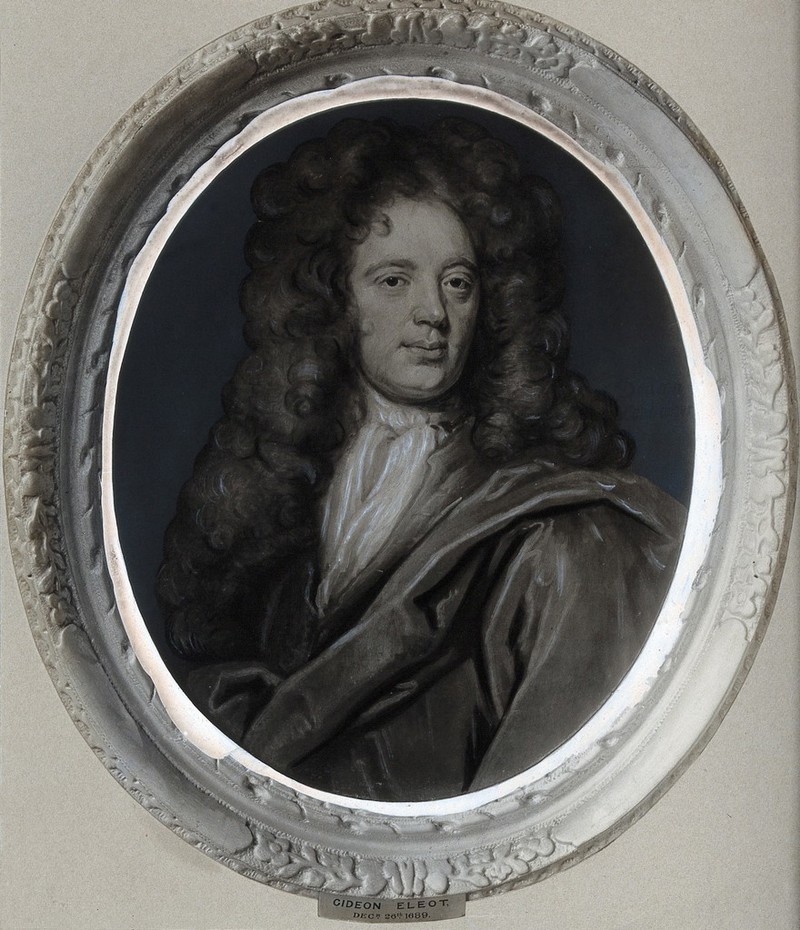
Gideon Eleot (Eliot). Photograph after J.B. Medina, 1689., by John Baptist Medina
John Baptist Medina · Wellcome Collection, London · Wellcome Collection
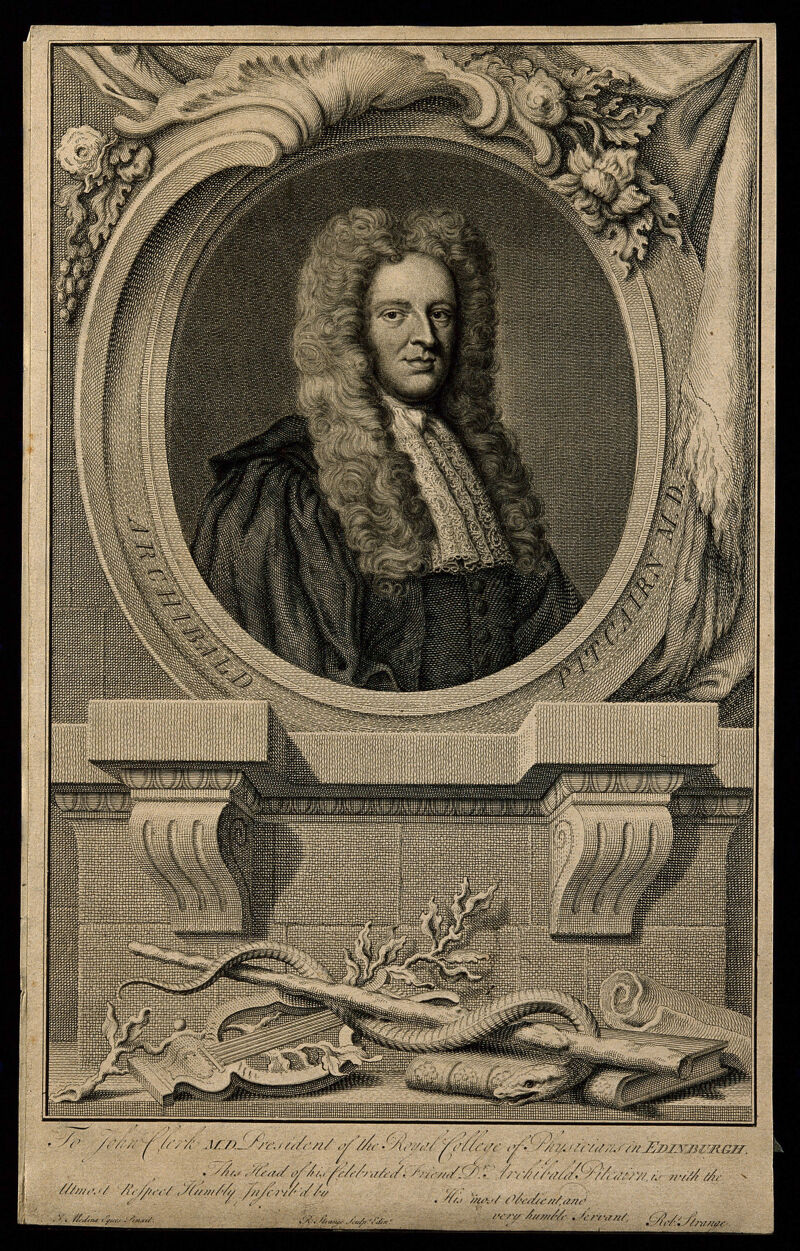
Archibald Pitcairne. Line engraving by R. Strange after J.B. de Medina., by John Baptist Medina
John Baptist Medina · Wellcome Collection, London · Wellcome Collection
Key facts
Key facts
• Name — John Baptiste Medina • Born — c. 1659 • Birthplace — Brussels, Spanish Netherlands • Died — 5 October 1710 • Place of death — Edinburgh, Scotland
Documentary record
John Baptist Medina, a painter, draughtsman and illustrator, was born in 1659 in Brussels and died in 1710. Both events are recorded by the Deutsche Nationalbibliothek.
Life and portrait-painting
Life and portrait-painting
Medina was the son of a Spanish army captain posted to Brussels, where he was born and later trained by François Duchatel, before coming to London in 1686 and setting up his studio in Drury Lane. Even in London he seems to have specialized in Scottish sitters, and in either 1688–89 or 1694 he moved to Edinburgh at the invitation of David Leslie, 3rd Earl of Leven. He remained there for the rest of his life. He was encouraged and sponsored by the Earl of Melville, whom he painted in London. From 1689, Melville, like many of Medina's subjects, a strong Whig, was Secretary of State for Scotland, effectively running the country for the King in London. With little competition, Medina was the most prominent Scottish portraitist for the rest of his life, charging £5 for a head and £10 for a half-length. His best known works are a group of about 30 oval bust-lengths, including a self-portrait, in Surgeons' Hall, Edinburgh; these are invariably compared to the Kit Cat Club series in London by Sir Godfrey Kneller. His style follows the conventions of Kneller, but his portraits are often more relaxed and informal, favouring relatively bright blues and rose-reds in the clothing, and dark backgrounds. The quality of the painting can vary considerably, probably reflecting the use of his assistants. In 1706, he was knighted, one of the last batch of Scottish knights to be created before the Acts of Union 1707. Medina died in Edinburgh on 5 October 1710. He was buried in Greyfriars Kirkyard in the centre of the city. The grave is a solid enclosed vault on the east side, now appearing half-sunken, adjacent to the steps leading to the northern section. The engraver, William Howison, is buried in front of the vault. • Illustration — The vault of Sir John Medina, Greyfriars Kirkyard, Edinburgh He trained both his own son and the talented William Aikman, the leading Scottish portrait-painter of the next generation. The Scottish National Portrait Gallery has a representative ten works, including another self-portrait, and a group of subject pictures bought from his studio by Sir John Clerk is held at Penicuik. Most of his paintings remain in Scotland – there are none, for example, in the National Portrait Gallery, London.
Life and career
Dated record
Life and career
The full dated record · 2 entries
1659
John Baptist Medina born at Brussels.
1710
John Baptist Medina died at Edinburgh.
Places
Named by the record
Places
Only places the record itself states, plotted where the house gazetteer settles their coordinates. Nothing is inferred from a name or a nationality.
Brussels.
Birth place
Edinburgh.
Death place
Illustrations to Paradise Lost
Illustrations to Paradise Lost
Although he appears to have painted other types of work than portraits, the only works other than portraits known to survive are his eight (out of a total of twelve plates prefacing each book of the poem) engraved book illustrations for the fourth edition, the first to be illustrated, of Paradise Lost by John Milton, published in London by Jacob Tonson in 1688. Though they have been described, perhaps rather unfairly, as "stiff and archaic", these follow Milton's text carefully, unlike those of the artists used for the other prints, and usually include several different episodes in each illustration. Appropriately, Medina drew on traditional Biblical iconography, carefully and imaginatively adapting it to fit Milton's text. Medina's designs preface Books 3 and 5 to 11; the plates were engraved from his designs by a specialist, Michael Burghers (also Burgese or Burgess), a Flemish engraver working in Oxford, who signed all but one plate as the engraver. They were still being used, in rather worn-out condition, for the sixth edition of 1695. The exact authorship of some plates is a matter of dispute. Purely based on the interpretation of a handwritten note attributed to Horace Walpole in the New York City Public Library copy of the book, Henry Aldrich, an Oxford don of diverse talents, but not otherwise known as an artist, has been identified as the unknown artist of some plates, usually Books I, II and XII. Bernard Lens II, otherwise known as a painter of enamels, is signed as the artist for Book IV, and Medina is signed as the artist for one more plate than some say would seem likely to be his on stylistic grounds.
Gallery of illustrations to Paradise Lost (1688)
Gallery of illustrations to Paradise Lost (1688)
• Illustration — Book 1: Satan Rousing the Rebel Angels. Anonymous artist, possibly Henry Aldrich. • Illustration — Book 2: Satan, Sin, and Death. Anonymous artist, possibly Henry Aldrich. • Illustration — Book 3: The Creation of Man. Medina. • Illustration — Book 4: Gabriel Expels Satan from the Garden. Signed by Bernard Lens. • Illustration — Book 5. Eve Relates her Dream to Adam. Medina • Illustration — Book 6: War in Heaven. Medina • Illustration — Book 7: Raphael warns Adam. Medina • Illustration — Book 8: Raphael advises Patience. Medina • Illustration — Book 9: The Fall. Medina • Illustration — Book 10: The Triumph of Satan and the Judgement of Adam and Eve. Medina • Illustration — Book 11: St Michael foretells the Crucifixion. Medina • Illustration — Book 12: The Expulsion. Anonymous artist, possibly Henry Aldrich.
Primary material
Documents and archives
reference work
- “John Baptist Medina”, English Wikipedia, consulted as further reading
Reputable secondary · Wikipedia
authority record
- Wikidata, structured authority record Q6220586: John Baptist Medina
General reference · Wikidata
Text attribution
Licensing
Text attribution
Part of the biographical narrative on this page reuses licensed material. Its origin, revision and licence are recorded here.
The biographical narrative on this page is based on the Wikipedia article John Baptist Medina, revision 1370872586 (EN edition), by its contributors. VALÉORINE has edited that text and built its own documentary record around it. The reused material is available under CC BY-SA 4.0, and this page's reuse of it is offered under the same licence. Everything else on this page — the chronology, the holdings, the evidence, the plates and the connections — is VALÉORINE's own record. Sources and licences.
Notes from the source article
Cited by Wikipedia
Notes from the source article
These works are cited by the source article, in its own numbering. They are recorded as its citations, not as sources VALÉORINE has verified.
- 1.Getty Name List – and variants, sometimes spelled "Baptiste", and "de Medina", but always "John"
- 2.Behrendt, 91
- 3.The earlier date per Waterhouse, 150, the later per the NGS
- 4.Macmillan, Duncan (1984), Scottish Painting 1500 - 1700, in Hearn, Sheila G. (ed.), Cencrastus No. 15, New Year 1984, pp. 25 - 29,
- 5.Waterhouse, 150–51
- 6.Monuments and monumental inscriptions in Scotland: The Grampian Society, 1871
- 7.Waterhouse, 151
- 8.National Galleries of Scotland
- 9.Behrendt, 91–2 All the illustrations are online from Christ's Collecge, Cambridge . This source gives Medina only 7 of the 12.
- 10.UWM Libraries. uwm.edu.
- 11.Miner, pp. 421–2, and following pages for commentary on the images.
- 12.King, John (2000). Milton and Religious Controversy: Satire and Polemic in Paradise Lost. Cambridge University Press. . Page 60 (on Google Books)
Bibliography printed in the source article · 6
- National Galleries of Scotland biography
- Behrendt, Stephen C.; The Moment of Explosion: Blake and the Illustration of Milton, University of Nebraska Press, 1983,
- Earl Roy Miner, William Moeck, Steven Edward Jablonski, Steven Jablonski; Paradise Lost, 1668–1968: Three Centuries of Commentary, Bucknell University Press, 2004, , online
- Waterhouse, Ellis; "Painting in Britain, 1530–1790", 4th Edn, 1978, Penguin Books (now Yale History of Art series)
- Macmillan, Duncan, Scottish Painting 1500 - 1700, in Hearn, Sheila G. (ed.), Cencrastus No. 15, New Year 1984, pp. 25 – 29,
- Marshall, Rosalind K. John de Medina, 1659–1710. Edinburgh, National Galleries of Scotland, 1988 (32pp) ,
References
Citations
References
Each reference names the institution holding it, so a reader may go to the document itself.
reference work
Secondary witnessauthority record
General reference
Further particulars
Held on the record
Further particulars
Open the remaining particulars
Recognition and collections
Work by John Baptist Medina is
Minneapolis Institute of Art, National Galleries Scotland, Yale Center for British Art and Burrell Collection
The Encyclopedia exists whether or not anything is for sale. Corrections are recorded rather than overwritten, and every version of this record is kept. Published 17 August 2026.
Elsewhere in Illustration
5,224 published records in this field, each with its sources named.
- John Alan MaxwellIllustrator
- John AlvinIllustrator
- John Archibald WebbIllustrator
- John AvonIllustrator
- John BatchelorIllustrator
- John BauerIllustrator
- John BearblockIllustrator
- John BerginIllustrator
Best supported in this field
For owners
Own a work by John Baptist Medina?
A specialist will read what you send and tell you what the house can establish, what it cannot, and whether the object is suited to sale. There is no charge and no obligation. The object stays with you throughout; nothing is shipped to us unless it is arranged in writing beforehand.