
Johann Wolfgang Baumgartner
Johann Wolfgang Baumgartner (1702 in Ebbs, Tirol - 7 September 1761 in Augsburg) was an Austrian-German Rococo painter.
Also recorded as Johann-Wolfgang Baumgartner · Wilhelm Baumgärtner · baumgartner j. w. · johann wolfg. baumgartner
Johann Wolfgang Baumgartner
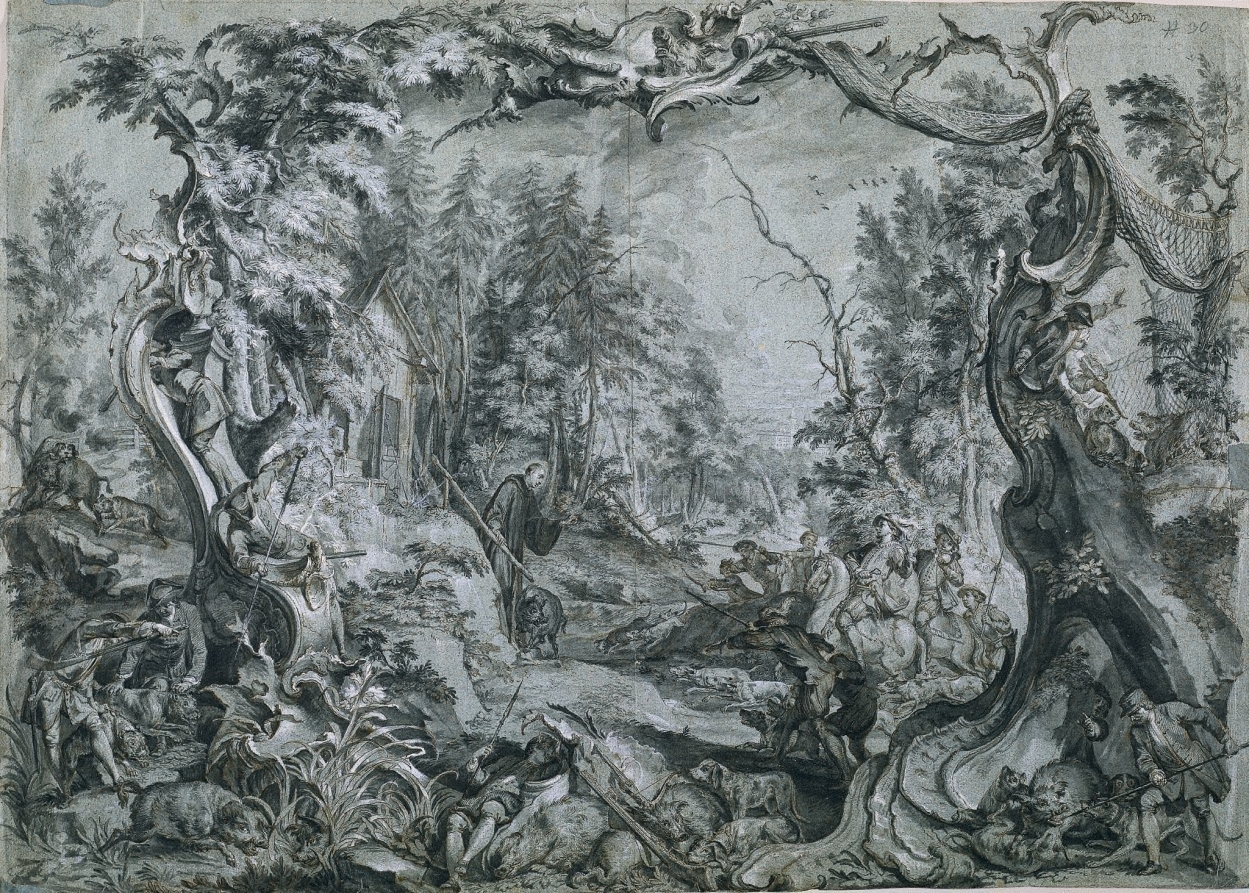
Johann Wolfgang Baumgartner · The Cleveland Museum of Art · Dudley P. Allen Fund · CC0
- Name
- Johann Wolfgang Baumgartner
- Born
- sources differ (1712 and 1702). · Ebbs.
- Died
- 1761. · Augsburg.
- Nationality
- Germany and Austria.
- Occupation
- painter, printmaker, draftsperson and artist.
- Languages
- German.
VALÉORINE Encyclopedia
VALÉORINE documentary reading
Documentary summary
Johann Wolfgang Baumgartner (1702 in Ebbs, Tirol - 7 September 1761 in Augsburg) was an Austrian-German Rococo painter.
Admitted source layer · organised and presented by VALÉORINE
Reference Check
Propose documentary evidence for Johann Wolfgang Baumgartner. A contribution is never written directly as fact: identity, source, rights and evidence gates still decide.
Sign in to contribute
World of VALÉORINE
Documentary connections
Only confirmed graph relationships appear here. Images are shown only when their identity and reuse rights both pass the documentary gate.
Documentary evidence
Documentary basis
Authority files
gnd · 16015492-3 · wikidata · Q261859 · wikipedia · Johann Wolfgang Baumgartner
In this article
Biography
Biography
The recorded working language is German. Places of work recorded in the authority are Augsburg. Work by Johann Wolfgang Baumgartner is recorded in the collections of Belvedere, Städel Museum, Nationalmuseum, Statens Museum for Kunst and Los Angeles County Museum of Art.
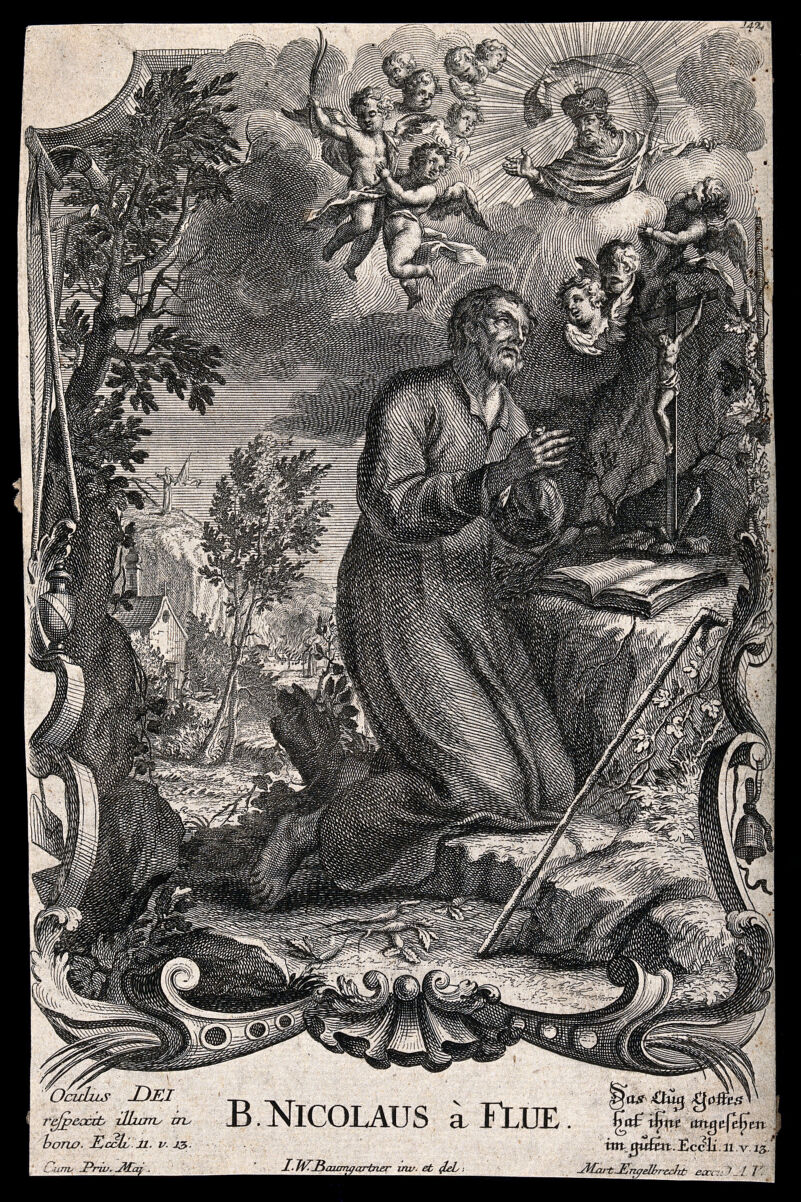
Saint Nicholas of Flue. Etching after J.W. Baumgärtner., 1700-1799, by Johann Wolfgang Baumgartner
Johann Wolfgang Baumgartner · Wellcome Collection, London · Wellcome Collection
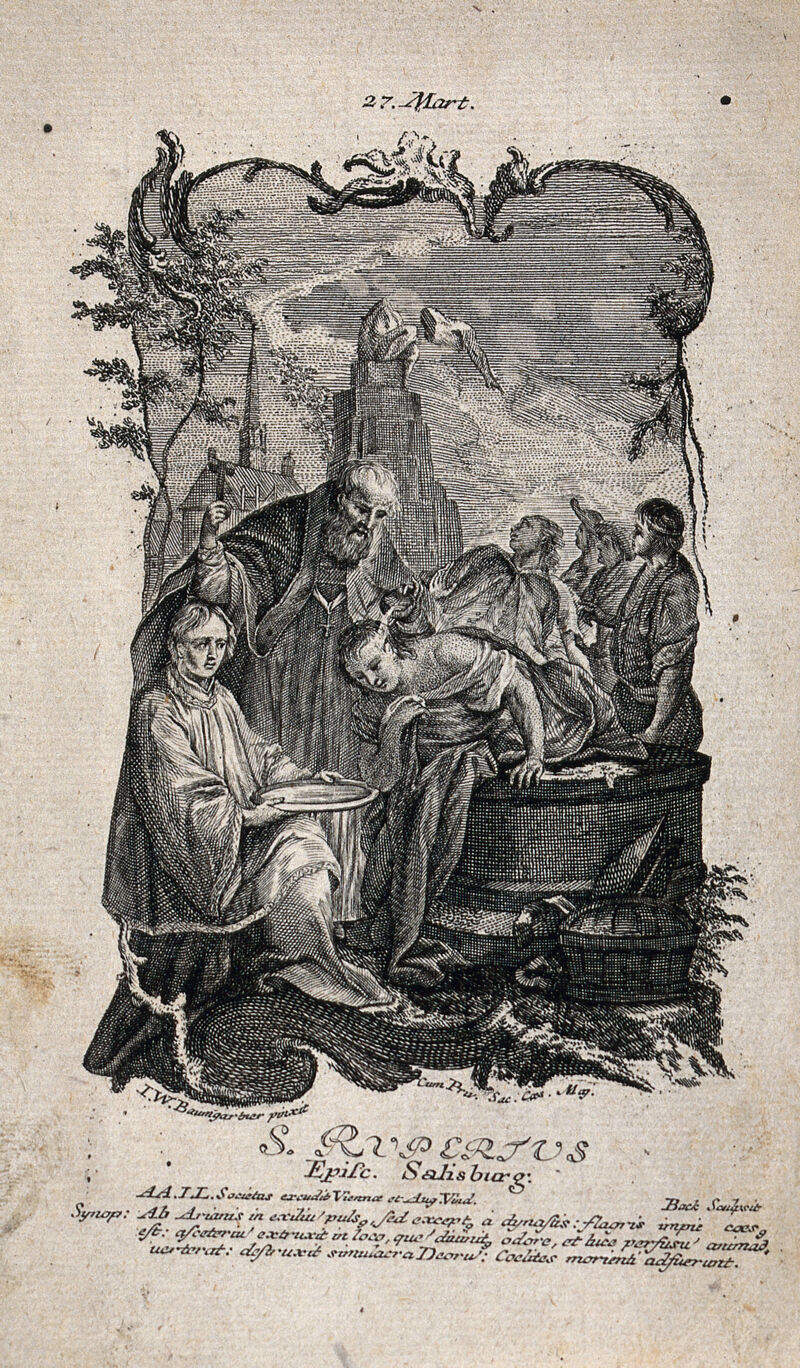
Saint Rupert of Salzburg. Etching by Bock after J.W. Baumgartner., by Johann Wolfgang Baumgartner
Johann Wolfgang Baumgartner · Wellcome Collection, London · Wellcome Collection
Key facts
Key facts
• Name — Johann Wolfgang Baumgartner • Style — Rococo • Illustration — The Prodigal Son Living with Harlots by Johann Wolfgang Baumgartner • Illustration — The Assumption and Crowning of Mary, painted ceiling in the transept of Baitenhausen church, 1760
Life
Life
He was born Johann Wolfgang Baumgartner in Tyrol and he learned glass painting in Salzburg. He moved to Augsburg and worked as a glass painter. The ceiling painting in the Sanctuary of the Holy Cross of the former Klosters Mountains is considered as his largest and most important work.
Works
Works
• Ceiling frescoes of the Sanctuary of St. Mary of Mount Carmel in Baitenhausen in Meersburg on Lake Constance, 1760 • Ceiling frescoes in the nave of the Sanctuary of St. Maria Loreto in Westheim • The Martyrdom of St. Venantius of Camerino • Daily edification of a true Christian • Mark the Evangelist writing • The Holy. John I. and the Gothic King Theodoric • Drawings of Bible pictures in Historia veteris (ac novi) Testamenti Iconibus Expressa
Identity and origins
Identity and origins
The authorities additionally record the headings Johann-Wolfgang Baumgartner, Wilhelm Baumgärtner, baumgartner j. w. johann wolfg. Baumgartner and joh. Wolfgang baumgartner. His recorded language was German.
Identity
Identity
Johann Wolfgang Baumgartner is recorded as painter, printmaker, draftsperson and artist.
Life and career
Dated record
Life and career
The full dated record · 2 entries
1702
Johann Wolfgang Baumgartner born at Ebbs.
1761
Johann Wolfgang Baumgartner died at Augsburg.
Places
Named by the record
Places
Only places the record itself states, plotted where the house gazetteer settles their coordinates. Nothing is inferred from a name or a nationality.
Ebbs.
Birth place
Augsburg.
Death place
Context
Primary material
Context
The circumstances in which Johann Wolfgang Baumgartner stands. A monk, suffering a hallucination that he is being attacked by wolves, being freed from his delusions by Saint Anselm. Drawing by an artist in the circle of J.W. Cathedral Church of Osnabrück: allegory and calendar. 1764, after J.W. Iris, Aesculapius and Flora routing death. Saints and martyrs. Klauber after J.W. Steudlin after J.W. Saint Rupert of Salzburg.
Documents and archives
Primary material
Documents and archives
reference work
- “Johann Wolfgang Baumgartner”, English Wikipedia, consulted as further reading
Reputable secondary · Wikipedia
- Wikidata, structured authority record Q261859: Johann Wolfgang Baumgartner
Reputable secondary · Wikimedia Foundation
authority file
- Gemeinsame Normdatei 16015492-3, Ausstellung: Johann Wolfgang Baumgartner - Ölskizzen und Hinterglasbilder (2009 : Salzburg).
General reference · Deutsche Nationalbibliothek
Literature
Scholarly footprint
A count of publications is evidence of attention, not of standing, and is given here only as a measure.
Citations
References
Each reference names the institution holding it, so a reader may go to the document itself.
reference work
Secondary witnessauthority file
Gemeinsame Normdatei 16015492-3, Ausstellung: Johann Wolfgang Baumgartner - Ölskizzen und Hinterglasbilder (2009 : Salzburg).Deutsche Nationalbibliothek
Secondary witnessreference work
Wikidata, structured authority record Q261859: Johann Wolfgang BaumgartnerWikimedia Foundation
Secondary witness
The Encyclopedia exists whether or not anything is for sale. Corrections are recorded rather than overwritten, and every version of this record is kept. Published 16 August 2026.
Elsewhere in Prints
4,138 published records in this field, each with its sources named.
- Johann Theodor de BryEngraver
- Johann Ulrich KrausEngraver
- Johann Wenzel PeterEngraver
- Johann Wilhelm BaurEngraver
- Johann Wolfgang von GoetheEngraver
- Johann ZoffanyEngraver
- Johanna Dorothea SysangEngraver
- Johanna Marie FosieEngraver
Best supported in this field
For owners
Own a work by Johann Wolfgang Baumgartner?
A specialist will read what you send and tell you what the house can establish, what it cannot, and whether the object is suited to sale. There is no charge and no obligation. The object stays with you throughout; nothing is shipped to us unless it is arranged in writing beforehand.