
Johann Heinrich Schönfeld
Johann Heinrich Schönfeld (23 March 1609 – 1684) was a German painter in the Baroque style.
Also recorded as Ansericco · Johann Heinrich Schoenfeld · Heinrich Schönfeld · Heinrich Schonfeld
Johann Heinrich Schönfeld

Joachim von Sandrart the Elder · Sandrart project · Public domain
- Name
- Johann Heinrich Schönfeld
- Born
- 23 March 1609
- Birthplace
- Biberach an der Riss
- Died
- 1684
- Place of death
- Augsburg
- Nationality
- Germany
- Occupation
- painter · engraver · draftsperson · copyist · etcher · artist
- Fields
- visual arts
- Languages
- German
VALÉORINE Encyclopedia
VALÉORINE documentary reading
Documentary summary
Johann Heinrich Schönfeld (23 March 1609 – 1684) was a German painter in the Baroque style.
Admitted source layer · organised and presented by VALÉORINE
Reference Check
Propose documentary evidence for Johann Heinrich Schönfeld. A contribution is never written directly as fact: identity, source, rights and evidence gates still decide.
Sign in to contribute
World of VALÉORINE
Documentary connections
Only confirmed graph relationships appear here. Images are shown only when their identity and reuse rights both pass the documentary gate.
Documentary evidence
Documentary basis
Authority files
wikidata · Q278623 · wikipedia · Johann Heinrich Schönfeld
In this article
Biography
Biography
The recorded working language is German. The field of work recorded is visual arts. Subjects and genres recorded for the work are allegory and history. Places of work recorded in the authority are Stuttgart, Basel and Rome. Work by Johann Heinrich Schönfeld is recorded in the collections of Thyssen-Bornemisza Museum, National Gallery of Canada, Städel Museum, Hessen Kassel Heritage and Bavarian State Painting Collections.
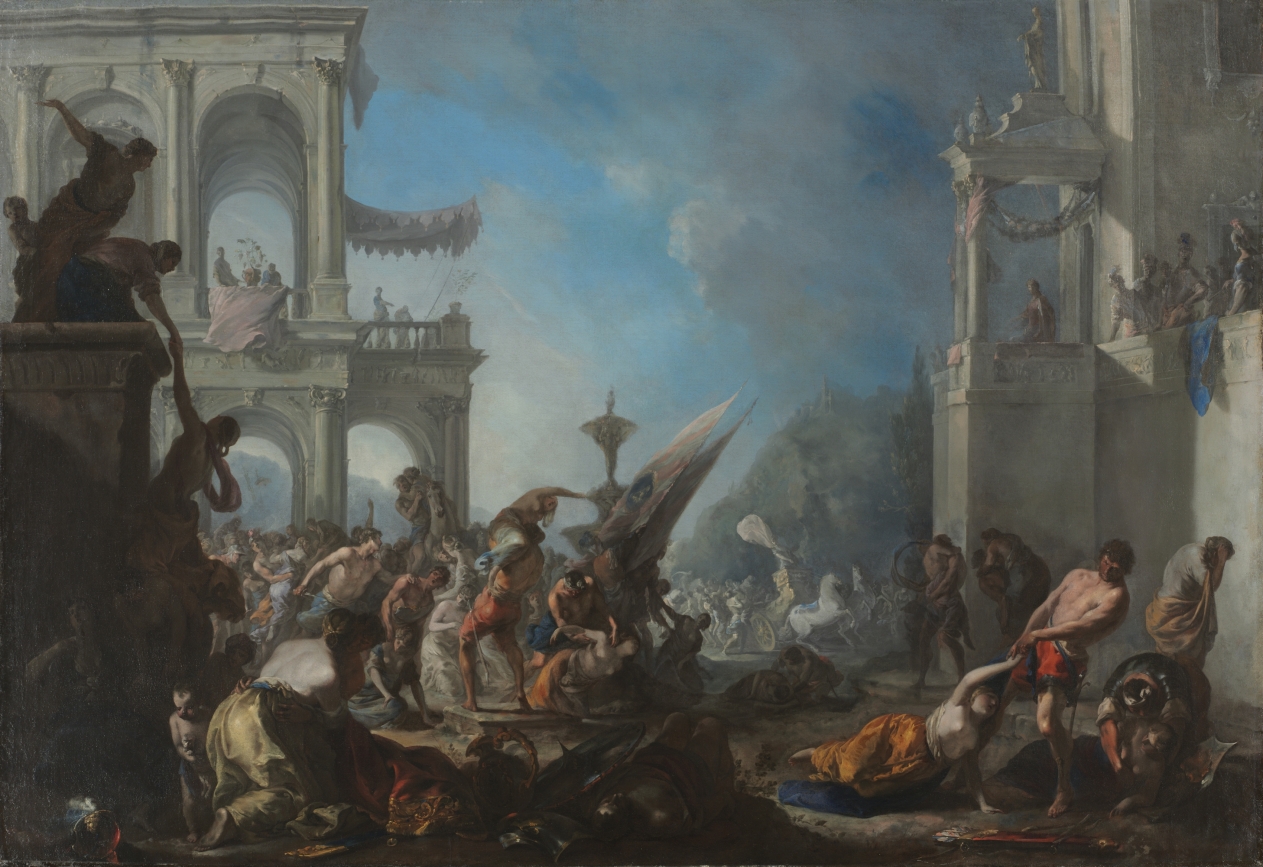
Abduction of the Sabine Women, c. 1640, by Johann Heinrich Schönfeld
Johann Heinrich Schönfeld · The Cleveland Museum of Art · Leonard C. Hanna Jr. Fund
Key facts
Key facts
• Name — Johann Heinrich Schönfeld • Born — 23 March 1609 • Birthplace — Biberach an der Riss • Died — 1684 • Place of death — Augsburg • Illustration — Death of the Daughter of Spurius Tarpeus, c.1640.
Biography
Biography
He was the son of Johann Baptist Schönfeld (died 1635), a goldsmith. From birth, he was blind in his left eye and could only use his right hand for simple tasks, so he was not trained as a goldsmith, as would have otherwise been the case. Instead, he received lessons in painting from Caspar Sichelbein in Memmingen. Later, he took study trips to Stuttgart and Basel. In 1633, at the height of the Thirty Years' War, he fled to Italy. Originally, he lived in Rome, then moved to Naples around 1649. After a brief stay in Dresden he returned home in 1651. The following year, in Pfuhl (near Ulm) he married Anna Elisabetha Strauß. They had eight children together. Shortly after their marriage, they moved to Augsburg, where he became a citizen and a member of the Master's Guild. In the following years, he created many church paintings; notably at Würzburg Cathedral, where he painted Christ carrying the Cross and a likeness of Saint Leonard of Noblac. Both paintings burned during the bombing of Würzburg in World War II. In addition to religious works, he painted mythological and genre scenes. One of his best-known students was Johann Schmidtner.
Identity
Identity
Johann Heinrich Schönfeld is recorded with the occupation copper engraver. Classed in the genre history painting. Recorded as painter, engraver, draftsperson, copyist and etcher.
Life and career
Dated record
Life and career
The full dated record · 2 entries
1609
Johann Heinrich Schönfeld born at Biberach an der Riß.
1684
Johann Heinrich Schönfeld died at Augsburg.
Places
Named by the record
Places
Only places the record itself states, plotted where the house gazetteer settles their coordinates. Nothing is inferred from a name or a nationality.
Biberach an der Riß.
Birth place
Augsburg.
Death place
Primary material
Documents and archives
authority record
- Wikidata, structured authority record Q278623: Johann Heinrich Schönfeld
General reference · Wikidata
reference work
- “Johann Heinrich Schönfeld”, English Wikipedia, consulted as further reading
Reputable secondary · Wikipedia
Notes from the source article
Cited by Wikipedia
Notes from the source article
These works are cited by the source article, in its own numbering. They are recorded as its citations, not as sources VALÉORINE has verified.
- 1.Petits Musées, grandes collections. Scala. 2003. 2-86656-327-1.
- 2.Gédéon, Vienne (musée)
- 3.1001 peintures au Louvre. Musée du Louvre Editions. 2005. 2-35031-032-9.
References
Citations
References
Each reference names the institution holding it, so a reader may go to the document itself.
authority record
Secondary witnessreference work
Secondary witness
Further particulars
Held on the record
Further particulars
Open the remaining particulars
The authorities additionally record the headings Ansericco, Johann Heinrich Schoenfeld, Heinrich Schönfeld, Heinrich Schonfeld and Johann Heinrich Schönfeldt. His recorded language was German. He was the child of Johann Baptist Schönfeld.
Identity and origins
Recognition and collections
Work by Johann Heinrich Schönfeld is
Thyssen-Bornemisza Museum, National Gallery of Canada, Städel Museum and Hessen Kassel Heritage
The Encyclopedia exists whether or not anything is for sale. Corrections are recorded rather than overwritten, and every version of this record is kept. Published 16 August 2026.
Elsewhere in Prints
4,138 published records in this field, each with its sources named.
- Johann Georg WilleEngraver
- Johann Gottfried HaidEngraver
- Johann Gottlieb PrestelEngraver
- Johann HauserEngraver
- Johann Heinrich TischbeinEngraver
- Johann Heinrich Wilhelm TischbeinEngraver
- Johann HeissEngraver
- Johann HulsmanEngraver
Best supported in this field
For owners
Own a work by Johann Heinrich Schönfeld?
A specialist will read what you send and tell you what the house can establish, what it cannot, and whether the object is suited to sale. There is no charge and no obligation. The object stays with you throughout; nothing is shipped to us unless it is arranged in writing beforehand.