
Johann Nepomuk Schönberg
Johann Nepomuk Schönberg (18442 December 1913) was an Austrian artist, war correspondent, war-artist, and illustrator who illustrated many of the wars and disasters of his time.
Also recorded as Johann Nep. Schönberg · Johann Schönberg
Johann Nepomuk Schönberg
Johann Nepomuk Schönberg · Wellcome Collection, London · Wellcome Collection · Public Domain Mark
- Name
- Johann Nepomuk Schönberg
- Birthplace
- Vienna
- Place of death
- Beckenham, London, England
- Occupation
- Artist, Illustrator
- Known for
- Illustrations of war
- Born
- 1844. · Vienna.
- Died
- 1913. · London.
Reference Check
Propose documentary evidence for Johann Nepomuk Schönberg. A contribution is never written directly as fact: identity, source, rights and evidence gates still decide.
Sign in to contribute
World of VALÉORINE
Documentary connections
Only confirmed graph relationships appear here. Images are shown only when their identity and reuse rights both pass the documentary gate.

Documentary evidence
Documentary basis
Authority files
wikidata · Q21459940 · wikipedia · Johann Schönberg
In this article
Key facts
Key facts
• Name — Johann Nepomuk Schönberg • Birthplace — Vienna • Place of death — Beckenham, London, England • Other Names — J Schonberg • Occupation — Artist, Illustrator • Years Active — 1862–1905 • Known for — Illustrations of war • Notable Works — Paintings of the Romanian War of Independence
Early life
Early life
Both his father Adolf (1813–1868) an engraver and lithographer, and his grandfather Johan (178012 March 1863) an engraver, were well known artists. Schönberg attended the Imperial and Royal Unified Academy of Fine Arts in Vienna from 1858 to 1860, where his father had also studied. He travelled to Munich to work under Hermann Anschütz at the Academy of Fine Arts, Munich. However, he had to abandon his studies to Vienna to assist his impoverished father. Fritz L'Allemand had seen some of his smaller war paintings and asked him to assist with completing his painting of "Banquet Table of the Maria Theresa Knights at Schönbrunn Castle". Schönberg spent several months at this task, it was the L'allemand who got paid and got the credit. Schönberg was of military age and served as a soldier in the Austrian army and fought in the Battle of Custoza (1866) as part of the Third Italian War of Independence. He also served in the Austro-Prussian War in 1866, and supplied sketches from this conflict to the Illustrated London News. Before and after his bouts of military service, he was studying in Vienna and Munich. He was already producing illustrations for books and for illustrated papers. During this period also he visited the Academy in Vienna in (1865–1867) and became a member of the Vienna Artists' Society at the Vienna Künstlerhaus. He married Pauline (born c. 1850) in c. 1873. The couple had no children. They both moved to England about the time of their marriage. In 1901, when Schönberg was in China, the census shows Pauline was staying with a cousin in Ernst Carl Fuchs at Penge in Kent. By the 1911 census, the couple, now in their 60s were boarding with the Bruck brothers, Walter, a fine art publisher, and William, a process engraver, in Weylands, 21, Southend Road, Beckham. The couple never naturalised, but continued to remain resident foreign citizens.
Work
Work
During his life, Schönberg produced a huge volume of work. His overall body of work numbers more than 2,000 drawings and paintings. His paintings were usually commissioned rather than being painted as speculative works. He almost never exhibited, and did not build up a reputation in this way. Wurzbach noted that Schönberg's sketches were well drawn, gave a faithful rendering of the scenes, and when many people were represented, the groups were cleverly distributed and the timing of the drawing chosen with a lucid eye. However, Wurzbach bemoaned that Schönberg's talent was being frittered away on illustration rather than on great works of art. One interesting commission that Schönberg received was from Prince Carol of the newly independent Romania. The Prince commissioned him to paint the key events of the Romanian War of Independence. Specifically, he was commissioned to paint a series of six oil paintings: • The Crossing of the Danube • The Bombardment of Vidin, also called This is the music I like! after the Prince's words when a shell burst near him on a battery in Calafat • The Assault on the Grivitza Redoubt • The Ruling Prince visiting the Grivitza Redoubt • Prince Carol at the Battle of Plevna • The first Encounter between Prince Carol I and Osman Nuri Pasha after the Surrender The paintings were based on Schönberg's own witnessing of these events, and were based on his own sketches and drawings made during the campaign. He worked hard to ensure that all those represented were accurately drawn. It was a long drawn out process as he first had to produce watercolour sketches and mid-sized oil paintings to get approval for the large-scale oil-paintings. The whole project took 25 years to complete. Bénézit shows only one auction result for Schönberg: Sailing Ships at Sea (1912, oil on canvas 53.5x37 cm) was sold for 15,000 ATS in Vienna on 19 June 1979.
Death
Death
Schönberg died on 2 December 1913 in Beckenham, London. He was still living at Weylands, 21 Southend Road Beckham when he died. He was buried in Lambeth North Cemetery on 6 December. His widow Pauline administered his estate, which amounted to only £48 10s.
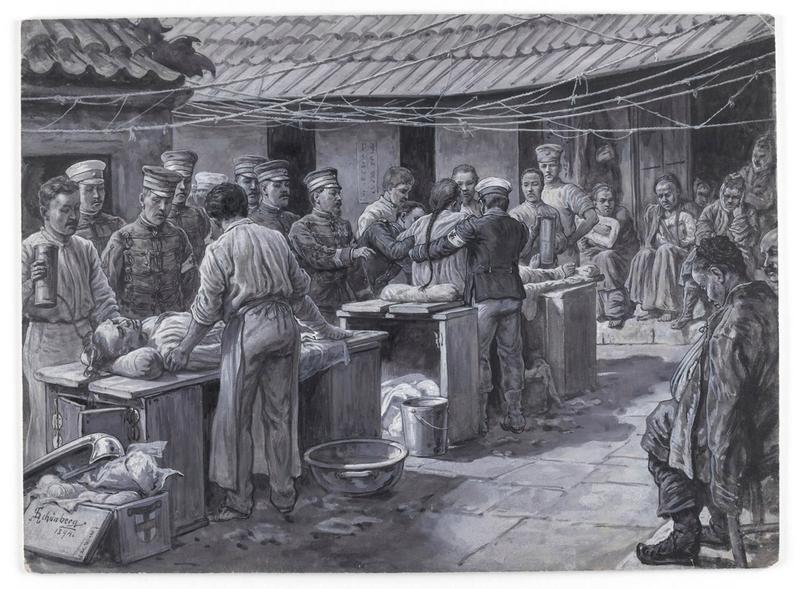
Pyongyang, Korea: wounded Chinese prisoners of war receiving medical treatment after the battle of Pyongyang. Gouache by J.N. Schönberg, 1894., 1894, by Johann Nepomuk Schönberg
Johann Nepomuk Schönberg · Wellcome Collection, London · Wellcome Collection
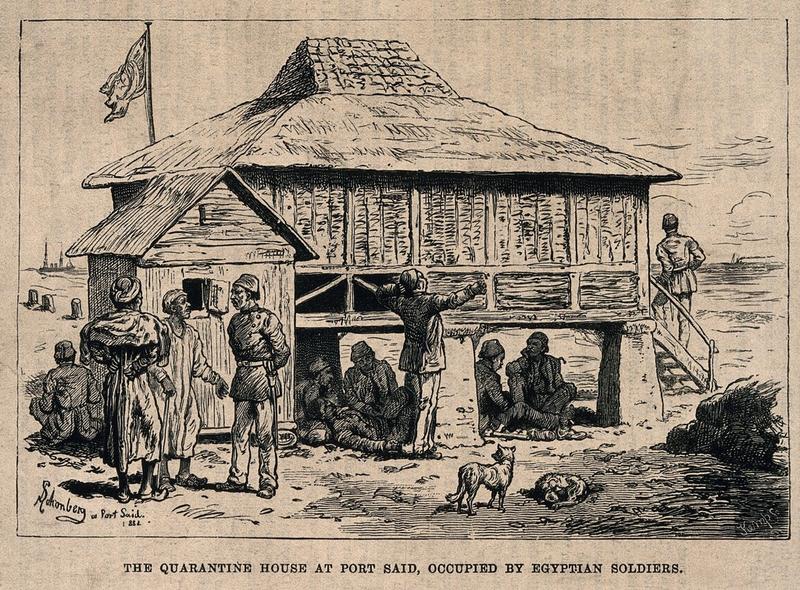
Port Said, Egypt: a quarantine station. Wood engraving by W. Kemp after J.N. Schönberg, 1882., 1882, by Johann Nepomuk Schönberg
Johann Nepomuk Schönberg · Wellcome Collection, London · Wellcome Collection
Life and career
Dated record
Life and career
The full dated record · 2 entries
1844
Johann Nepomuk Schönberg was born on 1 January 1844.
1913
Johann Nepomuk Schönberg died on 1 January 1913.
Places
Named by the record
Places
Only places the record itself states, plotted where the house gazetteer settles their coordinates. Nothing is inferred from a name or a nationality.
Vienna.
Birth place
London.
Death place
Press illustrations
Press illustrations
Schönberg provided illustrations for many publications, starting in his native Austria and then moving further afield to Germany, France, and England. Among the papers he illustrated for were: • Über Land und Meer (Stuttgart) This was a Hallberger publication like Illustrirte Welt, but they did not publish the same material. • Illustrirte Zeitung (Leipzig) • Daheim (magazine) • Illustrierte Welt • Le Monde Illustré • Illustrated London News Schönberg first works for the paper in 1866. He was appointed as their Special Artist in Romania in 1877 during the Romanian War of Independence. He remained on the staff of the newspaper for the next 22 years, until he went to Pretoria for The Sphere in 1899. He returned to the Illustrated London News after returning from Pretoria. • The Sphere Schönberg not only did his own drawings, but he also worked up the drawings sent in by other artists. For the illustrated weeklies, the illustrations were a two-stage process – the first with the production of the drawing, and then the engraving of the plates to reproduce them. Thus Schönberg worked on Melton Prior's drawings of the Zulu War in 1879. Houfe states that his illustration style was characterised by the heavy use of body-colour with grey washes.
Examples of illustrations from war zones
Examples of illustrations from war zones
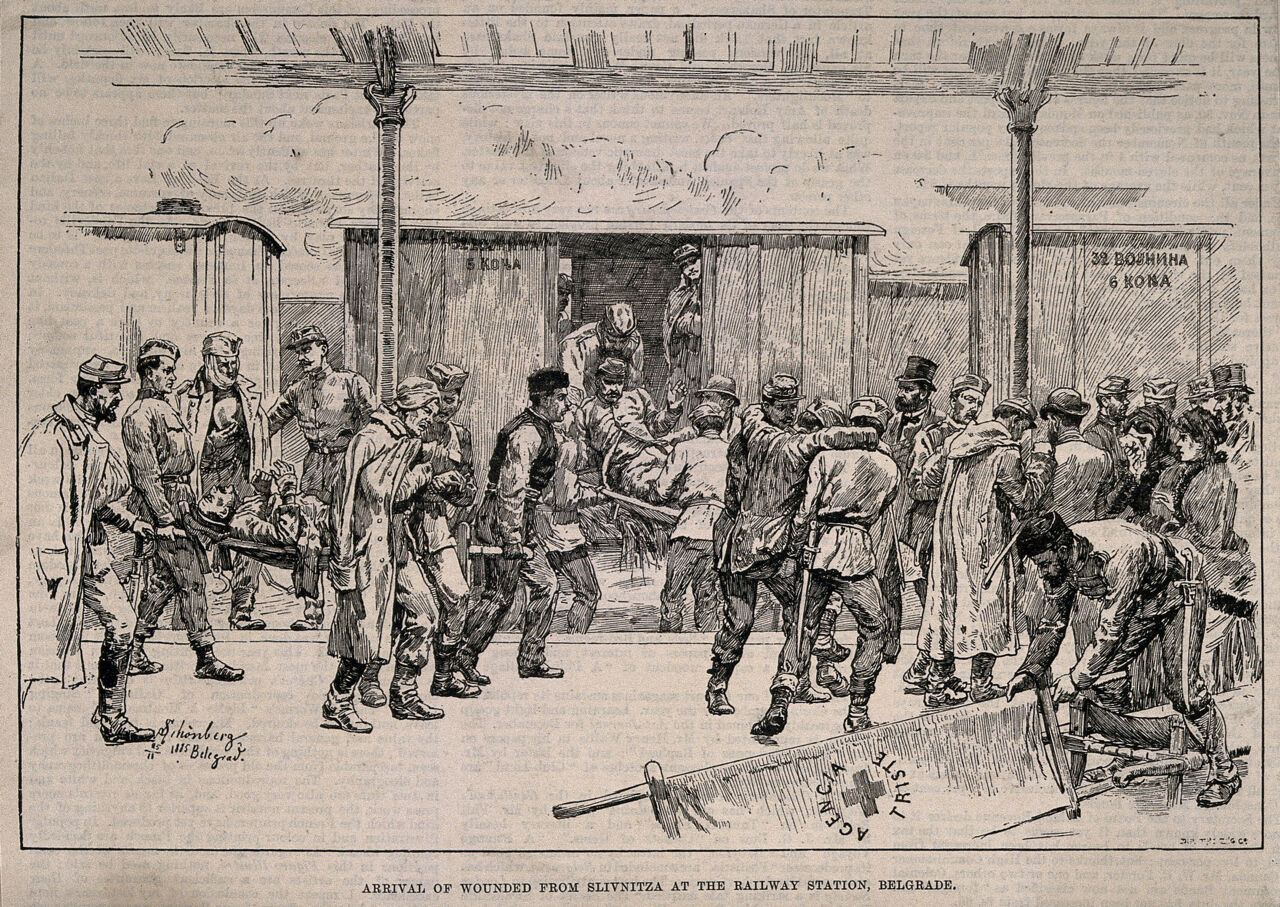
The following illustrations were drawn or painted by Schönberg during different military campaigns. They all show examples of military medicine as the illustrations are by courtesy of the Wellcome Collection. • Illustration — Sick and wounded soldiers at Ak Palanka during the Serbo-Bulgarian War of 1885 • Illustration — The Quarantine House for Egyptian soldiers suffering from the plague at Port Said during the British Conquest of Egypt (1882) • Illustration — Arrival of wounded from Slivnitza at Belgrade Railway station during the Serbo-Bulgarian War of 1885 • Illustration — Wounded Chinese prisoners getting medical treatment at Pyongyang, Korea, during the first Sino-Japanese War (1894–1895) Schönberg was a correspondent as well as an artist and sent reports and conducted interviews, in addition to sending sketches of the action or of the aftermath of war. Among the conflicts and disasters he covered were: • The American Civil War (12 April 18619 May 1865). Schönberg told a Canadian reporter in a 1901 interview, while he was on his way back from the Boxer Rebellion via Vancouver, that his first experience in the field was in 1863 when he drew military illustrations of the Civil War. • The Third Italian War of Independence (20 June 186612 August 1866). Schönberg was a soldier in the Austrian ranks for this war, but also did some illustration. • The Austro-Prussian War (14 June22 July 1866). This was the first work he did for the Illustrated London News. He was also in the ranks of the Austrian Army for this conflict. • The Franco-Prussian War (19 July 187028 January 1871). He later contributed to a book on the campaign. • The Prusso-Austrian War (14 June22 July 1855) where he produced drawings for the Illustrated London News, his first work for that paper. • The Serbo-Turkish War (30 June 187628 February 1877). This was the first of two wars that established Serbia as an independent state. In the lull between the two wars, Schönberg covered the tension in Bulgaria as the Special Artist for the Illustrated London News. • Russo-Turkish War otherwise known as the Romanian War of Independence (24 April 18773 March 1878). Schönberg covered this war in the interlude between the two Serbian wars as the Special Artist for the Illustrated London News. As a result of his work on this war, Prince Carol I of Romania asked him to paint six large canvases inspired by the war with the topics selected by the Prince. The first painting was ready in 1891 and it was 1903 before the sixth was handed over. • The Russo-Turkish War (13 December 18775 February 1878). This was effectively a continuation of the (1876–1877) conflict. • The flooding of Szegedin, Hungary in 1879, a disaster which destroyed over 90% of the houses. • The British Conquest of Egypt (1882) Egyptian campaign of July–September 1882. • The Serbo-Bulgarian War (14–28 November 1885) • The cholera epidemic in Hamburg in 1892 when over 8,000 died. • The First Sino-Japanese War (25 July 189417 April 1895) • The Second Boer War (11 October 189931 May 1902). • The Boxer Rebellion or Yihetuan Movement (2 November 18997 September 1901).
Book illustrations
Book illustrations
In addition to his illustrations for non-fiction works such as Alexander Patuzzi's History of the Popes, and Ludwig von Alvensleben's General History of the World, Schönberg illustrated books for a wide range of authors, mainly for children's fiction. Among the authors whose work he illustrated were: • Elbridge S. Brooks, a prolific author who wrote both serialised fiction, novels, and non-fiction for children • Harry Collingwood, a writer of boys' adventure fiction, usually in a nautical setting • Edward S. Ellis, a prolific American author of adventure fiction • George Manville Fenn, who wrote mainly for young adults • Henry Frith, a prolific Irish author and the English translator for many of Jules Verne's novels • John Percy Groves, a soldier who wrote stirring stories for boys • G. A. Henty, a prolific writer of boy's adventure fiction, often set in a historical context • Georgina Norway, who wrote adventure fiction for children as "G. Norway"
Examples of book illustration
Examples of book illustration
Given his Austrian roots, Schönberg was probably a good choice for the illustration of The Lion of the North: a tale of the times of Gustavus Adolphus and the wars of religion by G. A. Henty. Schönberg did twelve full-page illustrations as line-and-wash drawings reproduced by black line and sepia tint plates. Newbolt notes that Schönberg's work was limited by the quality of available processes and sometimes by the printer's choice of cheap paper. • Illustration — Colonel Munro seeks to enlist Nigel Graeme and his nephew • Illustration — Malcolm's courage and humanity at the battle of Schiefelbrune • Illustration — Colonel Munro presents Malcolm to the King • Illustration — Malcolm counsels the townspeople of Mansfield to resistance • Illustration — Malcolm and Grent cross the Rhine at midnight • Illustration — Malcolm fired at one of the natives and then with a loud shout dashed forward • Illustration — The last of the siege of the church-tower • Illustration — Death of Gustavus Adolphus at Lutzen • Illustration — Malcolm receives Lady Hilda's appeal for help • Illustration — A plan proposed for Thekla's safety • Illustration — Malcolm overpowered by treachery at the banquet • Illustration — Thekla advanced and laid her hand in Malcolm's Schönberg illustrated another Henty tale of trouble on the continent. This time it was In the Reign of Terror: The Adventures of a Westminster Boy, (1888), London, Blackie, a story about the French Revolution. Schönberg did eight full-page wash-drawings which were reproduced by halftone blocks printed in black on coated paper. The halftone blocks were fine-screen, almost the first time such blocks were used in the UK. A lot of handwork and deep-etching was done on the blocks to accentuate highlight and avoid a flat result. Newbolt further notes that examination with a glass shows that Blackie had printing problems with these very fine screens, which tended to get clogged by dust and ink, as Blackie had begun with screens which were too fine for the quality of paper they were using. • Illustration — Harry saves the girls from the mad dog • Illustration — The Marquis returns to his family • Illustration — The wreck of the Marquis's mansion • Illustration — Victor de Gisons struck down by a friendly blow • Illustration — Robespierre saved from the assassins • Illustration — Citizen Lebat takes Marie out of prison • Illustration — The journey to Nantes • Illustration — Jeanne and Virginie are rescued from the massacre
Primary material
Documents and archives
reference work
- “Johann Schönberg”, English Wikipedia, consulted as further reading
Reputable secondary · Wikipedia
authority record
- Wikidata, structured authority record Q21459940: Johann Nepomuk Schönberg
General reference · Wikidata
Text attribution
Licensing
Text attribution
Part of the biographical narrative on this page reuses licensed material. Its origin, revision and licence are recorded here.
The biographical narrative on this page is based on the Wikipedia article Johann Schönberg, revision 1350049547 (EN edition), by its contributors. VALÉORINE has edited that text and built its own documentary record around it. The reused material is available under CC BY-SA 4.0, and this page's reuse of it is offered under the same licence. Everything else on this page — the chronology, the holdings, the evidence, the plates and the connections — is VALÉORINE's own record. Sources and licences.
Notes from the source article
Cited by Wikipedia
Notes from the source article
These works are cited by the source article, in its own numbering. They are recorded as its citations, not as sources VALÉORINE has verified.
- 1.Bénézit, Emmanuel. Benezit Dictionary Of Artists. Editions Gründ. 12: Rouco-Sommer. 740. 2006. 978-2-7000-3082-2.
- 2.The Cholera. British Medical Journal. 1. 1677. 373–375. 1893-02-18. 20223584.
- 3.Lot 60: Date of Auction: 19th September 2003: Awards to Civilians from the Collection of John Tamplin: The Boxer campaign medal awarded to Mr John Schonberg, the noted War Correspondent and Artist of many conflicts: Footnote. Dix Noonan Webb. 2003.
- 4.In the path of two wars: Incidents of the Battlefield Related by the Famous War Artist Herr Schonberg. The Province, Vancouver, British Columbia, Canada. Saturday 4 May 1901. 15. 1901-05-04.
- 5.Greenwall, Ryno. Artists and Illustrators of the Anglo-Boer War. Fernwood Press. 1905-06-14. 0-9583154-2-6.
- 6.Houfe, Simon. Dictionary of British Book Illustrators and Caricaturists, 1800-1914. Antique Collectors' Club. 143. 1981.
- 7.Houfe, Simon. Dictionary of 19th Century British Book Illustrators and Caricaturists. Antique Collectors' Club. 293. 1996. 1-85149-193-7.
- 8.Johnson, J. The Dictionary of British Artists 1880-1940. Antique Collectors' Club. 449. 1905-06-08.
- 9.The Return of Our Special Artist from Pretoria: Some Account of the Adventures of John Schonberg. The Sphere. Saturday 16 June 1900. 14. 1900-06-16.
- 10.Newbolt, Peter. G.A. Henty, 1832-1902 : a bibliographical study of his British editions, with short accounts of his publishers, illustrators and designers, and notes on production methods used for his books. Scholar Press. 1996.
- 11.Wacha, G. Schönberg, Johann Nep. (1844-1913), Maler und Illustrator. Österreichisches Biographisches Lexikon.
- 12.In the Path of Two Wars. The Province. 15. 1901-05-04.
- 13.How the captive British Officers were guarded at night-time in Pretoria. The Sphere. Saturday 16 June 1900. 18. 1900-06-16.
- 14.Wills and Probates 1858-1996: Pages for Schonberg and Year of Death 1914. Find a Will Service.
- 15.Greenwood Publishing Group. Historical Dictionary of War Journalism. 275. 1997. 978-0-313-29171-5.
- 16.Ionescu, Adrian-Silvan. Picturi Puţin Cunoscute Cu Subiecte Din Războiul De Independenţă Datorate Lui Johann Nepomuk Schônberg (Little Known Paintings With Subjects From The War of Independence by Johann Nepomuk Schönberg). Muzeul Naţional (National Museum). XI. 85–105. 1999.
- 17.Innundation at Szegedin. Illustrated London News. Saturday 5 April 1879. 17. 1879-04-05.
- 18.H.M.S. Rapid at Kustendje. Illustrated London News. Saturday 1 September 1877. 13. 1877-09-01.
- 19.London Metropopolitan Archives. Board of Guardian Records, 1834-1906 and Church of England Parish Registers, 1813-2003. London Metropolitan Archives, London. London Metropolitan Archives.
- 20.Thomas Smits. The European Illustrated Press and the Emergence of a Transnational Visual Culture of the News, 1842-1870. Taylor & Francis. 193. 5 December 2019. 978-1-00-076722-3.
- 21."The Sphere" Special Correspondents in the Transvaal and China. The Sphere. Saturday 4 August 1900. 21. 1900-08-04.
- 22.Hodgson, Pat. The War Illustrators. Macmillan Publishing Co., Inc. 131. 1977.
- 23.Wood, Christopher. Dictionary of Victorian Painters. 418. 1978.
- 24.Constantin von Wurzbach. Biographisches Lexikon des Kaiserthums Oesterreich0: enthaltend die Lebensskizzen der denkwürdigen Personen, welche 1750 bis 1850 im Kaiserstaate und in seinen Kronländern gelebt haben. Schnabel - Schröter. 31. Zamarski. 123–125. 1876.
References
Citations
References
Each reference names the institution holding it, so a reader may go to the document itself.
reference work
Secondary witnessauthority record
General reference
The Encyclopedia exists whether or not anything is for sale. Corrections are recorded rather than overwritten, and every version of this record is kept. Published 17 August 2026.
Elsewhere in Illustration
5,224 published records in this field, each with its sources named.
- Johann Heinrich LipsIllustrator
- Johann Jacob DilleniusIllustrator
- Johann Kaspar LavaterIllustrator
- Johann Michael Siegfried LöweIllustrator
- Johann Robert SchürchIllustrator
- Johann Stephan CapieuxIllustrator
- Johann von SchraudolphIllustrator
- Johann Wilhelm SturmIllustrator
Best supported in this field
For owners
Own a work by Johann Nepomuk Schönberg?
A specialist will read what you send and tell you what the house can establish, what it cannot, and whether the object is suited to sale. There is no charge and no obligation. The object stays with you throughout; nothing is shipped to us unless it is arranged in writing beforehand.