
Johann Moritz Rugendas
Illustration — Moritz Rugendas; Calotype by Franz Hanfstaengl (before 1850). Johann Moritz Rugendas (29 March 1802 – 29 May 1858) was a German painter, famous in the first half of the 19th century for his works depicting landscapes and ethnographic subjects in several countries in the Americas. Rugendas is considered "by far the most varied and important of the European artists to visit Latin America." He was influenced by Alexander von Humboldt.
Also recorded as Moritz Rugendas · joh. moriz rugendas · Moriz Rugendas · Juan Mauricio Rugendas
Johann Moritz Rugendas
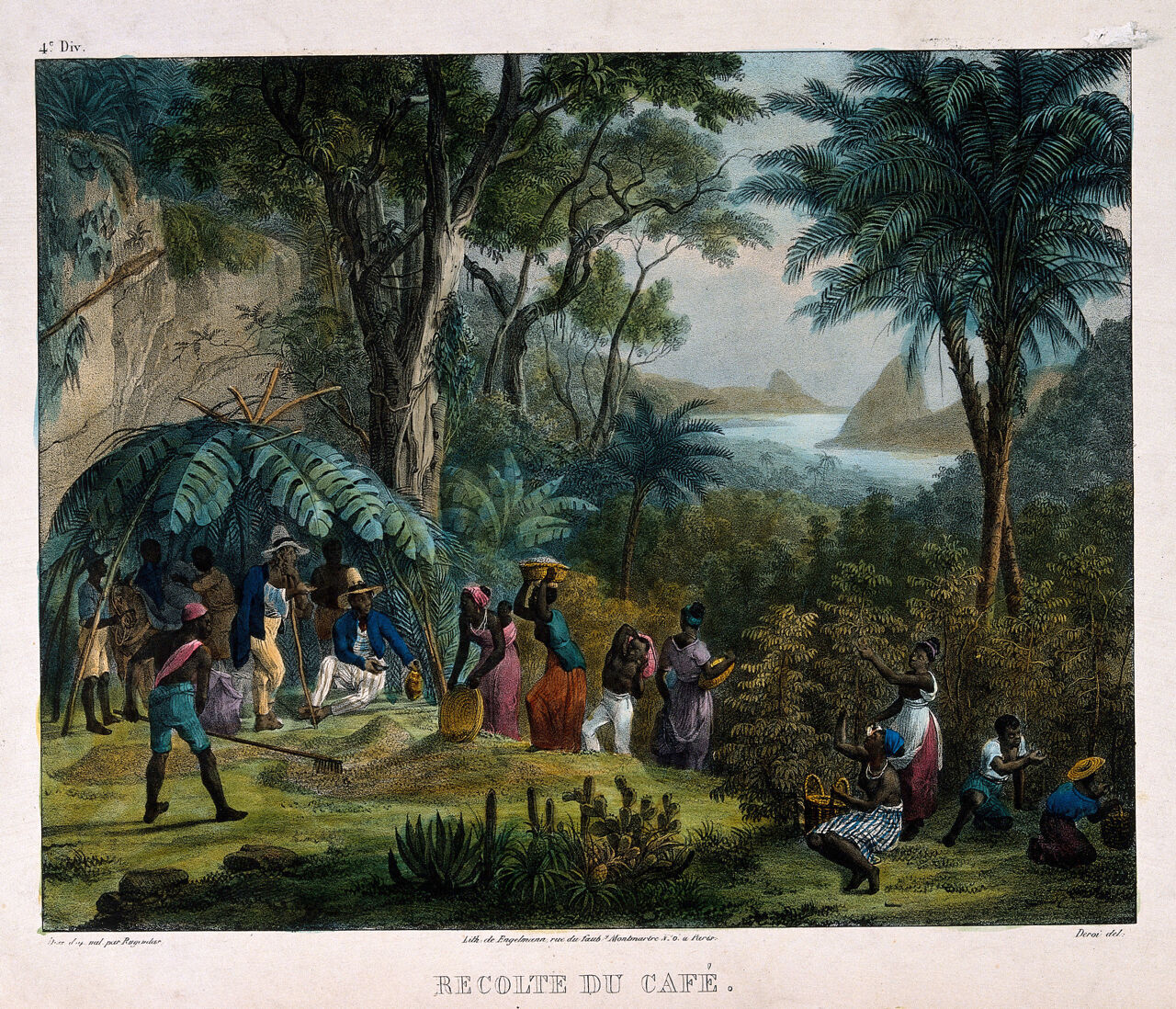
Johann Moritz Rugendas · Wellcome Collection, London · Wellcome Collection · Public Domain Mark
- Born
- 1802. · Augsburg.
- Died
- 1858. · Weilheim an der Teck.
- Nationality
- Kingdom of Bavaria.
- Fields
- landscape.
- Known for
- View of Valparaíso and View of the Valley of Mexico with Volcanoes and the Texcoco Lake.
- Honours
- Order of the Red Eagle 3rd Class and Order of the Red Eagle.
- Languages
- German.
VALÉORINE Encyclopedia
VALÉORINE documentary reading
Documentary summary
Illustration — Moritz Rugendas; Calotype by Franz Hanfstaengl (before 1850). Johann Moritz Rugendas (29 March 1802 – 29 May 1858) was a German painter, famous in the first half of the 19th century for his works depicting landscapes and ethnographic subjects in several countries in the Americas. Rugendas is considered "by far the most varied and important of the European artists to visit Latin America." He was influenced by Alexander von Humboldt.
Admitted source layer · organised and presented by VALÉORINE
Note VALÉORINE
Johann Moritz Rugendas (1802–1858) was a draftsperson, lithographer and painter, among other activities and a national of the Kingdom of Bavaria. Born in Augsburg, the draftsperson died in Weilheim an der Teck. Johann Moritz Rugendas lived in Peru, Valparaíso and Veracruz.
Works include View of Valparaíso. Genres include landscape and landscape painting. Languages used include German. Works by the draftsperson are held at AMALITA Collection, Chilean National History Museum and Chilean National Museum of Fine Arts, among others. Johann Moritz Rugendas received Order of the Red Eagle and Order of the Red Eagle 3rd Class.
Composed from admitted, traceable facts · 01 October 2026
VALÉORINE
Reference Check
Propose documentary evidence for Johann Moritz Rugendas. A contribution is never written directly as fact: identity, source, rights and evidence gates still decide.
Sign in to contribute
World of VALÉORINE
Documentary connections
Only confirmed graph relationships appear here. Images are shown only when their identity and reuse rights both pass the documentary gate.

Documentary evidence
Documentary basis
Authority files
wikidata · Q652305 · wikipedia · Johann Moritz Rugendas
In this article
Biography
Biography
Rugendas worked between 1804 and 1858 across painter, draftsperson, lithographer and traveler. The registers place that work in landscape painting. Every statement below returns to a source shown in the evidence panel; where the record is silent or divided, the article says so instead of resolving it.
The recorded working language is German. Subjects and genres recorded for the work are landscape. Alexander von Humboldt is recorded as an influence. Residence is recorded at Valparaíso and Veracruz. Works named in the authority record are View of Valparaíso and View of the Valley of Mexico with Volcanoes and the Texcoco Lake. Work by Johann Moritz Rugendas is recorded in the collections of Lima Art Museum, Chilean National Museum of Fine Arts, Print Collection, Chilean National History Museum and AMALITA Collection. Distinctions recorded are Order of the Red Eagle 3rd Class and Order of the Red Eagle.
section • Illustration — The huaso and the washerwoman Rugendas was born in Augsburg, into the seventh generation of a family of noted painters and engravers of the city (he was a great grandson of Georg Philipp Rugendas, 1666–1742, a celebrated painter of battles). He first studied drawing and engraving with his father, Johann Lorenz Rugendas II (1775–1826). From 1815-17, he studied with Albrecht Adam (1786–1862), and later in the Academy de Arts of Munich, with Lorenzo Quaglio II (1793–1869). When Rugendas was born, Augsburg was a Free Imperial City of the Holy Roman Empire. After the Napoleonic Wars, in 1806 it had the status of a city in the newly created Kingdom of Bavaria. • Illustration — The church of Andacollo. Rugendas was inspired by the artistic work of Thomas Ender (1793–1875) and the travel accounts in the tropics by Johann Baptist von Spix (1781–1826) and Carl von Martius (1794–1868) in the course of the Austrian Brazil Expedition, to join Baron von Langsdorff's scientific expedition to Brazil as an illustrator. Langsdorff was the consul-general of the Russian Empire in Brazil and had a plantation "Mandioca" in the northern region of Rio de Janeiro. In March 1822, they reached Brazil to Rio in the company of scientists Édouard Ménétries (1802-1861), Ludwig Riedel (1761-1861), Christian Hasse and Nester Rubtsov (1799-1874). As illustrator, Rugendas visited the Serra da Mantiqueira and the historical towns of Barbacena, São João del Rei, Mariana, Ouro Preto, Caeté, Sabará and Santa Luzia. Just before the fluvial phase of the expedition started (a fateful journey to the Amazon), he became alienated from von Langsdorff and left the expedition. He was replaced by the artists Adrien Taunay and Hércules Florence. But Rugendas continued to live on his own in Brazil until 1825, exploring and recording his many impressions of daily life in the provinces of Minas Gerais and Rio de Janeiro. He also visited the coastal provinces of Bahia and Pernambuco on his journey back to Europe. He produced mostly drawings and watercolors. • Illustration — Feast of San Juan in Amancaes. Lima, 1843. On his return to Europe between 1825 and 1828, Rugendas lived successively in Paris, Augsburg and Munich, with the aim of learning new art techniques, such as oil painting. There, he published from 1827 to 1835, with the help of Victor Aimé Huber, his monumental book Voyage Pittoresque dans le Brésil (Picturesque Voyage to Brazil), with more than 500 illustrations. It was considered one of the most important documents about Brazil in the 19th century. • Illustration — Battle of Maipu He spent time studying in Italy. Inspired by explorer and naturalist, Alexander Humboldt (1769–1859), Rugendas sought financial support for a much more ambitious project of recording pictorially the life and nature of Latin America. In his word, it would be "an endeavor to truly become the illustrator of life in the New World". In 1831 he traveled first to Haiti, and then to Mexico. In Mexico, he did drawings and watercolors of Morelia, Teotihuacan, Xochimilco, and Cuernavaca. He also began to practice oil painting, with excellent results. After becoming involved in a failed coup in 1834 against Mexico's president, Anastasio Bustamante, Rugendas was incarcerated and expelled from the country. From 1834 to 1844 he travelled to Chile, Argentina, Uruguay, Peru and Bolivia, and finally returned in 1845 to Rio de Janeiro. Well-accepted and feted by the court of Emperor Dom Pedro II of Brazil, he executed portraits of several members of the royal court and participated in an artistic exposition. At the age of 44, in 1846, Rugendas departed for Europe. The novel An Episode in the Life of a Landscape Painter by Argentinian writer César Aira is a surreal fictional account of Rugendas's trips to Argentina.
Depicting black people in Brazil
Depicting black people in Brazil
• Illustration — Enterro de um Negro. Lithograph by Johann Moritz Rugendas. From 1822 to 1825, as part of the Langsdorff expedition, Rugendas depicted black people living in Brazil. Along with other ethnographic artists who worked in Brazil, such as Jean-Batiste Debret, and François-August Biard, Rugendas is part of the tropical romanticism. This movement challenged the dichotomy between nature and civilization and considered places such as colonial Brazil to be a harmonious environment of racial mixing. Tropical romanticism was one of the elements that influenced Rugendas's representations of black people. According to Freitas, Rugendas illustrated black people of varied origins. This type of illustration details the physical characteristics of black men and women by focusing on hairstyles, adornments, marks and scars, and types of nose, lips, and eyes, demonstrating the ethnographic purpose of these drawings. In the same lithograph, the artist depicts four or five busts of men and women to compare differences and similarities among nations of origin, but also to identify different degrees of civilization. He identified more savage people by depicting them with skin marks and deformities, and normally without clothes. On the other hand, criollos were represented wearing clothes and jewelry, as if to mark a step forward toward civilization if compared with black Africans. Rugendas celebrated black people born in Brazil, saying they were more polished and benevolent than Africans. Secondly, Rugendas depicted black people in scenes. These painted images presented activities of urban work, such as street commerce, water transportation, and laundry. The main focus was in the activity and the landscape rather than in detailing variation among blacks of different origins. For this reason, he portrayed a generic type of black in such scenes. Rugendas represented the work performed by black people as a civilizing element that allowed them to develop themselves and to have social mobility. • Illustration — Familia de Agricultores. Lithograph by Johann Moritz Rugendas. Influenced by Alexander von Humboldt's ideas, Rugendas considered environmental conditions to be determinant factors to human development. He believed that the lack of what he considered formal education and civilizing elements in Africa contributed to the inferiority of the African race. Humboldt was an abolitionist, and Rugendas similarly disapproved of the Brazilian slavery system. He supported a gradual and progressive emancipation. The historian Robert Slenes said that Rugendas's political agenda that worked together with his ethnographic studies. To Slenes, the artist compromised with a conservative Christian reformism, typical of the abolitionist movement. Although Rugendas defended gradual emancipation, the artist also believed that Brazilian slavery represented a new, positive life for Africans, who got the chance to learn the Christian experience. In some images, for example the Enterro de um Negro na Bahia, Rugendas identified the dead body of a "black man with another corpse: the suffering Christ the ‘Savior’ honored by the city's name." There are other images where elements of Catholicism are present, such as Mercado de Negros (a slave market with a church in the background) and Familia de Agricultores, the latter one of the few images in which Rugendas portrays black people in private environments; they are slaves or servants to the white family. • Illustration — Mercado de Negros. Lithograph by Johann Moritz Rugendas. Petrônio Domingues says that the artistic work of foreigner painters and ethnographers in nineteenth-century Brazil had a strong influence on the development of the racial imaginary. The romantic view on slavery in Brazil as a civilizing influence, contributed to creation of the myth of racial democracy. Outside Brazil, the images Rugendas produced had relative success. He published a book with his travel log and a collection of one hundred pictures; it was called Viagem Pitoresca através do Brazil, in Portuguese; Voyage Pittoresque dans le Brésil, in French; and Malerische Reise in Brasilien, in German. During the nineteenth century, there was increased publication of travel books and the development of lithographs to illustrate them. Rugendas's images helped to spread the idea of racial harmony inside and outside Brazil.
Death
Death
He died on 29 May 1858 in Weilheim an der Teck, Germany. King Maximilian II of Bavaria had acquired most of his works in exchange for a life pension. His painting Columbus Taking Possession of the New World (1855) has been on view at the Neue Pinakothek, in Munich.
Identity
Identity
Johann Moritz Rugendas is recorded with the occupation draftsperson. Classed in the genre landscape painting. Established in Bibliothèque nationale de France under 12840181r. Recorded as painter, draftsperson, lithographer and traveler. Established in Library of Congress under n50052066. Established in RKDartists under 68800. Established in FAST under 17646.
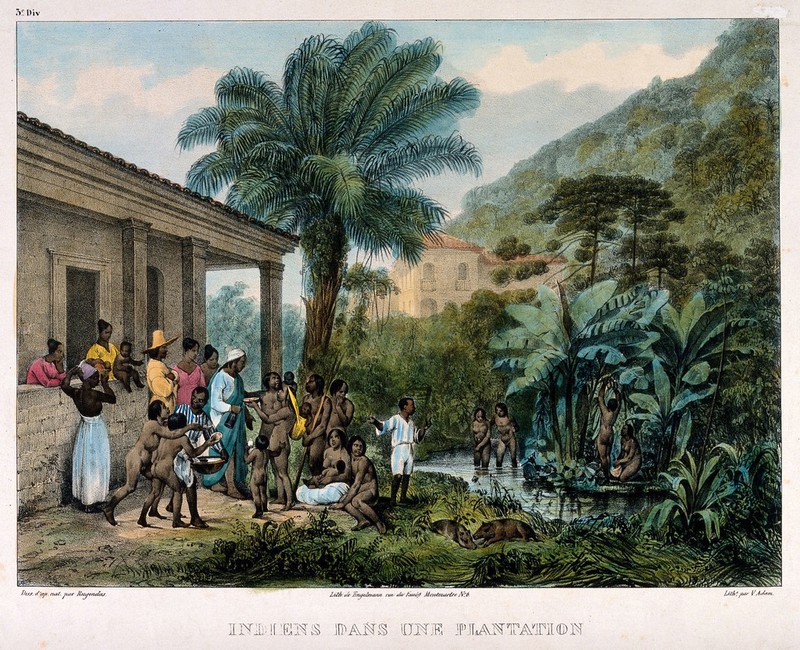
Indians on a coffee plantation washing in a lake and gathering together on the bank. Coloured lithograph by V. Adam, c. 1850, after J. M. Rugendas., 1850, by Johann Moritz Rugendas
Johann Moritz Rugendas · Wellcome Collection, London · Wellcome Collection
Life and career
Dated record
Life and career
Explore 1804–1858
The full dated record · 3 entries
1804
Johann Moritz Rugendas was born on 30 April 1804.
1858
Dies at Weilheim an der Teck.
1858
Johann Moritz Rugendas died at Weilheim an der Teck.
Places
Named by the record
Places
Only places the record itself states, plotted where the house gazetteer settles their coordinates. Nothing is inferred from a name or a nationality.
Valparaíso, Veracruz and Peru.
Residences
Augsburg.
Birth place
Weilheim an der Teck.
Death place
Recognition and collections
Where the work is held
Recognition and collections
Johann Moritz Rugendas received Order of the Red Eagle 3rd Class and Order of the Red Eagle.
Documents and archives
Primary material
Documents and archives
institutional register
- Wikidata, structured authority record Q652305: Johann Moritz Rugendas
General reference · Wikimedia Foundation
reference work
- “Johann Moritz Rugendas”, English Wikipedia, consulted as further reading
Reputable secondary · Wikipedia
Notes from the source article
Cited by Wikipedia
Notes from the source article
These works are cited by the source article, in its own numbering. They are recorded as its citations, not as sources VALÉORINE has verified.
- 1.Mary Jo Miles, "Johann Moritz Rugendas" in Encyclopedia of Latin American History and Culture, vol. 4, p. 619. New York: Charles Scribner's Sons 1996.
- 2.Sigrid Achenbach. Kunst um Humboldt: Reisestudiern aus Mittel- un Südamerika von Rugendas, Bellerman un Hildebrandt im Berliner Kupferstichkabinett. Berlin: Kupferstichkabinett Statliche Musee 2009.
- 3.Lody, Raul Giovanni da Motta. Cabelos de axé: identidade e resistência. Senac. 54. 2004. 85-7458-162-3.
- 4.Diener, Costa, "Rugendas e o Brasil"
- 5.Miles, "Rugendas, p. 619.
- 6.Miles, "Johann Moritz Rugendas", p. 619.
- 7.Miles, "Rugendas", p. 619.
- 8.Greenberg, Michael. The Novelist Who Can't Be Stopped. The New York Review of Books. January 13, 2011.
- 9.Araujo, Ana Lucia. Brazil through French Eyes: A Nineteenth-Century Artist in the Tropics. University of New Mexico Press, 2015. p.35-6.
- 10.Freitas, Iohana Brito de. Cores e Olhares no Brasil Oitocentista: os Tipos de Negros de Rugendas e Debret. Masters thesis. Universidade Federal Fluminense, 2009. p.65.
- 11.Diener, Pablo, Maria De Fátima G Costa, and Johann Moritz Rugendas. Rugendas e o Brasil. São Paulo, SP: Capivara, 2002. p.144.
- 12.Freitas, Iohana Brito de. Cores e Olhares no Brasil Oitocentista: os Tipos de Negros de Rugendas e Debret. Masters thesis. Universidade Federal Fluminense, 2009. p.68.
- 13.Slenes, Robert W. "African Abrahams, Lucretias and Men of Sorrows: Allegory and Allusion in the Brazilian Anti-slavery Lithographs (1827–1835) of Johann Moritz Rugendas," Slavery & Abolition 23, no.2, (2002): 147.
- 14.Domingues, Petrônio. "O Mito da Democracia Racial e a Mestiçagem no Brazil (1889–1930)." Diálogos Latinoamericanos, no. 10 (2005), 119.
- 15.Thomas, Sarah. "On the spot: Traveling artists and abolitionism,1770–1830," Atlantic Studies 8, no.2, (2011): 218.
- 16.Champlin, John Denison. Cyclopedia of Painters and Paintings. C. Scribner's sons. 1887.
Bibliography printed in the source article · 7
- Ades, Dawn, Art in Latin America. 1989.
- Diener, P.: Rugendas, 1802–1858. Wissner; Museo Nacional de Bellas Artes, Augsburg and Santiago de Chile, 1997. A massive catalogue of works in Spanish and Portuguese.
- Diener, P.; COSTA, M. de F. (org.). Rugendas e o Brasil. Obra completa. Rio de Janeiro: Editora Capivara, 2012.
- Lemos, Carlos. The Art of Brazil 1983.
- Miles, Mary Jo. "Johann Moritz Rugendas" in Encyclopedia of Latin American History and Culture, vol. 4, p. 619. New York: Charles Scribner's Sons 1996.
- Milla Batres, Carlos. Juan Mauricio Rugendas: El Perú Romántico del siglo XIX. Lima: Milla Batres 1975.
- Juan Mauricio Rugendas en Mexico (1831–1834) : un pintor en la senda de Alejandro de Humboldt; exposición del Instituto Ibero-Americano, Patrimonio Cultural Prusiano, Berlin. Berlin : Ibero-Amerikanisches Institut, 2002.
References
Citations
References
Each reference names the institution holding it, so a reader may go to the document itself.
institutional register
Wikidata, structured authority record Q652305: Johann Moritz RugendasWikimedia Foundation
Secondary witnessreference work
Secondary witness
Further particulars
Held on the record
Further particulars
Open the remaining particulars
The authorities additionally record the headings Moritz Rugendas, joh. Moriz rugendas, Moriz Rugendas, Juan Mauricio Rugendas and Maurice Rugendas. His recorded language was German. He was the child of Johann Lorenz Rugendas. Work and production. Works recorded as notable number 2: View of Valparaíso and View of the Valley of Mexico with Volcanoes and the Texcoco Lake. His recorded genre is landscape. Connected to 1 other published record in the VALÉORINE Encyclopedia.
Identity and origins
Within the Encyclopedia
The Encyclopedia exists whether or not anything is for sale. Corrections are recorded rather than overwritten, and every version of this record is kept. Published 17 August 2026.
Elsewhere in Paintings
19,183 published records in this field, each with its sources named.
- Johann Melchior WyrschArtist
- Johann Michael RottmayrArtist
- Johann Michael SattlerArtist
- Johann Michael SpeckterArtist
- Johann Nepomuk della CroceArtist
- Johann Nepomuk SchödlbergerArtist
- Johann Peter HasencleverArtist
- Johann Peter KrafftArtist
Best supported in this field
For owners
Own a work by Johann Moritz Rugendas?
A specialist will read what you send and tell you what the house can establish, what it cannot, and whether the object is suited to sale. There is no charge and no obligation. The object stays with you throughout; nothing is shipped to us unless it is arranged in writing beforehand.