
Johann Balthasar Neumann
Johann Balthasar Neumann (c. 27 January 1687 – 19 August 1753), usually known as Balthasar Neumann, was a German architect and military engineer and one of the most important designers of late Baroque architecture in Central Europe. He developed a distinctive architectural style integrating Austrian, Bohemian, Italian, and French influences.
Also recorded as Balthasar Neumann
Johann Balthasar Neumann

Marcus Friedrich Kleinert (1694-1742) · The original uploader was Hajotthu at German Wikipedia. · Public domain
- Name
- Balthasar Neumann
- Born
- c. 27 January 1687
- Birth Name
- Johann Balthasar Neumann
- Birthplace
- Eger, Bohemia, Holy Roman Empire (today Cheb, Czech Republic)
- Died
- 19 August 1753
- Place of death
- Würzburg, Prince-Bishopric of Würzburg, Holy Roman Empire
- Nationality
- Kingdom of Bohemia
- Occupation
- architect · engineer · teacher · general contractor · painter · master builder
- Known for
- Veitshöchheim Palace · Käppele · Basilica of the Transfiguration of Our Lord and Prüm
VALÉORINE Encyclopedia
VALÉORINE documentary reading
Documentary summary
Johann Balthasar Neumann (c. 27 January 1687 – 19 August 1753), usually known as Balthasar Neumann, was a German architect and military engineer and one of the most important designers of late Baroque architecture in Central Europe. He developed a distinctive architectural style integrating Austrian, Bohemian, Italian, and French influences.
Admitted source layer · organised and presented by VALÉORINE
Note VALÉORINE
No house-authored Note is published until its assertions and sources pass the VALÉORINE evidence contract. The documentary article remains available in full while that enrichment is being consolidated.
Documentary enrichment in progress · no unsupported statement published
Reference Check
Propose documentary evidence for Johann Balthasar Neumann. A contribution is never written directly as fact: identity, source, rights and evidence gates still decide.
Sign in to contribute
World of VALÉORINE
Documentary connections
Only confirmed graph relationships appear here. Images are shown only when their identity and reuse rights both pass the documentary gate.
Documentary evidence
Evidence Panel
not yet certified
- Identity
- resolved
- Independent source families
- 0
- Admitted assertions
- 0
- Open conflicts
- 0
Authority files
wikidata · Q61349 · wikipedia · Balthasar Neumann
In this article
Biography
Biography
His most notable works include the Würzburg Residence, described by UNESCO as one of the most important palaces of the High Baroque period, and the Basilica of the Fourteen Holy Helpers (Vierzehnheiligen), widely regarded as a masterpiece of German Baroque architecture.

Balthasar Neumann Plakette an einem Haus in Würzburg
Wolfram Esser · Eigene Fotografie vom 2004-04-02
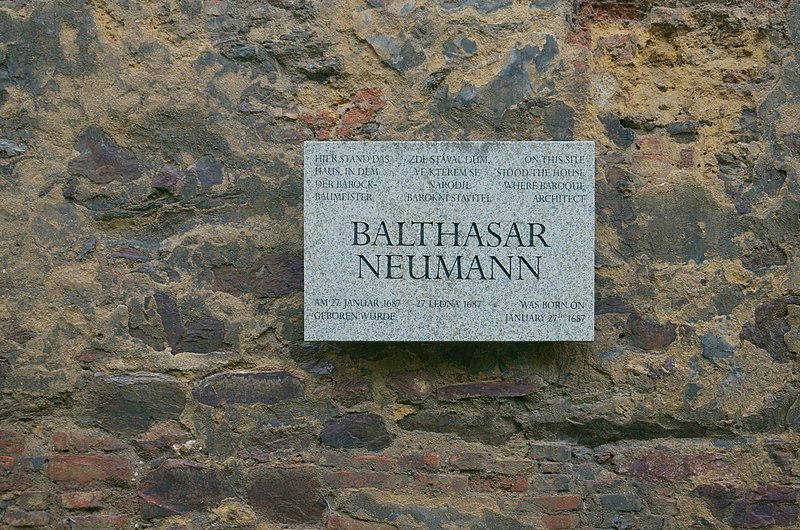
Cheb - deska na místě zbořeného domu, kde se 27. ledna 1687 narodil barokní stavitel Balthasar Neumann. Umístěno na zbytcíh městských hradeb na západě náměstí Baltazara Neumanna.
Adam Rejha
Key facts
Key facts
• Name — Balthasar Neumann • Born — c. 27 January 1687 • Birth Name — Johann Balthasar Neumann • Birthplace — Eger, Bohemia, Holy Roman Empire (today Cheb, Czech Republic) • Died — 19 August 1753 • Place of death — Würzburg, Prince-Bishopric of Würzburg, Holy Roman Empire • Significant Buildings — Würzburg Residence, Basilica of the Fourteen Holy Helpers
Early life
Early life
Neumann is believed to have been born on 27 January 1687 in Eger, Kingdom of Bohemia (now Cheb, Czech Republic), the seventh of nine children of the cloth-maker Hans Christoph Neumann (d. 1713) and his wife Rosina (1645–1707). He was baptized on 30 January 1687. He initially apprenticed at a bell and gun foundry in Eger. After travelling as a journeyman, he arrived in Würzburg in 1711. In 1712 he began studying geometry, architecture and land surveying, and entered military service in the Würzburg artillery, where he remained until his death, ultimately attaining the rank of colonel. Among his early technical works were measurement instruments (1712, now in the Deutsches Museum, Munich; 1713, Mainfränkisches Museum, Würzburg), a map of Würzburg (1715; copy in the Bavarian War Archive, Munich), and drawings for a new abbey at Ebrach (1716, now lost). In 1717 Neumann participated in the Austro–Turkish War, advancing with his unit from Vienna to Belgrade. In 1718 he travelled through northern Italy, studying architecture and briefly working on civilian construction projects in Milan.
Early commissions
Early commissions
• Illustration — Neumann's Würzburg Residence and part of its Court Gardens Neumann's career as an architect took off under Johann Philipp Franz von Schönborn, Prince-Bishop of Würzburg, who asked the young engineer in 1719 to plan, and in 1720 to lead construction of, his new palace, the Würzburg Residence. Although other architects participated, Neumann was able to give the project his personal imprint, which became his life's work. • Illustration — Interior of the Basilica of the Fourteen Holy Helpers Neumann’s second major commission for the Prince-Bishop was the Schönborn Chapel (Schönbornkapelle) of Würzburg Cathedral, begun in 1721. In 1723 he travelled to France, where he studied contemporary architectural developments. In Paris and Versailles he met the royal architects Germain Boffrand and Robert de Cotte, consulting them on aspects of the Würzburg projects. Upon returning to Würzburg, Neumann began construction of a hunting lodge known as Mädelhofen in 1724; the project remained unfinished and was demolished in 1725. In 1725, Neumann married Maria Eva Engelberts (1704–1745). The couple had eight children, including three sons and five daughters.
Patronage under the Schönborns
Patronage under the Schönborns
Under Prince-Bishop Christoph Franz von Hutten (1673–1729), Neumann received fewer commissions in Würzburg and increasingly worked for monastic patrons. His church at Münsterschwarzach Abbey (begun after 1727, demolished after 1821) marked an important stage in his development as a designer of ecclesiastical architecture. • Illustration — A Bust of Balthasar Neumann Another significant project of this period was the church at Kloster Holzkirchen (1728–1730), in which Neumann combined elements of French spatial planning, Italian dynamism, and German Baroque structural traditions. Friedrich Karl von Schönborn (1674–1746), who succeeded Hutten as Prince-Bishop and simultaneously served as Prince-Bishop of Bamberg, became Neumann’s principal patron. As Imperial Vice-Chancellor (Reichsvizekanzler), Schönborn resided at the imperial court in Vienna until 1734. He appointed Neumann director of all military, civil, and ecclesiastical construction in both bishoprics. In 1729 and again in 1739, Neumann was summoned to Vienna, where he exchanged views with Johann Lukas von Hildebrandt, Schönborn’s court architect. Hildebrandt’s influence is evident in aspects of the Würzburg Residence and in the hunting lodge at Werneck (begun after 1733). As chief engineer of the joint Hochstifts, Neumann was responsible for overseeing fortifications, transport and water engineering and for improving urban planning in practical and aesthetical terms. From 1731, he also taught military and civilian architecture at Würzburg University.
Major secular commissions
Major secular commissions
Neumann also worked for Damian Hugo Philipp von Schönborn (1676–1743) and Franz Georg von Schönborn (1682–1756). For the former, Prince-Bishop of Speyer, he designed the Corps de Logis of Schloss Bruchsal (begun after 1731), notable for its monumental staircase. In Bruchsal he also designed the Church of St. Peter (1740–1746), intended as the burial church of the Prince-Bishops of Speyer. For the Elector of Trier, Neumann designed the Dikasterialgebäude of Ehrenbreitstein Fortress (1739–1748) and the summer palace Schönbornslust at Kesselheim near Koblenz (1748–1752; demolished 1806). These commissions brought him into contact with patrons in western Germany. Among several projected works, only the staircase and New Apartments of the Brühl Palace (from 1743) were executed. Plans prepared for the ducal palace in Stuttgart (after 1747), Schwetzingen Palace (1749), and the Karlsruhe Residence (after 1750) remained unrealised. As a church architect, Neumann drew upon the work of Guarino Guarini, as well as the Bohemian architectural tradition transmitted to Franconia by Johann Dientzenhofer. He made frequent use of centralized and rotunda-based spatial compositions, a development that reached its fullest expression in the Basilica of the Fourteen Holy Helpers (Vierzehnheiligen, begun 1743) and the Abbey Church of Neresheim (begun 1747). Among his final large-scale proposals was a redesign of the Hofburg Palace in Vienna (after 1746), which was not executed. Neumann also worked on St. Paulinus’ Church, designing much of its interior decorative program.
Death and Commemoration
Death and Commemoration
• Illustration — West Berlin Postage Stamp depicting Balthasar Neumann Neumann died in Würzburg on 19 August 1753 and was buried in the Marienkapelle there. He was commemorated on the final series of the German 50 Deutsche Mark banknote (issued 1991–2002), which featured his portrait alongside the grand staircase of the Würzburg Residence. Neumann is also depicted in Giovanni Battista Tiepolo’s ceiling fresco above the staircase of the Würzburg Residence, shown in a pseudo-military uniform leaning over a cannon. According to contemporary accounts, Neumann reportedly remarked that the vault was constructed so securely that even the firing of a cannon would not cause it to collapse.
Ecclesiastical architecture
Ecclesiastical architecture
• Pilgrimage church at Gößweinstein (Wallfahrtskirche), 1730–1739. • Parish church at Heusenstamm, 1739–1744. • Würzburg, Käppele (1748–1749). • Kreuzkapelle, Kitzingen-Etwashausen (1741–1745). • Jesuit Church, Mainz (1742–1746; demolished 1805). • Pilgrimage church at Maria Limbach (1751–1755), his final project.
Secular and administrative buildings
Secular and administrative buildings
• Propsteigebäude of the Augustinian Canons, Heidenfeld (1723–1733). • Katharinenspital, Bamberg (1729–1738). • Domkapitelhaus, Bamberg (1730–1733). • Klerikalseminar, Bamberg (1731–1737). • Orangery, Schloss Seehof (1733–1737). • High altar, Worms Cathedral (1738–1740). • Geschäftshaus am Marktplatz, Würzburg (1739–1741). • Augustinerkirche, Würzburg (1741–1744). • Abbey and convent buildings at Oberzell (1744–1760).
Identity
Identity
Johann Balthasar Neumann is recorded with the occupation general contractor. Recorded with the occupation master builder. Recorded as architect, engineer, teacher and general contractor.
Life and career
Dated record
Life and career
The full dated record · 2 entries
1687
Johann Balthasar Neumann was born on 27 January 1687.
1753
Johann Balthasar Neumann died on 18 August 1753.
Places
Named by the record
Places
Only places the record itself states, plotted where the house gazetteer settles their coordinates. Nothing is inferred from a name or a nationality.
Johann Balthasar Neumann was born at Cheb.
Birthplace
Johann Balthasar Neumann died at Würzburg.
Deathplace
Johann Balthasar Neumann was born in Cheb.
Birthplace
Johann Balthasar Neumann died in Würzburg.
Deathplace
Catalogued output
Works and catalogued output
Design for a City Gate in Trier.
Primary material
Documents and archives
reference work
- “Balthasar Neumann”, English Wikipedia, consulted as further reading
Reputable secondary · Wikipedia
authority record
- Wikidata, structured authority record Q61349: Johann Balthasar Neumann
Unverified · Wikidata
Literature
Literature
Verschollen geglaubtes Planmaterial von Balthasar Neumann und seinem Baubüro, und eine unbekannte Zeichnung aus dem Umfeld Johann Dientzenhofers, 2010
Balthasar Neumann’s Schönborn Chapel at Würzburg Cathedral and its Berninesque prototype, Architectural Histories, 1983
Notes from the source article
Cited by Wikipedia
Notes from the source article
These works are cited by the source article, in its own numbering. They are recorded as its citations, not as sources VALÉORINE has verified.
- 1.Balthasar Neumann. Encyclopaedia Britannica.
- 2.UNESCO World Heritage Centre. Residence of Würzburg.
- 3.Vierzehnheiligen. Encyclopaedia Britannica.
- 4.Oxford University Press. Balthasar Neumann. Grove Art Online.
- 5.Balthasar Neumann. Encyclopaedia Britannica.
- 6.Aurenhammer, Hans. Balthasar Neumann. Prestel. 1985.
- 7.Oxford University Press. Balthasar Neumann. Grove Art Online.
- 8.Bayerische Nationalbibliothek. Biografie Balthasar Neumann (German).
- 9.Oxford University Press. Balthasar Neumann. Grove Art Online.
- 10.Aurenhammer, Hans. Balthasar Neumann. Prestel. 1985.
- 11.Oxford University Press. Balthasar Neumann. Grove Art Online.
- 12.Aurenhammer, Hans. Balthasar Neumann. Prestel. 1985.
- 13.Oxford University Press. Balthasar Neumann. Grove Art Online.
- 14.Aurenhammer, Hans. Balthasar Neumann. Prestel. 1985.
- 15.Oxford University Press. Balthasar Neumann. Grove Art Online.
- 16.Aurenhammer, Hans. Balthasar Neumann. Prestel. 1985.
- 17.Oxford University Press. Balthasar Neumann. Grove Art Online.
- 18.Deutsche Bundesbank. 50 Deutsche Mark Banknote (Balthasar Neumann).
- 19.Oxford University Press. Würzburg Residence. Grove Art Online.
- 20.Aurenhammer, Hans. Balthasar Neumann. Prestel. 1985.
- 21.Aurenhammer, Hans. Balthasar Neumann. Prestel. 1985.
Bibliography printed in the source article · 1
References
Citations
References
Each reference names the institution holding it, so a reader may go to the document itself.
reference work
Partially resolvedauthority record
Unverified
The Encyclopedia exists whether or not anything is for sale. Corrections are recorded rather than overwritten, and every version of this record is kept. Published 14 August 2026.
Elsewhere in Paintings
18,717 published records in this field, each with its sources named.
- Johann Adam KleinArtist
- Johann Adam RemeleArtist
- Johann Anton EismannArtist
- Johann Anton RambouxArtist
- Johann Baptist HeinefetterArtist
- Johann Baptist ReiterArtist
- Johann Baptist RuelArtist
- Johann Baptist von Lampi the ElderArtist
Best supported in this field
For owners
Own a work by Johann Balthasar Neumann?
A specialist will read what you send and tell you what the house can establish, what it cannot, and whether the object is suited to sale. There is no charge and no obligation. The object stays with you throughout; nothing is shipped to us unless it is arranged in writing beforehand.