
Jervis McEntee
Jervis McEntee (July 14, 1828 – January 27, 1891) was an American painter of the Hudson River School. He is a lesser-known figure of the 19th-century American art world, but was a close friend and traveling companion of several of the important Hudson River School artists. Aside from his paintings, McEntee's unpublished journals, written from 1872 to 1890, are an enduring legacy, documenting the life of a New York painter during and after the Gilded Age.
Also recorded as Jervis Mcentee · McEntee
Jervis McEntee
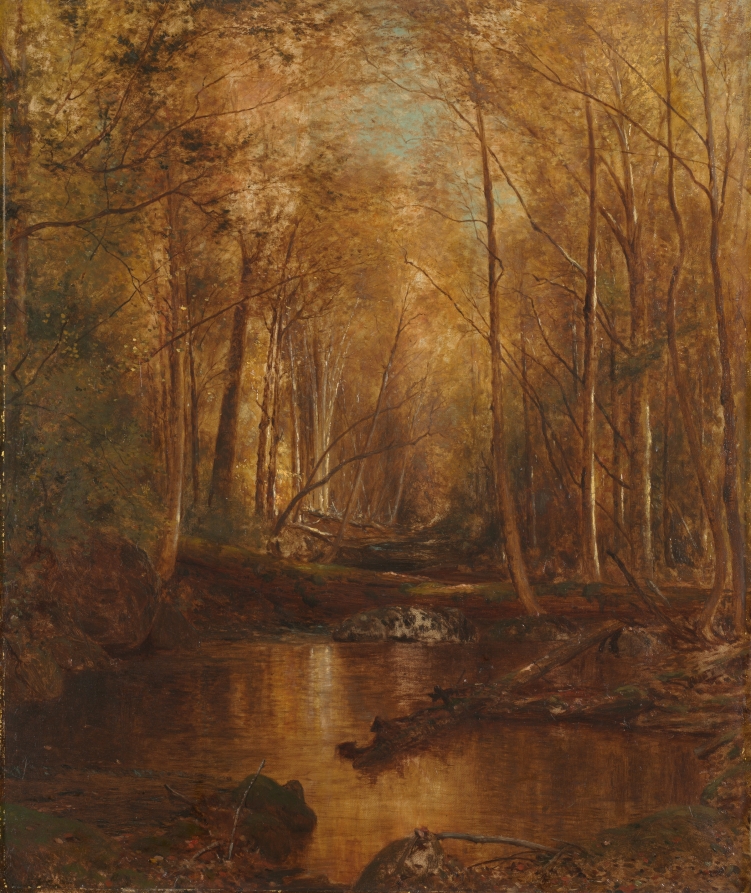
Jervis McEntee · The Cleveland Museum of Art · Hinman B. Hurlbut Collection · CC0
- Name
- Jervis McEntee
- Born
- 14 July 1828
- Birthplace
- Rondout, New York
- Died
- 27 January 1891
- Known for
- Painting
- Movement
- Hudson River School
- Nationality
- United States.
- Occupation
- painter.
- Fields
- painting.
- Movements
- Hudson River school.
- Teachers
- Frederic Edwin Church.
- Languages
- English.
VALÉORINE Encyclopedia
VALÉORINE documentary reading
Documentary summary
Jervis McEntee (July 14, 1828 – January 27, 1891) was an American painter of the Hudson River School. He is a lesser-known figure of the 19th-century American art world, but was a close friend and traveling companion of several of the important Hudson River School artists. Aside from his paintings, McEntee's unpublished journals, written from 1872 to 1890, are an enduring legacy, documenting the life of a New York painter during and after the Gilded Age.
Admitted source layer · organised and presented by VALÉORINE
Note VALÉORINE
No house-authored Note is published until its assertions and sources pass the VALÉORINE evidence contract. The documentary article remains available in full while that enrichment is being consolidated.
Documentary enrichment in progress · no unsupported statement published
Reference Check
Propose documentary evidence for Jervis McEntee. A contribution is never written directly as fact: identity, source, rights and evidence gates still decide.
Sign in to contribute
World of VALÉORINE
Documentary connections
Only confirmed graph relationships appear here. Images are shown only when their identity and reuse rights both pass the documentary gate.
Documentary evidence
Evidence Panel
not yet certified
- Identity
- resolved
- Independent source families
- 0
- Admitted assertions
- 0
- Open conflicts
- 0
Authority files
wikidata · Q2580100 · wikipedia · Jervis McEntee
In this article
Biography
Biography
Training under Frederic Edwin Church is recorded. The recorded working language is English. The field of work recorded is painting. Subjects and genres recorded for the work are landscape. Frederic Edwin Church is recorded as an influence. Works named in the authority record are Summer Hills, Kauterskill Clove. Work by Jervis McEntee is recorded in the collections of Metropolitan Museum of Art, Cleveland Museum of Art, Detroit Institute of Arts, Crystal Bridges Museum of American Art and Birmingham Museum of Art.
Key facts
Key facts
• Name — Jervis McEntee • Born — 14 July 1828 • Birthplace — Rondout, New York • Died — 27 January 1891 • Place of death — Rondout, New York • Known for — Painting • Movement — Hudson River School
Biography
Biography
McEntee was born in Rondout, New York on July 14, 1828, the son of James Smith McEntee (1800–1887), a civil engineer, and his wife Sarah Jane McEntee (1805–1883). His sister Mary was the wife of architect and co-designer of New York's Central Park Calvert Vaux. Otherwise, little is known of his childhood. From approximately 1844 to 1846, he attended the Clinton Liberal Institute in Clinton, New York.[1][2] He exhibited his first painting as a self-taught artist at the National Academy of Design in New York City in 1850. In the fall of that year he apprenticed with Frederic Edwin Church, then regarded as a rising star in the American art world. He left Church's studio in 1851, and while he never achieved Church's level of fame and fortune, they remained lifelong friends.[3] After studying with Church, McEntee attempted a career as a businessman in Rondout, but did not experience much success. After three years he gave up business and devoted himself wholly to his art, becoming one of the charter residents of Richard Morris Hunt's Tenth Street Studio Building in 1857.[4][5] Since many of the building's other occupants were bachelors or commuters, McEntee and his wife (who was known as a lively, sympathetic hostess) became the center of a spontaneous salon frequented by some of the best-known artists, writers, and actors of the era. After his wife died in 1878, McEntee stayed on at the building, an increasingly lonely widower, until his death in 1891. McEntee was a particularly close friend of Hudson River School artists Sanford Robinson Gifford, Worthington Whittredge, John Ferguson Weir, as well as figurative painter Eastman Johnson.[6] He was made an associate of the National Academy of Design in 1860, and a full academician in 1861. In 1869 he visited Europe, painting much in Italy.[7] He died of Bright's disease at his home in Rondout on January 27, 1891, and is buried in Montrepose Cemetery in Kingston, New York.[8]
Artistic style
Artistic style
• Illustration — A Cliff in the Katskills, c. 1885, in the Brooklyn Museum • Illustration — Mount Desert Island, Maine, by Jervis McEntee, 1864, in the National Gallery of Art,[14] Washington, D.C. The landscapes of Jervis McEntee are known for their melancholy and poetic mood. The sky is often cloudy in a McEntee landscape, the season autumn. While Jasper Francis Cropsey and other artists typically painted bright fall foliage, McEntee often captured the season near its end, with the leaves faded and falling from the trees. "Some people call my landscapes gloomy and disagreeable," McEntee wrote in his journal. "They say I paint the sorrowful side of nature …But this is a mistake…Nature is not sad to me but quiet, pensive, restful."
Journals
Journals
Aside from his paintings, McEntee's enduring legacy are the detailed journals he kept from the early 1870s until his death. These diaries provide a vivid, accurate impression of the life of a typical New York painter during and after the Gilded Age. In his writings, McEntee records a detailed account of Hudson River School artists, their day-to-day life, gossip and personal reflections, and the overall arc of the American art world in the second half of the 19th century. He discusses his artistic successes and trials, particularly as money becomes more scarce with the decline in popularity of Hudson River School art. The journals contain first-hand information on the inner workings of the National Academy and the Century Club, on the 1876 Centennial Exposition in Philadelphia, efforts to revive the American Art-Union, and on the vigorous growth of art societies and exhibitions throughout the country. The diaries also reveal the economy of art during the period, including the prices, patterns of collecting and patronage, the artists' dependence on personal contacts through clubs, social gatherings, and influential friends. Long passages describe McEntee's overwhelming anxieties over money and family difficulties; he is frequently lonely and depressed, and always worried about his status as an artist. McEntee's journals are now kept by the Archives of American Art, a research center within the Smithsonian Institution. Five volumes of these diaries, from 1872 to 1890, have been digitally scanned, transcribed, and can be browsed in their entirety online.[9] In addition, the Archives holds McEntee's personal papers, which were digitized in 2007.
Selected works
Selected works
• The Doge's Palace (Venice), undated, St. Johnsbury Athenaeum[10] • The Melancholy Days Have Come (1861), National Academy of Design[11] • Indian Summer (ca. 1861), Detroit Institute of Arts[12] • Evening Landscape, Late Autumn (1861), Bowdoin College Museum of Art[13] • Mount Desert Island, Maine (1864), John Wilmerding Collection, National Gallery of Art • October Snow (1870) • The Woods of Asshockan, Catskills (1871), St. Johnsbury Athenaeum[15] • Sea from Shore (1873), Mead Art Museum[16] • Cape Ann (1874) • A Song of Summer (1876) • Winter in the Mountains (1878) • Clouds (1870), Frances Lehman Loeb Art Center[17] • The Edge of a Wood (1880) • Kaatskill River (1881) • An Autumn Memory (1883), Worcester Art Museum[18] • Shadows of Autumn (1884) • The Kaatskills in Winter (1884) • A Cliff in the Katskills (c. 1885), Brooklyn Museum[19] • Christmas Eve (1885) • Shadows of Autumn (1886)
Life and career
Dated record
Life and career
The full dated record · 2 entries
1828
Jervis McEntee born at Rondout.
1891
Jervis McEntee died at New York City.
Places
Named by the record
Places
Only places the record itself states, plotted where the house gazetteer settles their coordinates. Nothing is inferred from a name or a nationality.
Rondout.
Birth place
New York City.
Death place
Notes from the source article
Cited by Wikipedia
Notes from the source article
These works are cited by the source article, in its own numbering. They are recorded as its citations, not as sources VALÉORINE has verified.
- 1.Syracuse University Libraries. Jervis McEntee Diary, 1844–1845. Finding Aids.
- 2.University of Tulsa, McFarlin Library. A journal of facts, folly & fun 1845 Oct 9-1846 Sep 29. Department of Special Collections and University Archives.
- 3.Howat, John K. Frederic Church. Yale University Press. 34. 2005. 978-0300109887.
- 4.Smithsonian Institution. The Jervis McEntee papers. Archives of American Art.
- 5.1900.
- 6.Stein, Paul G. A Hudson River School Diary. Archives of American Art Blog. Smithsonian Institution.
- 7.17. 230.
- 8.Obituary. Buffalo Courier. 2. 1891-01-28.
- 9.Smithsonian Institution. The Jervis McEntee Diaries. Archives of American Art.
- 10.St. Johnsbury Athenaeum. The Doge's Palace (Venice), undated, by Jervis McEntee. This Week from the Gallery Archives.
- 11.Jervis McEntee - Biography. Antiques & Fine Art Magazine.
- 12.Indian Summer. Detroit Institute of Arts.
- 13.Evening Landscape, Late Autumn. Bowdoin College Museum of Art.
- 14.National Gallery of Art. John Wilmerding Collection: American Masters from Bingham to Eakins.
- 15.St. Johnsbury Athenaeum. The Woods of Asshockan, Catskills, 1871, by Jervis McEntee. This Week from the Gallery Archives.
- 16.Sea from Shore. Collections Database, Five Colleges and Historic Deerfield Museum Consortium.
- 17.Clouds. Collection - Frances Lehman Loeb Art Center. October 2024.
- 18.An Autumn Memory. Worcester Art Museum.
- 19.Brooklyn Museum. Collections: American Art: A Cliff in the Katskills.
References
Citations
References
Each reference names the institution holding it, so a reader may go to the document itself.
reference work
Wikidata, structured authority record Q2580100: Jervis McEnteeWikimedia Foundation
Partially resolvedreference work
Partially resolved
Further particulars
Held on the record
Further particulars
Open the remaining particulars
The authorities additionally record the headings Jervis Mcentee and McEntee. His recorded language was English. Other recorded relations include Calvert Vaux.
Identity and origins
The Encyclopedia exists whether or not anything is for sale. Corrections are recorded rather than overwritten, and every version of this record is kept. Published 14 August 2026.
Elsewhere in Paintings
18,717 published records in this field, each with its sources named.
- Jerónimo Corte-RealArtist
- Jerónimo Jacinto de EspinosaArtist
- Jeronimus SweertsArtist
- Jeronymus van Diest IIArtist
- Jerzy Adam BrandhuberArtist
- Jerzy BitterArtist
- Jerzy JełowickiArtist
- Jerzy KossakArtist
Best supported in this field
For owners
Own a work by Jervis McEntee?
A specialist will read what you send and tell you what the house can establish, what it cannot, and whether the object is suited to sale. There is no charge and no obligation. The object stays with you throughout; nothing is shipped to us unless it is arranged in writing beforehand.