
Jan van den Hecke
Illustration — Portrait of Jan van den Hecke Jan van den Hecke or Jan van den Hecke the Elder (1620–1684) was a Flemish Baroque painter, draughtsman, printmaker and engraver, mainly known for his still lifes, landscapes and battle scenes. After training in Antwerp, he spent time in Rome, where he had important patrons. After his return to Flanders, he worked for a while in Brussels, probably painting flower still lifes for Archduke Leopold Wilhelm of Austria, the Austrian governor of the Spanish Netherlands, before returning to work in Antwerp.
Also recorded as Jan van der Hecke · John van Heck · Jan van Eckel · Jan Ivan Den Hecke
Jan van den Hecke
Jan van den Hecke · Wellcome Collection, London · Wellcome Collection · Public Domain Mark
- Died
- 1684 · Antwerp.
- Nationality
- Habsburg Netherlands
- Occupation
- painter · draftsperson · artist
- Fields
- painting
VALÉORINE Encyclopedia
VALÉORINE documentary reading
Documentary summary
Illustration — Portrait of Jan van den Hecke Jan van den Hecke or Jan van den Hecke the Elder (1620–1684) was a Flemish Baroque painter, draughtsman, printmaker and engraver, mainly known for his still lifes, landscapes and battle scenes. After training in Antwerp, he spent time in Rome, where he had important patrons. After his return to Flanders, he worked for a while in Brussels, probably painting flower still lifes for Archduke Leopold Wilhelm of Austria, the Austrian governor of the Spanish Netherlands, before returning to work in Antwerp.
Admitted source layer · organised and presented by VALÉORINE
Note VALÉORINE
Jan van den Hecke (1620–1684) was an artist, draftsperson and painter, a national of the Habsburg Netherlands. The artist was born in Kluisbergen and died in Antwerp.
Jan van den Hecke was a member of Antwerp Guild of Saint Luke and worked in Antwerp, Brussels and Rome. Activity centred on painting.
The work spans landscape and still life. Works are held at Auckland Art Gallery, Finnish National Gallery and Hermitage Museum, among others.
Composed from admitted, traceable facts · 27 September 2026
VALÉORINE
Reference Check
Propose documentary evidence for Jan van den Hecke. A contribution is never written directly as fact: identity, source, rights and evidence gates still decide.
Sign in to contribute
World of VALÉORINE
Documentary connections
Only confirmed graph relationships appear here. Images are shown only when their identity and reuse rights both pass the documentary gate.
Documentary evidence
Documentary basis
Authority files
wikidata · Q2486064 · wikipedia · Jan van den Hecke
In this article
Life
Life
The field of work recorded is painting. Subjects and genres recorded for the work are landscape and still life. Places of work recorded in the authority are Antwerp, Rome and Brussels. Work by Jan van den Hecke is recorded in the collections of Museum Boijmans Van Beuningen, Minneapolis Institute of Art, Auckland Art Gallery, Finnish National Gallery and Museum of Fine Arts Ghent (MSK).
Van den Hecke was born in Kwaremont near Ronse, about 10 km from Oudenaarde, East Flanders. He was registered in the Antwerp Guild of Saint Luke as an apprentice in 1636. He was a pupil of Abraham Hack, who also taught his contemporary, the flower painter Hieronymus Galle. He became a master in the Antwerp Guild in the year 1641–1642. • Illustration — Portrait of a young man in a flower garland He travelled to Italy, and spent a period in Rome. The precise dates of his trip are unknown: the alternatives that have been proposed are from 1644 to 1659 and 1653 to 1658. While there, he enjoyed the patronage of Paolo Giordano II Orsini, the duke of Bracciano. He may also have travelled in France during the 1650s. Van den Hecke spent time in Brussels in the mid-1650s. At this time he may have worked for Archduke Leopold Wilhelm of Austria, the Austrian governor of the Spanish Netherlands. who resided in Brussels and was an avid art collector. A number of van den Hecke's still life paintings found their way into the Archduke's collection and from there into the collection of the Kunsthistorisches Museum in Vienna. Archduke Leopold Wilhelm must have particularly liked his flower pieces as all of van den Hecke's paintings which he collected were pictures of flowers in vases and baskets and garland paintings. Van den Hecke returned to Antwerp around 1657. • Illustration — Flowers in a vase with the siege of Gravelines In 1660, van der Hecke married Maria Adriana Heyens, with whom he had three children. His son, known as Jan van den Hecke the Younger, was born in 1661 and became a popular painter of flowers and of other types of still life as well as of landscapes. Van den Hecke's two known pupils were Peeter vander Elstraeten (1657–60) and Peeter de Clerc (1672–73). Van den Hecke died in Antwerp in 1684.
General
General
Jan van den Hecke was a versatile artist working in many genres and techniques. He made still lifes of flowers, fruit and game, paintings of animals, landscapes, genre scenes, military scenes and allegorical paintings.
Still lifes
Still lifes
He was a gifted flower painter. As in the work of other Antwerp painters of his generation such as Jan Brueghel the Younger and Philips de Marlier, some of the flower paintings of van den Hecke were dedicated to the presentation of a single variety of flowers: tulips and wallflowers. Some of his flower still lifes, such as the Flowers in a Vase with the Siege of Gravelingen (Kunsthistorisches Museum), include a view onto a landscape or a battle scene, two genres in which van den Hecke was skilled. • Illustration — Sumptuous still life Jan van den Hecke made a number of works in a distinctively Flemish genre, which is referred to as 'garland painting'. Garland paintings are a special type of still life developed in early 17th century Antwerp by Jan Brueghel the Elder at the instigation of the Italian cardinal Federico Borromeo. Other artists involved in the early development of the genre included Hendrick van Balen, Andries Daniels, Peter Paul Rubens and Daniel Seghers. Garland paintings typically show a flower garland around a devotional image or portrait. The genre was initially connected to the visual imagery of the Counter-Reformation movement. It was further inspired by the cult of veneration and devotion to Mary prevalent at the Habsburg court (then the rulers over the Southern Netherlands) and in Antwerp generally. Garland paintings typically show a flower garland around a devotional image, portrait or other religious symbol (such as the host). • Illustration — Shepherds and travellers by a triumphal arch in the Roman Campagna Garland paintings were typically collaborations between a still life specialist and a figure painter. As van den Hecke was a gifted figure painter he may have painted both the still life elements as the figures in some of his garland paintings. This may have been the case in his Rosary Madonna in a Garland (circa 1671, Kroměříž Archdiocesan Museum, Kroměříž, Czech Republic). A collaboration with the figure painter Jan Lievens is the Portrait of a Young Man in Flower Garland (c. 1642–1644, Kunsthistorisches Museum). Van den Hecke also painted still lifes of game with dogs in the style of Jan Fyt and pronkstillevens with ostentatious objects, a genre invented in Antwerp. He was particularly skilled at painting gold, silver, crystal and porcelain.
Landscapes and military scenes
Landscapes and military scenes
His landscapes often include battle or military scenes with many figures. His landscapes are in an Italianate style. One of his paintings representing a Market in the Roman Campagna was formerly attributed to the Flemish Italianate painter Anton Goubau. Other of his landscapes tend towards the genre scenes painted by the group of Flemish and Dutch painters in Rome known as the Bamboccianti. The Bamboccianti comprised mostly Dutch and Flemish artists who had brought existing traditions of depicting peasant subjects from sixteenth-century Netherlandish art with them to Italy, and generally created small cabinet paintings or etchings of the everyday life of the lower classes in Rome and its countryside. • Illustration — The aftermath of the battle
Places
Named by the record
Places
Only places the record itself states, plotted where the house gazetteer settles their coordinates. Nothing is inferred from a name or a nationality.
Kluisbergen.
Birth place
Antwerp.
Death place
Prints
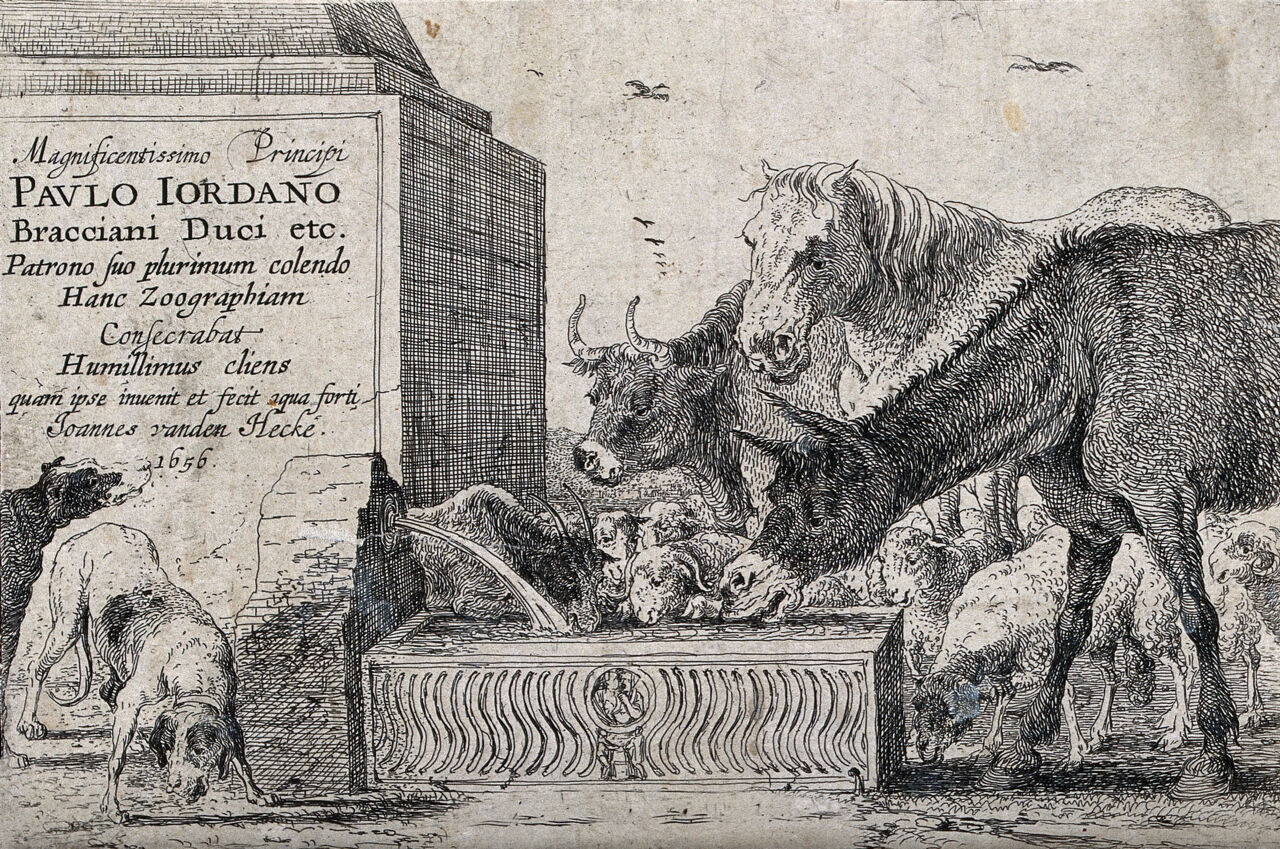
In the mid-1650s he made a number of etchings depicting various animals and battle scenes. He collaborated with other printmakers on publishing projects. In 1654 he made the designs for a series of 10 plates which were engraved by the Dutch engraver Theodor van Kessel and were entitled Alcune Animali (Some animals). This series depicted various animals. He created another series of 11 prints plus a title page referred to as the Zoographia (Description of Animals), which also depicted different animals and was printed in 1656. It was dedicated to van den Hecke's patron in Rome, Paolo Giordano II Orsini, the duke of Bracciano. He made a topographical drawing of the Castle of Reet that was engraved by Jacob Neefs as an illustration in the Antwerp historian Jacob Le Roy's Notitia Marchionatus Sacri Romani Imperii (published in Amsterdam by Albertus Magnus and printed by Frans Lamminga, 1678), a book with engravings of secular and religious landmarks or points of interest in the Spanish Netherlands.
Notes from the source article
Cited by Wikipedia
Notes from the source article
These works are cited by the source article, in its own numbering. They are recorded as its citations, not as sources VALÉORINE has verified.
- 1.Also known as: Jan van den Hecke (I), Jan van Hecke, Jan vanden Eecken, Jan van Ecke, Joannes van Heck
- 2.Jan van den Hecke (I) at the Netherlands Institute for Art History
- 3.Hieronymus Galle (I) at the Netherlands Institute for Art History
- 4.Jan van den Hecke I (Biographical details) at the British Museum
- 5.Huguette Vanagt, Daniël Seghers - Guirlande met de Heilige Theresia van Avila at Openbaar Kunstbezit Vlaanderen
- 6.Jan van den Hecke (II) at the Netherlands Institute for Art History
- 7.The Zoographia at Old Master Prints
- 8.Jan van den Hecke, Flowers in a Vase with the Siege of Gravelingen at the Kunsthistorisches Museum
- 9.David Freedberg, "The Origins and Rise of the Flemish Madonnas in Flower Garlands, Decoration and Devotion", Münchener Jahrbuch der bildenden Kunst, xxxii, 1981, pp. 115–150.
- 10.Susan Merriam, Seventeenth-Century Flemish Garland Paintings. Still Life, Vision and the Devotional Image, Ashgate Publishing, Ltd., 2012
- 11.Jan van den Hecke, Rosary Madonna in a Garland at the Kroměříž Archdiocesan Museum
- 12.Jan Lievens and Jan van den Hecke, Portrait of a Young Man in Flower Garland at the Kunsthistorisches Museum
- 13.Jan van den Hecke the Elder, Still Life with a Gilt Goblet, Fruit and Oysters, 1643, on artnet
- 14.Joannes van Heck biography in: Arnold Houbraken, De groote schouburgh der Nederlantsche konstschilders en schilderessen, 1718
- 15.Jan van den Hecke (I), Market in the Roman Campagna at the Netherlands Institute for Art History
- 16.Jan van den Hecke (I), Hunting Party at a Tavern
- 17.Levine, David A. (December 1988). "The Roman Limekilns of the Bamboccianti". The Art Bulletin. College Art Association. 70 (4), p. 570
- 18.Haskell, Francis (1993). "Chapter 8". Patrons and Painters: Art and Society in Baroque Italy. Yale University Press, pp. 132–134.
- 19.Title-page of the series Alcune Animali at the British Museum
- 20.Title-page of the series of animal prints of the Zoographia at the British Museum
- 21.A view of the Castle of Reedt at the British Museum
References
Citations
References
Each reference names the institution holding it, so a reader may go to the document itself.
reference work
Secondary witnessreference work
Secondary witness
The Encyclopedia exists whether or not anything is for sale. Corrections are recorded rather than overwritten, and every version of this record is kept. Published 31 August 2026.
Elsewhere in Paintings
18,452 published records in this field, each with its sources named.
- Jan van de PavertArtist
- Jan van den AveelenArtist
- Jan van den BrinkArtist
- Jan van den DobbelsteenArtist
- Jan van den HoeckeArtist
- Jan van der ElburchtArtist
- Jan van der KooiArtist
- Jan van der VenneArtist
Best supported in this field
For owners
Own a work by Jan van den Hecke?
A specialist will read what you send and tell you what the house can establish, what it cannot, and whether the object is suited to sale. There is no charge and no obligation. The object stays with you throughout; nothing is shipped to us unless it is arranged in writing beforehand.