
James Sant
James Sant (1820–1916) was one of the most eminent English painters of the Victorian era, specialising in portraiture and known particularly for images of aristocratic women and children, with a strong allegorical approach to childhood symbolism. He was an elected member of the Royal Academy and appointed Principal Court Painter in Ordinary to Queen Victoria and the Royal Family.
Also recorded as James J. Sant · James Sant R.A.
James Sant

James Sant · Art UK · Public domain
- Birth Name
- James Sant
- Born
- 23 April 1820
- Birthplace
- London, United Kingdom of Great Britain and Ireland
- Occupation
- Court & Society Painter
- Education
- Royal Academy Schools
- Known for
- Royal portraitist
- Movement
- History painting Symbolism Romanticism Academic Art English School
- Awards
- Royal Victorian Order Royal Academician Accademia Raffaello, Italy Paris Exposition Universelle (1889)
- Spouse
- Elizabeth (Eliza) Thomson
- Died
- 1916 · London.
- Nationality
- United Kingdom of Great Britain and Ireland
- Fields
- portrait · history · allegorical · genre · landscape
VALÉORINE Encyclopedia
VALÉORINE documentary reading
Documentary summary
James Sant (1820–1916) was one of the most eminent English painters of the Victorian era, specialising in portraiture and known particularly for images of aristocratic women and children, with a strong allegorical approach to childhood symbolism. He was an elected member of the Royal Academy and appointed Principal Court Painter in Ordinary to Queen Victoria and the Royal Family.
Admitted source layer · organised and presented by VALÉORINE
Reference Check
Propose documentary evidence for James Sant. A contribution is never written directly as fact: identity, source, rights and evidence gates still decide.
Sign in to contribute
World of VALÉORINE
Documentary connections
Only confirmed graph relationships appear here. Images are shown only when their identity and reuse rights both pass the documentary gate.

Documentary evidence
Documentary basis
Authority files
wikidata · Q3806718 · wikipedia · James Sant
In this article
Biography
Biography
James Sant studied at Royal Academy Schools. Training under John Varley and Augustus Wall Callcott is recorded. The recorded working language is English. Subjects and genres recorded for the work are portrait, history, allegorical and genre. Edwin Landseer is recorded as an influence. Residence is recorded at Lancaster Gate. Works named in the authority record are Queen Victoria (1819-1901). Work by James Sant is recorded in the collections of Tate, Royal Collection, National Portrait Gallery, Walker Art Gallery and National Library of Wales. Distinctions recorded are Commander of the Royal Victorian Order.
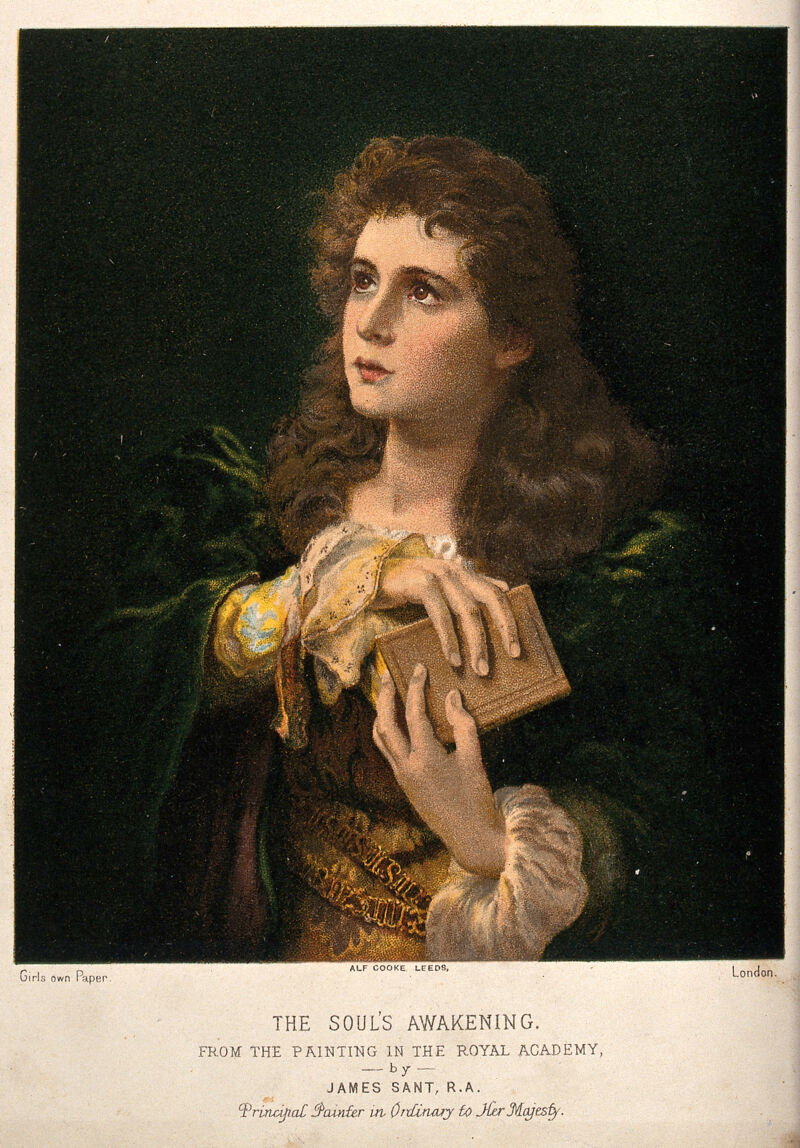
A young woman pressing a half-open book to her heart, her eyes raised upwards, as she undergoes a religious revelation. Colour lithograph after James Sant., by James Sant
James Sant · Wellcome Collection, London · Wellcome Collection
Key facts
Key facts
• Birth Name — James Sant • Born — 23 April 1820 • Birthplace — London, United Kingdom of Great Britain and Ireland • Place of death — London, United Kingdom of Great Britain and Ireland • Occupation — Court & Society Painter • Education — Royal Academy Schools • Known for — Royal portraitist • Movement — History painting Symbolism Romanticism Academic Art English School • Notable Works — Queen Victoria The Royal Family Capt. Colin Mackenzie, Madras Army Miss Martineau's Garden • Patrons — Queen Victoria • Awards — Royal Victorian Order Royal Academician Accademia Raffaello, Italy Paris Exposition Universelle (1889) • Spouse — Elizabeth (Eliza) Thomson • Children — 6 • Relatives — * George Sant RBA (brother) • Sarah Sherwood Clarke (sister) • Gen. Sir Mowbray Thomson (brother-in-law) • John Mount Batten (son-in-law)
Biography
Biography
Sant was born in Croydon, Surrey, England, on 23 April 1820. He was taught first by the watercolourist John Varley, then by Sir A. Callcott RA, then from the age of twenty was taught by the Royal Academy Schools. He lived to the age of 96 and exhibited at the Grosvenor Gallery as well as producing nearly three hundred canvases for exhibition at the Academy. The first of these, a portrait of his father, William Sant, was exhibited in 1840; the last was exhibited in 1915. In 1851 he married Elizabeth (Eliza) Thomson, daughter of Dr R.M.M. Thomson, a surgeon and member of the Agri Horticultural Society of India, and sister of Gen. Sir Mowbray Thomson. His 1853 picture of The Infant Samuel was his first popular success, and engravings of this by Samuel Cousins and of Little Red Riding Hood and The Soul's Awakening sold in great numbers. In 1861, twenty-two portraits of friends and relatives of Frances, Lady Waldegrave, known as the Strawberry Hill Collection, were exhibited by Ernest Gambart at his French Gallery in Pall Mall and at the Paris Salon. This enhanced his reputation, and he was elected ARA and later RA; in 1871 he was appointed Principal Painter in Ordinary (official portraitist) to Queen Victoria, having become known for his portraits of the royal children and in particular his 1870 Portrait of Prince Leopold and Princess Beatrice. He was the last artist to hold the title. Sant is best known for his portraits, particularly of aristocratic women and of children; he was "the emperor of children", in the words of the Athenaeum. Nevertheless, many of his pictures were landscapes and particularly gardens; he also painted seascapes, landscapes with animals, and other subjects, including The Wish Tower, a Martello Tower at Eastbourne. His later pictures are freer in style; some have been favourably compared with the work of the French Impressionists and some have a visionary or mannerist quality; his landscapes could include figures with blank or distorted features or simple silhouettes, such as The nun in Convent Walls (1910). He continued painting into old age; All My Fancy! (1910), an Italian landscape with villa and hills, he painted in bed from memory. He became a Commander of the Royal Victorian Order (CVO) in 1914 and resigned from the RA in the same year to "make room for younger men". He died in Lancaster Gate, London, on 12 July 1916. His work can be found at the National Gallery, Tate Britain and the National Portrait Gallery in London. At auction, Sant's work can achieve hundreds of pounds sterling or hundreds of thousands of pounds depending on size, quality and subject matter. Allegorical subjects remain popular; Courage, Anxiety and Despair: Watching the Battle (circa 1850) achieved £61,250 in 2012 and Astronomy almost twice this in 2008. His The Schoolmaster's Daughter (1870) and Miss Martineau's Garden (1873) are illustrated in Victorian Painters by Jeremy Maas; The Seventh Earl of Cardigan Relating the Story of the Cavalry Charge of Balaclava... (1854) is illustrated in the same volume and in Victorian Painters by Christopher Wood. Many of his works were reproduced as prints during his lifetime; his Courage has since been reproduced as a greetings card and his Hilda Pennington-Mellor, aged three (1880), as a postcard. Sant's work can also be seen at the Victoria Memorial in Kolkata, India, the Art Gallery of New South Wales in Sydney, Australia and the Yale Center for British Art.
Family
Family
Sant's brother, George Sant RBA (Royal Society of British Artists) (1821–1877), was a landscape painter, and the two brothers occasionally collaborated on paintings. Both James and George Sant were among the notable artist acquaintances of Charles Dodgson (Lewis Carroll); James Sant, his daughter Sarah Fanny and son Jemmy were the subjects of photographic studies by Dodgson. His sister, Sarah Sherwood Clarke (1825–1906), was also an accomplished artist but all that is presently known of her work is a collection of 48 different views of Scotland from 1854; these were exhibited for the first time at the Watercolours & Works on Paper Fair in London in February 2010. She married Frederick Clarke, Superintendent and later Secretary of the London and South Western Railway.
Gallery
Gallery
• Illustration — Capt. Colin Mackenzie, Madras Army, lately a hostage in Caubool, in his Affghan Dress, c.1842 (National Army Museum Sandhurst, Indian Army Memorial Room) • Illustration — Self-Portrait, 1844 (National Portrait Gallery, London) • Illustration — The Fairy Tale, c.1845-1870 (Walker Art Gallery) @Google Arts & Culture • Illustration — Wigram Money, Bengal Civil Service, c.1840-1845 (British Library Collection) • Illustration — Ernest Edgcumbe, 3rd Earl of Mount Edgcumbe, c.1847 (Mount Edgcumbe House) • Illustration — Ernest Edgcumbe,3rd Earl of Edgcumbe, in Peers Robes, c.1847 (Mount Edgcumbe House) • Illustration — Caroline, 3rd Countess of Mount Edgcumbe with her Children, c.1847 (Mount Edgcumbe House) • Illustration — Wild Flowers, 1849 (Wolverhampton Art Gallery) • Illustration — The Bursar (Richard Berens), 1849, commissioned by (All Souls College, Oxford) • Illustration — Astronomy, 1850 (Private Collection) • Illustration — Anne Warburton, c.1850, (National Library of Wales) • Illustration — John Singleton Copley, Baron Lyndhurst, Lord Chancellor (Government Art Collection) • Illustration — Sentiment, 1852 (The Wallace Collection) • Illustration — Maternity Portrait of the artist's wife Elizabeth and daughter, 1852 • Illustration — Countess of Morley, c.1852 (National Trust) • Illustration — The Infant Samuel, 1853 (Bury Art Museum) • Illustration — The Novice, 1856 (Harris Museum) • Illustration — Princess Helena and Princess Luise, 1857 (Royal Collection) • Illustration — Enigma (Southampton City Art Gallery) • Illustration — Contemplations (Atkinson Art Gallery and Library) • Illustration — Thought Folded Over (Danum Gallery, Library and Museum) • Illustration — George Villiers, 4th Earl of Clarendon (Government Art Collection) • Illustration — The Bride (Sheffield Museums Trust) • Illustration — Portrait of a Lady (Glasgow Museums) • Illustration — Ophelia • Illustration — The Student University of Dundee Fine Art Collections) (Government Art Collection) • Illustration — The Russell Sisters, 1858 • Illustration — Prince Henri, Duke of Aumale, c.1848-1860 (Royal Collection) • Illustration — Princess Maria Carolina of Bourbon-Two Sicilies, c.1848-1860 (Royal Collection) • Illustration — The Bride of Abydos (Government Art Collection) • Illustration — The First Sense of Sorrow, 1862 (Touchstones Rochdale) • Illustration — Mary Fothergill and her children Richard and Mary of Lowbridge House, c.1864 (Exhibited: Royal Academy 1864) • Illustration — Archibald Campbell Tait, Archbishop of Canterbury, c.1865 (National Portrait Gallery, London) • Illustration — The Duet (Tate Britain) • Illustration — Prince Leopold, 1869 (Royal Collection) • Illustration — Princess Beatrice, later Princess Henry of Battenberg, 1869 (Royal Collection) • Illustration — The Schoolmaster's Daughter, 1870 (Royal Academy) • Illustration — Prince Albert Victor of Wales, 1871 (Royal Collection) • Illustration — Queen Victoria with three grandchildren, 1872 (Royal Collection) • Illustration — Princess Louise of Wales, 1872 (Royal Collection) • Illustration — Prince Ernest of Hesse, c.1872 (Royal Collection) • Illustration — Major Dennistoun as a Boy, 1873 (Glasgow Museums) • Illustration — Miss Martineau's Garden, 1873 (Tate Britain) • Illustration — The Children of Major Barrett, of Moredon, Taunton, 1875 • Illustration — The Walker Sisters, c.1875 (Bury Art Museum) • Illustration — The Royal Portrait of H.M. Queen Victoria, 1876 (Palace of Westminster) • Illustration — Lord Almeric Athelstan and Lady Clementina, the Children of George Spencer-Churchill, 6th Duke of Marlborough, 1876 • Illustration — A Young Child (Royal Collection) • Illustration — Lady Frances Bushby, née Lady Frances North, daughter of Francis North, 6th Earl of Guilford, 1879 • Illustration — Lady Susannah Holford (then Susannah Wilson)(right) and her sister Ethel, 1880 (Royal Academy Exhibition of 1881) • Illustration — Lesbia, c.1881 (Art Gallery of New South Wales) • Illustration — Ida and Ethel, Twin Daughters of J. Searlight, Esq., 1884 (Russell-Cotes Art Gallery & Museum) • Illustration — Madame Adeline Patti, 1886 (National Portrait Gallery) On display at The Beaney House of Art & Knowledge, Canterbury • Illustration — A Thorn Amidst the Roses, 1887 (Manchester Art Gallery) • Illustration — The Soul's Awakening, 1888 (Victoria & Albert Museum) • Illustration — Sterne's Maria, c.1889 (Sudley House) • Illustration — Courage, Anxiety and Despair: Watching the Battle (Private Collection) • Illustration — The Infant Timothy (Bury Art Museum) • Illustration — Rosalind (Tate Britain) • Illustration — A Pastoral, 1892 (Royal Academy) • Illustration — Arthur Agar-Robartes, 8th Viscount Clifden with his sister Edith, 1893 (National Trust) • Illustration — Colonel Batten, C.B. c.1895 • Illustration — St. Helena: The Last Phase; commissioned by Lord Rosebery, c.1895 (Glasgow Museums) • Illustration — Julie Gollan, daughter of Spencer H. Gollan, Esq., 1898 (Harris Museum & Art Gallery) • Illustration — Dame Emily Francis of Ashton Court, c.1900 (Bristol Museum & Art Gallery) • Illustration — At the Opera, 1900 (Abbot Hall Art Gallery) • Illustration — Linnean Society of London: First Formal Admission of Women Fellows, 1906 (Linnean Society of London) • Illustration — Meditation (Sheffield Museums Trust) • Illustration — Contemplation (Bury Art Museum) • Illustration — Self-portrait, 1916 (Royal Academy)
Identity and origins
Identity and origins
The authorities additionally record the headings James J. His recorded language was English. He married Elizabeth (Eliza) Thomson. 2 children are recorded: Mowbray Lees Sant and Mary Edith Sant. Other recorded relations include Mowbray Thomson, Dr Richard Mowbray Martin Thomson and John Mount Batten.
Life and career
Dated record
Life and career
The full dated record · 2 entries
1820
James Sant born at London.
1916
James Sant died at London.
Places
Named by the record
Places
Only places the record itself states, plotted where the house gazetteer settles their coordinates. Nothing is inferred from a name or a nationality.
Lancaster Gate
Residences
London.
Birth place
Primary material
Documents and archives
scholarly publication
- Sant, James (1820–1916), portrait and genre painter, Oxford Dictionary of National Biography, 2004
Scholarly · Crossref registry · 2004
- Sant, James, Benezit Dictionary of Artists, 2011
Scholarly · Crossref registry · 2011
Institutional database
- Wikidata, structured authority record Q3806718: James Sant
Scholarly · Wikimedia Foundation
reference work
- “James Sant”, English Wikipedia, consulted as further reading
Reputable secondary · Wikipedia
Notes from the source article
Cited by Wikipedia
Notes from the source article
These works are cited by the source article, in its own numbering. They are recorded as its citations, not as sources VALÉORINE has verified.
- 1.Jeremy Maas. Victorian Painters. Barrie & Jenkins. 215. 1988. 0-7126-2051-6.
- 2.James Sant, C.V.O., R.A. (1820–1916).
- 3.James Sant (1820–1916), Painter.
- 4.Sant, James.
- 5.The Library of Nineteenth Century Photography.
- 6.Sant, James (1820–1916), portrait and genre painter.
- 7.Classical Portrait of a Man.
- 8.James Sant; Eliza Sant (née Thomson).
- 9.Gere, C. Artistic Circles: Design & Decoration in the Aesthetic Movement. Harry N. Abrams. 42. 2010. 978-1-85177-602-3.
- 10.The Tower Gate. artnet.
- 11.Sir Charles Holmes. The National Gallery: France and England. G Bell & Sons Ltd. 240.
- 12.Convent Walls. 28 September 2015.
- 13.All My Fancy. 28 September 2015.
- 14.Art auction result for James Sant.
- 15.Courage, Anxiety and Despair: Watching the Battle.
- 16.Jeremy Maas. Victorian Painters. Barrie & Jenkins. 1988. 0-7126-2051-6.
- 17.Christopher Wood. Victorian Painters. Antiques Collectors' Club. 1999. 1-85149-172-4.
- 18.British Museum; James Sant (1820–1916), Painter.
- 19.James Sant (1820–1916), Painter.
- 20.Lewis Carroll.
- 21.James Sant.
- 22.Sarah Sherwood Clarke nee Sant. 12 September 2015.
- 23.Watercolours + Works on Paper. Lilium's Compendium.
Bibliography printed in the source article · 5
References
Citations
References
Each reference names the institution holding it, so a reader may go to the document itself.
scholarly publication
Sant, James (1820–1916), portrait and genre painter, Oxford Dictionary of National Biography, 2004Crossref registry
Institutional witnessscholarly publication
Sant, James, Benezit Dictionary of Artists, 2011Crossref registry
Institutional witnessInstitutional database
Wikidata, structured authority record Q3806718: James SantWikimedia Foundation
Institutional witnessreference work
Secondary witness
Further particulars
Held on the record
Further particulars
Open the remaining particulars
Formation and teaching. Sant studied at Royal Academy Schools. He trained under John Varley and Augustus Wall Callcott. His recorded influences include Edwin Landseer. His work is associated with academic art, British School and Symbolism. He belonged to Royal Academy of Arts and Accademia Raffaello. He worked at Lancaster Gate. Work and production. His recorded genres are portrait, history, allegorical, genre and landscape. Sant received Commander of the Royal Victorian Order. Recorded as painter, portraitist and artist.
Career and activity
Recognition and collections
Work by James Sant is
Tate, Royal Collection, National Portrait Gallery and Walker Art Gallery
The Encyclopedia exists whether or not anything is for sale. Corrections are recorded rather than overwritten, and every version of this record is kept. Published 16 August 2026.
Elsewhere in Paintings
19,065 published records in this field, each with its sources named.
- James Peter QuinnArtist
- James PriorArtist
- James RamsayArtist
- James Renwick BrevoortArtist
- James SchoppertArtist
- James SeymourArtist
- James SharplesArtist
- James ShawArtist
Best supported in this field
For owners
Own a work by James Sant?
A specialist will read what you send and tell you what the house can establish, what it cannot, and whether the object is suited to sale. There is no charge and no obligation. The object stays with you throughout; nothing is shipped to us unless it is arranged in writing beforehand.