
Ishikawa Toyonobu
Ishikawa Toyonobu was a Japanese ukiyo-e print artist. He is sometimes said to have been the same person as Nishimura Shigenobu, a contemporary ukiyo-e artist and student of Nishimura Shigenaga about whom very little is known. A pupil of Nishimura Shigenaga, Toyonobu produced many monochrome "lacquer prints" (urushi-e) which reflected the influence of Okumura Masanobu as well.
Also recorded as Shūha Meijōdō · Shūha · Nukaya Shichibei · Magosaburō Nishimura Shigenobu
Ishikawa Toyonobu
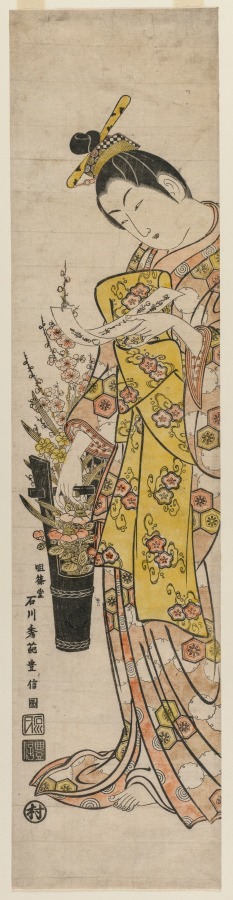
Ishikawa Toyonobu · The Cleveland Museum of Art · The Kelvin Smith Collection, given by Mrs. Kelvin Smith · CC0
- Name
- Ishikawa Toyonobu
- Born
- 1711
- Died
- 1 July 1785
- Movement
- Kaigetsudō school
- Nationality
- Japan
- Occupation
- painter · ukiyo-e artist · wood engraver · illustrator
- Teachers
- Nishimura Shigenaga
- Languages
- Japanese
VALÉORINE Encyclopedia
VALÉORINE documentary reading
Documentary summary
Ishikawa Toyonobu was a Japanese ukiyo-e print artist. He is sometimes said to have been the same person as Nishimura Shigenobu, a contemporary ukiyo-e artist and student of Nishimura Shigenaga about whom very little is known. A pupil of Nishimura Shigenaga, Toyonobu produced many monochrome "lacquer prints" (urushi-e) which reflected the influence of Okumura Masanobu as well.
Admitted source layer · organised and presented by VALÉORINE
Note VALÉORINE
Ishikawa Toyonobu (1711–1785) was a Japanese illustrator, painter and ukiyo-e artist, among other activities. The illustrator was born in Tokyo. Ishikawa Toyonobu worked in Japan and Tokyo.
Languages used include Japanese. Works by the illustrator are held at Auckland Art Gallery, Finnish National Gallery and Metropolitan Museum of Art, among others.
Composed from admitted, traceable facts · 26 September 2026
VALÉORINE
Reference Check
Propose documentary evidence for Ishikawa Toyonobu. A contribution is never written directly as fact: identity, source, rights and evidence gates still decide.
Sign in to contribute
Documentary evidence
Documentary basis
Authority files
wikidata · Q3038261 · wikipedia · Ishikawa Toyonobu
In this article
Biography
Biography
Many of these were yakusha-e (actor prints) and bijin-ga (images of beautiful women), including images of standing courtesans, whose faces conveyed an impassivity typical of the works of the Kaigetsudō school. Toyonobu also experimented with semi-nude forms, something his chief predecessors also did, but never succeeded in developing it into a trend or subgenre within ukiyo-e. Art historian Richard Lane points out that these images, depicting women with the top half of their kimono open and let down to reveal their chests, were intended as suggestive and erotic, and were not "glorification of the human form such as we find in Greek art". Later in his career, Toyonobu became one of the leading producers of color prints, chiefly benizuri-e ("rose prints"), but stopped producing ukiyo-e shortly after Suzuki Harunobu pioneered the full-color print (nishiki-e) in 1765. He had one notable pupil, Ishikawa Toyomasa, who is known chiefly for his depictions of children at play, and who may have been Toyonobu's son.
Training under Nishimura Shigenaga is recorded. Ishikawa Sekishin and Ishikawa Toyomasa are recorded as having studied under Ishikawa Toyonobu. The recorded working language is Japanese. Places of work recorded in the authority are Tokyo and Japan. Work by Ishikawa Toyonobu is recorded in the collections of Minneapolis Institute of Art, Museo del Prado, The Nelson-Atkins Museum of Art, Auckland Art Gallery and Finnish National Gallery.
Key facts
Key facts
• Name — Ishikawa Toyonobu • Native Name — 石川 豊信 • Born — 1711 • Died — 1 July 1785 • Movement — Kaigetsudō school • Style — Ukiyo-e • Illustration — Kabuki actors Nakamura Shichisaburō and Sanogawa Ichimatsu, in 1740s print by Toyonobu. Ishikawa Toyonobu was a Japanese ukiyo-e print artist. He is sometimes said to have been the same person as Nishimura Shigenobu, a contemporary ukiyo-e artist and student of Nishimura Shigenaga about whom very little is known. A pupil of Nishimura Shigenaga, Toyonobu produced many monochrome "lacquer prints" (urushi-e) which reflected the influence of Okumura Masanobu as well. Many of these were yakusha-e (actor prints) and bijin-ga (images of beautiful women), including images of standing courtesans, whose faces conveyed an impassivity typical of the works of the Kaigetsudō school. Toyonobu also experimented with semi-nude forms, something his chief predecessors also did, but never succeeded in developing it into a trend or subgenre within ukiyo-e. Art historian Richard Lane points out that these images, depicting women with the top half of their kimono open and let down to reveal their chests, were intended as suggestive and erotic, and were not "glorification of the human form such as we find in Greek art". Later in his career, Toyonobu became one of the leading producers of color prints, chiefly benizuri-e ("rose prints"), but stopped producing ukiyo-e shortly after Suzuki Harunobu pioneered the full-color print (nishiki-e) in 1765. He had one notable pupil, Ishikawa Toyomasa, who is known chiefly for his depictions of children at play, and who may have been Toyonobu's son.
Works
Works
=
Gallery
Gallery
• Illustration — Hanging a Poem on a Cherry Tree (Urushi-e) • Illustration — Wakashu with a Flower Cart • Illustration — Torioi by Japanese Kabuki actors • Illustration — Kabuki actors Onoe Kikugoro I and Nakamura Kiyosaburo
Bijin-ga Prints =
Bijin-ga Prints =
Bijin-ga prints depict beautiful and erotic images of women, intended for urban citizens during the Edo period. Some Bijin-ga prints of Ishikawa Toyonubu include imagery or references of sex workers. "Beauty Reading A Letter" c. 1758 depicts a woman reading a letter on a scroll and the interior of a room. It is a benizuri-e color woodblock print which was on display at the Art Institute of Chicago "Courtesan Reading a Letter" c. 1745 was on display at the Art Institute of Chicago. It is a hand-colored woodblock print of a prostitute reading a letter, adorned in floral and patterned wear. Prostitute of Osaka, Left Sheet c. 1745. A young female attendant carrying a cup of sake represents the city of Osaka.
Urushi-e Prints
Urushi-e Prints
Ishikawa Toyonobu made lacquer paintings, also referred to as Urushi-e. Of Sanogawa checkered Hisamatsu c. 1745 was a woodblock print with hand coloring and lacquer. The print portrays "a Kabuki actor, Sanogawa Ichimatsu is shown concealing a letter addressed 'Somoji' (To You). He is identified by the crest on his sleeve". The print is currently displayed at the Honolulu Museum of Art.
Yakusha-e Prints
Yakusha-e Prints
Some of his prints include subject based benizuri-e prints, often showcasing actors and figures in theatre. During the Edo period, the theater form of Kabuki thrived and emerged, making actors a common subject of painters. The Actor Sanogawa Ichimatsu I as Hisamatsu c. 1748 The Actors Onoe Kikugoro I and Sanogawa Ichimatsu I dressed as mendicant monks c. 1744 A hosoban benizuri-e print of two actors portraying a young man removing snow from a woman's geta c. 1750
Collections
His work is held in many museums worldwide, including the British Museum, the Museum of Fine Arts, Boston, the Metropolitan Museum of Art, the Israel Museum, Jerusalem, the Harvard Art Museums, the Asian Art Museum, the University of Michigan Museum of Art, the Minneapolis Institute of Art, the Victoria and Albert Museum, the MOA Museum of Art, the Ota Memorial Museum of Art, the National Museum of Asian Art, the Museo Nacional del Prado, the Art Institute of Chicago, the Portland Art Museum, the RISD Museum, and the Fine Arts Museums of San Francisco.
Notes from the source article
Cited by Wikipedia
Notes from the source article
These works are cited by the source article, in its own numbering. They are recorded as its citations, not as sources VALÉORINE has verified.
- 1.Lane, p. 89.
- 2.hashira-e British Museum. The British Museum.
- 3.Young Woman with Umbrella. collections.mfa.org.
- 4.Ishikawa Toyonobu | Segawa Kikunojō II | Japan | Edo period (1615–1868). www.metmuseum.org.
- 5.Ishikawa Toyonobu, Japan, 1711-1785 The Israel Museum, Jerusalem. www.imj.org.il.
- 6.Harvard. From the Harvard Art Museums' collections Young Women Fighting over a Theater Program. harvardartmuseums.org.
- 7.Asian Art Museum Online Collection. searchcollection.asianart.org.
- 8.Exchange: Hanging a Poem on a Cherry Tree. exchange.umma.umich.edu.
- 9.Prostitute of Osaka, Left Sheet, Ishikawa Toyonobu; Publisher: Urokogataya Magobei ^ Minneapolis Institute of Art. collections.artsmia.org.
- 10.Two Cranes and a Plum Tree Ishikawa Toyonobu V&A Search the Collections. V and A Collections. 2021-01-08.
- 11.MOA MUSEUM OF ART » コレクション » Parody of Hanshan and Shide. www.moaart.or.jp.
- 12.Collection 8 太田記念美術館 Ota Memorial Museum of Art.
- 13.Young woman reading a letter. Freer Gallery of Art & Arthur M. Sackler Gallery.
- 14.Pescadora de orejas de mar y niño - Colección - Museo Nacional del Prado. www.museodelprado.es.
- 15.Toyonobu, Ishikawa. The Actor Onoe Kikugoro I holding a puppet of the Actor Sanogawa Ichimatsu I. The Art Institute of Chicago.
- 16.Ishikawa Toyonobu. portlandartmuseum.us.
- 17.Ishikawa Danjuro III (Sandaime Ishikawa Danjuro) RISD Museum. risdmuseum.org.
- 18.Two Women and Attendant Crossing Bridge in the Rain - Ishikawa Toyonobu, Urokogataya. FAMSF Search the Collections. 2016-04-22.
References
Citations
References
Each reference names the institution holding it, so a reader may go to the document itself.
reference work
Secondary witnessreference work
Secondary witness
The Encyclopedia exists whether or not anything is for sale. Corrections are recorded rather than overwritten, and every version of this record is kept. Published 16 August 2026.
Elsewhere in Illustration
5,224 published records in this field, each with its sources named.
- Isabelle MalenfantIllustrator
- Isabelle PierreIllustrator
- Isamu ImakakeIllustrator
- Isamu KamikokuryoIllustrator
- Ismar DavidIllustrator
- Israel SilvestreIllustrator
- István ÁrkossyIllustrator
- István BartaIllustrator
Best supported in this field
For owners
Own a work by Ishikawa Toyonobu?
A specialist will read what you send and tell you what the house can establish, what it cannot, and whether the object is suited to sale. There is no charge and no obligation. The object stays with you throughout; nothing is shipped to us unless it is arranged in writing beforehand.