
Heinrich Biber
Illustration — Portrait of Biber • Illustration — Signature of Biber Heinrich Ignaz Franz von Biber (correctly Biber von Bibern; bapt. 12 August 1644 – 3 May 1704) was a Czech-Austrian composer and violinist of the middle Baroque era. Biber worked in Graz and Kroměříž before he illegally left his employer, Prince-Bishop Karl Liechtenstein-Kastelkorn, and settled in Salzburg.
Also recorded as Heinrich Ignaz Franz Biber
Heinrich Biber

Paul Seel · modified from aeiou.at · Public domain
- Born
- 1644
- Died
- 1704
- Occupation
- composer · violinist · musician
- Fields
- opera
- Movements
- Baroque music
- Known for
- Rosary Sonatas
VALÉORINE Encyclopedia
VALÉORINE documentary reading
Documentary summary
Illustration — Portrait of Biber • Illustration — Signature of Biber Heinrich Ignaz Franz von Biber (correctly Biber von Bibern; bapt. 12 August 1644 – 3 May 1704) was a Czech-Austrian composer and violinist of the middle Baroque era. Biber worked in Graz and Kroměříž before he illegally left his employer, Prince-Bishop Karl Liechtenstein-Kastelkorn, and settled in Salzburg.
Admitted source layer · organised and presented by VALÉORINE
Note VALÉORINE
No house-authored Note is published until its assertions and sources pass the VALÉORINE evidence contract. The documentary article remains available in full while that enrichment is being consolidated.
Documentary enrichment in progress · no unsupported statement published
Reference Check
Propose documentary evidence for Heinrich Biber. A contribution is never written directly as fact: identity, source, rights and evidence gates still decide.
Sign in to contribute
World of VALÉORINE
Documentary connections
Only confirmed graph relationships appear here. Images are shown only when their identity and reuse rights both pass the documentary gate.

Documentary evidence
Evidence Panel
technical hold · checked 25 September 2026
- Identity
- resolved
- Independent source families
- 0
- Admitted assertions
- 0
- Open conflicts
- 0
Authority files
museum · 62f6746a-0b65-4e65-8e50-67b394252914 · wikidata · Q153455 · wikipedia · Heinrich Ignaz Franz Biber
In this article
Biography
Biography
He remained there for the rest of his life, publishing much of his music but apparently seldom, if ever, giving concert tours. Biber was among the major composers for the violin in the history of the instrument. His own technique allowed him to easily reach the 6th and 7th positions, employ multiple stops in intricate polyphonic passages, and explore the various possibilities of scordatura tuning. Among other pieces, Biber wrote operas, sacred music and music for chamber ensemble. He also wrote one of the earliest known pieces for solo violin, the monumental passacaglia of the Mystery Sonatas. During Biber's lifetime, his music was known and imitated throughout Europe. In the late 18th century he was named the best violin composer of the 17th century by music historian Charles Burney. In the late 20th century Biber's music, especially the Mystery Sonatas, enjoyed a renaissance. Today, it is widely performed and recorded.
Biber was born in Wartenberg, Bohemia (now Stráž pod Ralskem, Czech Republic). Little is known about his early education, other than that he may have studied at a Jesuit gymnasium at Opava in Bohemia, and that he may have had musical education by a local organist. Before 1668 Biber worked at the court of Prince Johann Seyfried von Eggenberg in Graz, and then he was employed by the Bishop of Olomouc, Karl II von Liechtenstein-Kastelkorn, in Kroměříž. Biber's associate from the early 1660s, Pavel Josef Vejvanovský, worked there as director of the Kapelle. Biber apparently enjoyed a good reputation, and his violin playing skills were very highly regarded. • Illustration — Monument to Biber in his hometown, Stráž pod Ralskem In summer 1670 Karl II sent Biber to Absam, near Innsbruck, to negotiate with the celebrated instrument maker Jacob Stainer for the purchase of new instruments for the Kapelle. Biber never reached Stainer, however, and instead entered the employ of the Archbishop of Salzburg, Maximilian Gandolph von Kuenburg. Because Karl and Maximilian were friends, Biber's former employer refrained from taking any action; he was, however, very hurt by the composer's decision, and waited until 1676 to officially issue his release papers. It is not coincidental that most of the autograph compositions Biber sent to Kremsier date from the early 1670s. Biber remained in Salzburg for the rest of his life. His musical and social careers flourished: he started publishing his music in 1676, performed before the Emperor Leopold I (and was rewarded by him) in 1677, became deputy Kapellmeister at Salzburg in 1679 and Kapellmeister in 1684. In 1690 Biber was raised to nobility by the Emperor, with the title of Biber von Bibern. Finally, the new Archbishop of Salzburg, Johann Ernst, Count Thun, appointed Biber lord high steward, the highest social rank Biber would attain. • Illustration — Commemorative plaque next to Biber's grave in Petersfriedhof The composer was married on 30 May 1672 at the bishop's summer residence, Hellbrunn Palace, just outside Salzburg. His wife Maria Weiss was a daughter of a Salzburg merchant, citizen and tradesman, Peter Weiss. Together they had 11 children, four of whom survived to adulthood. All were musically gifted. Anton Heinrich (1679–1742) and Carl Heinrich (1681–1749) both served as violinists at the Salzburg court, and the latter was promoted to Kapellmeister in 1743. Daughters Maria Cäcilia (born 1674) and Anna Magdalena (1677–1742) became nuns at Santa Clara, Merano, and the Nonnberg Abbey, respectively. Anna Magdalena was an alto singer and a violinist, and in 1727 became director of the choir and the Kapelle of the Abbey. She used her father's Singfundament, a basic singing instruction book, for her work in the Abbey. On 3 November 1692, Biber was appointed steward by Archbishop Johann Ernst. He then received his Coat of arms. Biber died in Salzburg on 3 May 1704. His grave is located in the Petersfriedhof.
Works
Works
• Illustration — Biber's symbolic reconfiguration of the violin for the Resurrection sonata of the Mystery Sonatas Biber's violin music was possibly influenced, on one hand, by the Italian tradition of Marco Uccellini and Carlo Farina, and on the other, by the then-nascent German polyphonic tradition as exemplified by Johann Heinrich Schmelzer, who may have been Biber's teacher. Biber's achievements included further development of violin technique – he was able to reach the 6th and 7th positions, and his left-hand and bowing techniques were far more advanced than those of contemporary Italian composers. He also excelled at counterpoint, frequently writing fully polyphonic textures, with much use of multiple stops. Yet another area in which Biber made a substantial contribution was the art of scordatura, i.e. music for alternative tunings of the instrument. Finally, much of Biber's music employs various forms of number symbolism, affekte, programmatic devices, etc., as seen in the symbolic retuning of the violin for the Resurrection sonata of the Mystery Sonatas. During the latter half of the 17th century Biber was, together with the composers of the Dresden school (Johann Jakob Walther and Johann Paul von Westhoff), regarded as one of the best and most influential violinists in Europe. However, soon after his death, German violinists started following the style of Arcangelo Corelli and his imitators.
Instrumental music
Instrumental music
Biber's finest scordatura writing is represented in two collections. The first dates from c. 1676 and is known variously as Mystery Sonatas, Rosary Sonatas (Mysterien Sonaten, Die Rosenkranz-Sonaten), Copper-Plate Engraving Sonatas, etc., remaining unpublished during the composer's lifetime. It comprises sixteen pieces: fifteen sonatas for violin and continuo portraying the fifteen Mysteries of the Rosary, and a long passacaglia for solo violin. In the extant copy of the collection, each piece is accompanied by a small engraving depicting the mystery it portrays, while the image (an ink drawing) preceding the passacaglia depicts a guardian angel with a child. Only the first and the last pieces use normal tuning; all others employ some form of scordatura: • Illustration — Tunings for the 16 pieces of Mystery Sonatas The sonatas were dedicated to Maximilian Gandolph von Khuenburg, whom Biber addresses in the preface: "I have consecrated the whole to the honour of the XV Sacred Mysteries, which you promote so strongly." Although unpublished during the composer's lifetime, these works are his most popular pieces today, and one of the reasons for the revival of interest in his music. The entire set has been recorded by numerous violinists such as John Holloway, Andrew Manze, and many others. Sonata 15 is famous for one of its themes, which matches the theme of Paganini's Caprice No. 24 almost exactly; it is possible that Paganini was inspired by Biber, just as Franz Liszt, Johannes Brahms and Sergei Rachmaninoff were later inspired by Paganini's Caprice. The second work in which Biber explored scordatura techniques is Harmonia artificioso-ariosa (1696), his last known published collection of instrumental music. It contains seven partitas for two instruments and basso continuo: five for two violins, one for two violas d'amore, and one for violin and viola. Six of the partitas require scordatura tunings, including those for viola and two violas d'amore; Biber uses the full potential of the technique, including all possibilities for complex polyphony: some of the pieces are in five parts, with both of the melodic instruments carrying two. No other chamber works by Biber use such devices, and the only other pieces to use scordatura are two of the sonatas included in Sonatae violino solo of 1681. That collection comprises eight sonatas for violin and basso continuo, all noted already by Charles Burney in the late 18th century, for the brilliant virtuosic passages and elaborate structures. In contrast to both Mystery Sonatas and Harmonia, these works consist mostly of pieces in free forms (prelude, aria) or variations, rather than dances. Biber's other published collections of instrumental music are Sonatae tam aris quam aulis servientes (1676), Mensa sonora (1680), and Fidicinium sacro profanum (1682/3). Sonatae tam aris contains sonatas in five, six or eight parts; some of them only use string instruments, some include one or two trumpets. Mensa sonora is a set of six partitas for one or two violins, viola, cello, and basso continuo, and Fidicinium sacro profanum comprises twelve sonatas for one or two violins, two violas, and continuo. Finally, manuscript sources include numerous other pieces: fantasias, balletti, sonatas, etc. Among these are the Battalia, a programmatic "battle" piece which anticipates such latter-day techniques as polytonality and col legno playing, and the Sonata representativa, another typical 17th-century piece similar to works by Walther and Farina, which imitates various birds and animals. An example of Biber's versatility in instrumental music is the Sonata S Polycarpi, which is scored for eight trumpets and timpani.
Sacred music
Sacred music
Unlike most composers for the violin, Biber did not limit himself to music for the instrument. He was also a prolific composer of sacred vocal works: masses, requiems, motets, etc. Many of those were polychoral and employing large instrumental forces, inspired by the possibilities of the spacious interior of the Salzburg Cathedral. Among the polychoral works, Missa Salisburgensis (1682) is the best known. An expansive setting of the mass for sixteen voices and 37 instrumentalists (i.e. 53 parts total), it was previously attributed to Orazio Benevoli, but today Biber's authorship is certain. The instrumentation includes not only string ensembles, but also oboes, cornetts, trumpets, and timpani. Among his many polychoral works are Plaudite tympana à 53 (1682) Vesperae à 32 (1693), Missa Bruxellensis (1696) and Missa Sancti Henrici (1697), which was composed for the occasion of the taking of the veil by his second daughter, Anna Magdalena, at Nonnberg Abbey in Salzburg. In tribute to the Emperor Henry II, the second founding saint of the convent, she took the name Maria Rosa Henrica when her novitiate began in 1696. The Mass of Saint Henry is scored for a five-voice choir with two soprano lines and an orchestra of two violins, three violas, two trumpets, timpani and continuo, with optional extra trumpets and sackbuts to double the voice parts. Although Biber is best known for the massive polychoral works, he was also capable of writing for smaller forces. Missa quadragesimalis is a simple a cappella setting (with only a continuo part provided) for four voices, as is the Stabat Mater.
Identity
Identity
Heinrich Biber is recorded with the occupation violinist. Classed in the genre opera. Recorded as composer, violinist and musician.
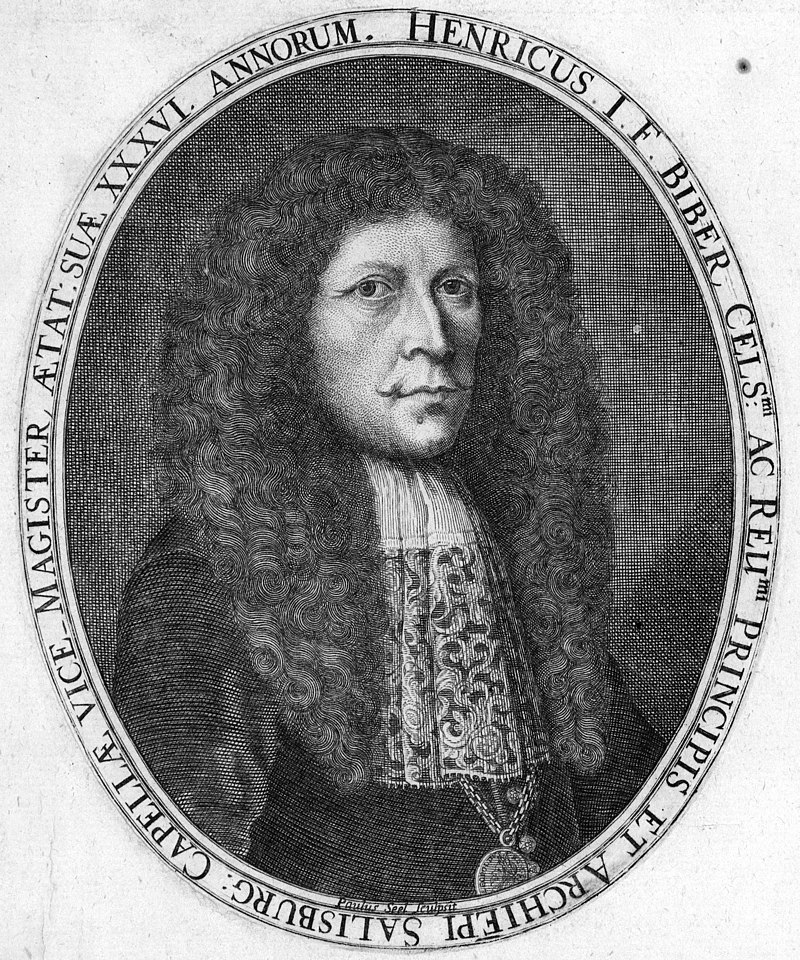
Heinrich Ignaz Franz von Biber (* 12. August 1644 in Wartenberg, Böhmen; † 3. Mai 1704 in Salzburg), Komponist
Paul Seel
Life and career
Dated record
Life and career
Explore 1644–1704
The full dated record · 3 entries
1644
Heinrich Biber was born on 12 August 1644.
1690
Arminio is dated 1690.
1704
Heinrich Biber died on 3 May 1704.
Selected recordings
• Requiem à 15 Vesperae à 32, Els Bongers, Anne Grimm, Kai Wessel, Peter de Groot, Marcel Reyans, Simon Davies, René Steur, Kees-Jan de Koning, Amsterdam Baroque Orchestra & Choir, Ton Koopman • Missa Bruxellensis – Jordi Savall, Le Concert des Nations, La Capella Reial de Catalunya – Alia Vox 9808 • Requiem / Battalia – Jordi Savall, La Capella Reial de Catalunya, Le Concert des Nations – Alia Vox 9825 • "Sonata Representativa for violin & continuo in A major", The Zarjaz, La Leggenda Del Block, Editio Seconda, Traite Pour Marbre Neon Harpe Et Voix – Basilcia Records BA 005 • "Mensa sonora and Sonata representativa", Reinhard Goebel, Musica Antiqua Köln – Archiv Produktion (DG) 423701 • "The Rosary Sonatas", Richard Egarr, Andrew Manze, Alison McGillivray, Harmonia Mundi 907321 • Biber: Passacaglia for Solo Viola, Arranged by Marco Misciagna (Live) - MM08 - Marco Misciagna, viola
Primary material
Documents and archives
reference work
- Wikidata, structured authority record Q153455: Heinrich Biber
Reputable secondary · Wikimedia Foundation
- “Heinrich Ignaz Franz Biber”, English Wikipedia, consulted as further reading
Reputable secondary · Wikipedia
scholarly publication
- Biber, Heinrich Ignaz Franz von (opera), Oxford Music Online, 2002
Scholarly · Crossref registry · 2002
Institutional database
- MusicBrainz artist record for Heinrich Biber
Scholarly · MetaBrainz Foundation
Notes from the source article
Cited by Wikipedia
Notes from the source article
These works are cited by the source article, in its own numbering. They are recorded as its citations, not as sources VALÉORINE has verified.
- 1.Britannica 64368 Heinrich Biber
- 2.A Survey of the Unaccompanied Violin Repertoire, Centering on Works by J.S. Bach and Eugene Ysaÿe, drum.lib.umd.edu, p. 19-20
- 3.Dann, Elias. Heinrich Ignaz Franz von Biber. 2001.
- 4.Biber, Heinrich Ignaz Franz von. Baker's Biographical Dictionary of Musicians. 2001.
- 5.Norwich, J. J. Oxford illustrated encyclopedia. Oxford University Press. 47. 1985–1993. 0-19-869129-7.
- 6.A Survey of the Unaccompanied Violin Repertoire, Centering on Works by J. S. Bach and Eugene Ysaÿe, drum.lib.umd.edu, p. 12
- 7.Heinrich Ignaz Franz Biber, encyclopedia.com. Retrieved February 21, 2015
- 8.StainerQuartett: Jacob Stainer, stainerquartett.ch
- 9.Heinrich Ignaz Franz von Biber – A Chronology, bluntinstrument.org.uk
- 10.Heinrich Ignaz Franz Biber, Salzburg Wiki
- 11.Brewer, Charles E. The Instrumental Music of Schmeltzer, Biber, Muffat and their Contemporaries. Ashgate Publishing. 1 March 2011. 9781409494225.
- 12."Heinrich Biber", Hyperion Records
- 13.Battalia by Heinrich Ignaz Franz Biber , wmea.com
- 14.List of works by Heinrich Ignaz Franz von Biber, imslp.org
- 15.Karl Heinrich Wörner, Wolfgang Gratzer, Lenz Meierott (1993): , p. 229. Vandenhoeck & Ruprecht, .
- 16.Linn Records – Virtuoso in the Making — Biber
References
Citations
References
Each reference names the institution holding it, so a reader may go to the document itself.
scholarly publication
Biber, Heinrich Ignaz Franz von (opera), Oxford Music Online, 2002Crossref registry
VerifiedInstitutional database
MusicBrainz artist record for Heinrich BiberMetaBrainz Foundation
Verifiedreference work
Wikidata, structured authority record Q153455: Heinrich BiberWikimedia Foundation
Partially resolvedreference work
Partially resolved
Further particulars
Held on the record
Further particulars
Open the remaining particulars
The authorities additionally record the heading Heinrich Ignaz Franz Biber. His recorded languages were German and Czech. Biber worked in music. His work is associated with Baroque music. Recorded position is court chapel master. He worked at Kroměříž. Connected to 1 other published record in the VALÉORINE Encyclopedia.
Identity and origins
Career and activity
Within the Encyclopedia
The Encyclopedia exists whether or not anything is for sale. Corrections are recorded rather than overwritten, and every version of this record is kept. Published 14 August 2026.
Elsewhere in Music memorabilia
42,108 published records in this field, each with its sources named.
- Heinrich BaermannPerson
- Heinrich BellermannPerson
- Heinrich BenderPerson
- Heinrich BertéPerson
- Heinrich Bolten-BaeckersPerson
- Heinrich BonePerson
- Heinrich Christoph KochPerson
- Heinrich DornPerson
Best supported in this field
For owners
Own a work by Heinrich Biber?
A specialist will read what you send and tell you what the house can establish, what it cannot, and whether the object is suited to sale. There is no charge and no obligation. The object stays with you throughout; nothing is shipped to us unless it is arranged in writing beforehand.