
Hans van der Laan
Illustration — Hans van der Laan Portrait Dom Hans van der Laan (29 December 1904 – 19 August 1991) was a Dutch Benedictine monk and architect. He was a leading figure in the Bossche School. His theories on numerical ratios in architecture, in particular regarding the plastic ratio, were very influential.
Also recorded as Hans Van Der Laan · Dom van der Laan · Dom Hans van der Laan
Hans van der Laan
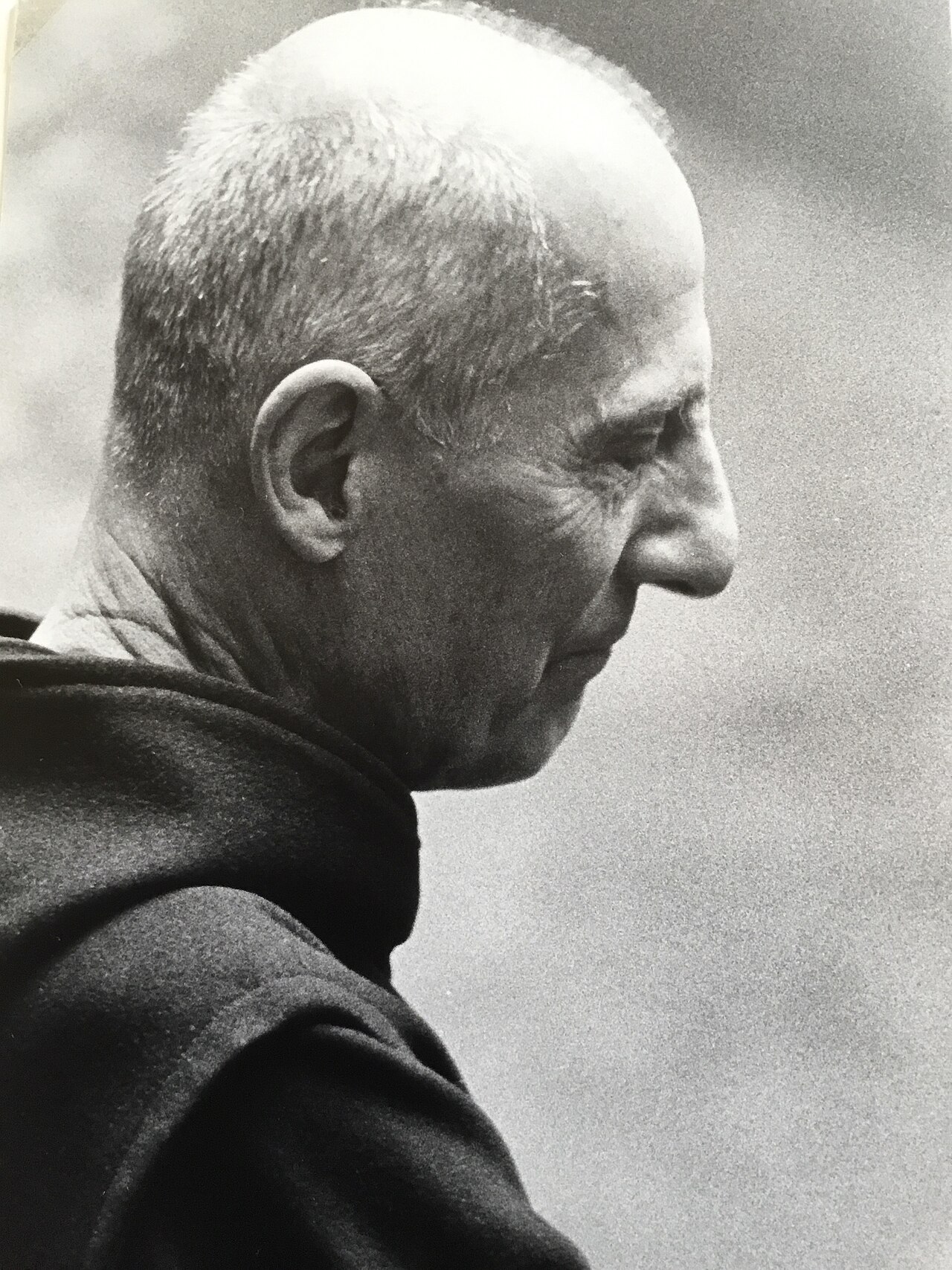
Petsoe · CC BY-SA 4.0
- Born
- Hans van der Laan was born on 29 December 1904. · Leiden.
- Died
- Hans van der Laan died on 19 August 1991. · Lemiers.
- Nationality
- Kingdom of the Netherlands
- Occupation
- architect · designer
- Fields
- architecture · product design
- Movements
- Bossche School
- Education
- Delft University of Technology
- Languages
- Dutch
VALÉORINE Encyclopedia
VALÉORINE documentary reading
Documentary summary
Illustration — Hans van der Laan Portrait Dom Hans van der Laan (29 December 1904 – 19 August 1991) was a Dutch Benedictine monk and architect. He was a leading figure in the Bossche School. His theories on numerical ratios in architecture, in particular regarding the plastic ratio, were very influential.
Admitted source layer · organised and presented by VALÉORINE
Note VALÉORINE
Hans van der Laan was a Dutch architect and designer. Born in Leiden, the architect died in Lemiers.
Hans van der Laan studied at Delft University of Technology. The architect was active in architecture and product design. Hans van der Laan was associated with Bossche School.
Languages used include Dutch. Works by the architect are held at Museum Boijmans Van Beuningen and Nieuwe Instituut.
Composed from admitted, traceable facts · 26 September 2026
VALÉORINE
Reference Check
Propose documentary evidence for Hans van der Laan. A contribution is never written directly as fact: identity, source, rights and evidence gates still decide.
Sign in to contribute
World of VALÉORINE
Documentary connections
Only confirmed graph relationships appear here. Images are shown only when their identity and reuse rights both pass the documentary gate.
Documentary evidence
Documentary basis
Authority files
wikidata · Q1583336 · wikipedia · Hans van der Laan
In this article
Early life
Early life
He may be regarded as intellectually related to the second generation of "De Groep".
Hans van der Laan studied at Delft University of Technology. The recorded working language is Dutch. The field of work recorded is architecture and product design. Work by Hans van der Laan is recorded in the collections of Museum Boijmans Van Beuningen and Nieuwe Instituut.
Van der Laan was the ninth of the eleven recorded children of Leiden architect Leo van der Laan (1864–1942) by his marriage to Anna Stadhouder (1871–1941). His brothers Jan van der Laan and Nico van der Laan also became architects. His teenage years were marred by a diagnosis of tuberculosis when he was seventeen. The illness also delayed the commencement of his university level studies, but he used a year in a sanatorium to study higher mathematics so that once he did resume his studies he was able to omit the mathematics based elements of the standard course. Hans studied architecture from 1923 to 1926 at the Technische Hogeschool of Delft, where M.J. Granpré Molière was the dominant figure. Granpré Molière regarded his Catholic faith as inseparably bound up with architecture, a concept with which Van der Laan could not agree. He did not complete his course and in 1927 moved to St. Paul's Abbey, Oosterhout, to become a Benedictine monk. He was ordained into the priesthood in 1934. Later he lived in St. Benedictusberg Abbey at Mamelis near Vaals. As sacristan he developed a strong interest in the design of liturgical objects and church furnishings. His interest in architecture was also reawakened. He tried to find an answer to the question of which criteria the aesthetics of a building must meet, and developed a theory of numerical relationships in which the "plastic ratio", a three-dimensional expression of the golden ratio, played a central part. After World War II Van der Laan, with his brother Nico, led a course in Church Architecture in the Kruithuis in 's-Hertogenbosch, using the early Christian basilica as an example, for training architects for the post-war reconstruction of Catholic churches and monasteries, and also of secular buildings. From these courses arose the Bossche School, a name given by opponents of the Van der Laan brothers and their followers. To illustrate his ideas about relationships he made use of two teaching aids developed by himself: the architectural abacus and the morphotheque, for two- and three-dimensional forms respectively.
Works
Works
Van der Laan designed only a few buildings, mostly Christian, not all of which were realised. In Helmond he built with his brother the octagonal St. Joseph's Chapel (1948). The church of St. Benedictusberg Abbey (1967) at Mamelis (near Vaals) is his best-known executed work. His design for the library of the same monastery was awarded the Limburg Architecture Prize in 1989. The crypt, the sacristy and a courtyard or atrium there were also designed by him. (The rest of the premises date from the 1920s and are not by him). In Belgium he built Roosenberg Abbey at Waasmunster (Sisters of Mary, 1975), as well as the mother house in the same place (from 1978), and the church of the Immaculate Heart of Mary ("Onbevlekt Hart van Maria") in Wijnberg in Wevelgem. In Best a house with a patio was built to his designs (Naalden House, 1981). The last work to be executed from his designs was the monastery of the Benedictine nuns of Tomelilla in southern Sweden (largely finished in 1995). One of the earliest works of the Dutch artist group the Observatorium was based on his work.
List
List
• St. Salvator's Chapel in Baarle-Nassau, 1929-1930 • Guest wing of the Benedictine nunnery in Oosterhout, 1938 • St. Joseph's Chapel in Helmond, 1948 • St. Benedictusberg Abbey in Mamelis in Vaals, 1956–1968 • Onbevlekt Hart van Maria in Wijnberg in Wevelgem, Belgium, 1963-1969 • Roosenberg Abbey in Waasmunster, Belgium, 1972–1974 • Jos Naalden House in Best, 1972–1982 • Bethlehem Church in Breda, 1977–1979 • Benedictine monastery in Tomelilla, Sweden, 1986–1991 • Illustration — St. Joseph's Memorial Chapel, Helmond (1948) • Illustration — Church of St. Benedictusberg Abbey, Mamelis in Vaals (1967) • Illustration — Roosenberg Abbey, Waasmunster (1975) He also designed the furniture and fittings for his buildings.
Theoretical works
Theoretical works
• Het plastisch getal. Brill, Leiden 1967 • De architectonische ruimte. Brill, Leiden 1977 (also available in English as: "Architectonic Space" Brill, Leiden, Netherlands,.) • Het vormenspel der liturgie. Brill, Leiden 1985 (also available in English as: "The Play of Forms",.)
Identity
Identity
Hans van der Laan is recorded as a citizen of Kingdom of the Netherlands. Recorded with the occupation furniture designer. Career and activity. Laan worked in architecture and product design. His work is associated with Bossche School. He belonged to Benedictines.
Life and career
Dated record
Life and career
Explore 1904–1991
The full dated record · 5 entries
1904
Hans van der Laan was born on 29 December 1904.
1956
St. Benedictusberg Abbey is dated 1956.
1963
Kerk Onbevlekt Hart van Maria is dated 1963.
1982
Naalden House is dated 1982.
1991
Hans van der Laan died on 19 December 1991.
Places
Named by the record
Places
Only places the record itself states, plotted where the house gazetteer settles their coordinates. Nothing is inferred from a name or a nationality.
Hans van der Laan was born at Leiden.
Birthplace
Hans van der Laan died at Lemiers.
Deathplace
Leiden.
Birth place
Lemiers.
Death place
Hans van der Laan died at Vaals.
Deathplace
Primary material
Documents and archives
reference work
- Wikidata, structured authority record Q1583336: Hans van der Laan
Reputable secondary · Wikimedia Foundation
- “Hans van der Laan”, English Wikipedia, consulted as further reading
Reputable secondary · Wikipedia
authority file
- VIAF cluster 73891312 for Hans van der Laan, aggregating national library name authorities.
General reference · OCLC
Notes from the source article
Cited by Wikipedia
Notes from the source article
These works are cited by the source article, in its own numbering. They are recorded as its citations, not as sources VALÉORINE has verified.
- 1.Van der Laan Stichting, Berg en Dal. Introductie . Het Plastisch Getal. Van der Laan foundation website.
- 2.Der Architekonische Raum: Analyse und Anwendung der Architekturthorie Dom Hans van der Laan. 2004.
- 3.the twentieth century "Amsterdam Group" of figurative abstract architects
- 4.Van der Laan Stichting, Berg en Dal. Biography: The Benedictine monk and architect Dom Hans van der Laan was . Van der Laan foundation website.
Bibliography printed in the source article · 6
- Ferlenga, Alberto: Dom Hans van der Laan – Works and Words, Architectura & Natura, 2011,
- Ferlenga, Alberto; Verde, Paola: Dom Hans van der Laan – works and words, Architectura & Natura, 2001
- Padovan, Richard: Dom Hans van der Laan – modern primitive, Architectura & Natura, 1994
- Remery, Michael, 2010: Mystery and Matter: On the Relationship Between Liturgy and Architecture in the Thought of Dom Hans van der Laan OSB (1904-1991) (Studies in Religion and the Arts vol. 3). Brill
- Voet, Caroline: Between the Lines and its Margins. Spatial Systematics in the work of Dom Hans van der Laan (1904-1991). (Dissertation) KU Leuven, Arenberg doctoral school of science, engineering & technology, 2013. Abstract online (table of contents)
- Voet, Caroline: "Dom Hans van der Laan. Tomelilla", Architectura & Natura, Amsterdam 2016.
References
Citations
References
Each reference names the institution holding it, so a reader may go to the document itself.
authority file
Secondary witnessreference work
Wikidata, structured authority record Q1583336: Hans van der LaanWikimedia Foundation
Secondary witnessreference work
Secondary witness
The Encyclopedia exists whether or not anything is for sale. Corrections are recorded rather than overwritten, and every version of this record is kept. Published 16 August 2026.
Elsewhere in Modern design
3,254 published records in this field, each with its sources named.
- Hans RottenhammerDesigner
- Hans SchlegerDesigner
- Hans TegnerDesigner
- Hans TrippelDesigner
- Hans von AachenDesigner
- Hans von MattDesigner
- Hans WildermannDesigner
- Harald BelkerDesigner
Best supported in this field
For owners
Own a work by Hans van der Laan?
A specialist will read what you send and tell you what the house can establish, what it cannot, and whether the object is suited to sale. There is no charge and no obligation. The object stays with you throughout; nothing is shipped to us unless it is arranged in writing beforehand.