
Hans Knieper
Illustration — Frederick II's Throne Baldaquin. Hans Knieper (alternative names: Hans Kniepper, Hans Knipper, Johan van Antwerpen, Hans Maler, Hans Knibber, Jan Knibber, signature: I. Knibber and monogram IDK) (probably Antwerp,? – Elsinore, 2 November 1587) was a Flemish painter and draughtsman. He became a court painter and tapestry cartoon designer at the Royal Danish Court and ran a tapestry weaving shop in Denmark.
Also recorded as Johan von Antwerpen · Hans Knipper · Hans Maler Knieper · Johan Von Antwerpen Knipper
Hans Knieper
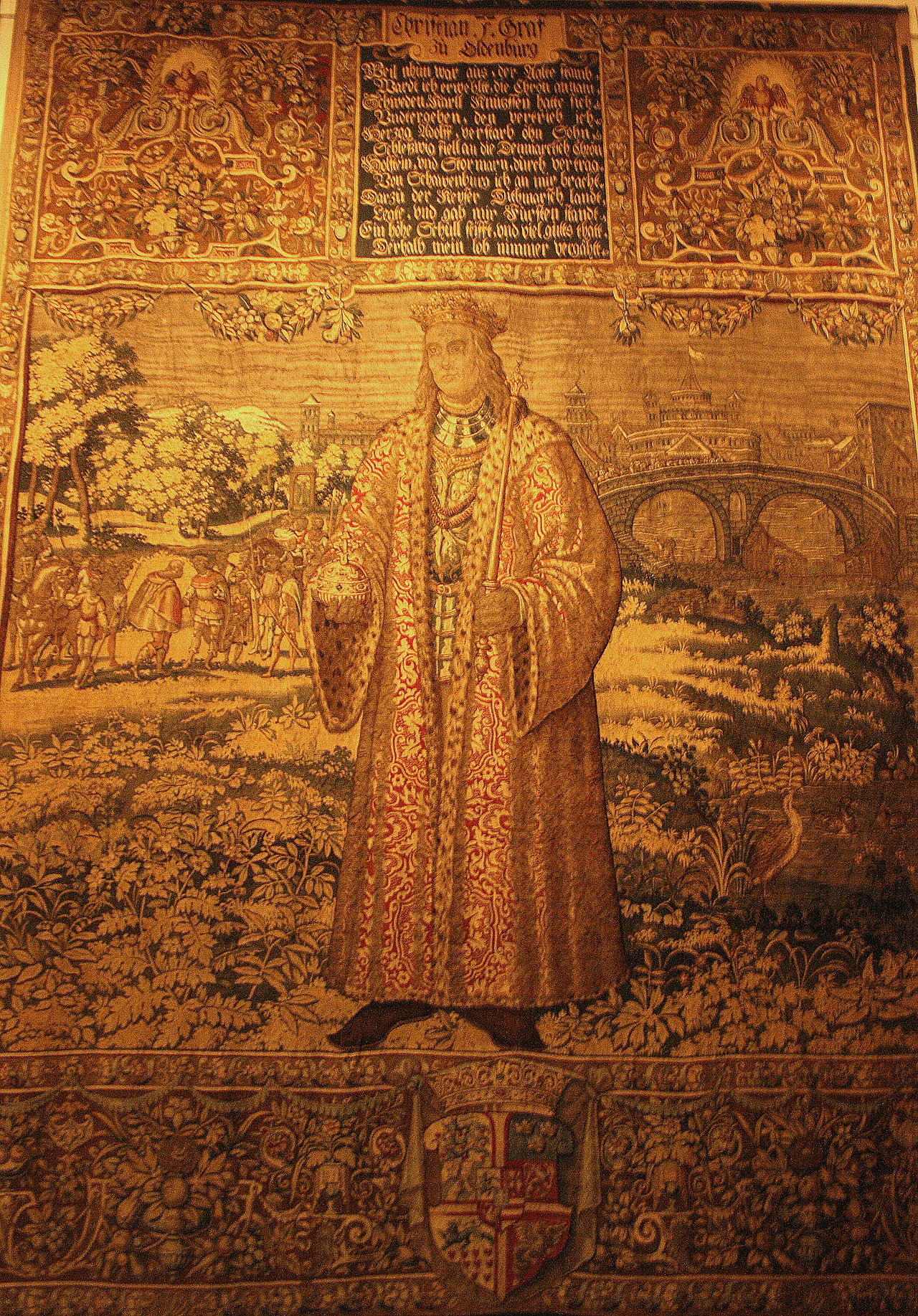
Hans Knieper · Own photo at the Nationalmuseet København · Public domain
- Born
- 1577 · Antwerp.
- Died
- 1587 · Helsingør.
- Nationality
- Habsburg Netherlands
- Occupation
- painter · carpets designer
- Fields
- portrait
VALÉORINE Encyclopedia
VALÉORINE documentary reading
Documentary summary
Illustration — Frederick II's Throne Baldaquin. Hans Knieper (alternative names: Hans Kniepper, Hans Knipper, Johan van Antwerpen, Hans Maler, Hans Knibber, Jan Knibber, signature: I. Knibber and monogram IDK) (probably Antwerp,? – Elsinore, 2 November 1587) was a Flemish painter and draughtsman. He became a court painter and tapestry cartoon designer at the Royal Danish Court and ran a tapestry weaving shop in Denmark.
Admitted source layer · organised and presented by VALÉORINE
Reference Check
Propose documentary evidence for Hans Knieper. A contribution is never written directly as fact: identity, source, rights and evidence gates still decide.
Sign in to contribute
World of VALÉORINE
Documentary connections
Only confirmed graph relationships appear here. Images are shown only when their identity and reuse rights both pass the documentary gate.
Documentary evidence
Documentary basis
Authority files
wikidata · Q3359452 · wikipedia · Hans Knieper
In this article
Early life and training
Early life and training
Subjects and genres recorded for the work are portrait. Places of work recorded in the authority are Helsingør. Work by Hans Knieper is recorded in the collections of Kronborg Castle, National Museum of Art, Architecture and Design, National Museum of Denmark, Nationalmuseum and Statens Museum for Kunst.
Very little is known about Knieper's early life and training in Flanders. He was likely born in Antwerp, as he was referred to by the name 'Johannes de Antwerpia' in his initial contract with the Danish king. A training in Brussels has been proposed based on a possible link with the Brussels family of weavers de Smet and the fact that he added a mark composed of a crown and a B to the tapestries that he designed for Kronborg Castle in Denmark. The B mark was a famous mark of a Brussels weaving workshop. The only work attributed to him in his home country is a watercolour of an allegorical figure now in Gaasbeek in Belgium.
Kronborg Castle
Kronborg Castle
• Illustration — Detail of the Throne Baldaquin Knieper must have had quite an international reputation as an artist since the Danish king Frederick II's envoy Thomas Tenniker engaged him in 1577 on the king's behalf to go to Helsingør to design tapestries for the decoration of Kronborg Castle. At the time king Frederick II was transforming the medieval fortress radically into a magnificent Renaissance castle, using as principal architects Knieper's fellow Flemings Hans Hendrik van Paesschen and Anthonis van Obbergen. Rather than decorating the castle by importing finished artworks, Frederick decided to invite artists to produce their work in situ. Knieper arrived in Kronborg in the company of the Flemish master weaver Anthonius de Goech (or the Corte or de Gorth). Anthonius de Goech brought all the materials to execute the tapestries with him but died within three months of his arrival (eight months after his appointment). Knieper was then given the post of director of the weaving workshop. He travelled back and forth between Denmark and Flanders to import further materials and skilled workers. He managed to establish a high-quality workshop near Kronborg Castle which had about 20 weavers and executed many works for the king. He probably appointed another master weaver to manage the actual weaving work in the shop.
First tapestries
First tapestries
As early as 1579 his workshop was able to deliver twelve tapestries with the Old Testament story of David and Nebuchadnezzar and a single tapestry with the story of Susanna and Daniel, none of which have survived. He delivered in the same year a further five tapestries of the Susanna series and two more Daniels. It has been speculated that between 1579 and 1581 the weaving activities ceased. It is not clear whether the Flemish weavers returned to their home country. In this period, Knieper continued to work as the royal painter. He made paintings for the king's chamber (the story of Gideon) and other rooms as well as the altarpiece for the castle's chapel. Knieper was also responsible for the maintenance and preservation of the castle's tapestries.
The genealogy
The genealogy
In 1581 Frederick II commissioned Knieper's weaving workshop to design and weave a tapestry series of the Danish royal genealogy which would include 111 former Danish kings, as well as the king himself and the Crown Prince Christian III, and of some tapestries of hunting scenes. A similar Swedish tapestry cycle with no less than 143 kings had already been planned in 1560 by the Swedish king Erik XIV. In Denmark, the Swedish artist Antonius Samfleth had painted in 1574 a painted royal series totaling 117 portraits Knieper produced designs for 40 tapestries of the genealogy in 1584 that covered the entire walls of the ballroom at Kronborg Castle. Of these 14 still survive. Behind the life-size portraits Knieper created a background, with castles and forests, animals and plush vegetation, allegorical profundities, heraldic expressions and ornamentation of an elegance and brilliance.
The Throne Baldaquin
The Throne Baldaquin
• Illustration — Portrait of Frederick II, 1581 When this series was completed in 1585, the king commissioned Knieper to make the Throne Baldaquin. The Throne Baldaquin was made of 8 separate tapestry pieces which were woven with silver, gold and silk. It was intended to hang above the heads of the king and queen when they sat at the head of the banquet table. Its rich materials and distinguished and refined style make it probably Northern Europe's most beautiful piece of fabric. It was completed in 1586 and was in 1659 taken by the Swedes as war loot after they sacked Kronborg. It remained in the Swedish royal family until after Karl XV's death it was transferred to the State and is now in the Nationalmuseum in Stockholm.
Portrait painting
Portrait painting
Knieper is said to have revived Danish portrait painting. Portraits of king Frederick II, the queen Sophie, the queen's father, the Duke Ulrich III of Mecklenburg-Güstrow, and the crown prince Christian have been attributed to him. Knieper's portrait painting and in particular the portrait of Frederick II represent a break with the domestic portrait tradition. It is the oldest known full-length profane portrait that is furthermore set into a three-dimensional pictorial space.
Painting for Tycho Brahe
Painting for Tycho Brahe
The famous Danish astronomer Tycho Brahe invited Knieper in 1587 to come to the island Hven that he had received as a gift from king Frederick II. In Uraniborg observatory on the island Brahe had built an astronomical instrument called the mural quadrant that consisted of an arch attached to a wall. Brahe commissioned three artists to make a mural painting above the arch. Hans Knieper painted the landscape at the top, Hans van Steenwinckel the Elder painted the three arches representing the three areas of Uraniborg and Tobias Gemperle painted the portrait of Brahe. Knieper married Marine Johansen who survived him.

Hans Knieper, 1581 Frederik 2.
Hans Knieper

Kong Abel af Danmark, fra Kronborg Slots vægtapeter.
Orf3us
Life and career
Dated record
Life and career
The full dated record · 2 entries
1577
Hans Knieper born at Antwerp.
1587
Hans Knieper died at Helsingør.
Places
Named by the record
Places
Only places the record itself states, plotted where the house gazetteer settles their coordinates. Nothing is inferred from a name or a nationality.
Antwerp.
Birth place
Helsingør.
Death place
References
Citations
References
Each reference names the institution holding it, so a reader may go to the document itself.
reference work
Wikidata, structured authority record Q3359452: Hans KnieperWikimedia Foundation
Secondary witnessreference work
Secondary witness
Further particulars
Held on the record
Further particulars
Open the remaining particulars
Recognition and collections
Work by Hans Knieper is
Kronborg Castle, National Museum of Art, Architecture and Design, National Museum of Denmark and Nationalmuseum
The Encyclopedia exists whether or not anything is for sale. Corrections are recorded rather than overwritten, and every version of this record is kept. Published 16 August 2026.
Elsewhere in Paintings
19,183 published records in this field, each with its sources named.
- Hans Jakob OeriArtist
- Hans JordaensArtist
- Hans Jørgen HammerArtist
- Hans Jürgen KallmanArtist
- Hans KnudsenArtist
- Hans KohnertArtist
- Hans KrellArtist
- Hans KrüsiArtist
Best supported in this field
For owners
Own a work by Hans Knieper?
A specialist will read what you send and tell you what the house can establish, what it cannot, and whether the object is suited to sale. There is no charge and no obligation. The object stays with you throughout; nothing is shipped to us unless it is arranged in writing beforehand.