
Haladie
The haladie is a double-edged dagger from ancient India, consisting of two curved blades, each approximately 8.5 in in length, attached to a single hilt. The weapon was used by warriors of the Indian Rajput clans, and was both a stabbing and slicing blade. Some haladie had spikes on one side of the handle in the style of a knuckle duster, while others had a third blade in this position.
Haladie
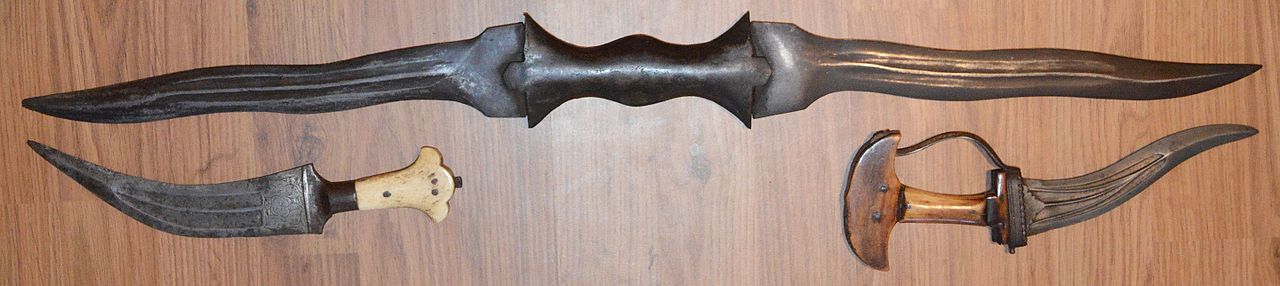
Worldantiques · CC BY-SA 3.0
- Name
- Haladie
- Field
- dagger
- Region
- India
Reference Check
Propose documentary evidence for Haladie. A contribution is never written directly as fact: identity, source, rights and evidence gates still decide.
Sign in to contribute
World of VALÉORINE
Documentary connections
Only confirmed graph relationships appear here. Images are shown only when their identity and reuse rights both pass the documentary gate.

Documentary evidence
Documentary basis
Authority files
wikidata · Q1570196 · wikipedia · Haladie
In this article
Overview
Overview
In some cases the main blades would be serrated. Eventually, the haladie began to be used outside of India, most notably in Syria. The haladie is believed to be one of the world's first triple-edged blades.
Key facts
Key facts
• Name — Haladie • Origin — India and Syria • Type — Blade • Used By — Rajputs
Places
Named by the record
Places
Only places the record itself states, plotted where the house gazetteer settles their coordinates. Nothing is inferred from a name or a nationality.
- India
Named but not plotted · 1
Haladie is associated with India.
Country
Text attribution
Licensing
Text attribution
Part of the biographical narrative on this page reuses licensed material. Its origin, revision and licence are recorded here.
The biographical narrative on this page is based on the Wikipedia article Haladie, revision 1290398334 (EN edition), by its contributors. VALÉORINE has edited that text and built its own documentary record around it. The reused material is available under CC BY-SA 4.0, and this page's reuse of it is offered under the same licence. Everything else on this page — the chronology, the holdings, the evidence, the plates and the connections — is VALÉORINE's own record. Sources and licences.
Notes from the source article
Cited by Wikipedia
Notes from the source article
These works are cited by the source article, in its own numbering. They are recorded as its citations, not as sources VALÉORINE has verified.
- 1.Near Eastern Weapon Parallels. Journal of Book of Mormon Studies. 8. 1. 39–40, 78. 1999.
- 2.Egerton, Earl Wilbraham. A Description of Indian and Oriental Armour. W. H. Allen & co ., limited. 1896. 9788120612051.
- 3.Bonhams. Lot 85 An Indian Double-Bladed Haladie, A Malabar Sacrificial Knife, And Two Khyber Lohar. 25 July 2012.
- 4.Throwing Weapons.
References
Citations
References
Each reference names the institution holding it, so a reader may go to the document itself.
reference work
Secondary witnessreference work
Secondary witness
Connections
The Encyclopedia exists whether or not anything is for sale. Corrections are recorded rather than overwritten, and every version of this record is kept. Published 14 August 2026.
Elsewhere in Militaria
6,095 published records in this field, each with its sources named.
- hakapikTerminology
- Hakim RifleTerminology
- HAL Light Combat HelicopterTerminology
- HAL RudraTerminology
- halberdTerminology
- Halcón M-1943Terminology
- Halcón ML-57Terminology
- Halcon ML-63Terminology
Best supported in this field
For owners
Own an object connected with Haladie?
A specialist will read what you send and tell you what the house can establish, what it cannot, and whether the object is suited to sale. There is no charge and no obligation. The object stays with you throughout; nothing is shipped to us unless it is arranged in writing beforehand.