
Giulio Campagnola
Illustration — The Young Shepherd, engraving using stipple technique Giulio Campagnola (c. 1482) was an Italian engraver and painter, whose few, rare, prints translated the rich Venetian Renaissance style of oil paintings of Giorgione and the early Titian into the medium of engraving; to further his exercises in gradations of tone, he also invented the stipple technique, where multitudes of tiny dots or dashes allow smooth graduations of tone in the essentially linear technique of engraving; variations on this discovery were to be of huge importance in future printmaking. He was the adoptive father of the artist Domenico Campagnola.
Also recorded as Julio Campagnola · Giulio, Venet. Campagnola
Giulio Campagnola
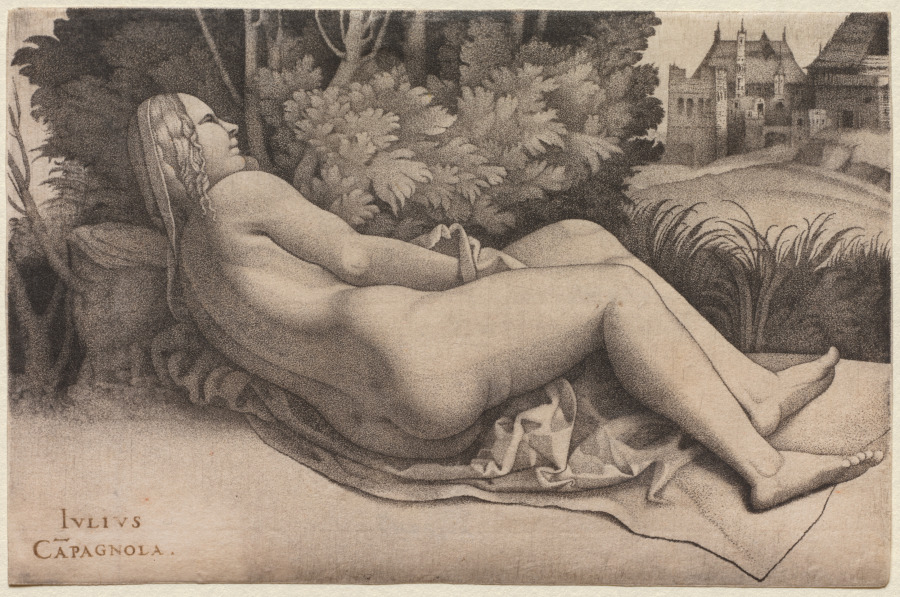
Giulio Campagnola · The Cleveland Museum of Art · Gift of The Print Club of Cleveland · CC0
- Born
- 1482 · Padua.
- Died
- 1515 · Venice.
- Nationality
- Republic of Venice
- Occupation
- painter · printmaker
VALÉORINE Encyclopedia
VALÉORINE documentary reading
Documentary summary
Illustration — The Young Shepherd, engraving using stipple technique Giulio Campagnola (c. 1482) was an Italian engraver and painter, whose few, rare, prints translated the rich Venetian Renaissance style of oil paintings of Giorgione and the early Titian into the medium of engraving; to further his exercises in gradations of tone, he also invented the stipple technique, where multitudes of tiny dots or dashes allow smooth graduations of tone in the essentially linear technique of engraving; variations on this discovery were to be of huge importance in future printmaking. He was the adoptive father of the artist Domenico Campagnola.
Admitted source layer · organised and presented by VALÉORINE
Note VALÉORINE
Giulio Campagnola (1482–1515) was a painter and printmaker and a national of the Republic of Venice. Born in Padua, the painter died in Venice. Giulio Campagnola worked in Ferrara, Padua and Venice. Works by the painter are held at Art Institute of Chicago, Kupferstichkabinett Berlin and Minneapolis Institute of Art, among others.
Composed from admitted, traceable facts · 26 September 2026
VALÉORINE
Reference Check
Propose documentary evidence for Giulio Campagnola. A contribution is never written directly as fact: identity, source, rights and evidence gates still decide.
Sign in to contribute
World of VALÉORINE
Documentary connections
Only confirmed graph relationships appear here. Images are shown only when their identity and reuse rights both pass the documentary gate.
Documentary evidence
Evidence Panel
original value insufficient · checked 25 September 2026
- Identity
- resolved
- Independent source families
- 0
- Admitted assertions
- 0
- Open conflicts
- 0
Authority files
wikidata · Q1989594 · wikipedia · Giulio Campagnola
In this article
Life
Life
• Illustration — The Astrologer, so-called • Illustration — Christ with the Woman of Samaria His early years are better documented than his adult life. He was born in Padua, then subject to the republic of Venice, and home to one of the three major European universities of the fifteenth century, the University of Padua. His father Girolamo was characterised by A. Hyatt Mayor as "a writer of some note, probably also an amateur artist, who belonged to what would now be called the intelligentsia"; letters by him in very good humanist Latin survive. According to Giorgio Vasari, Girolamo was also an artist "a Paduan painter and disciple of Squarcione", but this remark is the only evidence for that. A number of sources, including Vasari, say that Campagnola was extremely accomplished in a number of artistic areas as a teenager. A letter written by a relative when he was fifteen describes him as a talented poet, singer and lutenist, able to read Latin, Greek and Hebrew, and skilled in painting, engraving and cutting gemstones. This letter was sent to the court at Mantua (where Andrea Mantegna was then the court artist) in an attempt to find him a position there. It is not clear if he ever went to Mantua, although (like nearly all contemporary Italian printmakers) his work shows the influence of Mantegna. One engraving is certainly based (perhaps not directly, as there was another print of it) on a drawing by Mantegna or his workshop. • Illustration — Concert by a brook, the landscape by Giulio, the figures by Domenico • Illustration — Landscape with Two Men Sitting near a Coppice, pen and wash (Louvre Museum). Later begun as an engraving by Giulio, but finished by his son Domenico. Some ascribe the drawing to Giorgione. In 1499 he appears (rather briefly) in the accounts of the court at Ferrara, another centre of North Italian printmaking. There is then no documentation until 1507, when another Paduan recorded lending him a painting and three copper engraving plates. This was in Venice, where most writers assume he was living by then. His engraving of an Astrologer is dated 1509 on the plate, and the only later record comes from the will of Aldus Manutius in 1515, when Manutius asks that he be given the work of cutting the moulds for, or perhaps designing, some printing type. At the period he also became a friend of the humanist and alchemical poet Giovanni Aurelio Augurello. Depicting his experiments with artificial blue pigments in his Chrysopoeia (Venice 1515) Augurello refers to Giulio ("meus Iulius") as the one person who at least is somehow profiting from the vain quest for gold. After this there is no further record, but an engraving plate that he had left half-finished was completed by his adopted son c. 1517, so he is assumed to have died by then at the latest, probably in Venice. He had adopted Domenico Campagnola, apparently an orphan of German parentage, in about 1512. Another source claimed that he took holy orders, but this is now discounted. Fortunately, for those seeking to reconstruct his career, he was in the habit of signing, though not dating, his engravings, often with his full name and Antenoreus, a slightly showy learned reference to the Trojan whom Virgil designated the founder of Padua.
Professional status
Professional status
Most writers see Campagnola as a professional artist, who received some sort of training in Mantua, Ferrara or Venice. Vasari describes him as a painter, and the Venetian connoisseur Marcantonio Michiel mentions cabinet paintings that were ascribed to him in Venetian collections in about 1530, but no paintings are generally attributed to him, although he is often brought into arguments about the many "Giorgionesque" paintings without an agreed attribution. He is often given a share in the fresco cycle in the Scuola del Santo at Padua, attributed to his son Domenico. There are drawings related to his prints, and in a similar style to them, but only a handful of these are generally agreed to be by him, with Titian, Giorgione and in one case Mantegna also being brought into contention. It is still possible to see Campagnola, as W.R. Rearick did, as a "dilettante" who probably mostly lived in Padua, probably with another career altogether. This, however, remains a minority view. Most of his prints have no surviving preparatory drawings, and in general the question of whether Campagnola designed them himself or engraved then after drawings provided by other artists remains open. Most historians, however, see him as an independent artist responsible for conceiving as well as executing most of his prints, rather than a precursor of Marcantonio Raimondi or Domenico Campagnola who acted as a technical collaborator with a greater artist who supplied the designs.
Work
Work
The dating of his work is based very largely on the stylistic arrangement of his work around the Astrologer, dated 1509, and his presumed death around 1515. Whilst the chronological sequence of his engravings set out by Arthur M. Hind has been generally accepted, the dating of them remains a subject for discussion. His early work is heavily influenced by Albrecht Dürer, and includes one direct copy of a Dürer engraving, and a few where landscape elements are copied from Dürer. He also included a portrait of Dürer in his Marriage of the Virgin Mary, which Dürer himself may have drawn. The next group of engravings, which include the Astrologer, very successfully interpret the mood of Venetian painting of the first decade of the century in the medium of engraving. It is this group that he is most famous for, and that also introduce his stipple technique. Stippling means engraving with dots or little flicks of the burin, rather than the normal lines. Campagnola is able to convey varying tone by different intensities of dots, rather than by techniques of hatching and cross-hatching usually necessary. These engravings are in a combination of line and stipple work, and in the case of three of them (see gallery: The Old Shepherd, The Young Shepherd and The Astrologer), there are first states which are purely in line-work. The plates were later reworked in stipple work, in at least one case after a considerable number of impressions of the first state had been taken. The final group of prints are almost entirely in stipple, except for the main outlines. There are also some prints in Campagnola's manner of which the authorship is disputed. • Illustration — Two Naked Women, an early print, 11.9 × 18.1 cm • Illustration — Leda and the Swan, a disputed attribution • Illustration — Ganymede carried off • Illustration — Baby with Three Cats, perhaps an exercise in stipple technique • Illustration — Stag tethered to a tree • Illustration — "Venus", or reclining nude • Illustration — The Old Shepherd
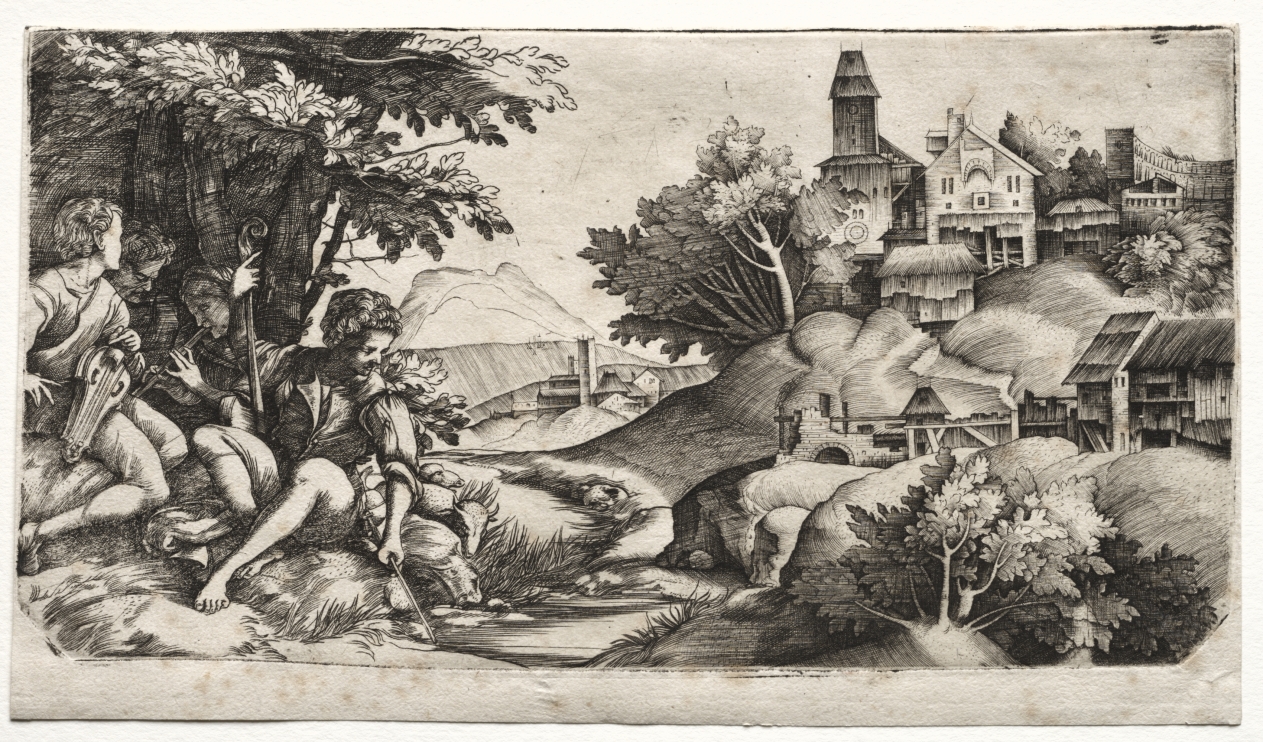
Shepherds in a Landscape, c. 1517, by Giulio Campagnola
Giulio Campagnola · The Cleveland Museum of Art · Dudley P. Allen Fund
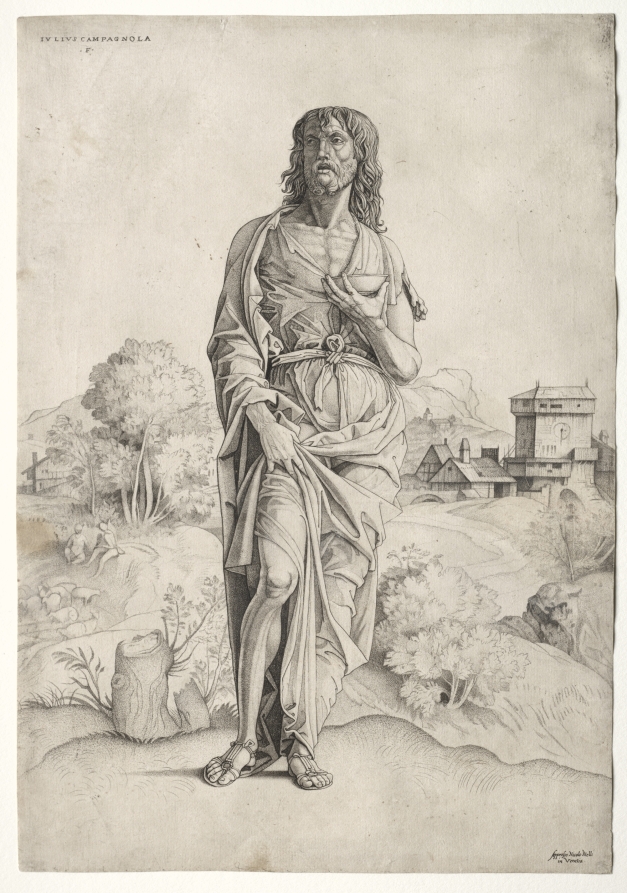
Saint John the Baptist, c. 1505, by Giulio Campagnola
Giulio Campagnola · The Cleveland Museum of Art · Dudley P. Allen Fund
Life and career
Dated record
Life and career
Explore 1482–1515
The full dated record · 5 entries
1482
Giulio Campagnola was born on 1 January 1482.
1499
Recorded as work location: Ferrara.
1507
Recorded as work location: Venice.
1515
Dies at Venice.
1515
Giulio Campagnola died on 1 January 1515.
Places
Named by the record
Places
Only places the record itself states, plotted where the house gazetteer settles their coordinates. Nothing is inferred from a name or a nationality.
Padua.
Birth place
Venice.
Death place
Primary material
Documents and archives
reference work
- “Giulio Campagnola”, English Wikipedia, consulted as further reading
Reputable secondary · Wikipedia
authority record
- Wikidata, structured authority record Q1989594: Giulio Campagnola
Unverified · Wikidata
Notes from the source article
Cited by Wikipedia
Notes from the source article
These works are cited by the source article, in its own numbering. They are recorded as its citations, not as sources VALÉORINE has verified.
- 1.His total oeuvre consists of about fifteen engravings (Mark Zucker, The Illustrated Bartsch, Commentary 35; Patricia Emison, "Asleep in the Grass of Arcady: Giulio Campagnola's Dreamer" Renaissance Quarterly 45.2 (Summer 1992:271-292) p. 274 note 4; the Metropolitan Museum of Art had only seven prints by him when A. Hyatt Mayor described the three most recent acquisitions (Mayor, "Giulio Campagnola" The Metropolitan Museum of Art Bulletin, 32.8 (August 1937:192-196).
- 2.Mayor 1937:194
- 3.Vasari, Giorgio. Lives of the most eminent Painters, Sculptors, and Architects. H.G. Bohn. 2. 1851.
- 4., National Gallery of Art.
- 5.The relationship is depicted in Dal Canton, Giuseppina: Giulio Campagnola 'pittore alchimista’ (I), Antichità viva 16/5 (1977), pp. 11-19; part (II) ibid 17/2 (1978), pp. 3-10.
- 6., National Gallery of Art.
- 7.Giulio Campagnola: Landscape with Two Men Sitting near a Coppice , Louvre.
- 8.Giulio Campagnola: the Rape of Ganymede, Metropolitan Museum of Art; the landscape is lifted verbatim from Dürer's Masonna with a Monkey of 1499 (Mayer 1937:`94).
- 9.Giornale Nuovo of things near & far. Campagnola. July 15, 2004.
- 10.Decker, Heinrich. The Renaissance in Italy: Architecture • Sculpture • Frescoes. The Viking Press. 157–58. 1969.
- 11.Giulio Campagnola: Saint John the Baptist, Worcester Art Museum, Massachusetts.
References
Citations
References
Each reference names the institution holding it, so a reader may go to the document itself.
reference work
Partially resolvedauthority record
Unverified
The Encyclopedia exists whether or not anything is for sale. Corrections are recorded rather than overwritten, and every version of this record is kept. Published 14 August 2026.
Elsewhere in Paintings
18,623 published records in this field, each with its sources named.
- Giuliano GhelliArtist
- Giulio Aristide SartorioArtist
- Giulio BergonzoliArtist
- Giulio CalviArtist
- Giulio CampiArtist
- Giulio CantalamessaArtist
- Giulio CarmignaniArtist
- Giulio Cesare AmidanoArtist
Best supported in this field
For owners
Own a work by Giulio Campagnola?
A specialist will read what you send and tell you what the house can establish, what it cannot, and whether the object is suited to sale. There is no charge and no obligation. The object stays with you throughout; nothing is shipped to us unless it is arranged in writing beforehand.