
Giovanni Piancastelli
Giovanni Piancastelli (September 14, 1845 – September 23, 1926) was an Italian painter and architect.
Giovanni Piancastelli

Giovanni Piancastelli · karlundfaber.de · Public domain
- Name
- Giovanni Piancastelli
- Born
- 14 September 1845
- Birthplace
- Castel Bolognese, Italy
- Died
- 23 September 1926
- Place of death
- Bologna, Italy
- Occupation
- Painter, architect
- Nationality
- Kingdom of Italy
- Teachers
- Achille Farina
VALÉORINE Encyclopedia
VALÉORINE documentary reading
Documentary summary
Giovanni Piancastelli (September 14, 1845 – September 23, 1926) was an Italian painter and architect.
Admitted source layer · organised and presented by VALÉORINE
Note VALÉORINE
No house-authored Note is published until its assertions and sources pass the VALÉORINE evidence contract. The documentary article remains available in full while that enrichment is being consolidated.
Documentary enrichment in progress · no unsupported statement published
Reference Check
Propose documentary evidence for Giovanni Piancastelli. A contribution is never written directly as fact: identity, source, rights and evidence gates still decide.
Sign in to contribute
World of VALÉORINE
Documentary connections
Only confirmed graph relationships appear here. Images are shown only when their identity and reuse rights both pass the documentary gate.
Documentary evidence
Evidence Panel
wikipedia incomplete · checked 25 September 2026
- Identity
- resolved
- Independent source families
- 0
- Admitted assertions
- 0
- Open conflicts
- 0
Authority files
wikidata · Q3767934 · wikipedia · Giovanni Piancastelli
In this article
Key facts
Key facts
• Name — Giovanni Piancastelli • Born — 14 September 1845 • Birthplace — Castel Bolognese, Italy • Died — 23 September 1926 • Place of death — Bologna, Italy • Occupation — Painter, architect • Illustration — The Roman Countryside Emigration – Departing • Illustration — The Roman Countryside Emigration – Returning Giovanni Piancastelli (September 14, 1845 – September 23, 1926) was an Italian painter and architect.
Biography
Biography
He was born to a family of little resources in Castel Bolognese. His initial lessons were under a Cappucini priest at a local convent. By virtue of the patronage of Counts Giuseppe Rossi and Domenico Zauli Naldi, by 1860, he had enrolled at the Scuola di Disegno in Faenza, where his teacher was Achille Farina. In 1862, through the patronage of Duke Camillo Zacchia, he then traveled to Rome where he apprenticed under Guido Guidi. By 1864, he enrolled in the Accademia di San Luca, where he had among teachers: Francesco Podesti, Alessandro Capalti, Vincenzo Pasqualoni, Annibale Angelini, Francesco Coghetti, and Antonio Sarti. He painted Genre painting and landscapes early in his career, while later he was employed in painting portraits and religious designs. Among his works are Campagna Romana; Emigrazione dall'Agro Romano ("Roman Countryside Emigration", displayed at the 1878 Paris Universal Exposition); Marina; Spiaggia al Tramonto; and the Moglie del Marinaio (Sailor's Wife exhibited at Turin). At Bologna in 1888, he exhibited a painting on wood entitled Atropo and a water color titled Charitas. In 1866-1872, he enlisted in the infantry, serving in Siena in 1871, where he met Luigi Mussini. After his service, he is hired by Prince Marcantonio Borghese as a teacher of design and painting. In 1886, he was entrusted with reorganizing and transferring the dispersed Borghese collections, including works at the Villa Costaguti-Borghese at Nettuno to Villa Borghese on Pincian Hill. He became director of the Galleria Borghese in 1902. In 1865, he won an architectural competition held by the Congregation of the Virtuosi. In 1875, he was awarded two silver medals at Faenza's Esposizione Romagnola. In 1889, he was named Academic of Honor by the Bolognese Royal Academy of Fine Arts. He painted La morte di San Giovanni Nepomuceno (Death of Saint John of Nepomuk) for Prince Giulio Torlonia in 1894. In 1896, the art critic Corrado Ricci commissioned from Piancastelli several drawings for the story of Il Passo della Badessa (The Passage of Badessa), published in the magazine "Emporium". He became the curator of the Borghese art collection and aided Adolfo Venturi in completing his catalogue of the works in 1893. In 1902, when he was director, the Italian state acquired the villa and collections. He resigned in 1906 to live in Bologna. In 1906, he was nominated to become a Knight of the Order of Saints Maurice and Lazarus. He died at Bologna in 1926.
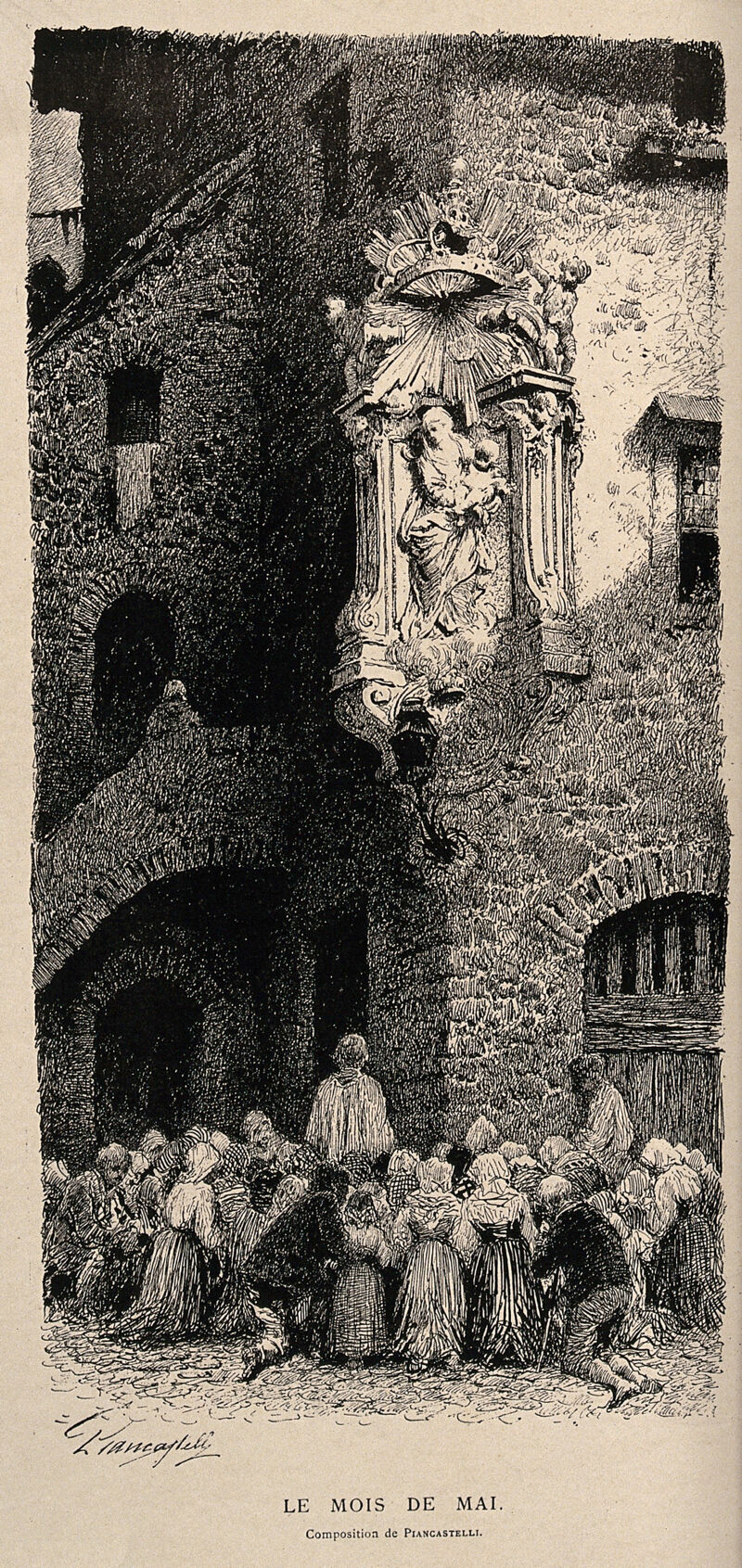
A crowd venerating a street tabernacle with a sculpture of the Virgin and Child. Wood engraving by Pincastelli., by Giovanni Piancastelli
Giovanni Piancastelli · Wellcome Collection, London · Wellcome Collection
Places
Named by the record
Places
Only places the record itself states, plotted where the house gazetteer settles their coordinates. Nothing is inferred from a name or a nationality.
Castel Bolognese.
Birth place
Bologna.
Death place
Citations
References
Each reference names the institution holding it, so a reader may go to the document itself.
reference work
Partially resolvedreference work
Partially resolved
The Encyclopedia exists whether or not anything is for sale. Corrections are recorded rather than overwritten, and every version of this record is kept. Published 15 September 2026.
Elsewhere in Paintings
18,623 published records in this field, each with its sources named.
- Giovanni MoneriArtist
- Giovanni NiccoloArtist
- Giovanni Paolo CavagnaArtist
- Giovanni PessinaArtist
- Giovanni Pietro GnocchiArtist
- Giovanni PisanoArtist
- Giovanni QuagliataArtist
- Giovanni Raffaele BadaraccoArtist
Best supported in this field
For owners
Own a work by Giovanni Piancastelli?
A specialist will read what you send and tell you what the house can establish, what it cannot, and whether the object is suited to sale. There is no charge and no obligation. The object stays with you throughout; nothing is shipped to us unless it is arranged in writing beforehand.