
Georg Jensen
Georg Arthur Jensen (31 August 1866 – 2 October 1935) was a Danish silversmith and founder of Georg Jensen A/S (also known as Georg Jensen Sølvsmedie).
Also recorded as Georg Arthur Jensen · Arthur Georg Jensen · Georges Jensen
Georg Jensen
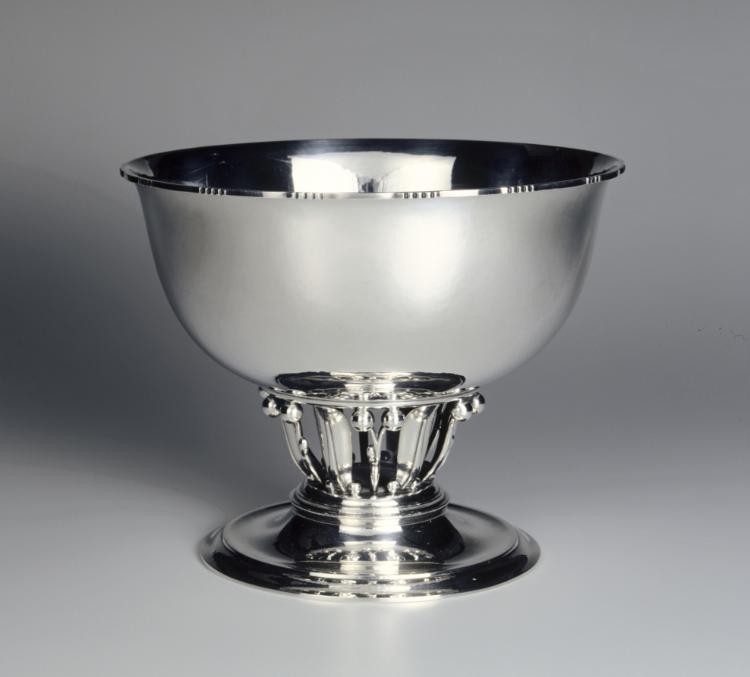
Georg Jensen · The Cleveland Museum of Art · Gift of John E. Doxsey in memory of Walter S. and Esther E. Doxsey · CC0
- Name
- Georg Jensen
- Birth Name
- Georg Arthur Jensen
- Born
- 31 August 1866
- Birthplace
- Rådvad, Denmark
- Died
- 2 October 1935
- Place of death
- Copenhagen, Denmark
- Education
- Sculpting
- Known for
- Silversmith
- Movement
- Art Nouveau
- Nationality
- Kingdom of Denmark.
- Occupation
- designer, silversmith, sculptor, jewelry designer, ceramicist, painter and goldsmith.
- Movements
- Art Nouveau.
VALÉORINE Encyclopedia
VALÉORINE documentary reading
Documentary summary
Georg Arthur Jensen (31 August 1866 – 2 October 1935) was a Danish silversmith and founder of Georg Jensen A/S (also known as Georg Jensen Sølvsmedie).
Admitted source layer · organised and presented by VALÉORINE
Note VALÉORINE
Georg Jensen (1866–1935) was a Danish ceramicist, designer and goldsmith, among other activities. The ceramicist was born and died in Rådvad.
Georg Jensen worked for Bing & Grøndahl and Siegfried Wagner. The ceramicist was active in jewelry and jewelry design. Georg Jensen was associated with Art Nouveau. Languages used include Danish.
Composed from admitted, traceable facts · 30 September 2026
VALÉORINE
Reference Check
Propose documentary evidence for Georg Jensen. A contribution is never written directly as fact: identity, source, rights and evidence gates still decide.
Sign in to contribute
Documentary evidence
Documentary basis
Authority files
getty · 500305741 · gnd · 10190515-4 · wikidata · Q288218 · wikipedia · Georg Jensen
In this article
Key facts
Key facts
• Name — Georg Jensen • Birth Name — Georg Arthur Jensen • Born — 31 August 1866 • Birthplace — Rådvad, Denmark • Died — 2 October 1935 • Place of death — Copenhagen, Denmark • Resting Place — Hellerup Cemetery • Education — Sculpting • Alma Mater — Royal Danish Academy of Fine Arts • Known for — Silversmith • Movement — Art Nouveau • Illustration — Georg Jensen in his workshop in Copenhagen, 1906 • Illustration — A Georg Jensen shop at Strøget, Copenhagen
Early life
Early life
Born in 1866, Jensen was the son of a knife grinder in the town of Raadvad, just to the north of Copenhagen. Jensen began his training in goldsmithing at the age of 14 in Copenhagen. His apprenticeship with the firm Guldsmed Andersen ended in 1884, and this freed Georg to follow his artistic interests. In 1884 he became a journeyman and in 1887 he enrolled at the Royal Danish Academy of Fine Arts (Kongelige Danske Kunstakademi), where he studied sculpture with Theobald Stein. He graduated in 1892 and began exhibiting his work. After graduation he started studying ceramics with Joachim Petersen (1870–1943). Although his ceramic sculptures were well received, making a living as a fine artist proved difficult and he turned his hand to the applied arts: first as a modeller at the Bing & Grøndahl porcelain factory and, beginning in 1898, with a small pottery workshop he founded in partnership with Christian Petersen. Again the work was well received, but the sales were not strong enough to support Jensen, now a widower, and his two young sons.
Career
Career
Jensen made his first piece of jewelry in 1899, a silver and gilt "Adam and Eve" belt buckle. In 1901, Jensen abandoned ceramics and began again as a silversmith and designer with the master Mogens Ballin. This led Jensen to make a landmark decision, when in 1904, he risked what small capital he had and opened his own little silversmithy at 36 Bredgade in Copenhagen. Jensen's training in metalsmithing along with his education in the fine arts allowed him to combine the two disciplines and revive the tradition of the artist craftsman. Soon, the beauty and quality of his Art Nouveau creations caught the eye of the public and his success was assured. His silver and jewelry designs from this period often featured plump abstract organic shapes and were accented with gemstones like amber, garnet, citrine, malachite, moonstone, and opal. This approach reflected his personal style, which was rooted in the Art Nouveau movement, but also transcended it with a more streamlined version popular in the 1920s and 1930s. The Copenhagen quarters were greatly expanded and before the end of the 1920s, Jensen had opened retail stores in Berlin (1909), London (1921), and New York City (1924). The New York retail store, Georg Jensen Inc. (New York, NY), was founded and operated independently as a family business by Frederik Lunning, a successful salesman of Georg Jensen products first in Odense, then in Copenhagen. The first store, 1924-1935, was incorporated as Georg Jensen Handmade Silver, followed in 1935-1978 by the large Fifth Avenue department store selling many goods aside from Jensen silver, incorporated as Georg Jensen Inc. In 1930, Adda Husted Andersen worked for Jensen in New York City, enameling homewares.
Georg Jensen brand signs
Georg Jensen brand signs
When he was twenty Georg Jensen signed his first sculpture with "My Father" (1887). In 1894 he used the markings GJ as brandsign and from 1899 he often used GJ. In most cases the year was put next to the brand sign.
Brand signs of Georg Jensen
Brand signs of Georg Jensen
• Illustration — 1. Used 1904–1908 2. Used 1909–1914 3. Used 1910–1925 4. Used 1915–1930 5. Used 1915–1927 6. Used 1925–1932 7. Used in the years 1930–1939 for engravings 8. Used 1933–1944 9. Used 1945–1951 for items that were sold in Copenhagen 10. Used 1945–present
Brand signs from the designers of Georg Jensen
Brand signs from the designers of Georg Jensen
Source: • Illustration — 1. Johan Rohde (1856–1935) 2. Gundorph Albertus (1887–1970) 3. Harald Nielsen (1892–1977) 4. Arno Malinowski (1899–1976) 5. Sigvard Bernadotte (1907–2002) 6. Henning Koppel (1918–1981) 7. Bent Gabrielsen (b. 1928) 8. Nanna and Jørgen Ditzel 9. Nanna Ditzel (1923–2005) 10. Vivianna Torun Bülow-Hübe (1927–2004) 11. Allan Scharff (b. 1940)
Family tree Georg Jensen
Family tree Georg Jensen
Marie Vidar Jorgen Magna Vibeke Laura Lise Birgitte Soren Magdalene Mette
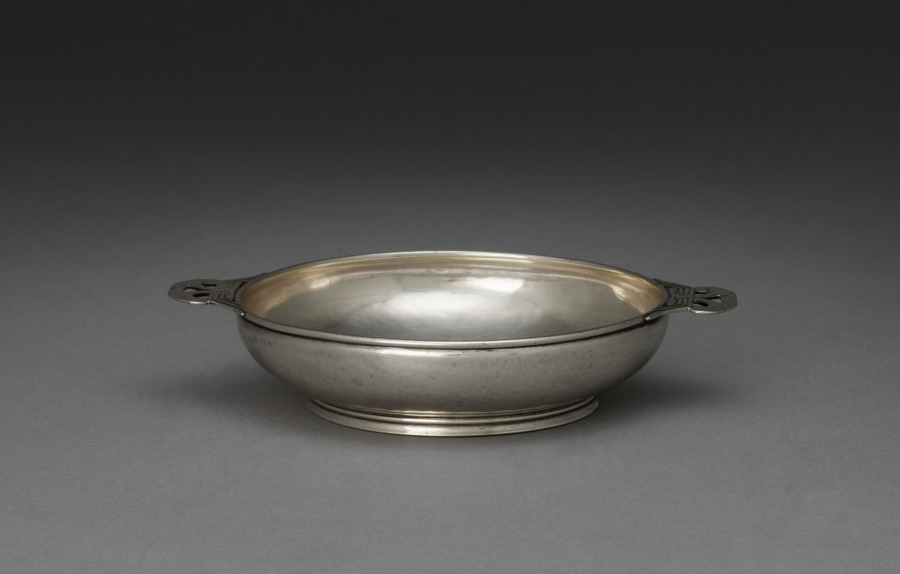
Bowl with Two Handles, c. 1925, by Georg Jensen
Georg Jensen · The Cleveland Museum of Art · Gift of Henry H. Hawley
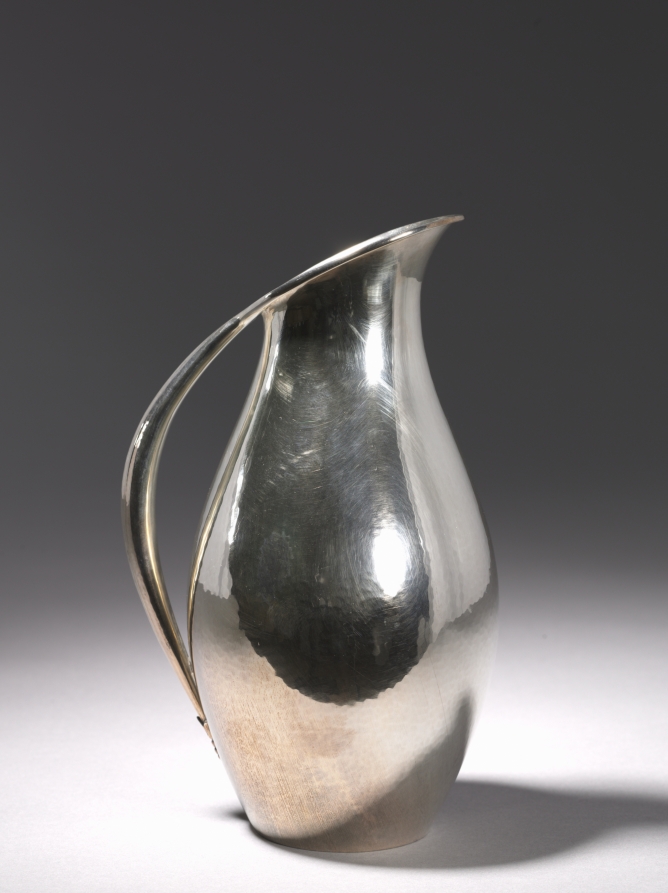
Water Pitcher, c. 1950, by Georg Jensen
Georg Jensen · The Cleveland Museum of Art · Bequest of Muriel Butkin
Life and career
Dated record
Life and career
The full dated record · 2 entries
1866
Georg Jensen was born in 1866.
1935
Georg Jensen died at Rådvad.
Museum collections and exhibitions
Museum collections and exhibitions
During his lifetime, Jensen's work was collected by museums including the Danish Museum of Decorative Art and the Museum Folkwang. In 2005, the Bard Graduate Center in New York presented an exhibition entitled Georg Jensen Jewelry.
Documents and archives
Primary material
Documents and archives
authority file
- Gemeinsame Normdatei 10190515-4, Georg Jensen A/S.
General reference · Deutsche Nationalbibliothek
- Getty Union List of Artist Names 500305741, Georg Jensen Museum.
General reference · The Getty Research Institute
reference work
- Wikidata, structured authority record Q288218: Georg Jensen
Reputable secondary · Wikidata
- “Georg Jensen”, English Wikipedia, consulted as further reading
Reputable secondary · Wikipedia
Notes from the source article
Cited by Wikipedia
Notes from the source article
These works are cited by the source article, in its own numbering. They are recorded as its citations, not as sources VALÉORINE has verified.
- 1.Georg Arthur Jensen. kunst-und-kultur.de.
- 2.Lunning, Elizabeth. Jensen, Georg (Arthur). Oxford University Press. 2003. 10.1093/gao/9781884446054.article.t044604.
- 3.Bard Graduate Center. Georg Jensen Jewelry Exhibition. bgc.bard.edu.
- 4.Misiorowski, Elise B. Art Nouveau: Jewels and Jewelers. Gems & Gemology. 22. 4. 209–228. 1986-01-01. 0016-626X.
- 5.Jenssen, Victoria. The Art of Carol Janeway: A Tile & Ceramics Career with Georg Jensen Inc. and Ossip Zadkine in 1940s Manhattan. Friesen Press. 2022.
- 6.In Memory of Adda Husted-Andersen, 1900-1990 - Ganoksin Jewelry Making Community. Ganoksin.
- 7.Moonan, Wendy. Celebrating an Artist Who Was Also a Craftsman. New York Times. 22 July 2005.
- 8.Esplund, Lance. Jewelry's Rhythms. The New York Sun. 4 August 2005.
- 9.Antiques in Oxford. Georg Jensen designers.
References
Citations
References
Each reference names the institution holding it, so a reader may go to the document itself.
authority file
Gemeinsame Normdatei 10190515-4, Georg Jensen A/S.Deutsche Nationalbibliothek
Secondary witnessauthority file
Getty Union List of Artist Names 500305741, Georg Jensen Museum.The Getty Research Institute
Secondary witnessreference work
Secondary witnessreference work
Secondary witness
Further particulars
Held on the record
Further particulars
Open the remaining particulars
Formation and teaching. Each of those relationships is stated by the authority record rather than inferred from style. Jensen worked in jewelry and jewelry design. His work is associated with Art Nouveau. He was employed by Bing & Grøndahl and Siegfried Wagner.
Career and activity
Recognition and collections
Work by Georg Jensen is
Museum Boijmans Van Beuningen, Art Institute of Chicago, National Gallery of Victoria and Nationalmuseum
The Encyclopedia exists whether or not anything is for sale. Corrections are recorded rather than overwritten, and every version of this record is kept. Published 14 August 2026.
Elsewhere in Silver
384 published records in this field, each with its sources named.
- Gaspare MolaArtist
- Gatja Helgart RotheArtist
- Geoffrey MauncellArtist
- Georg Ferdinand HowaldtArtist
- Georg WechterArtist
- George HeriotArtist
- George Michael MoserArtist
- George WickesArtist
Best supported in this field
For owners
Own a work by Georg Jensen?
A specialist will read what you send and tell you what the house can establish, what it cannot, and whether the object is suited to sale. There is no charge and no obligation. The object stays with you throughout; nothing is shipped to us unless it is arranged in writing beforehand.