
Fujiwara no Toshinari
Also recorded as Fujiwara no Shunzei · Shakua · no Shunzei Fujiwara
Fujiwara no Toshinari
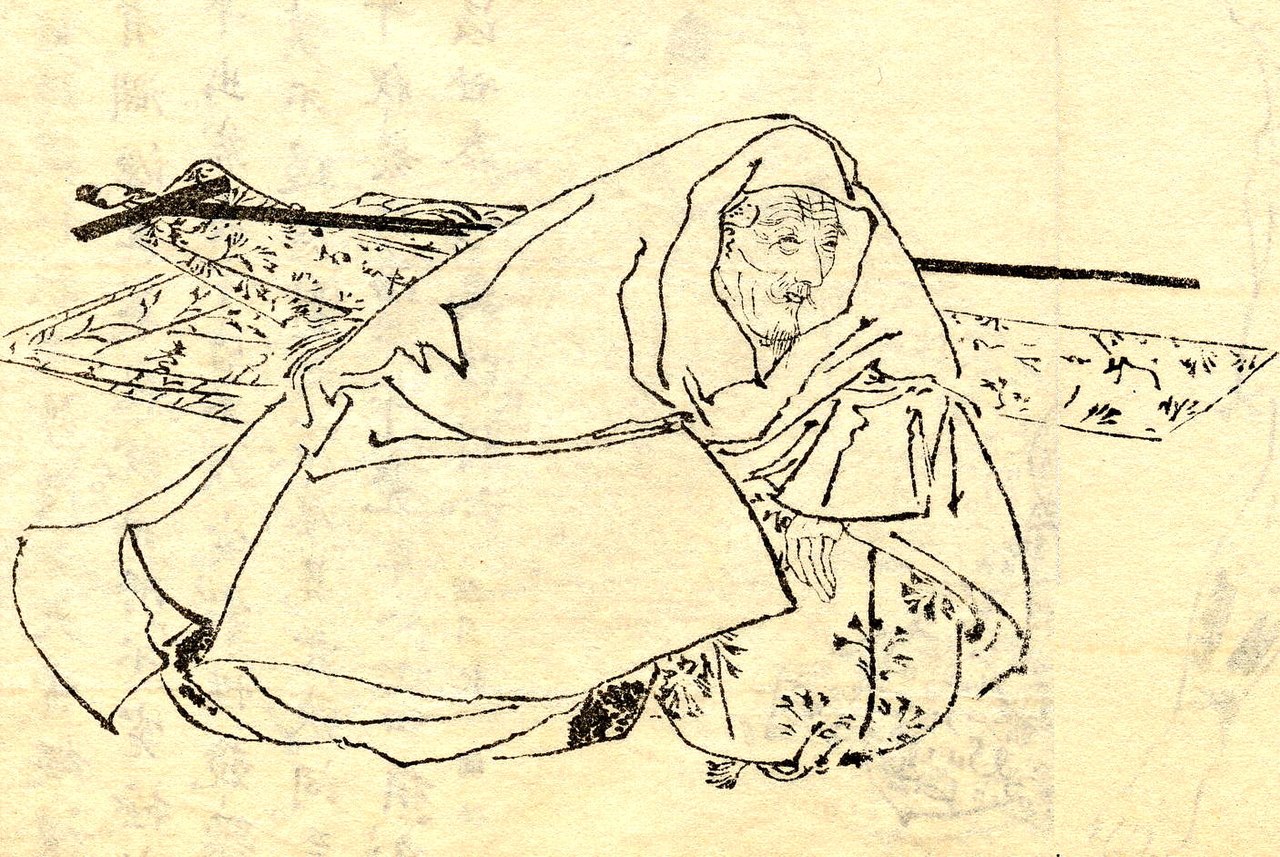
Wikimedia Commons · Public domain
- Name
- Fujiwara no Shunzei
- Born
- 1114
- Died
- 22 December 1204
- Occupation
- Poet, courtier, and monk ɸɯ.(d)ʑi.wa.ɾa no to.ɕiꜜ.na.ɾʲi, -ɕɯꜜn.dzei, -dzeː, 1114 – 22 December 1204 was a Japanese poet, courtier, and Buddhist monk of the late Heian period.
- Nationality
- Japan.
- Languages
- Japanese.
VALÉORINE Encyclopedia
VALÉORINE documentary reading
Note VALÉORINE
Fujiwara no Toshinari (1114–1204) was a Japanese poet and writer. The poet was born in Kyoto. Languages used include Japanese.
Composed from admitted, traceable facts · 27 September 2026
VALÉORINE
Reference Check
Propose documentary evidence for Fujiwara no Toshinari. A contribution is never written directly as fact: identity, source, rights and evidence gates still decide.
Sign in to contribute
World of VALÉORINE
Documentary connections
Only confirmed graph relationships appear here. Images are shown only when their identity and reuse rights both pass the documentary gate.
Documentary evidence
Evidence Panel
not yet certified
- Identity
- resolved
- Independent source families
- 0
- Admitted assertions
- 0
- Open conflicts
- 0
Authority files
wikidata · Q934255 · wikipedia · Fujiwara no Shunzei
In this article
Key facts
Key facts
• Name — Fujiwara no Shunzei • Born — 1114 • Died — 22 December 1204 • Occupation — Poet, courtier, and monk ɸɯ.(d)ʑi.wa.ɾa no to.ɕiꜜ.na.ɾʲi, -ɕɯꜜn.dzei, -dzeː, 1114 – 22 December 1204 was a Japanese poet, courtier, and Buddhist monk of the late Heian period. He was also known by his monastic name Shakua and when younger (1123–67) as Akihiro. He was noted for his innovations in the waka poetic form and compiling the Senzai Wakashū ("Collection of a Thousand Years"), the seventh imperial anthology of waka poetry.
Early life
Early life
Fujiwara no Shunzei was born in 1114. He was a descendant of the statesman Fujiwara no Michinaga and son of Fujiwara no Toshitada of the Mikohidari branch of the influential aristocratic and poetic Fujiwara clan. His father died when he was ten years old and he was adopted by Hamuro Akiyori. As Akiyori's adopted son, he took the name Akihiro (顕広), but in 1167, when he was 53, he returned to the house he had been born into and took the name Toshinari. (Shunzei is the Sino-Japanese reading for the same characters used to write Toshinari.)
Career
Career
Shunzei attained at the imperial court the post of Kōtai Gōgū-daibu (皇太后宮大夫) and held the Senior Third Rank (non-counsellor 非参議). He was commissioned in 1183 to compile the Senzai Wakashū ("Collection of a Thousand Years"), the seventh imperial anthology of waka poetry, by the Retired Emperor Go-Shirakawa, who despite Shunzei's low rank (he was "Chamberlain to the Empress Dowager", a nominal rank Earl Miner describes as "pitiably low"), admired him. Go-Shirakawa's trust in Shunzei is significant, as imperial anthologies were landmarks in the poetic circles of the court, second to no other events in significance; poets were willing to risk their lives just for the chance to have a poem included. The Tale of the Heike relates that Shunzei was compiling the Senzai Wakashū during the Genpei War, and that Taira no Tadanori (1144–1184), who was on the opposing side (the one which did not hold the capital where Shunzei lived), ventured into enemy territory to Shunzei's residence, asking him to include a particular poem of his. Tadanori then managed to successfully escape back to his own forces without being apprehended. Shunzei eventually did decide to include Tadanori's poem, but attributed it ("tactfully" as Donald Keene characterizes it) to "Anonymous".
Poetry
Poetry
• Illustration — Shunzei reciting his poem on the hotogisu (bird) from the Shinkokinshu (drawing by Hishikawa Moronobu) As Shunzei's father and grandfather and a number of other relatives were all men of literature and poetry, he began writing and composing poetry at a young age. He tended to hew to an older style of poetry such as that seen in the Man'yōshū and even wrote his first poetic commentary on Man'yōshū—Man'yōshū Jidaikō —but he also drew upon recently imported and translated Tang dynasty Chinese poetry. From a literary criticism perspective, he notably was an early supporter of the Tale of Genji, and after his 30s and 40s, he was especially known for his criticism and judgments at various poetry gatherings and contests, where he favored poems that displayed his preferred poetic style of yugen (one of the ten orthodox styles of poetry which focused on conveying romantic emotion, with characteristic undertones of nostalgia and regret). His style was sometimes summarized as "old diction, new treatment". He wrote that poems "should somehow... produce an effect of both charm and of mystery and depth. If it is a good poem, it will possess a kind of atmosphere distinct from its words and their configuration and yet accompanying them." An example: His style was disciplined, determinedly sensitive and emotional. The poet Shinkei (1406–1475) wrote the following about his composition of poetry: • "Very late at night he would sit by his bed in front of an oil lamp so dim it was difficult to tell whether it was burning or not, and with a tattered court robe thrown over his shoulders and an old court cap pulled down to his ears, he would lean on an armrest, hugging a wooden brazier for warmth, while he recited verse to himself in an undertone. Deep into the night, when everyone else was asleep, he would sit there bent over, weeping softly."
Monk
Monk
• Illustration — Shunzei drawing by Kikuchi Yosai Shunzei took Buddhist vows in 1176 when he was 62. He adopted the dharma name of Shakuagaku (釈阿覚) or Shakua (釈阿). Most of his critical philosophy of poetry is known from his sole major work of criticism, written a decade (in 1197, and revised in 1201) after he was asked by the emperor to compile the anthology, Fūteishō ("Notes on Poetic Style through the Ages"). He died on December 22, 1204, at age 90.
Children
Children
Shunzei's son, Fujiwara no Teika, succeeded him in prominence as a poet, and was more successful in court politics than his father. Teika is considered one of the four best poets in Japanese history. Shunzei's granddaughter, Fujiwara Toshinari no Musume (c. 1200; often simply called "Shunzei's Daughter"), whom he raised and taught, was also successful as a poet in the vein of Teika (who sought her advice after Shunzei died).
Identity and origins
Identity and origins
The authorities additionally record the headings Fujiwara no Shunzei, Shakua and no Shunzei Fujiwara. His recorded language was Japanese. His recorded confession was Buddhism. He was the child of Toshitada Fujiwara and Daughter of Fujiwara no Atsuie, wife of Fujiwara no Toshitada. He married Bifukumon'in no Kaga and Daughter of Fujiwara no Tadatada (wife of Fujiwara no Toshinari). 4 children are recorded: Fujiwara no Teika, Fujiwara no Nariie, Kenshunmon-in Chūnagon and Goshirakawain Kyōgoku no tsubone. Other recorded relations include Jakuren and Shunzei's Daughter.
Life and career
Dated record
Life and career
The full dated record · 2 entries
1114
Fujiwara no Toshinari born at Kyoto.
1204
Fujiwara no Toshinari died.
Notes from the source article
Cited by Wikipedia
Notes from the source article
These works are cited by the source article, in its own numbering. They are recorded as its citations, not as sources VALÉORINE has verified.
- 1.Keene, Donald. Seeds in the Heart. Columbia University Press. 681–692 (note 2). 1999. 0-231-11441-9.
- 2.Sanseidō. 10 March 2025.
- 3.Miner, Earl. An Introduction to Japanese Court Poetry. Stanford University Press. 110. 1968.
- 4.Columbia University Press. The Tales of the Heike. 75–77. 2006. 9780231138031.
- 5.Keene, Donald. The Pleasures of Japanese Literature. Columbia University Press. 61. 1988. 0-231-06736-4.
- 6.Citko, Malgorzata Karolina. How to Establish a Poetic School in Early Medieval Japan: Fujiwara no Shunzei's Man'yōshū Jidaikō. Monumenta Nipponica. 74. 2. 173–209. 2019. 1880-1390.
- 7."The high quality of poetic theory (karon) in this age depends chiefly upon the poetic writings of Fujiwara Shunzei and his son Teika. The other theorists of tanka writing, stimulated by father and son either to agreement or disagreement, contributed also toward the high level of poetic theory, but we may say that Shunzei and Teika were most representative of the age." This quote is sourced to Odagiri Hideo in pg 10 of his "Nihon ni okeru bungei hyōron no seiritsu" (The Rise of Art Criticism in Japan), pub. by Geijutsuron-shū ("Collection of Discussions of Art"), Tokyo 1962; see Shun'ichi H. Takayanagi 's review of Japanese Court Poetry by Robert H. Brower and Earl Miner in Monumenta Nipponica, Vol. 18, No. 1/4. (1963), pp. 352-364.
- 8.Miner, Earl. An Introduction to Japanese Court Poetry. Stanford University Press. 102. 1968.
- 9.Miner, Earl. An Introduction to Japanese Court Poetry. Stanford University Press. 109. 1968.
- 10.pg. 34; Miner adds this in a footnote: "Sasamegoto, NKGT, V, 268". An Introduction to Japanese Court Poetry, by Earl Miner. 1968, Stanford University Press, LC 68-17138 However, Shun'ichi H. Takayanagi in his review of Japanese Court Poetry by Robert H. Brower and Earl Miner (Monumenta Nipponica, Vol. 18, No. 1/4. (1963), pp. 352–364. ) says that this quote is actually from Shunzei's son, Teika, when Teika was describing his father to his son, Tameie.
- 11.Skillion. The New York Public Library Literature Companion. Free Press. 6 November 2001. 9781439137215.
- 12.Miner, Earl. Japanese Court Poetry. Stanford University Press. 265. 1961. 326761.
References
Citations
References
Each reference names the institution holding it, so a reader may go to the document itself.
reference work
Partially resolvedreference work
Partially resolved
The Encyclopedia exists whether or not anything is for sale. Corrections are recorded rather than overwritten, and every version of this record is kept. Published 14 August 2026.
Elsewhere in Books
38,988 published records in this field, each with its sources named.
- Fujiwara no TamekaneAuthor
- Fujiwara no TametokiAuthor
- Fujiwara no TeikaAuthor
- Fujiwara no TomoieAuthor
- Fujiwara no ToshiyukiAuthor
- Fujiwara no UmakaiAuthor
- Fujiwara no YoshitakaAuthor
- Fukuda Chiyo-niAuthor
Best supported in this field
For owners
Own a work by Fujiwara no Toshinari?
A specialist will read what you send and tell you what the house can establish, what it cannot, and whether the object is suited to sale. There is no charge and no obligation. The object stays with you throughout; nothing is shipped to us unless it is arranged in writing beforehand.