
Ikkyū Sōjun
February 1, 1394 – December 12, 1481 was a Japanese Zen Buddhist monk and poet who had a great impact on the infusion of Japanese art and literature with Zen attitudes and ideals. He is perhaps best known for his radical approach to Zen, which included breaking Buddhist monastic precepts and his stance against celibacy.
Also recorded as Crazy Cloud · Sodzi︠u︡n · Kyōun · Sojun Ikkyu
Ikkyū Sōjun
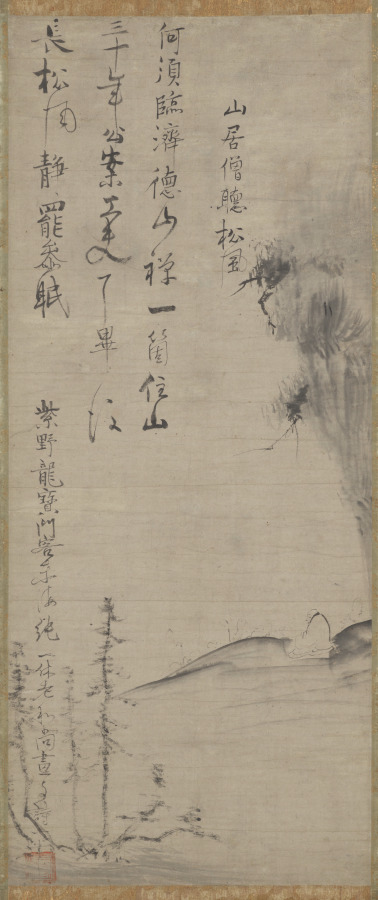
Ikkyū Sōjun · The Cleveland Museum of Art · Mr. and Mrs. William H. Marlatt Fund · CC0
- Name
- Ikkyū Sōjun
- Born
- February 1, 1394
- Birthplace
- Kyoto, Japan
- Died
- December 12, 1481 (aged 87)
- Place of death
- Kyōtanabe, Kyoto
- Nationality
- Ashikaga shogunate
- Occupation
- buddhist monk · poet · calligrapher
- Fields
- philosophy
- Languages
- Japanese
VALÉORINE Encyclopedia
VALÉORINE documentary reading
Documentary summary
February 1, 1394 – December 12, 1481 was a Japanese Zen Buddhist monk and poet who had a great impact on the infusion of Japanese art and literature with Zen attitudes and ideals. He is perhaps best known for his radical approach to Zen, which included breaking Buddhist monastic precepts and his stance against celibacy.
Admitted source layer · organised and presented by VALÉORINE
Note VALÉORINE
Ikkyū Sōjun (1394–1481) was a buddhist monk, calligrapher and poet and a national of Ashikaga shogunate. Born in Kyoto, the buddhist monk died in Kyōtanabe-shi.
Ikkyū Sōjun held the position of abbot. The buddhist monk was active in philosophy.
Languages used include Japanese. Works by Ikkyū Sōjun are held at Cleveland Museum of Art, Metropolitan Museum of Art and Vanderbilt Museum of Art.
Composed from admitted, traceable facts · 27 September 2026
VALÉORINE
Reference Check
Propose documentary evidence for Ikkyū Sōjun. A contribution is never written directly as fact: identity, source, rights and evidence gates still decide.
Sign in to contribute
World of VALÉORINE
Documentary connections
Only confirmed graph relationships appear here. Images are shown only when their identity and reuse rights both pass the documentary gate.
Documentary evidence
Documentary basis
Authority files
getty · 500319872 · gnd · 119044226 · wikidata · Q467613
In this article
Biography
Biography
Sōjun worked between 1394 and 1481 across Buddhist monk, poet and calligrapher. This article rests on 4 visual works, 1 digitised documents and 10 scholarly references drawn from named institutional registers. Every statement below returns to a source shown in the evidence panel; where the record is silent or divided, the article says so instead of resolving it.
The recorded working language is Japanese. The field of work recorded is philosophy. Positions recorded include abbot. Work by Ikkyū Sōjun is recorded in the collections of Vanderbilt Museum of Art, Cleveland Museum of Art and Metropolitan Museum of Art.
Key facts
Key facts
• Name — Ikkyū Sōjun • Other Names — Shūken • Dharma Name — Ikkyū Sōjun • Born — February 1, 1394 • Birthplace — Kyoto, Japan • Died — December 12, 1481 (aged 87) • Place of death — Kyōtanabe, Kyoto • Religion — Buddhism • School — Rinzai • Title — Zen master • Predecessor — Kaso • Illustration — Buddhist verse by Ikkyū
Childhood
Childhood
Ikkyū was born in 1394 in a small suburb of Kyoto. It is generally held that he was the son of Emperor Go-Komatsu and a low-ranking court noblewoman. His mother was forced to flee to Saga, where Ikkyū was raised by servants. At the age of five, Ikkyū was separated from his mother and placed in a Rinzai Zen temple in Kyoto called Ankoku-ji, as an acolyte. The temple masters taught Chinese culture and language as part of the curriculum, a method termed Gozan Zen. He was given the name Shuken, and learned about Chinese poetry, art and literature.
Training and enlightenment
Training and enlightenment
When Ikkyū turned thirteen he entered Kennin-ji in Kyoto to study Zen under a well known priest by the name of Botetsu. Here Ikkyū began to write poetry frequently that was non-traditional in form. He was openly critical of Kennin-ji's leadership in his poetry, disheartened with the social stratum and lack of zazen practice he saw around him. In 1410, at the age of sixteen, Ikkyū left Kennin-ji and entered the temple Mibu-dera, where an abbot named Seiso was in residence. He did not stay long, and soon found himself at Saikin-ji in the Lake Biwa region where he was the sole student of an abbot named Ken'o. It seemed Ikkyū had finally found a master that taught true Rinzai Zen as Ikkyū saw it. Ken'o was sporadic in his teaching style and was a strong believer in the supremacy of zazen. In 1414, when Ikkyū was 21, Ken'o died. Ikkyū performed funeral rites and fasted for seven days. In despair Ikkyū tried to kill himself by drowning himself in Lake Biwa, but was talked out of it from the shore by a servant of his mother. Ikkyū soon found a new teacher in a master named Kaso at Zenko-an, a branch temple of Daitoku-ji. Kaso was much like Ken'o in his style. For years he worked hard on assigned and made dolls for a local merchant in Kyoto. In 1418 Ikkyū was given Case 15 of the Mumonkan ("The Gateless Gate", a famous set of 49), known as "Tozan's Three (or 60?) Blows", which depicts Tozan becoming enlightened when Ummon rebukes him for wandering from one monastery to another. One day a band of blind singers performed at the temple and Ikkyū penetrated his while engrossed in the music. In recognition of his understanding Kaso gave Shuken the Dharma name Ikkyū, which roughly means 'One Pause'. In 1420, Ikkyū was meditating in a boat on Lake Biwa when the sound of a crow sparked satori. When Ikkyū told Kasō of his experience, Kasō replied, "This is the enlightenment of a mere arhat, you're no master yet." Ikkyū responded, "Then I'm happy to be an arhat, I detest masters." Thus, Kasō declared, "Ha, now you really are a master." Kasō confirmed Ikkyū's great enlightenment and granted him inka. However, when presented with his inka, Ikkyū threw it to the ground and stomped off. Kasō retained the inka for safekeeping, but when Ikkyū learned of this, he tore it to pieces. Later, when his disciples had it pieced back together, Ikkyū burned it completely. Ikkyū came up against the jealousy of Yoso, a more senior student who eventually came to run the monastery. In Ikkyū's poems, Yoso appears as a character unhealthily obsessed with material goods, who sold Zen to increase the prosperity of the temple.
Vagabond
Vagabond
Ikkyū could sometimes be a troublemaker. Known to drink in excess, he would often upset Kaso with his remarks and actions to guests. In response, Kaso gave inka to Yoso and made him Dharma heir. Ikkyū quickly left the temple and lived many years as a vagabond. He was not alone, however, as he had a regular circle of notable artists and poets from that era. Around this time, he established a sexual relationship with a blind singer, Mori, who became the love of his later life. Ikkyū strove to live Zen outside of formal religious institutions. However, the Ōnin War had reduced Daitokuji to ashes, and Ikkyū was elected to be its abbot late in life, a role he reluctantly took on. This firmly placed him at the head of one of the most important Zen institutions. However, Ikkyū refused to give formal sanction to any of his disciples, stating his intent thus: "I have never given inka to anyone.... So if after I'm gone, someone comes claiming to have my inka, you should report him to the authorities and prosecute for criminal misconduct. That's why I'm telling everyone the facts by way of a written testament." Toward the end of his life, Ikkyū told his disciples: After my death some of you will seclude yourselves in the forests and mountains to meditate, while others may drink saké and enjoy the company of women. Both kinds of Zen are fine, but if some become professional clerics, babbling about 'Zen as the way,' they are my enemies. I have never given an inka, and if anyone claims to have received such a thing from me, have him or her arrested! In 1481, Ikkyū died at the age of 87 from acute ague.
In popular culture
In popular culture
• Toei Animation produced the historical comedy anime series Ikkyū-san (一休さん) based on Ikkyū's recorded early life at Ankoku-ji Temple, originally airing on TV Asahi from October 15, 1975, to June 28, 1982. The anime was directed by Kimio Yabuki and written by Makoto Tsuji, Tadaki Yamazaki, Hisao Okawa, Tatsuo Tamura, Hiroyasu Yamaura and Keisuke Fujikawa. The series was received by all ages in Japan and throughout Asia. In 1976, a theatrical film released was released as part of the Toei Manga Matsui film festival in the summer of that year. • In the anime OVA Read or Die, a clone of Ikkyū appears as the leader of the villains, all of whom are also clones of famous historical figures. • In the second edition of the book On the Warrior's Path, author Daniele Bolelli refers to Ikkyū as his "hero and philosophical role model". He also explored Ikkyū's life story in a chapter of his 50 Things You're Not Supposed to Know: Religion, and in two episodes of the podcast History on Fire. • The Japanese manga author Hisashi Sakaguchi wrote a life story of Ikkyū, あっかんべェ一休, 'Ikkyu', or 'Akkanbe Ikkyu', more or less according to the popular stories about him. The manga has been translated in four volumes into Catalan, Spanish, French, German, Italian and Portuguese. • In the manga Afterschool Charisma, a clone of Ikkyū appears among the main body of classmates in a special school filled with clones of famous historical figures. • Comic author Tom Robbins identifies Ikkyū as his "idol". • Kleenex Girl Wonder wrote the song "Don't Cry, Ikkyu" about Ikkyū. • Wednesday Campanella's song and PV "Ikkyu-san".
Life and work
Life and work
Ikkyū Sōjun was born on 1 February 1394 in Kyoto. Sōjun held the nationality of Ashikaga shogunate. Recorded father: Go-Komatsu. Recorded sibling: Shōkō and Ogawa no miya. Sōjun worked as Buddhist monk, poet and calligrapher. Sōjun held the posts of abbot. Sōjun worked in Japanese.
Life and career
Dated record
Life and career
Explore 1394–1481
The full dated record · 3 entries
1394
Ikkyū Sōjun born at Kyoto.
1481
Dies at Kyōtanabe-shi.
1481
Ikkyū Sōjun died at Kyōtanabe-shi.
Places
Named by the record
Places
Only places the record itself states, plotted where the house gazetteer settles their coordinates. Nothing is inferred from a name or a nationality.
Kyoto.
Birth place
Kyōtanabe-shi.
Death place
Sex as a form of Zen practice
Ikkyū felt a close connection with the Chinese Chan master Linji, for whom everyday ordinary activities expressed the buddha-nature. Linji said, "Shit and piss and just be human; when hungry, eat; when tired, sleep; make yourself the master of every situation!" According to Yanagida Seizan, this represents a recognition of the "fundamental value of the human being." Ikkyū was inspired by such an attitude, taking it to include sexual needs as well. "If you are thirsty," Ikkyū said, "you dream of water; if you are cold, you dream of a warm coat; as for me, I dream of the pleasures of the boudoir—that's my nature!" Ikkyū also took seriously Huineng's teaching that "outside of licentiousness, there is no true Buddha-nature." For Ikkyū, sex was a form of spiritual practice. He regarded sex in light of the nonduality of desire and bodhi, and it also served as a means for him to test his own sense of enlightenment as well. According to John Stevens, "For Ikkyū, the passions were the anvil on which true enlightenment is forged." That Ikkyū regarded sex as a religious rite is also exemplified by his insistence on wearing monk's robes when entering brothels. Ikkyū wrote that sex was better than sitting in meditation and working on koans: Rinzai's disciples never got the Zen message, But I, the Blind Donkey, know the truth: Love play can make you immortal. The autumn breeze of a single night of love is better than a hundred thousand years of sterile sitting meditation... Stilted koans and convoluted answers are all monks have, Pandering endlessly to officials and rich patrons. Good friends of the Dharma, so proud, let me tell you, A brothel girl in gold brocade is worth more than any of you. Ikkyū frequented brothels as a means of deepening his satori and applying Zen to daily living. As Covell and Yamada point out, this resembles the tenth Ox-herding stage in which Hotei mingles freely with everyone, going beyond the duality between the saintly and common person. Ikkyū praised "pavilion girls" who, unlike priests whose minds were filled with philosophical dialectics, existed in a state of no-mind, facing the present moment immediately and without calculated thinking or regrets. This was to act free of the logically-structured mind. Ikkyū also came to embrace the view found in Esoteric Buddhism that the real Buddha is none other than one's own body. Thus, when he practiced Zen, he practiced with the body as well as the mind. Such a tantric attitude, which also draws on the language of alchemy, can be seen in the following: A sex-loving monk, you object! Hot-blooded and passionate, totally aroused. But then lust can exhaust all passion, Turning base metal into pure gold. The lotus flower Is not stained by the mud; This dewdrop form, Alone, just as it is, Manifests the real body of truth.
Catalogued output
Paintings, prints and other visual works
These are objects catalogued as visual works, each held or recorded by the institution named against it. 4 works carry dates between 1440 and 1483. The run opens with Calligraphy with Willow and Swallows and closes with Inscription on the anonymous painting of Chen Puxie. The 1440s are the densest part of the run, with 2 titles, and that concentration is a fact about what the registers have catalogued rather than a judgement on the work itself.
Calligraphy with Willow and Swallows
1440
Reflections of Priest Foyen
1449
Listening to the Wind in the Pines
1450
Inscription on the anonymous painting of Chen Puxie
1483
Legacy
Ikkyū is one of the most significant (and eccentric) figures in Zen history. To Japanese children, he is a folk hero, mischievous and always outsmarting his teachers and the. In addition to passed down oral stories, this is due to the very popular animated TV series Ikkyū-san. In Rinzai Zen tradition, he is both heretic and saint. He was among the few Zen priests who addressed the subject of sexuality from a religious context, and he stood out for arguing that enlightenment was deepened by partaking in love and sex, including lovers, prostitutes and monastic homosexuality. He believed that sex was part of the human nature, and therefore purer than hypocritical organizations and worldly pursuits. At the same time, he warned Zen against its own bureaucratic politicising. Usually he is referred to as one of the main influences on the Fuke sect of Rinzai zen, as he is one of the most famous flute player mendicants of the medieval times of Japan. The piece "Murasaki Reibo" is attributed to him. He is credited as one of the great influences on the Japanese tea ceremony, and renowned as one of medieval Japan's greatest calligraphers and sumi-e artists. Ikkyū wrote in Kanbun-style classical Chinese, which was employed by many contemporary Japanese authors. For instance, the "Calling My Hand Mori's Hand" poem. My hand, how it resembles Mori's hand. I believe the lady is the master of loveplay; If I get ill, she can cure the jeweled stem. And then they rejoice, the monks at my meeting. Ikkyū is also connected with a Hell Courtesan, who became his disciple.
Primary material
Documents and archives
scholarly publication
- Ikkyū Sōjun, Dao Companions to Chinese Philosophy, 2019
Scholarly · Crossref registry · 2019
- Literature of medieval Zen temples: Gozan (Five Mountains) and Ikkyū Sōjun, The Cambridge History of Japanese Literature, 2015
Scholarly · Crossref registry · 2015
institutional register
- Gemeinsame Normdatei 119044226, Ikkyū, Sōjun.
General reference · GND (German National Library)
- Wikidata, structured authority record Q467613: Ikkyū Sōjun
General reference · Wikimedia Foundation
authority file
- Getty Union List of Artist Names 500319872, Ikkyū Sōjun.
General reference · The Getty Research Institute
Authority records
Notes from the source article
Cited by Wikipedia
Notes from the source article
These works are cited by the source article, in its own numbering. They are recorded as its citations, not as sources VALÉORINE has verified.
- 1.Kodansha Encyclopedia of Japan, entry "Ikkyū" by James H. Sanford
- 2.Peipei Qiu. Basho and the Dao: The Zhuangzi and the Transformation of Haikai. University of Hawaii Press. 2005. 9780824828455.
- 3.Broughton, Jeffrey. The Bodhidharma Anthology, the Earliest Records of Zen, pages 22-23. University of California Press, 1999.
- 4.The Zen Teaching of Bodhidharma, Translated with an Introduction by Red Pine, page 39, North Point Press, 1989
- 5.Messer, Sarah. Having Once Paused: Poems of Zen Master Ikkyū (1394–1481). University of Michigan Press. 1–2. 2015. 978-0-472-07256-9.
- 6.Crow With No Mouth: Ikkyū, 15th Century Zen Master, Versions by Stephen Berg, Preface by Lucien Stryk, page 9, Copper Canyon Press, 1989
- 7.John Stevens, Three Zen Masters: Ikkyū, Hakuin, and Ryōkan, page 20, Kodansha International, 1993
- 8.Letting Go: The Story of Zen Master Tōsui, Translated and with an Introduction by Peter Haskel, page 133, note 81, University of Hawai'i Press, 2001
- 9.John Stevens, Three Zen Masters: Ikkyū, Hakuin, and Ryōkan, page 56, Kodansha International, 1993
- 10.John Stevens, Three Zen Masters: Ikkyū, Hakuin, and Ryōkan, page 24, Kodansha International, 1993
- 11.Jinhua Jia, The Hongzhou School of Chan Buddhism in Eighth- through Tenth-Century China, page 76, State University of New York Press, 2006
- 12.Carter Covell, Jon; and Yamada, Sobin. Unraveling Zen's Red Thread, Ikkyu's Controversial Way, page 73. Hollym International Corp, 1980.
- 13.The Recorded Sayings of Layman P'ang, a Ninth-Century Zen Classic, translated from the Chinese by Ruth Fuller Sasaki, Yoshito Iriya, Dana Fraser, pages 83-84. Weatherhill, 1971.
- 14.Sonja Arntzen, Ikkyū And The Crazy Cloud Anthology, A Zen Poet of Medieval Japan, Revised and Expanded, page 29, Quirin Press, 2022
- 15.Wild Ways: Zen Poems of Ikkyū, translated by John Stevens, pages 75-76, White Pine Press, 2003
- 16.Carter Covell, Jon; and Yamada, Sobin. Unraveling Zen's Red Thread, Ikkyu's Controversial Way, pages 72-75. Hollym International Corp, 1980.
- 17.Dr. Jon Covell, and Abbot Yamada Sobin, Zen At Daitoku-ji, page 101, Kodansha International, 1974
- 18.William R. LaFleur. Liquid Life: Abortion and Buddhism in Japan. Princeton University Press. 2020. 9781400843671.
- 19.University of Tokyo Press. Ikkyū and The Crazy Cloud Anthology: A Zen Poet of Medieval Japan. 33. 1986. 9780860083405.
- 20.Tr. Arntzen 1987:158, note Ikkyū's use of the literary metaphor gyōkeihō 玉茎萌 "jeweled stem" meaning "phallus".
- 21.Avilés, Ernult José Rodolfo. The uncanny and the superflat in macabre representations: Iconographic analysis of a Kawanabe Kyosai blockprint. Ritsumeikan Journal of Asia Pacific Studies. 39. 1. 58–80. 2021.
- 22.Ikkyu-san, the Clever Little Monk. Essays in Idleness. August 2025.
- 23.EPISODE 45 Sex, Sake and Zen: The Life of Ikkyu Sojun (Part 1). 18 March 2019.
- 24.Robbins, Tom. Wild Ducks Flying Backward. Random House. 2006. 0-553-38353-1.
- 25.Random House. Opening Remarks at Northwest Bookfest 1996. 2006. 9780553902945.
- 26.Don't Cry, Ikkyu.
Bibliography printed in the source article · 7
- On the Warrior's Path, Daniele Bolelli, Blue Snake Books, 2008.
- The Possible Impossibles of Ikkyu the Wise, I.G. Reynolds, 1971, Macrae Smith Company, Philadelphia, Trade SBN: 8255-3012-1.
- Ikkyu and the Crazy Cloud Anthology, Sonja Arntzen, 1987, University of Tokyo Press, .
- Unraveling Zen's Red Thread: Ikkyu's Controversial Way, Dr. Jon Carter Covell and Abbot Sobin Yamada, 1980, HollyM International, Elizabeth, New Jersey, .
- Wild Ways: Zen Poems of Ikkyu, translated by John Stevens, published by Shambhala, Boston, 1995.
- Crow with No Mouth, versions by Stephen Berg, published by Copper Canyon Press, WA, 2000. .
- Steiner, Evgeny. Zen-Life: Ikkyu and Beyond. Cambridge Scholars Publishing, 2014. .
References
Citations
References
Each reference names the institution holding it, so a reader may go to the document itself.
scholarly publication
Ikkyū Sōjun, Dao Companions to Chinese Philosophy, 2019Crossref registry
Institutional witnessscholarly publication
Literature of medieval Zen temples: Gozan (Five Mountains) and Ikkyū Sōjun, The Cambridge History of Japanese Literature, 2015Crossref registry
Institutional witnessauthority file
Getty Union List of Artist Names 500319872, Ikkyū Sōjun.The Getty Research Institute
Secondary witnessinstitutional register
Gemeinsame Normdatei 119044226, Ikkyū, Sōjun.GND (German National Library)
General referenceinstitutional register
Wikidata, structured authority record Q467613: Ikkyū SōjunWikimedia Foundation
General reference
People, houses and institutions
Knowledge graph
People, houses and institutions
Teachers, collaborators, publishers and institutions recorded against this person, each on a stated basis.
Born at
1- KyotoPlace
Established from a fact already recorded on a verified source.
The Encyclopedia exists whether or not anything is for sale. Corrections are recorded rather than overwritten, and every version of this record is kept. Published 14 August 2026.
Elsewhere in Books
39,529 published records in this field, each with its sources named.
- Ikeogu OkeAuthor
- Ikhlas FakhriAuthor
- Ikki KajiwaraAuthor
- Ikki KitaAuthor
- Ikole Botuli-BolumbuAuthor
- Ikuma ArishimaAuthor
- Ila Arab MehtaAuthor
- Ilahi JamadarAuthor
Best supported in this field
For owners
Own a work by Ikkyū Sōjun?
A specialist will read what you send and tell you what the house can establish, what it cannot, and whether the object is suited to sale. There is no charge and no obligation. The object stays with you throughout; nothing is shipped to us unless it is arranged in writing beforehand.