
Frederick Judd Waugh
Frederick Judd Waugh (September 13, 1861 in Bordentown, New Jersey – September 10, 1940) was an American artist, primarily known as a marine artist. During World War I, he designed ship camouflage for the U.S. Navy, under the direction of Everett L.
Also recorded as Frederick J. Waugh · Frederick Waugh · Waugh · f.j. waugh
Frederick Judd Waugh
Frederick Judd Waugh · Wellcome Collection, London · Wellcome Collection · Public Domain Mark
- Name
- Frederick Judd Waugh
- Born
- September 13, 1861
- Birthplace
- Bordentown, New Jersey
- Died
- September 10, 1940
- Nationality
- United States
- Occupation
- painter
- Fields
- marine
- Education
- Pennsylvania Academy of the Fine Arts
VALÉORINE Encyclopedia
VALÉORINE documentary reading
Documentary summary
Frederick Judd Waugh (September 13, 1861 in Bordentown, New Jersey – September 10, 1940) was an American artist, primarily known as a marine artist. During World War I, he designed ship camouflage for the U.S. Navy, under the direction of Everett L.
Admitted source layer · organised and presented by VALÉORINE
Reference Check
Propose documentary evidence for Frederick Judd Waugh. A contribution is never written directly as fact: identity, source, rights and evidence gates still decide.
Sign in to contribute
World of VALÉORINE
Documentary connections
Only confirmed graph relationships appear here. Images are shown only when their identity and reuse rights both pass the documentary gate.

Documentary evidence
Documentary basis
Authority files
wikidata · Q5498174 · wikipedia · Frederick Judd Waugh
In this article
Biography
Biography
Frederick Judd Waugh studied at Pennsylvania Academy of the Fine Arts. Subjects and genres recorded for the work are marine. Work by Frederick Judd Waugh is recorded in the collections of The Nelson-Atkins Museum of Art, Metropolitan Museum of Art, Art Institute of Chicago, Smithsonian American Art Museum and Pennsylvania Academy of the Fine Arts.

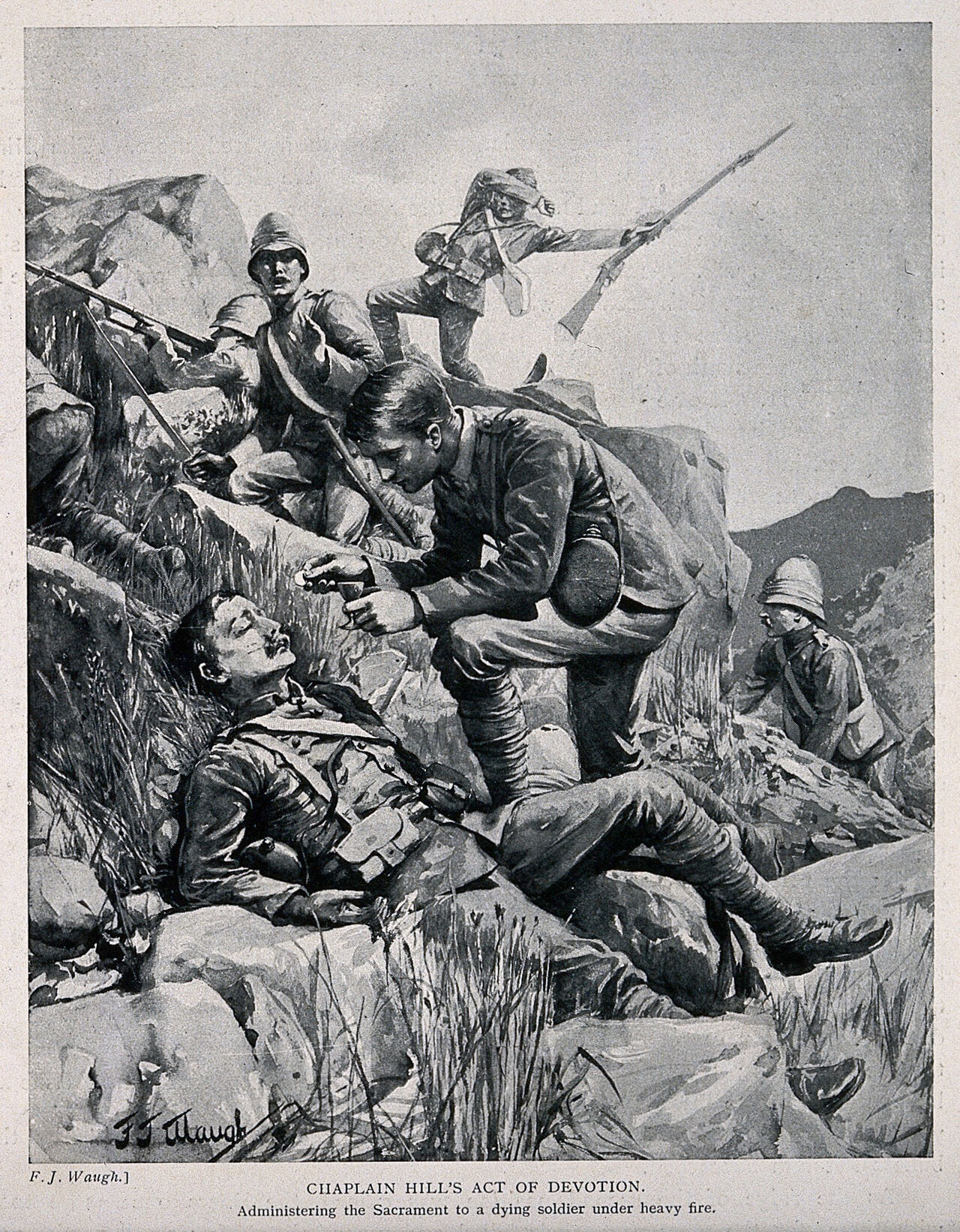
Boer War: British ambulance men taking the dead and wounded blindfolded behind enemy lines. Reproduction of a watercolour by F.J. Waugh, 1900., 1900, by Frederick Judd Waugh
Frederick Judd Waugh · Wellcome Collection, London · Wellcome Collection
Key facts
Key facts
• Name — Frederick Judd Waugh • Born — September 13, 1861 • Birthplace — Bordentown, New Jersey • Died — September 10, 1940
Gallery
Gallery
• Illustration — 'The Knight of the Holy Grail' • Illustration — 'Jersey City at Sunset' • Illustration — "The Next Wave" • Illustration — "Still Life"
Camouflage Service
Camouflage Service
In 1918, Waugh was recommended to serve as a camouflage artist (or camoufleur) for the U.S. Navy, as a member of the Design Section of its marine camouflage unit. That section was located in Washington, D.C., and was headed by American painter Everett L. Warner. According to a biography of Waugh, “Many large ships, including the Leviathan, were painted according to his designs. Though the enterprise was of course a team effort in which no man played a solo part, he had every reason to be proud of his record. Only one ship with his system of camouflage was lost during the war”.
Literary works and interest in folklore
Literary works and interest in folklore
• Illustration — Roaring Forties by Frederick Judd Waugh, currently on display at the Metropolitan Museum of Art. Waugh was known to produce literary work, publishing a short poem in Pamela Colman Smith’s short-lived periodical The Green Sheaf; a fairy tale in The English Illustrated Magazine; and, in 1916, the book The Clan of Munes. Intended as a work of American folklore aimed at children, the book lays out the fictional history and adventures of the “Munes, or tribe of American Fairies”, creatures Waugh regarded as a “gift to his fellow countrymen”. He reported that the idea for these driftwood-based fairies had come to him two summers previously when painting at Monhegan, Maine. Together with his non-marine artworks, these pieces reflect Waugh’s lifelong interest in fairy lore and the supernatural. In an interview with New York City paper The Sun (4 November 1916, p. 9), he asserted that he “dreamed dreams and saw visions—real ones”, and described his history of writing fairy tales, along with his regret at burning the stories he had written while in London.
Places
Named by the record
Places
Only places the record itself states, plotted where the house gazetteer settles their coordinates. Nothing is inferred from a name or a nationality.
Bordentown City.
Birth place
Barnstable County.
Death place
Background and paintings
Waugh was the son of a well-known Philadelphia portrait painter, Samuel Waugh. He studied at the Pennsylvania Academy of Fine Arts with Thomas Eakins, and at the Académie Julian in Paris with Adolphe-William Bouguereau. After leaving Paris, he moved to England, residing on the island of Sark in the English Channel, where he made his living as a seascape painter. In 1898 he was recorded as living in Heath and Reach, Bedfordshire. In 1908, Waugh returned to the U.S., settling in Montclair Heights, New Jersey. He had no studio until art collector William T. Evans (a railroad financier and President of the dry goods firm, Mills Gibbs Corporation) offered him one in exchange for one painting a year. In later years, he lived on Bailey Island, Maine, and in Provincetown, Massachusetts. Waugh’s marinescapes were highly acclaimed, garnering him the Popular Prize at the Carnegie International Exhibition for five years in a row, a feat accomplished by no other artist. In 1914, he was a judge of the art exhibit on Monhegan Island, ME during the 1914 Ter-Centenary celebration of the Voyage of Captain John Smith. In addition to his marinescapes, Waugh sometimes published work in periodicals, such as The Green Sheaf, to which he contributed at least one illustration. He also produced paintings and sketches on legendary and mythological themes; see, for instance, his 1921 sketch “Levitation in Dream No. 3”, and his c.1912 painting “The Knight of the Holy Grail”.
Citations
References
Each reference names the institution holding it, so a reader may go to the document itself.
reference work
Secondary witnessreference work
Secondary witness
The Encyclopedia exists whether or not anything is for sale. Corrections are recorded rather than overwritten, and every version of this record is kept. Published 16 August 2026.
Elsewhere in Paintings
19,183 published records in this field, each with its sources named.
- Frederick Daniel HardyArtist
- Frederick DielmanArtist
- Frederick Ferdinand SchaferArtist
- Frederick Hans HaagensenArtist
- Frederick KemmelmeyerArtist
- Frederick McCubbinArtist
- Frederick Melville DumondArtist
- Frederick NashArtist
Best supported in this field
For owners
Own a work by Frederick Judd Waugh?
A specialist will read what you send and tell you what the house can establish, what it cannot, and whether the object is suited to sale. There is no charge and no obligation. The object stays with you throughout; nothing is shipped to us unless it is arranged in writing beforehand.