
Franz Xaver Winterhalter
Franz Xaver Winterhalter (20 April 1805 – 8 July 1873) was a German painter and lithographer, known for his flattering portraits of royalty and upper-class society in the mid-19th century. His name has become associated with fashionable court portraiture. Among his best known works are Empress Eugénie Surrounded by her Ladies in Waiting (1855) and the portraits he made of Empress Elisabeth of Austria (1865).
Also recorded as Francis Xavier Winterhalter · Franz Xavier Winterhalter · f. winterhalter · Franz X. J. Winterhalter
Franz Xaver Winterhalter
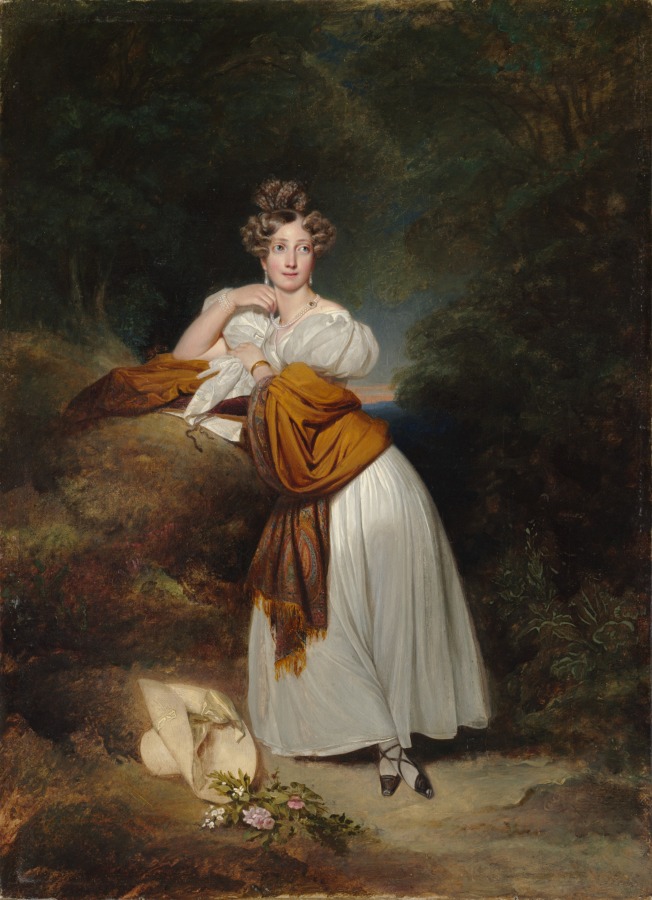
Franz Xaver Winterhalter · The Cleveland Museum of Art · The Thomas L. Fawick Memorial Collection · CC0
- Name
- Franz Xaver Winterhalter
- Born
- 20 April 1805
- Birthplace
- Menzenschwand, Modena-Breisgau
- Died
- 8 July 1873
- Place of death
- Frankfurt am Main, Germany
- Field
- Painting, lithography
- Nationality
- German Empire and Grand Duchy of Baden.
- Fields
- painting and portrait painting.
- Movements
- academic art and Rococo Revival.
- Teachers
- Joseph Karl Stieler and Peter von Cornelius.
- Known for
- Portrait of Barbara Dmitrievna Mergassov Rimsky-Korsakova, Girl from sabine mountains, Empress Eugenie Surrounded by her Ladies in Waiting and Florinda.
- Languages
- German.
VALÉORINE Encyclopedia
VALÉORINE documentary reading
Documentary summary
Franz Xaver Winterhalter (20 April 1805 – 8 July 1873) was a German painter and lithographer, known for his flattering portraits of royalty and upper-class society in the mid-19th century. His name has become associated with fashionable court portraiture. Among his best known works are Empress Eugénie Surrounded by her Ladies in Waiting (1855) and the portraits he made of Empress Elisabeth of Austria (1865).
Admitted source layer · organised and presented by VALÉORINE
Note VALÉORINE
No house-authored Note is published until its assertions and sources pass the VALÉORINE evidence contract. The documentary article remains available in full while that enrichment is being consolidated.
Documentary enrichment in progress · no unsupported statement published
Reference Check
Propose documentary evidence for Franz Xaver Winterhalter. A contribution is never written directly as fact: identity, source, rights and evidence gates still decide.
Sign in to contribute
World of VALÉORINE
Documentary connections
Only confirmed graph relationships appear here. Images are shown only when their identity and reuse rights both pass the documentary gate.
Documentary evidence
Evidence Panel
not yet certified
- Identity
- resolved
- Independent source families
- 0
- Admitted assertions
- 0
- Open conflicts
- 0
Authority files
gnd · 1091945640 · wikidata · Q168659 · wikipedia · Franz Xaver Winterhalter
In this article
Biography
Biography
Training under Joseph Karl Stieler and Peter von Cornelius is recorded. Carl Wahlbom, Federico de Madrazo y Kuntz and Gottlieb Bodmer are recorded as having studied under Franz Xaver Winterhalter. The recorded working language is German. The field of work recorded is painting and portrait painting. Subjects and genres recorded for the work are portrait and landscape. Places of work recorded in the authority are Paris, Belgium and Freiburg im Breisgau. Positions recorded include court painter. Works named in the authority record are Portrait of Barbara Dmitrievna Mergassov Rimsky-Korsakova, Girl from sabine mountains, Empress Eugenie Surrounded by her Ladies in Waiting and Florinda. Work by Franz Xaver Winterhalter is recorded in the collections of Städel Museum, Minneapolis Institute of Art, J. Paul Getty Museum, Nationalmuseum and National Gallery of Victoria.
Key facts
Key facts
• Name — Franz Xaver Winterhalter • Born — 20 April 1805 • Birthplace — Menzenschwand, Modena-Breisgau • Died — 8 July 1873 • Place of death — Frankfurt am Main, Germany • Field — Painting, lithography
Early years
Early years
Franz Xaver Winterhalter was born in the small village of Menzenschwand (now part of Sankt Blasien), in Germany's Black Forest, on 20 April 1805. He was the sixth child of Fidel Winterhalter (1773–1863), a farmer and resin producer in the village, and his wife Eva Meyer (1765–1838), a member of a long established Menzenschwand family. His father was of peasant stock and was a powerful influence in his life. Of the eight brothers and sisters, only four survived infancy. Throughout his life Franz Xaver remained very close to his family, in particular to his brother Hermann (1808–1891), who was also a painter. After attending school at a Benedictine monastery in St. Blasien, Winterhalter left Menzenschwand in 1818 at the age of 13 to study drawing and engraving. He trained as a draughtsman and lithographer in the workshop of Karl Ludwig Schüler (1785–1852) in Freiburg im Breisgau. In 1823, at the age of 18, he went to Munich, sponsored by the industrialist Baron von Eichtal (1775–1850). In 1825, he was granted a stipend by Louis I, Grand Duke of Baden (1763–1830) and began a course of study at the Academy of Fine Arts, Munich with Peter von Cornelius (1783–1867), whose academic methods made him uncomfortable. Winterhalter found a more congenial mentor in the fashionable portraitist Joseph Karl Stieler (1781–1858). During this time, he supported himself working as lithographer. Winterhalter entered court circles when in 1828 he became drawing master to Sophie, Margravine of Baden, at Karlsruhe. His opportunity to establish himself beyond southern Germany came in 1832 when he was able to travel to Italy, 1833–1834, with the support of Grand Duke Leopold of Baden. In Rome he composed romantic genre scenes in the manner of Louis Léopold Robert and attached himself to the circle of the director of the Académie des Beaux-Arts, Horace Vernet. On his return to Karlsruhe he painted portraits of the Grand Duke Leopold of Baden and his wife, and was appointed painter to the grand-ducal court. Nevertheless, he left Baden to move to France, where his Italian genre scene Il dolce Farniente attracted notice at the Salon of 1836. Il Decameron a year later was also praised; both paintings are academic compositions in the style of Raphael. In the Salon of 1838 he exhibited a portrait of the Prince of Wagram with his young daughter. His career as a portrait painter was soon secured when in the same year he painted Louise of Orléans, Queen of the Belgians, and her son. It was probably through this painting that Winterhalter came to the notice of Maria Amalia of the Two Sicilies, Queen of the French, mother of the Queen of the Belgians.
Court painter
Court painter
• Illustration — Leonilla Bariatinskaia Princess of Sayn Wittgenstein Sayn (1843), J. Paul Getty Museum, Los Angeles. Winterhalter contrasted sumptuous fabrics and vivid colors against creamy flesh to heighten the sensuality of the pose, the model, and the luxuriant setting. • Illustration — Portrait of Countess Potocka (1854), National Museum, Warsaw. Countess Potocka sat for this portrait in Paris, where she went after returning from a trip to the Holy Land. Róża Krasińska, who with her mother went to Paris, wrote that she was "a few times in the Winterhalter's studio, while the mother posed for her portraits". Winterhalter first visited England in 1842, and returned several times to paint Queen Victoria, Prince Albert and their growing family, painting at least 120 works for them, a large number of which remain in the Royal Collection, on display to the public at Buckingham Palace and other royal residences. On display at Osborne House is Florinda, given by Victoria as a birthday present for Albert in 1852. • Illustration — Empress Eugénie Surrounded by her Ladies in Waiting (1855), Château de Compiègne. Persistence saw Winterhalter survive from the fall of one dynasty to the rise of another. Paris remained his home until a couple of years before his death. In the same year, his marriage proposal was rejected, and Winterhalter remained a bachelor committed to his work. After the accession of Napoleon III, his popularity grew. From then on, under the Second Empire, Winterhalter became the chief portraitist of the imperial family and court of France. The French Empress Eugénie became a favorite sitter, and she treated him generously. In 1855 Winterhalter painted his masterpiece: Empress Eugénie Surrounded by her Ladies in Waiting. He set the French Empress in a pastoral setting gathering flowers in a harmonious circle with her ladies in waiting. The painting was acclaimed and exhibited in the Exposition Universelle (1855). It remains Winterhalter's most famous work. The composition shows a marked similarity to Florinda and this gave rise to scandalous gossip that the Empress and her ladies had posed déshabillé for the earlier painting. In 1852, he went to Spain to paint Queen Isabella II with her daughter. Russian aristocratic visitors to Paris also liked to have their portraits executed by the famous master. As the "Painter of Princes", Winterhalter was thereafter in constant demand by the courts of Britain (from 1841), Spain, Belgium, Russia, Mexico, the German states, and France. During the 1850s and 1860s, Winterhalter painted a number of important portraits of Polish and Russian aristocrats. In 1857, he painted the portrait of Tsarina Maria Alexandrovna. During this time he also painted portraits of members of the André family, including the art collector Édouard André, Henriette André Walther, and Ernest André, which now hang in the Musée Jacquemart-André in Paris. During the Second Mexican Empire in the 1860s, headed by Maximilian I of Mexico, Winterhalter was commissioned to paint portraits of the Imperial couple. The Empress of Mexico, Charlotte of Belgium was the daughter of Louise-Marie of France, Queen of the Belgians, whom Winterhalter painted at the beginning of his career in France. Some of Winterhalter's paintings of the Mexican monarchs still remain in their Mexico City palace, Chapultepec Castle, now the National Museum of History. • Illustration — Barbe Dmitrievna Mergassov Madame Rimsky-Korsakov (1864), oil on canvas, 117 × 90 cm, Musée d'Orsay, Paris During a visit to Frankfurt am Main in the summer of 1873, he contracted typhus and died on 8 July. He was 68 years old. • Illustration — Portrait of Empress Elisabeth of Austria (1865), oil on canvas, 255 × 133 cm, Kunsthistorisches Museum, Vienna. • Illustration — The Royal Family depicting Queen Victoria and Prince Albert's family in 1846 by Franz Xaver Winterhalter. left to right: Prince Alfred (unbreeched at two years); the Prince of Wales; Queen Victoria; Prince Albert; and Princesses Alice, Helena and Victoria
Gallery
Gallery
• Illustration — Il dolce Farniente, 1836 • Illustration — Il Decameron, 1837 • Illustration — Portrait of Leopold I of Belgium, 1840 • Illustration — Portrait of the Duchess of Nemours, 1840 • Illustration — Portrait of Louise of Orléans, 1841 • Illustration — Portrait of Louis Philippe I, 1841 • Illustration — Queen Victoria, 1843 • Illustration — The Duke of Wellington and Sir Robert Peel, 1844 • Illustration — Portrait of Albert Edward, Prince of Wales, 1846 • Illustration — The First of May 1851, 1851 • Illustration — The Cousins, 1852 • Illustration — Florinda, 1853 • Illustration — Portrait of Napoleon III, 1853 • Illustration — Portrait of Empress Eugénie, 1853 • Illustration — Portrait of Countess Potocka, 1854 • Illustration — Princess Louise of Prussia, 1856 • Illustration — Portrait of Queen Victoria, 1859 • Illustration — Portrait of Prince Albert, 1859 • Illustration — Portrait of Albert Edward, Prince of Wales, 1864 • Illustration — Portrait of Alexandra of Denmark, 1864 • Illustration — Portrait of Franz Joseph I, 1865
Life and career
Dated record
Life and career
The full dated record · 2 entries
1805
Franz Xaver Winterhalter born at Menzenschwand.
1873
Franz Xaver Winterhalter died at Frankfurt.
Places
Named by the record
Places
Only places the record itself states, plotted where the house gazetteer settles their coordinates. Nothing is inferred from a name or a nationality.
Menzenschwand.
Birth place
Frankfurt.
Death place
Primary material
Documents and archives
reference work
- Wikidata, structured authority record Q168659: Franz Xaver Winterhalter
Reputable secondary · Wikimedia Foundation
- “Franz Xaver Winterhalter”, English Wikipedia, consulted as further reading
Reputable secondary · Wikipedia
authority file
- Gemeinsame Normdatei 1091945640, Franz Xaver Winterhalter and the Courts of Europe 1830-70 (1987-1988; London + 1988; Paris).
Unverified · Deutsche Nationalbibliothek
Notes from the source article
Cited by Wikipedia
Notes from the source article
These works are cited by the source article, in its own numbering. They are recorded as its citations, not as sources VALÉORINE has verified.
- 1.Paul Getty, J. Franz Xaver Winterhalter. The J. Paul Getty Museum. J Paul Getty Trust.
- 2.Ormond & Blackett-Ord. Franz Xaver Winterhalter and the Courts of Europe, p. 18.
- 3.Ormond & Blackett-Ord. Franz Xaver Winterhalter and the Courts of Europe, p. 19.
- 4.Ormond & Blackett-Ord. Franz Xaver Winterhalter and the Courts of Europe, p. 20.
- 5.Ormond & Blackett-Ord. Franz Xaver Winterhalter and the Courts of Europe, p. 21.
- 6.Ormond & Blackett-Ord. Franz Xaver Winterhalter and the Courts of Europe, p. 25.
- 7.Ormond & Blackett-Ord. Franz Xaver Winterhalter and the Courts of Europe, p. 185.
- 8.Cholewianka-Kruszyńska, Aldona. Panny Branickie z Białej Cerkwi na portretach F. X. Winterhaltera. Gazeta Antykwaryczna. 9. 14–21. 2001.
- 9.Florinda Signed and dated 1852. Royal Collections Trust.
- 10.Ormond & Blackett-Ord. Franz Xaver Winterhalter and the Courts of Europe, p. 217.
References
Citations
References
Each reference names the institution holding it, so a reader may go to the document itself.
authority file
Gemeinsame Normdatei 1091945640, Franz Xaver Winterhalter and the Courts of Europe 1830-70 (1987-1988; London + 1988; Paris).Deutsche Nationalbibliothek
Partially resolvedreference work
Wikidata, structured authority record Q168659: Franz Xaver WinterhalterWikimedia Foundation
Partially resolvedreference work
Partially resolved
Further particulars
Held on the record
Further particulars
Open the remaining particulars
He trained under Joseph Karl Stieler and Peter von Cornelius. Each of those relationships is stated by the authority record rather than inferred from style.
The authorities additionally record the headings Francis Xavier Winterhalter, Franz Xavier Winterhalter, f. winterhalter, Franz X. Winterhalter and F. His recorded language was German. Winterhalter worked in painting and portrait painting. His work is associated with academic art and Rococo Revival. Recorded position is court painter. He worked at Paris, Belgium, Freiburg im Breisgau and Karlsruhe. Recorded as painter, lithographer, draftsperson and artist.
Identity and origins
Career and activity
Recognition and collections
Work by Franz Xaver Winterhalter is
Städel Museum, Minneapolis Institute of Art, J. Paul Getty Museum and Nationalmuseum
The Encyclopedia exists whether or not anything is for sale. Corrections are recorded rather than overwritten, and every version of this record is kept. Published 14 August 2026.
Elsewhere in Paintings
18,717 published records in this field, each with its sources named.
- Franz Werner TammArtist
- Franz WidnmannArtist
- Franz Xaver PetterArtist
- Franz Xaver StöberArtist
- Franz Xaver ZettlerArtist
- Freake-Gibbs painterArtist
- Fred A. PrechtArtist
- Fred BachrachArtist
Best supported in this field
For owners
Own a work by Franz Xaver Winterhalter?
A specialist will read what you send and tell you what the house can establish, what it cannot, and whether the object is suited to sale. There is no charge and no obligation. The object stays with you throughout; nothing is shipped to us unless it is arranged in writing beforehand.